
For the longest time, the way vendors have been selling into water utilities has followed the identical pattern of waiting for an RFP to drop, pulling together a proposal and keeping fingers crossed in the hopes of things working out fine.
I have been watching companies do this for years, renowned names, budding companies or mid-scale orgs. All of them had great things to offer yet they all met at the same frustrating standstill, all because, by the time the much awaited RFP was published, the game was already over. The utility had already defined what they needed, specs were already written out around someone else’s solution. The relationships were already built with a competitor who’d been in the room months earlier.
This is the fundamental problem with reactive selling in the water sector. The formal procurement process is just the public announcement of a decision that’s been building for years.
- Capital improvement plans get drafted.
- Regulatory mandates get issued.
- Funding gets secured.
- Engineering firms get hired and by the time a bid goes public, the important conversations have already happened without you.
U.S. and Canadian water utilities spent about $188 billion in 2022 on capital projects and operations. That number is projected to reach almost $223 billion by 2030. There’s over $625 billion in infrastructure upgrades needed by 2043.
The opportunity is enormous and capturing it requires showing up before the RFP, not after.
What “Predictive Intelligence” for Water Utility Sales Actually Means
This is not as talked about but something that significantly changes the course of everything is a shift from reactive monitoring to predictive intelligence which implies that instead of watching bid boards, you look out for signals.
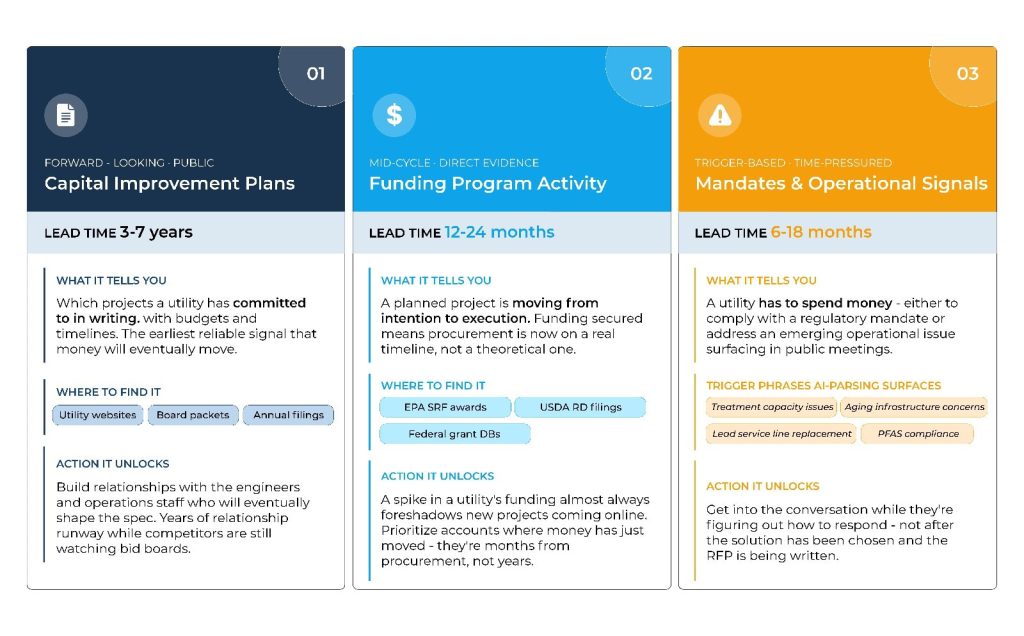
Most U.S. water utilities publish multi-year Capital Improvement Plans which outline planned projects, expected timelines, and budget allocations. By systematically analyzing CIPs, sales teams can identify and track projects three to seven years in advance of formal bids. It might not seem like it but that’s years of relationship-building time that is systematically taken upon while several others were still waiting for the RFP. Look out for:
Funding program signals: These matter because when a utility applies to the EPA State Revolving Fund or secures a federal infrastructure grant, that’s a direct signal that projects are moving from planning to execution. A spike in funding almost always foreshadows new projects coming online.
Regulatory mandates: When the EPA issues new requirements around PFAS, lead service lines, or treatment standards, utilities have to respond. They’re going to spend money on compliance. The question is whether you’re in the conversation when they’re figuring out how.
AI-powered tools that parse public meeting agendas and operational reports for specific language consisting of terms like “treatment capacity issues,” “aging infrastructure concerns,” “lead service line replacement,” nascent needs before they become formal projects, that is before they become RFPs.
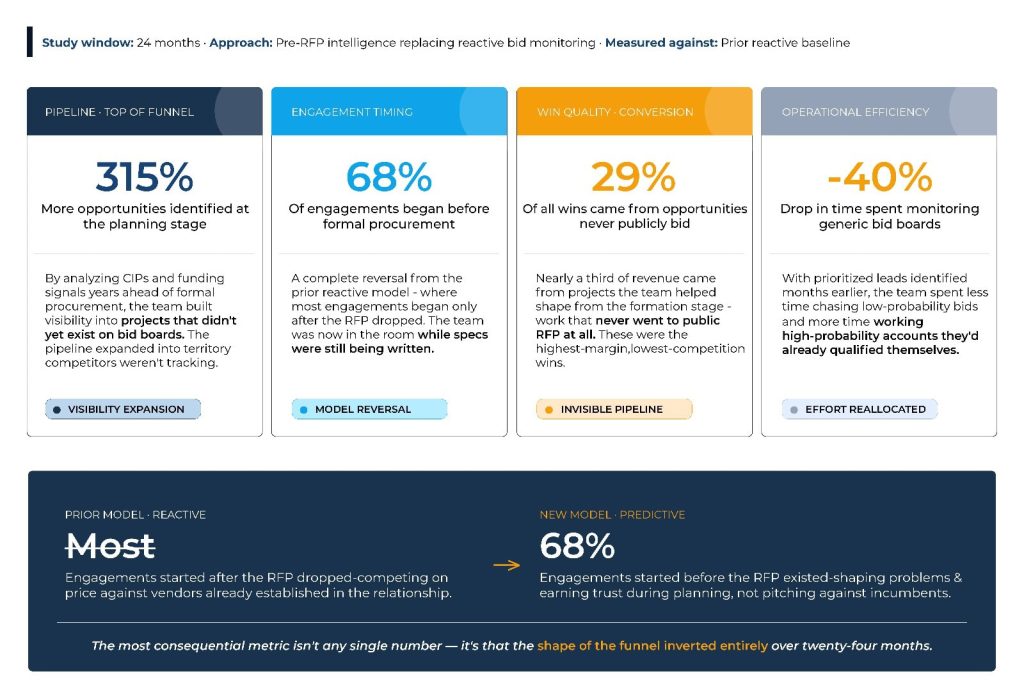
In one two-year case study, adopting pre-RFP intelligence led to a 315% increase in identified opportunities at the planning stage. Sixty-eight percent of engagements shifted to begin before formal procurement, a complete reversal from the prior reactive model. Early-engagement opportunities that never went to public bid at all accounted for 29% of all wins.
The bid monitoring effort dropped by more than 40% because the team spent less time on generic bid sites and prioritized high-probability leads they’d already identified themselves.
Why Early Engagement Changes the Deal
When you show up before the RFP, everything changes and that is not an exaggeration.
You’re no longer simply responding to someone else’s specifications but helping shape them. You understand the utility’s actual problem before it gets translated into procurement language, build relationships with operators, engineers, and finance directors while they’re still figuring out what they need and by the time formal procurement starts, they already know you and have already seen how you think, allowing them to lay their trust on you.
Dave Cox of Water Online says:
“Successful contractors constantly look for early opportunities, and one of the richest sources is the capital plans issued by utilities and local governments. These plans serve as blueprints of future projects, including expected funding sources and timelines. By focusing on utilities with expanding capital budgets or new funding, sales teams can prioritize where future projects are most likely.”
Maria Rodriguez, a director of business development, described the shift by saying:
“We’re now engaging while utilities are still defining problems rather than evaluating prescribed solutions. This completely transforms our ability to influence outcomes.”