
Every PFAS funding navigator tells utilities where the money is. Atlas tells vendors which utility will spend it, on what, and when.
There are good PFAS funding navigators on the web. Non-profits and state agencies maintain them, and they do a real service for a utility manager trying to work out whether an emerging-contaminants grant, a State Revolving Fund loan, or a settlement payment applies to their system.
They were built for the utility. They were not built for the company selling the treatment system, the media, the monitoring, or the engineering to that utility. For a vendor, “where is the money” is only the first of four questions. The other three are: which specific utilities have a PFAS problem the money can solve, where each of them is in the funding process, and when the money turns into a procurement.
Atlas, AquaIntel’s grounded AI agent for water vendors, was built to answer all four, with citations to the utility’s own record.
PFAS money reaches utilities through at least five channels, and each publishes its information in a different place, in a different format, on a different schedule.
| Channel | What it funds | Where the information lives |
| DWSRF Emerging Contaminants (IIJA) | PFAS evaluation, pilot, design, and treatment, largely as grants or principal forgiveness | EPA allotment tables, then 50 state Intended Use Plans and project priority lists |
| Base DWSRF and Clean Water SRF | Treatment plants, residuals handling, collection and biosolids projects affected by PFAS | State IUPs, project priority lists, and state finance authority agendas |
| WIFIA | Large projects, often bundling PFAS treatment with other capital work | EPA WIFIA letters of interest and closed-loan announcements |
| PFAS manufacturer settlements | Testing and treatment for public water systems, paid out in phases from 2024 onward | Claims administrator notices, utility board resolutions accepting payments |
| State programs and bonds | State-specific PFAS grants, plus the utility’s own revenue bonds and rate cases | State legislation, EMMA disclosures, board rate hearings |
The federal FY2026 allotments are the final year of the five-year IIJA emerging-contaminants appropriation. That means the 2026 and 2027 state Intended Use Plan cycles are where the last tranche of the most vendor-relevant PFAS money gets committed to named projects. A navigator that shows the allotment by state is useful. A tool that shows which utility’s project moved onto the priority list this cycle is actionable.
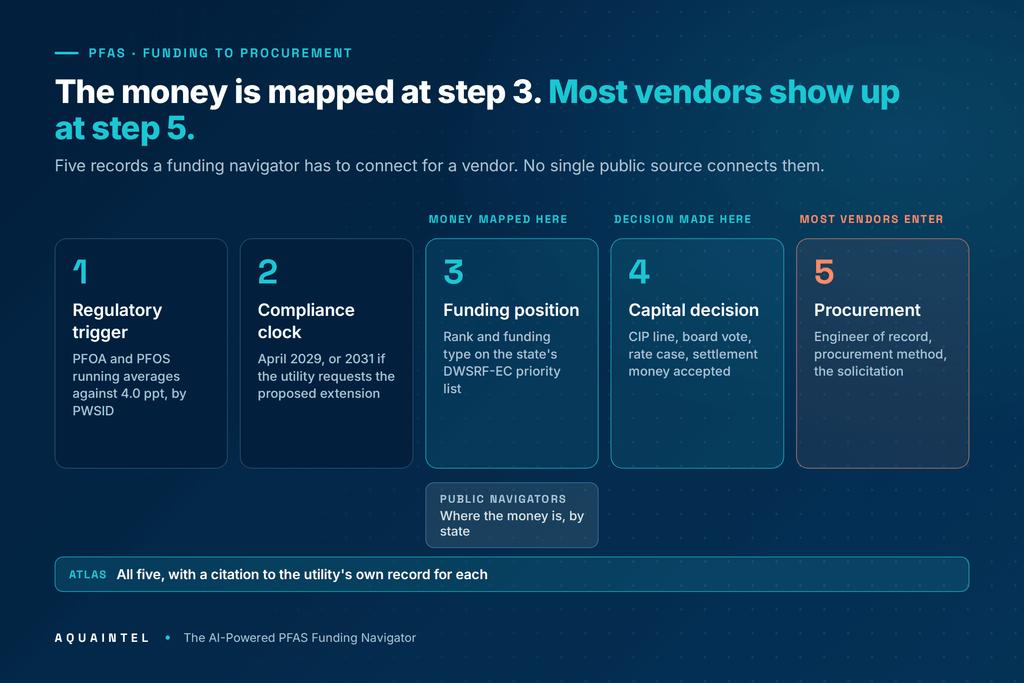
A funding navigator built for go-to-market has to connect five records that no single public source connects.
- The regulatory trigger. The utility’s PFOA and PFOS running annual averages against the 4.0 parts-per-trillion maximum contaminant levels, identified by the utility’s PWSID, not by its name.
- The compliance clock. The enforceable date of April 26, 2029, or April 26, 2031 for systems that request the extension EPA proposed in May 2026, and whether this utility has signaled it will.
- The funding position. Whether the utility’s project appears on its state’s DWSRF emerging-contaminants project priority list, its ranking, the funding type, and whether it has advanced from evaluation to design to construction.
- The capital decision. The capital improvement plan line, the board vote authorizing the project, the rate case that pays the local share, and any settlement money the board has resolved to accept.
- The procurement. The engineer of record selected for design, the procurement method, and the solicitation, which is the last step in the chain, not the first.
Most vendors enter at step five. The money was mapped at step three, and the decision was made at step four.
How Atlas maps funding to a specific permit
Atlas sits on top of the AquaIntel record for more than 65,000 U.S. water and wastewater systems, built from more than 100 data sources. When you ask it a funding question, it does not summarize a web page. It resolves the utility to its identifiers, reads the relevant documents in the record, and answers with citations.
Ask Atlas: “Which utilities in Pennsylvania have PFOA or PFOS above 4 ppt and a project on the FY2026 emerging-contaminants priority list?” It returns the utilities by PWSID, the sample results with their reporting period, the priority-list entry with its rank and funding type, and the board minute or CIP line that shows the project is real.
Ask: “Where is this utility in its PFAS project?” It walks the chain: monitoring results, the board authorization of a treatment alternatives study, the state’s evaluation-phase grant, the engineer selected, the design contract, the construction funding application. Each step is tied to a document you can open.
Ask: “Has this utility said it will request the 2031 extension?” It reads the board packages and compliance correspondence rather than guessing.
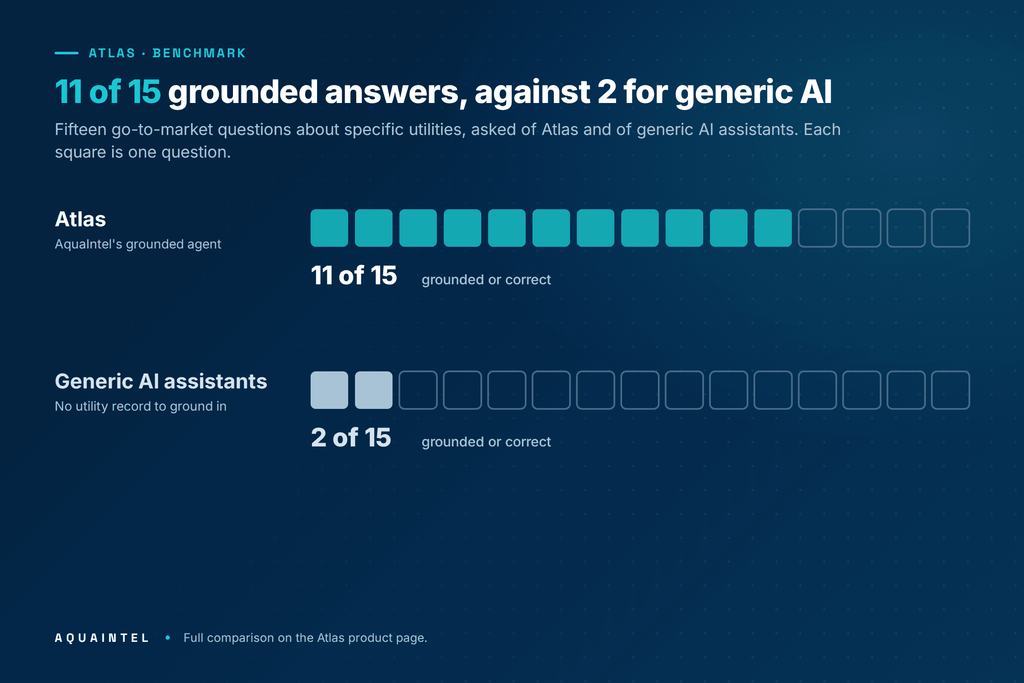
We benchmarked Atlas against generic AI assistants on 15 go-to-market questions of this type. Atlas returned grounded or correct answers on 11 of 15. The generic models managed 2 of 15, because they have no utility record to ground in. The full comparison is on the Atlas product page.
The PFAS project timeline, and where the money enters it
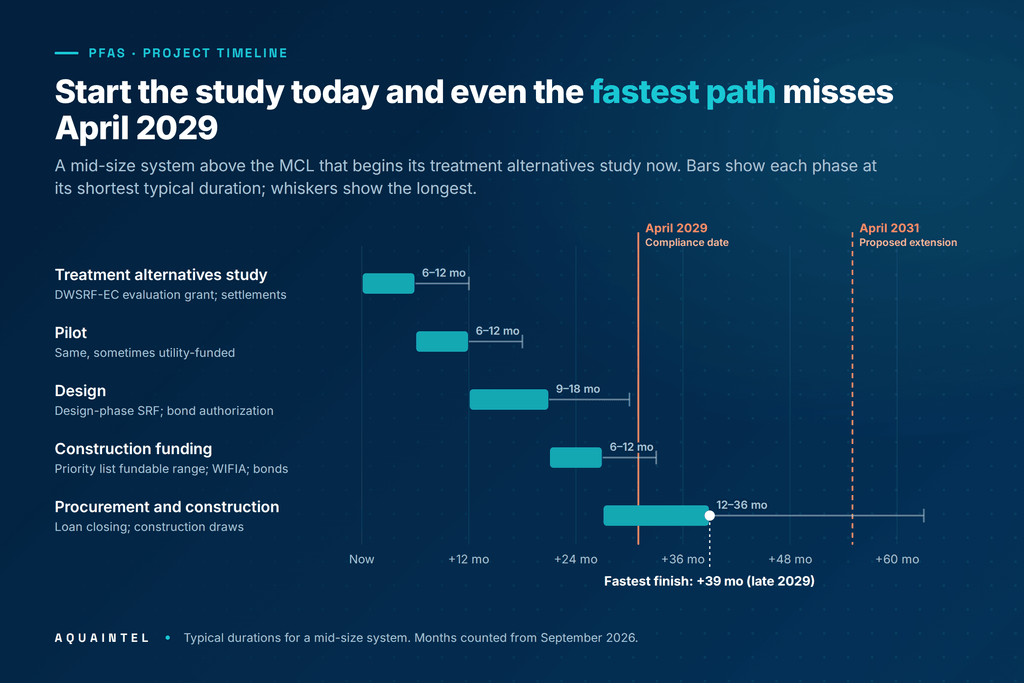
Understanding the sequence is what turns a funding list into a sales calendar. A typical PFAS treatment project for a mid-size system runs like this.
| Phase | Typical duration | Funding event | What a vendor should be doing |
| Monitoring and results | 12–24 months | None, or a small evaluation grant | Confirm the numbers and the source water; be known to the utility’s engineers |
| Treatment alternatives study | 6–12 months | DWSRF-EC evaluation grant; settlement funds | Get your technology into the alternatives evaluation with comparable performance data |
| Pilot | 6–12 months | Same, sometimes utility-funded | Pilot on their water; this is where the spec is written |
| Design | 9–18 months | Design-phase SRF assistance; bond authorization | Be the basis of design; support the engineer of record |
| Construction funding | 6–12 months | Project moves to fundable range on the priority list; WIFIA; revenue bonds | Track the IUP and the board vote; prepare for the procurement method they choose |
| Procurement and construction | 12–36 months | Loan closing; construction draws | Respond to the solicitation you already know is coming |
The compliance deadline compresses this. A utility above the MCL today that has not started an alternatives study cannot comfortably finish construction by April 2029. Those utilities are the most likely to request the proposed extension, and the ones that will not request it are the ones that will procure fastest. Atlas can tell you which is which.
The public and non-profit navigators are the right starting point for a utility manager. They explain eligibility, link to the application portals, and list the state contacts. Atlas does not replace that.
Atlas starts where they stop. A navigator will tell you that a state received its emerging-contaminants allotment and that small and disadvantaged systems get priority. Atlas will tell you which nine systems in that state are above the MCL, which four are on the current priority list, which two have already selected an engineer, and what the board of the fifth one said in March about affordability. It cites each claim to the document it came from, so a sales team can act on it without re-researching it.
That is the difference between a navigator built to help utilities apply and a navigator built to help vendors show up at the right utility, at the right phase, with the right evidence.
Frequently asked questions
What federal funding is available for PFAS treatment in drinking water?
The main federal channel is the Drinking Water State Revolving Fund emerging-contaminants program funded by the Infrastructure Investment and Jobs Act, distributed to states by allotment and awarded to utilities through each state’s Intended Use Plan. Base DWSRF, WIFIA loans, and the PFAS manufacturer settlements are the other significant sources.
When do water utilities have to comply with the PFAS drinking water rule?
The maximum contaminant levels for PFOA and PFOS are 4.0 parts per trillion each, with an enforceable compliance date of April 26, 2029. In May 2026 EPA proposed allowing systems to request an extension to April 26, 2031. EPA has separately proposed rescinding the limits for the other four regulated PFAS. Vendors should verify the status of both proposed rules before quoting dates to a utility.
How does Atlas know which utility has a PFAS problem?
It resolves each utility to its PWSID and reads the sample results reported to the state primacy agency and EPA, alongside the utility’s consumer confidence reports and board packages.
Can Atlas tell me when a PFAS RFP will be issued?
It can tell you where the utility is in the project chain and what it has funded, which is the most reliable predictor available. Board minutes and priority lists typically show a project months before any solicitation is published.
Bring us your target states or your top 25 accounts. We will run them through Atlas and the PFAS Intelligence screener and show you which utilities have a PFAS driver, where each one sits on its state’s funding list, and what its board has already decided.