
Search for “RFP scoring criteria” and you will get the same template a dozen times over: technical approach 40 percent, price 25 percent, past performance 20 percent, key personnel 15 percent. It is a fine template for buying office furniture or a payroll system.
It is not how a water utility scores you.
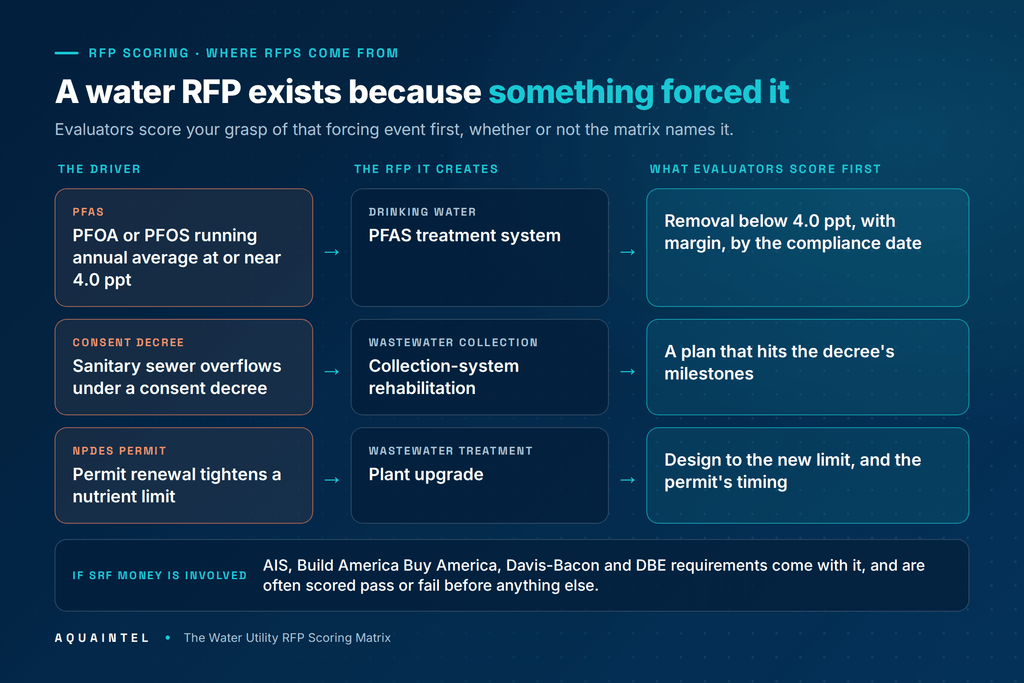
A water or wastewater utility rarely issues an RFP because it wants something. It issues one because a regulator, a permit, a consent decree, or a funding agency has forced its hand. The scoring matrix the evaluation committee uses is shaped by whichever of those forced the procurement. If you do not know which one it was, you are guessing at 60 percent of the points before you write a word.
This post gives you a water-specific scoring matrix template, explains what each criterion actually measures, and shows how the public record tells you your likely score before the solicitation is even published.
Why generic RFP scoring templates fail in water
Three things make utility procurement different from the generic case.
The driver is regulatory, not commercial. A PFAS treatment RFP exists because a running annual average of PFOA or PFOS is at or near the federal maximum contaminant level of 4.0 parts per trillion. A collection-system rehabilitation RFP exists because of a sanitary sewer overflow consent decree. A plant upgrade exists because an NPDES permit renewal tightened a nutrient limit. Evaluators score your understanding of that driver first, whether or not the matrix names it.
The money has strings. If the project is funded through a State Revolving Fund, the RFP inherits American Iron and Steel, Build America Buy America, Davis-Bacon, and disadvantaged business requirements. A proposal that cannot document compliance is scored down or thrown out regardless of technical merit.
The evaluators are engineers. As we wrote in “Why Engineers Decide Your Fate,” the people scoring a utility RFP are usually the utility’s own engineers and the engineer of record. They score performance data from systems like theirs, not marketing claims.
Generic RFP writing services do not know any of this because they do not know the utility. They know your proposal. The scoring committee knows both.
The Water Utility RFP Scoring Matrix template
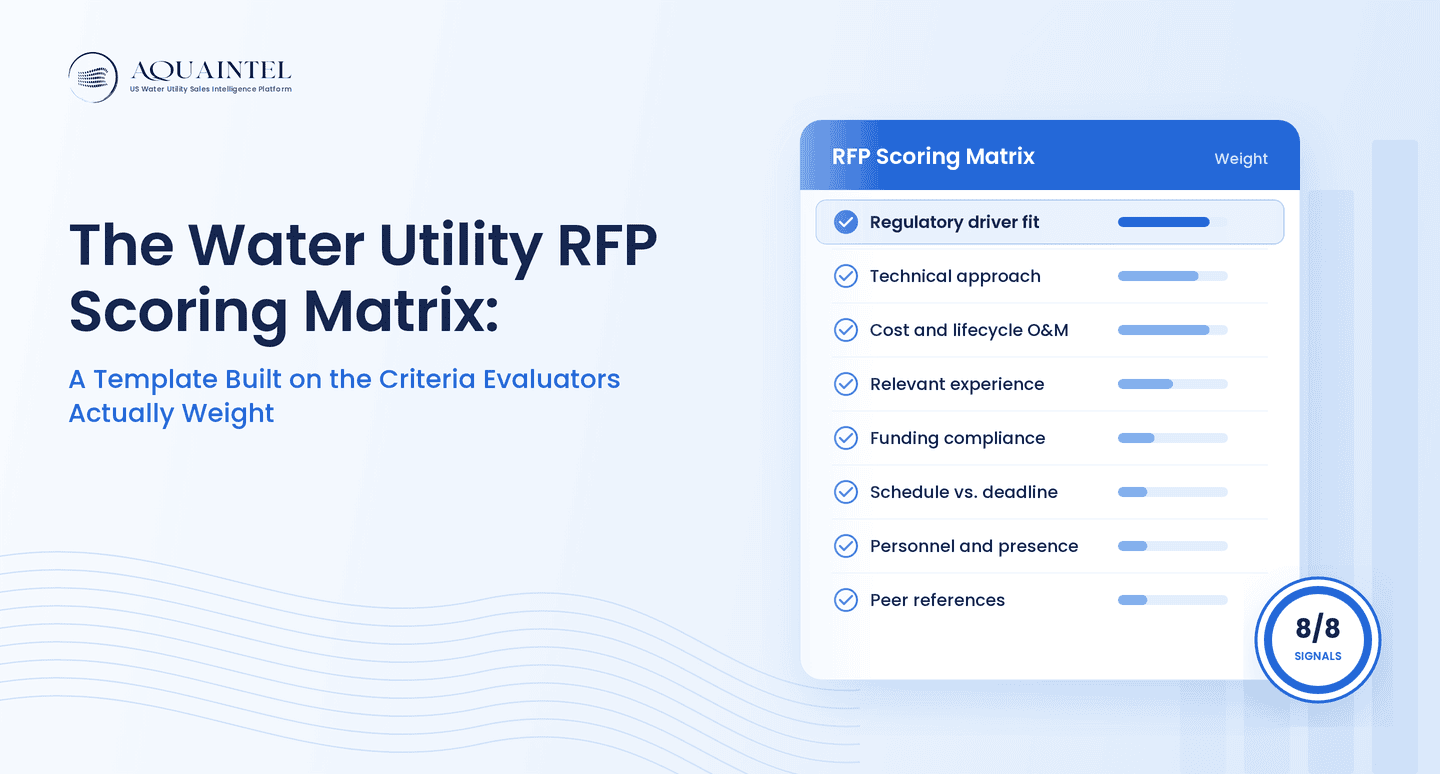
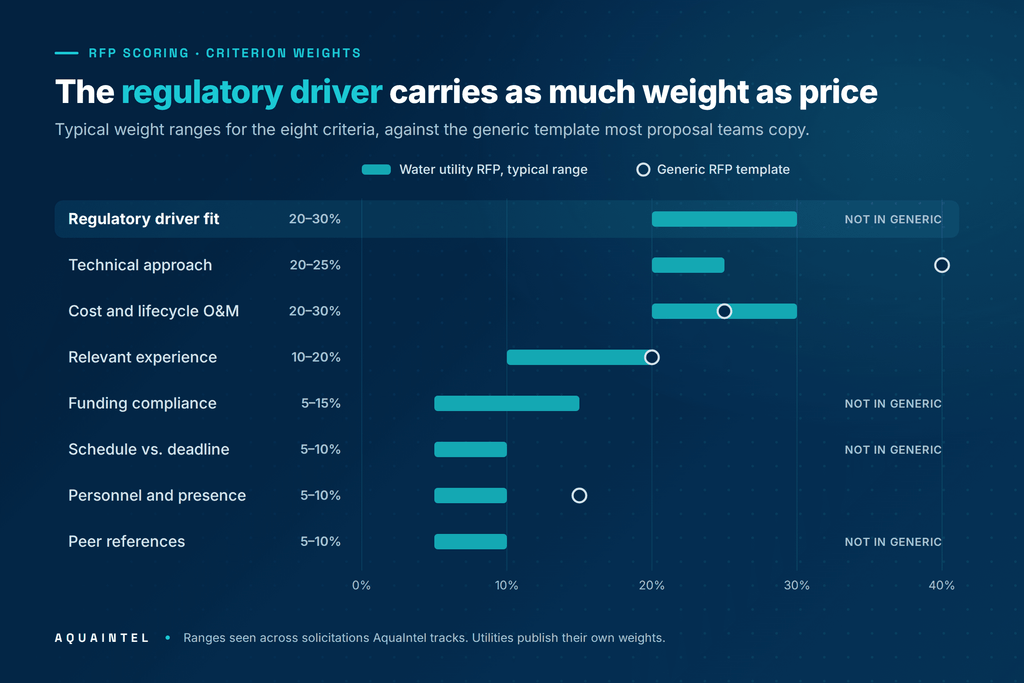
The table below is the template. Weights are ranges because every utility publishes its own, but the ranges reflect what we see across the solicitations AquaIntel tracks. The last column is the part no generic template has: the public signal that tells you, before the RFP, how you will score on that line.
| # | Criterion | Typical weight | What evaluators actually score | Pre-RFP signal that predicts your score |
| 1 | Regulatory driver fit | 20–30% | Does the proposal solve the specific compliance problem, at the specific level, by the specific deadline? | The utility’s PFOA and PFOS running annual averages against the 4.0 ppt MCL; NPDES permit limits and expiry; consent decree milestones |
| 2 | Technical approach and performance data | 20–25% | Pilot or full-scale data from comparable source water and treatment trains; residuals handling; redundancy | Source water type and treatment train on record; prior pilot studies in board minutes |
| 3 | Relevant experience | 10–20% | Installations at systems of similar size, source, and primacy agency | Population served, system class, and the state agency the utility reports to |
| 4 | Funding and procurement compliance | 5–15% | AIS, BABA, Davis-Bacon, DBE participation, SRF documentation | Whether the project sits on the state Intended Use Plan project priority list; WIFIA status; bond authorizations |
| 5 | Cost and lifecycle O&M | 20–30% | 20-year present value, not bid price; chemical, media, energy, and disposal costs | Rate-case history and the utility’s stated affordability constraints |
| 6 | Schedule against compliance deadline | 5–10% | Whether the project finishes before the enforceable date, with float | The compliance date that applies (April 2029 for PFOA/PFOS, or 2031 if the utility requests the proposed extension) |
| 7 | Key personnel and local presence | 5–10% | Named staff with relevant licenses; response time for service | Incumbent vendors already on site; distance to the nearest service center |
| 8 | Peer references | 5–10% | References from utilities the evaluators know, ideally in the same state | Which neighboring utilities have awarded similar contracts, and to whom |
Add a ninth line for anything the RFP scores that is specific to that utility, and you have a complete matrix. Most water RFPs score five to eight of these lines. Almost none score fewer than five.
What each criterion really measures
1. Regulatory driver fit
This is the criterion that generic templates fold into “technical approach,” and it is the one that decides most water RFPs. The evaluators know exactly which number forced the procurement. If it is PFAS, they know the utility’s PFOA and PFOS results down to the tenth of a part per trillion, and they know whether the hazard index for the mixture compounds still applies after EPA’s proposed rescission. If it is wastewater, they know the permit’s new limit and whether the permit is administratively continued past its expiry.
Your proposal scores well here when it names the driver, names the number, and designs to it with margin. It scores poorly when it describes a product and leaves the evaluator to map it to their problem.
2. Technical approach and performance data
Water evaluators discount performance claims from dissimilar systems. Granular activated carbon data from a groundwater system with low organic loading does not transfer to a surface water system on the Potomac. Show data from the same source water class, similar influent quality, and a comparable treatment train, and this criterion is yours.
3. Relevant experience
“Similar” means similar to the evaluators. A utility serving 40,000 people under a state primacy agency wants references from utilities of roughly that size under that agency. A federal-primacy utility like DC Water, which reports directly to EPA Region 3 because the District never sought primacy, is a different reference market entirely.
4. Funding and procurement compliance
If the project is on a state SRF project priority list, this criterion is often pass-fail before it is scored. The Drinking Water SRF emerging contaminants allotments that fund most PFAS projects carry the full federal cross-cutter package. A single missing certification can disqualify a technically superior bid.
5. Cost and lifecycle O&M
Utilities that have been through a rate case in the last two years score lifecycle cost harder than bid price. Look for the words “affordability” and “rate impact” in the board minutes preceding the RFP. If they appear, your O&M narrative matters more than your capital number.
6. Schedule against the compliance deadline
The enforceable PFOA and PFOS compliance date is April 26, 2029. In May 2026 EPA proposed a rule letting systems request an extension to April 26, 2031. Whether a given utility intends to request it is usually visible in its board packages and its state’s compliance correspondence. A proposal scheduled against the wrong date is scored against the wrong date.
7 and 8. Personnel, presence, and references
These are the criteria vendors over-invest in because they are the easiest to write. They are also the lowest-weighted. Get them right, but do not expect them to win the evaluation.
A worked example
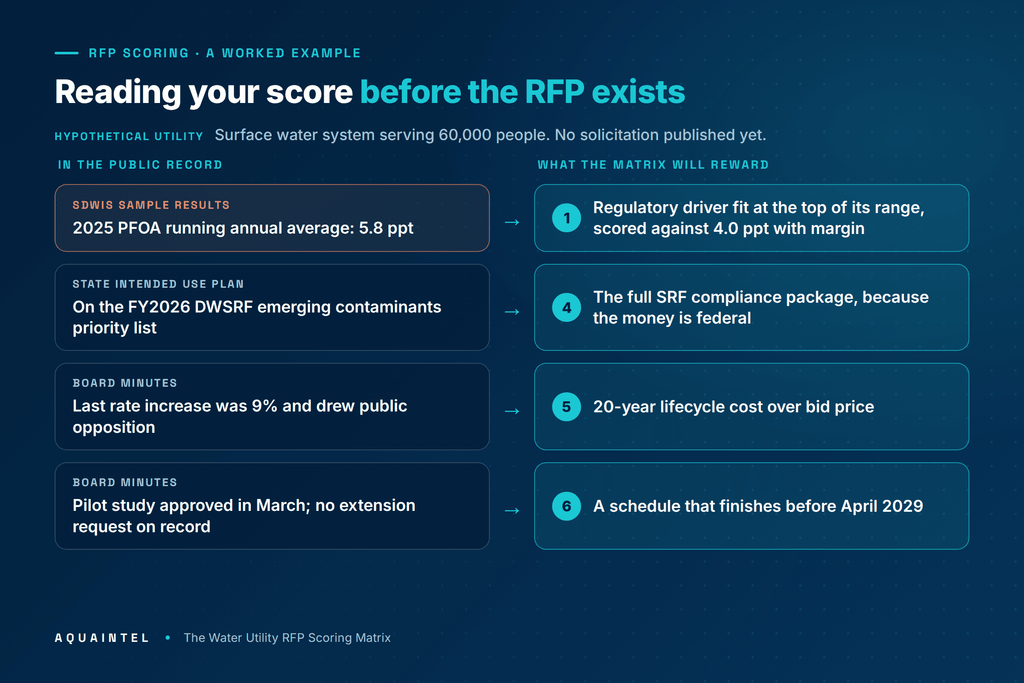
Consider a hypothetical surface water utility serving 60,000 people. Its 2025 PFOA running annual average is 5.8 ppt. Its state added a “PFAS treatment alternatives evaluation” for the utility to the FY2026 DWSRF emerging contaminants project priority list. The board approved a pilot study in March. The utility’s last rate increase was 9 percent and drew public opposition.
Before any RFP exists, the matrix tells you:
- Criterion 1 will be weighted at the top of the range, and evaluators will score against 4.0 ppt with margin, not against “PFAS removal.”
- Criterion 4 will carry the full SRF compliance package because the money is federal.
- Criterion 5 will emphasize lifecycle cost because of the rate backlash.
- Criterion 6 will be scored against 2029 unless the board minutes show an extension request.
A vendor with strong surface-water GAC data, a documented BABA supply chain, and a credible 20-year O&M model starts this evaluation with most of the points already in reach. A vendor that discovers the RFP on a bid board the day it posts starts from zero.
Using the matrix before the RFP
The most valuable use of a scoring matrix is not scoring proposals. It is deciding whether to bid at all, and it is deciding what to say to the utility in the six to eighteen months before the solicitation.
Fill in the template for a target account using the public record: SDWIS sample results, NPDES permit status, the state Intended Use Plan, the capital improvement plan, and board minutes. Score yourself honestly on each line. If you are below three out of five on criterion 1 or 2, no amount of proposal writing will fix it. If you are strong on 1, 2, and 4, you should be in front of the utility’s engineers now, not after the RFP.
This is the logic behind AquaIntel’s RFP FitCheck. It reads the solicitation against your capability profile and the utility’s own record, so a response starts at roughly 70 percent complete rather than at a blank page. The PFAS Intelligence and Permits Intelligence screeners supply the signals in the last column of the template for more than 65,000 U.S. water and wastewater systems, so the matrix can be filled in for an account before the account has written its RFP.
Frequently asked questions
What weights do water utilities typically use in RFP evaluation?
Technical criteria, including regulatory driver fit and technical approach, usually total 40 to 55 percent. Cost is 20 to 30 percent. Experience, compliance, schedule, personnel, and references share the remainder. Utilities publish their weights in the RFP, and many publish evaluation summaries in board packages after award.
Which technical criteria matter most in a PFAS treatment RFP?
Demonstrated removal of PFOA and PFOS to below 4.0 ppt on comparable source water, residuals and spent-media management, lifecycle O&M cost, and a schedule that meets the applicable compliance date.
How do I find a utility’s PFAS levels and permit status before an RFP?
Drinking water sample results are reported to the state primacy agency and EPA through SDWIS and appear in the utility’s consumer confidence report. Wastewater permit limits and expiry dates are in EPA’s ICIS and ECHO databases. AquaIntel aggregates both, with the funding and board-minute context, in one account record.
Do utilities score proposals differently when SRF money is involved?
Yes. SRF-funded procurements add federal cross-cutting requirements that are often evaluated as pass-fail before weighted scoring begins.
Get the template
The scoring matrix above is available as a fillable worksheet with a column for your self-score and a column for the source document behind each signal. If you want it pre-filled for the accounts in your territory, talk to us and we will run it against the AquaIntel record for your top targets.