


Ask a general-purpose sales intelligence tool for the decision makers at a water utility and you will get a list of titles: a chief executive, a chief financial officer, a “VP Procurement,” and forty people with “engineer” somewhere in their headline. Every one of them is real. Almost none of them is the person who will decide whether your product goes into the next capital project.
Water utilities do not buy the way companies buy. Authority is split between a board that approves capital and rates, executives who own programs, engineers who write specifications, procurement staff who run the process, and regulators who set the deadline that makes the whole thing happen. The org chart that matters for go-to-market is not the one on LinkedIn. It is the one you assemble from the utility’s own public record.
This post gives you the method, and works it through the most instructive example in the country: the Washington, D.C. regulatory landscape.
Why generic sales intelligence fails on utilities
Three structural reasons.
Titles do not map to buying authority. The person who decides a PFAS treatment technology is usually a plant manager or a program engineer, plus the outside engineer of record. Neither will appear in a search for “decision maker.”
The account boundary is negotiated, not given. A regional treatment plant may be owned by one authority, governed by a board with seats from four jurisdictions, and paid for by suburban utilities that are customers, partners, and ratepayers at once. A contact database has no field for that.
Change is driven by public events. A CEO transition, a new consent decree, a rate case, or a board reorganization reshuffles who owns what. Those events are published in board packages and press releases months before contact databases catch up.
The five layers of a utility org chart
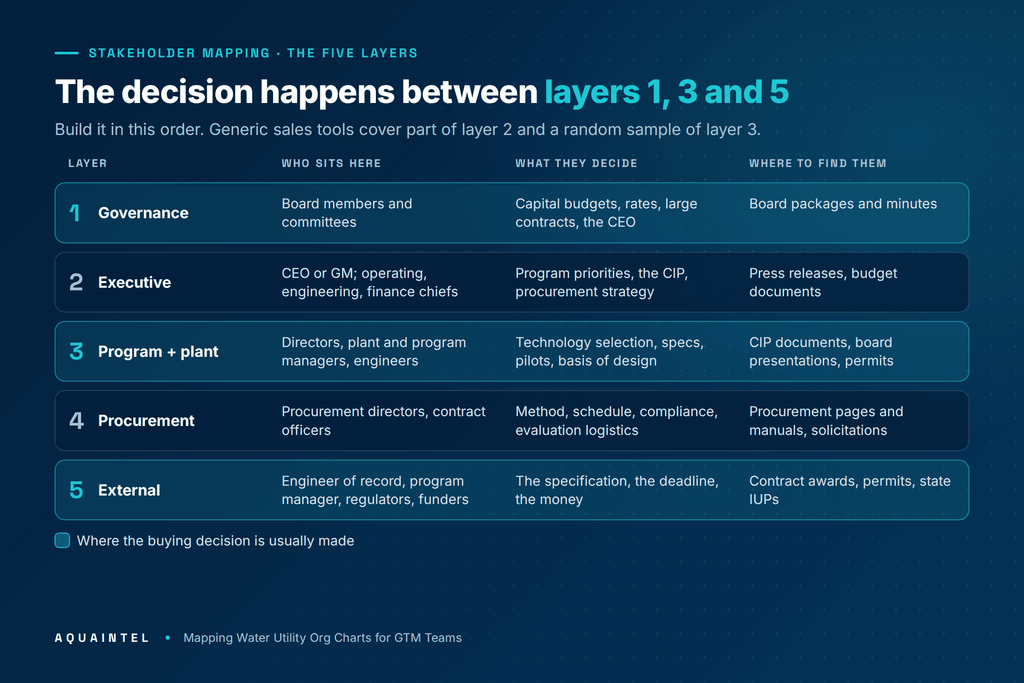
Every utility org chart that is useful for selling has the same five layers. Build them in this order.
| Layer | Who sits here | What they decide | Where to find them |
|---|---|---|---|
| 1. Governance | Board members, board committees | Capital budgets, rates, contracts above a threshold, the CEO | Board meeting packages and minutes, enabling legislation |
| 2. Executive | CEO or general manager, chief operating, engineering, and financial officers | Program priorities, the capital improvement plan, major procurement strategy | Press releases, budget documents, department summaries |
| 3. Program and plant | Department directors, plant managers, program managers, engineers | Technology selection, specifications, pilot studies, basis of design | CIP documents, board presentations, permit correspondence |
| 4. Procurement | Procurement directors, contract officers, compliance staff | Method, schedule, compliance requirements, evaluation logistics | Procurement pages, procurement manuals, solicitation documents |
| 5. External influencers | Engineer of record, program management consultant, regulators, funding agencies | The specification, the deadline, the money | Contract awards, permits, state Intended Use Plans, regulatory correspondence |
The generic tools give you a partial layer 2 and a random sample of layer 3. The decision usually happens between layers 1, 3, and 5.
The Washington, D.C. landscape, layer by layer
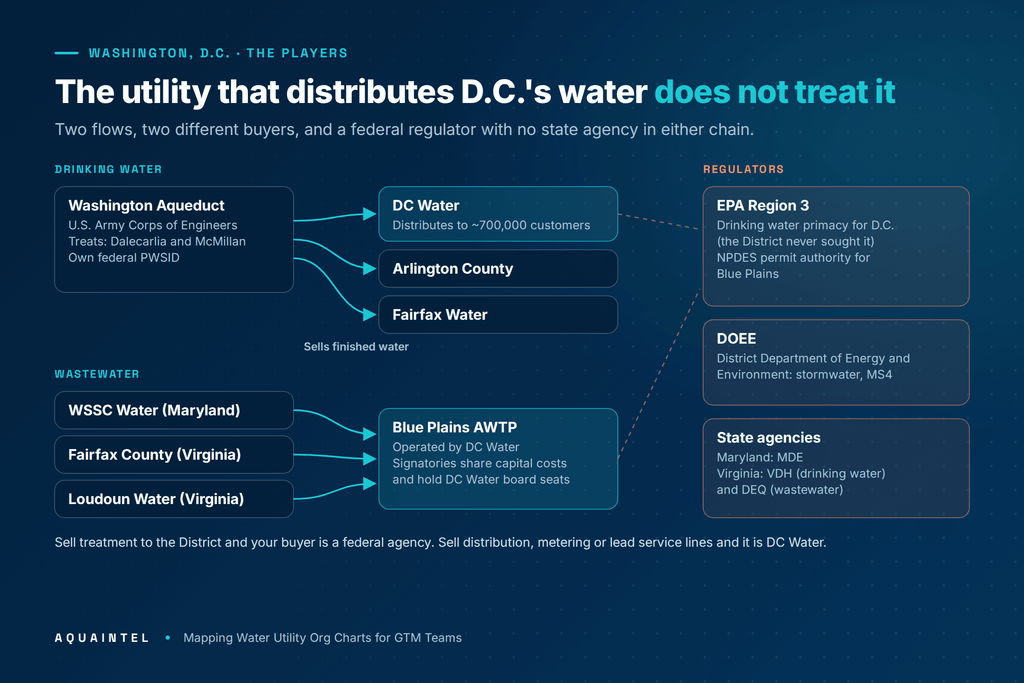
D.C. is worth studying because it breaks every simplifying assumption at once. The utility that distributes the District’s drinking water does not treat it. The largest advanced wastewater plant in the world sits inside the District but serves two million people outside it. And there is no state agency in either regulatory chain.
The players
DC Water (District of Columbia Water and Sewer Authority). An independent authority created in 1996 under both a District law and an Act of Congress. It distributes drinking water to roughly 700,000 retail customers under its own PWSID, operates the Blue Plains Advanced Wastewater Treatment Plant under an NPDES permit issued directly by EPA, and holds the District’s MS4 stormwater permit. Three services, three regulatory chains, one authority.
Washington Aqueduct. A federal facility operated by the U.S. Army Corps of Engineers. It owns the Potomac intakes and the Dalecarlia and McMillan treatment plants, holds its own federal PWSID, and sells finished water to DC Water, Arlington County, and Fairfax Water. If you sell drinking water treatment in the District, your buyer is a federal agency, not DC Water. If you sell distribution, metering, or lead service line work, it is DC Water. Get that wrong and you have mapped the wrong org chart entirely.
The Blue Plains signatories. WSSC Water, Fairfax County, and Loudoun Water send wastewater to Blue Plains under an intermunicipal agreement. They are counterparties to DC Water, they hold seats on its board, and they pay a share of its capital program. A Blue Plains project has an audience in three states.
The regional utilities. WSSC Water is a bi-county commission serving Montgomery and Prince George’s counties in Maryland, with commissioners appointed by the two county executives. Fairfax Water and Loudoun Water are Virginia authorities whose boards are appointed by their county boards of supervisors. Each has its own state primacy agency, its own funding channel, and its own PFAS picture.
The regulators
EPA Region 3 is the primacy agency for the District. D.C. never sought Safe Drinking Water Act primacy, so drinking water compliance runs straight to EPA. EPA is also the NPDES permitting authority for Blue Plains. In Maryland the equivalents are the Maryland Department of the Environment; in Virginia, the Virginia Department of Health for drinking water and the Department of Environmental Quality for wastewater.
DOEE, the District Department of Energy and Environment, enforces local environmental regulation, issues permits, and administers stormwater and Chesapeake Bay obligations. For MS4 and green infrastructure work, DOEE is in the room.
The DC Council exercises oversight through committee hearings and confirms District board appointees. Rates, however, are set by the DC Water board after public hearing, not by a public service commission. A vendor used to state-regulated investor-owned utilities will look for a rate-case docket that does not exist.
Layer 1: governance at DC Water
The DC Water board has eleven principal members and eleven alternates: six from the District, two each from Montgomery and Prince George’s counties, and one from Fairfax County. Five of eleven seats belong to suburban jurisdictions. All members vote on joint-use facilities such as Blue Plains; only District members vote on matters affecting District retail ratepayers.
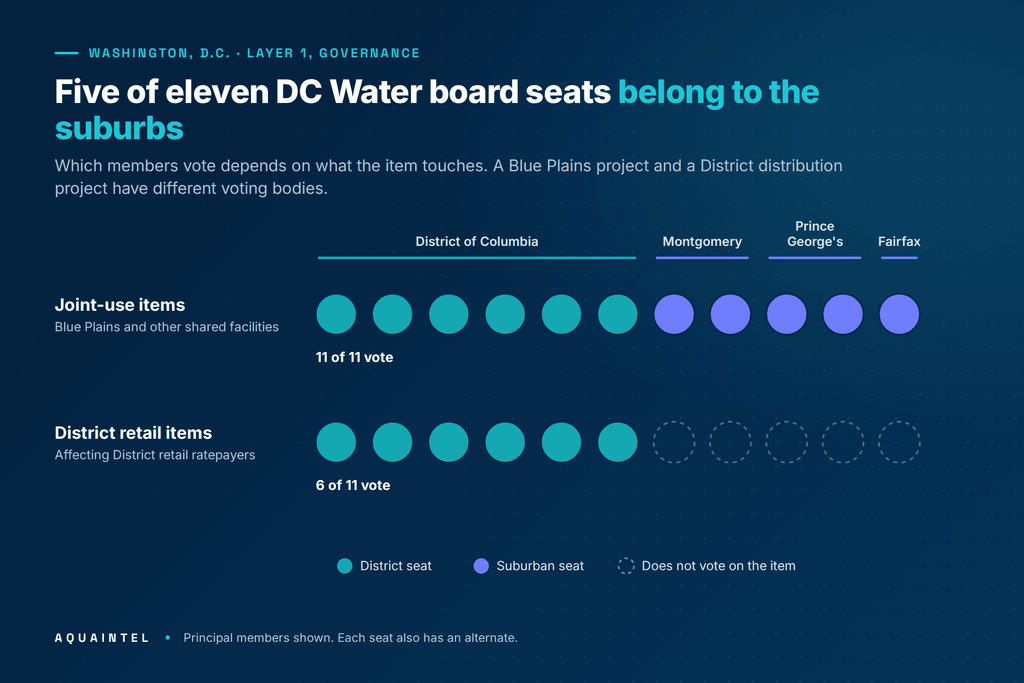
For a vendor, that means a Blue Plains capital item has a different voting body than a District distribution item, and the suburban members answer to their own county executives. The board’s standing committees, which include environmental quality and operations, finance and budget, and District retail rates, are where capital projects are first presented. Committee packages are published monthly and are the single best source for layer 3 names, because staff present their own projects.
Layer 2: the executive structure
DC Water reorganized under a strategic plan into seven departments: administrative services, finance and procurement, people and talent, performance, customer experience, legal affairs, and operations and engineering. The CEO and general manager reports to the board. In 2026 the board announced a leadership transition and a nationwide CEO search. A new CEO typically restructures within the first year, so any org chart built today needs a re-check date.
Layer 3: programs and plants
This is where the technical decisions live. Blue Plains has its own plant leadership. The capital program is run through program managers and a program management consultant. Distribution, lead service line replacement, and the Clean Rivers tunnel program each have owners. The budget’s departmental summaries and the CIP name the programs; the board committee packages name the people presenting them.
Layer 4: procurement
DC Water’s procurement is centralized and organized into centers of excellence under a vice president of procurement and compliance, with separate directors for goods and services and for capital programs. Because DC Water is an independent authority, its procurement is governed by its own regulations and procurement manual, not by District government procurement rules. The current contacts are published on DC Water’s procurement contacts page. Map the roles from that page, then verify the names against the most recent board package.
Layer 5: external influencers
The engineer of record and the program management consultant on a capital program often have more influence on the specification than anyone inside the utility. Contract awards in board minutes tell you who they are. EPA Region 3 sets the compliance clock. For PFAS, the relevant results belong to the Washington Aqueduct, whose monitoring has stayed below the federal limits, while Fairfax Water’s Occoquan source has shown some results above the PFOA and PFOS maximum contaminant levels. Same region, different buyer, different urgency.
The method, applied anywhere
The D.C. example is extreme, but the method is the same for a 30,000-customer utility in Ohio.
- Resolve the identifiers first. PWSID, NPDES permit, MS4 permit. If the identifiers point to different organizations, you have more than one account.
- Read the enabling structure. Authority, department, district, or commission. It tells you who appoints the board and who sets rates.
- Pull twelve months of board packages. Extract every staff presenter, every contract award, and every consultant named. That is layers 1, 3, and 5 in one pass.
- Overlay the budget and CIP. Programs with money have owners.
- Map procurement last. It is the easiest layer to find and the least decisive.
- Set a re-check trigger. CEO changes, consent decrees, rate cases, and reorganizations invalidate the chart.
AquaIntel’s People and Buying Committee module does this at scale. It scores contacts by influence from the public record rather than by title, and identifies the handful of people at each utility who actually decide. Across one recent account program it scored more than 2,000 contacts to surface the four per utility who mattered. Procurement Access Intelligence adds the procurement layer, and SpecMap adds the engineers of record.
A template for the D.C. buying committee
Fill this in by role before you fill it in by name.
| Role | DC Water | Washington Aqueduct | Regional utilities |
|---|---|---|---|
| Approves capital | Board, by committee; suburban members on joint-use items | Army Corps, with wholesale customers consulted | Commission or authority board |
| Owns the program | Operations and engineering department; program managers | Aqueduct leadership | Engineering directors |
| Writes the spec | Plant and program engineers; engineer of record | Corps engineers; consultants | Engineer of record |
| Runs the process | Procurement centers of excellence | Federal acquisition | Authority procurement |
| Sets the deadline | EPA Region 3; DOEE for stormwater | EPA Region 3 | MDE; VDH; Virginia DEQ |
| Pays | District ratepayers; Blue Plains signatories | Wholesale customers | County ratepayers |
Frequently asked questions
Who are the decision makers at a water utility?
For capital purchases, a board approves, an executive sponsors, a program or plant engineer selects the technology, an outside engineer of record writes the specification, and procurement runs the process. The technical decision is usually made in the third and fourth of those, not the first.
Who regulates DC Water?
EPA Region 3 directly, for both drinking water and wastewater, because the District has no state primacy agency. The District Department of Energy and Environment regulates stormwater and local environmental matters. Rates are set by the DC Water board, not by a public service commission.
Who treats Washington, D.C.’s drinking water?
The Washington Aqueduct, a federal facility operated by the U.S. Army Corps of Engineers. DC Water purchases finished water and distributes it.
How often should a utility org chart be refreshed?
After every board meeting for active accounts, and immediately after a CEO change, a reorganization, a consent decree, or a rate case.
Map your territory
Send us your target utilities. We will return the five-layer org chart for each, built from board packages, budgets, permits, and awards, with the four people who decide and the documents that prove it.