
Most vendors assume they lose deals because a competitor had a better product, stronger relationships, or more aggressive pricing.
Sometimes that’s true.
But in the utility industry, many deals are won or lost long before procurement begins.
By the time an RFP is released, the utility has often spent months, or even years, identifying a problem, evaluating alternatives, securing funding, aligning stakeholders, and building internal consensus. Procurement is rarely the start of the buying journey. More often, it’s one of the final stages.
The uncomfortable reality is that many vendors only enter the conversation after the most important decisions have already been made.
The companies that consistently outperform their competitors understand something different. Utilities reveal where they’re heading long before they formally announce it.
The challenge is recognizing those signals early enough to matter.
Why Utilities Move Slowly and Why That Matters
Unlike most commercial buyers, utilities don’t make large purchasing decisions overnight.
A treatment upgrade might require engineering assessments, board approvals, environmental reviews, funding applications, rate discussions, and regulatory sign-off before procurement can even begin. A pump replacement program may spend years moving through planning and budgeting cycles before it reaches the market.
This complexity is often frustrating for vendors, but it creates a significant opportunity.
This isn’t just a theory about how utilities behave; it shows up directly in win rates. Across public-sector procurement broadly, the average win rate for vendors sits around 45%, but vendors who engage the buyer before the RFP is published push that closer to 60%. The highest-value window for that engagement typically opens 6 to 18 months before a solicitation is ever issued long before most vendors are paying attention.
Because utility decisions unfold gradually, they leave behind evidence at every stage of the process. An engineering study commissioned today may become a procurement opportunity next year.
The Infrastructure Challenge Is Creating More Signals Than Ever
The volume of future investment facing the water sector is staggering.
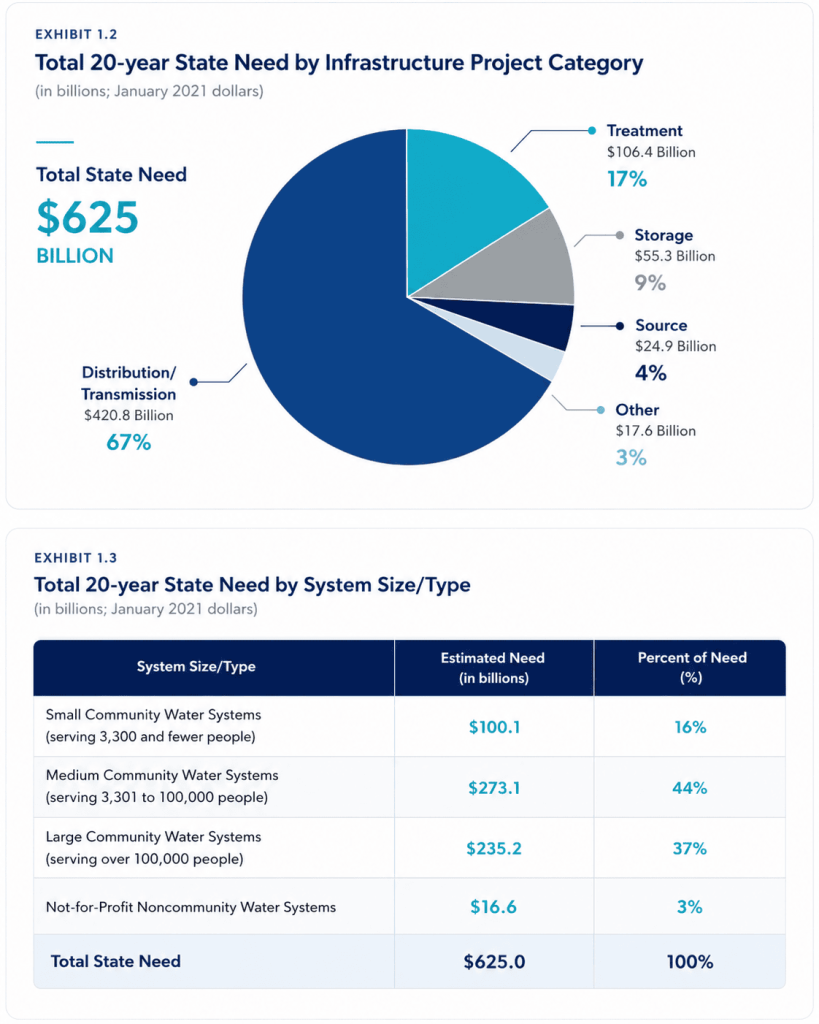
According to the EPA’s 7th Drinking Water Infrastructure Needs Survey, U.S. drinking water systems require approximately $625 billion in infrastructure investment over the next twenty years. Wastewater systems face similarly large challenges, with estimated needs exceeding $630 billion.
At the same time, aging assets continue to place increasing pressure on utilities. A 2023 Utah State University study found that the U.S. and Canada experience approximately 260,000 water main breaks every year — roughly one every two minutes
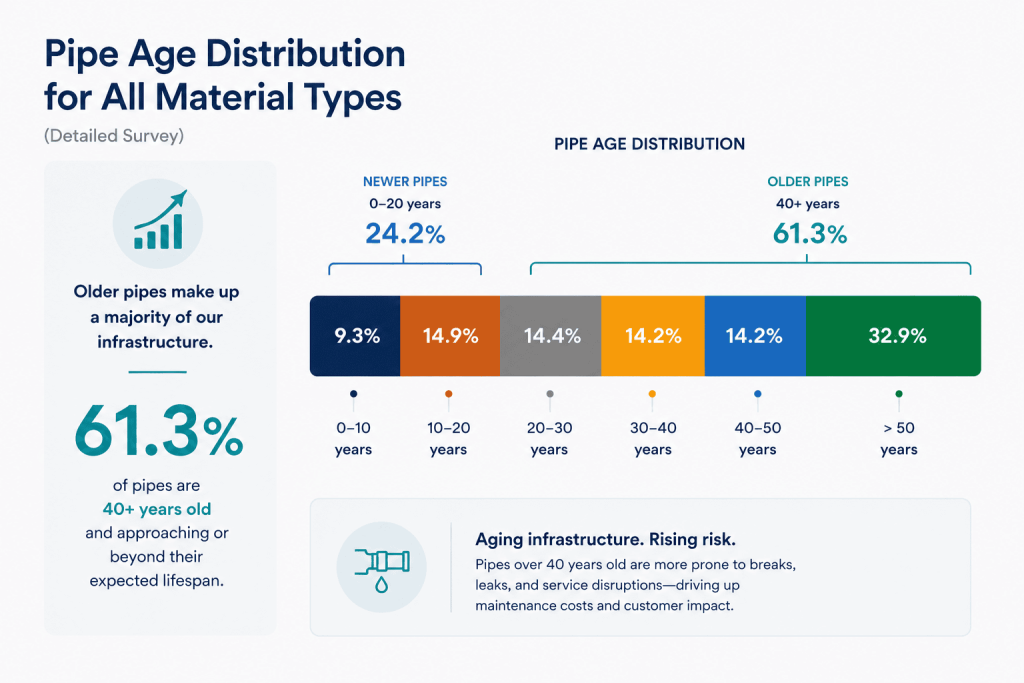
The major reason for this frequency is the age of pipes across USA, where 61.3% of pipes are 40+ years old and approaching or beyond their expected lifespan.
Utilities know these problems exist.
They’re conducting studies, evaluating options, pursuing funding, updating asset management plans, and preparing long-term capital programs.
In other words, they’re generating enormous amounts of information that reveal where future spending is likely to occur.
The question is no longer whether signals exist.
The question is whether anyone can make sense of them.
The Clues Most Vendors Overlook
One of the biggest misconceptions in utility sales is that valuable information is difficult to find.
The opposite is often true.
Utilities are among the most transparent organizations in the country. Board packets, capital improvement plans, annual budgets, engineering reports, permit applications, rate studies, compliance records, and regulatory filings are often publicly available.
Multiply that across the roughly 50,000 community water systems in the U.S. most too small to ever make national news and the country is generating an enormous, constant stream of public procurement signals. No sales team, however disciplined, can read all of it.
Hidden inside those documents are clues about future procurement activity. Individually, none of these signals are particularly useful. The real value emerges when they begin appearing together.
The next difficulty is distinguishing meaningful signals from noise.
Utilities face budget constraints, staffing shortages, grant delays, political approvals, leadership changes, and competing priorities. A utility may clearly recognize a problem and still postpone action for years.
This is why individual signals are often misleading. What matters is convergence.
Consider two utilities.
- One is renewing a permit.
- The other is renewing a permit while simultaneously conducting engineering assessments, increasing maintenance spending, applying for funding, and discussing reliability concerns in board meetings.
Both utilities generated a signal but only one generated a meaningful buying signal and that distinction changes everything.
Why Human Monitoring Breaks Down
Once organizations recognize the value of early signals, the instinct is clear: monitor more of them. The difficulty isn’t deciding to do it—it’s doing it consistently at scale..
This isn’t a discipline problem, it’s a math problem. Industry research consistently shows B2B sales reps spend only 28-35% of their working time actually talking to buyers; the rest disappears into CRM upkeep, internal meetings, and manual account research typically 5 to 8 hours a week per rep just piecing together what’s happening at accounts they already know about. That’s before accounting for the utilities they haven’t noticed yet. Even a highly disciplined team can only read so many board packets before something slips through.
How Modern Intelligence Systems Solve the Problem
This is where technology becomes far more than a convenience.
It becomes a necessity.
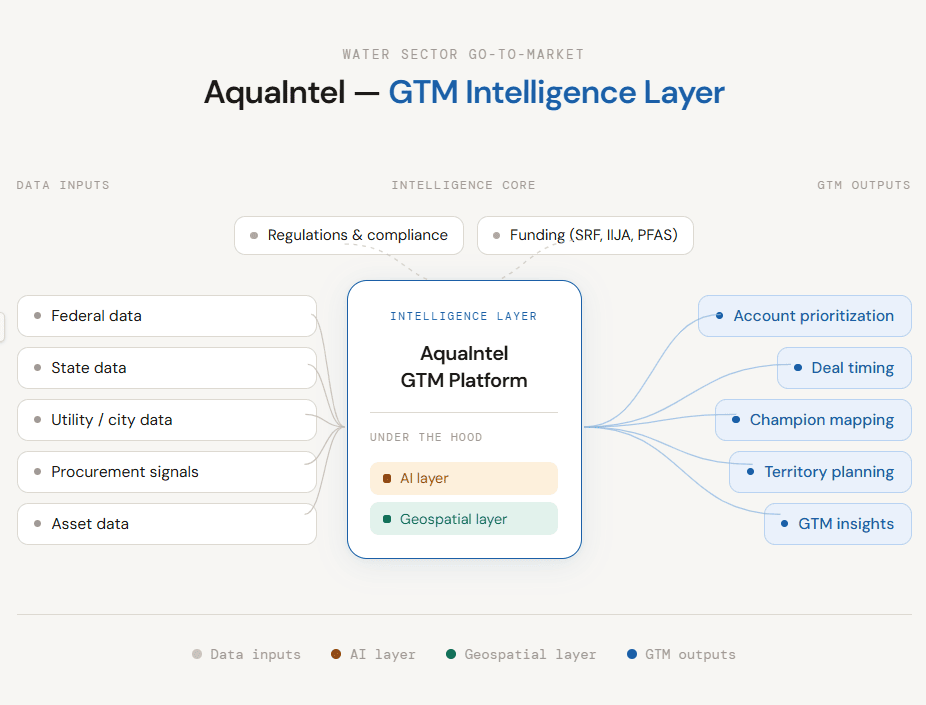
Modern intelligence platforms continuously monitor thousands of public information sources and transform fragmented information into structured insight.
- Document intelligence systems analyze board minutes, engineering reports, budgets, and planning documents using natural language processing to identify discussions around asset condition, operational challenges, maintenance burden, compliance risks, and future investments.
- Operational analytics examine maintenance activity, energy consumption, performance trends, and reliability metrics to identify assets showing signs of deterioration before replacement projects are formally discussed.
- Regulatory intelligence systems monitor permit renewals, enforcement actions, compliance trends, and evolving regulatory requirements to identify utilities likely to face future investment pressure.
- Financial intelligence systems track capital improvement plans, bond issuances, State Revolving Fund applications, grant activity, and rate adjustments to understand both infrastructure needs and financial readiness.
These systems combined create something much more powerful—context.
Instead of seeing isolated events, organizations can see how operational, regulatory, financial, and planning signals interact with one another.
The result isn’t a perfect prediction.
It’s a significantly better understanding of which utilities are most likely to buy, what challenges are driving those decisions, and when engagement is most likely to be effective.
Why AquaIntel Exists
AquaIntel was built around a simple observation
The utilities most likely to buy tomorrow are already leaving evidence today.
The platform continuously monitors the signals that matter across the utility landscape and translates them into actionable commercial intelligence.
Rather than overwhelming teams with disconnected alerts, AquaIntel evaluates signal combinations, applies confidence scoring, identifies emerging opportunities, and prioritizes accounts based on the likelihood of future procurement activity.
This allows sales teams to focus their attention where it creates the greatest impact.
- Account managers gain visibility into why opportunities are emerging.
- Technical specialists understand the operational and regulatory challenges utilities are facing before conversations begin.
- Leadership teams gain a clearer picture of where future demand is developing across their territories.
If you found this article valuable, you might also find “The Next Compliance Wave: Climate, Cybersecurity and the Future of Water Vendor Growth“ valuable, where we take a deeper look at another challenge shaping the future of water utilities and what it means for vendors.
The Advantage of Showing Up Early
The greatest advantage of early engagement isn’t visibility.
It’s influence.
When vendors engage before procurement begins, they have an opportunity to help utilities evaluate problems, understand trade-offs, explore alternatives, and define project requirements.
By the time formal procurement starts, they’re no longer introducing themselves. They’re continuing a conversation that may have begun months earlier.
That’s a fundamentally different position from responding to an RFP alongside every other vendor in the market.