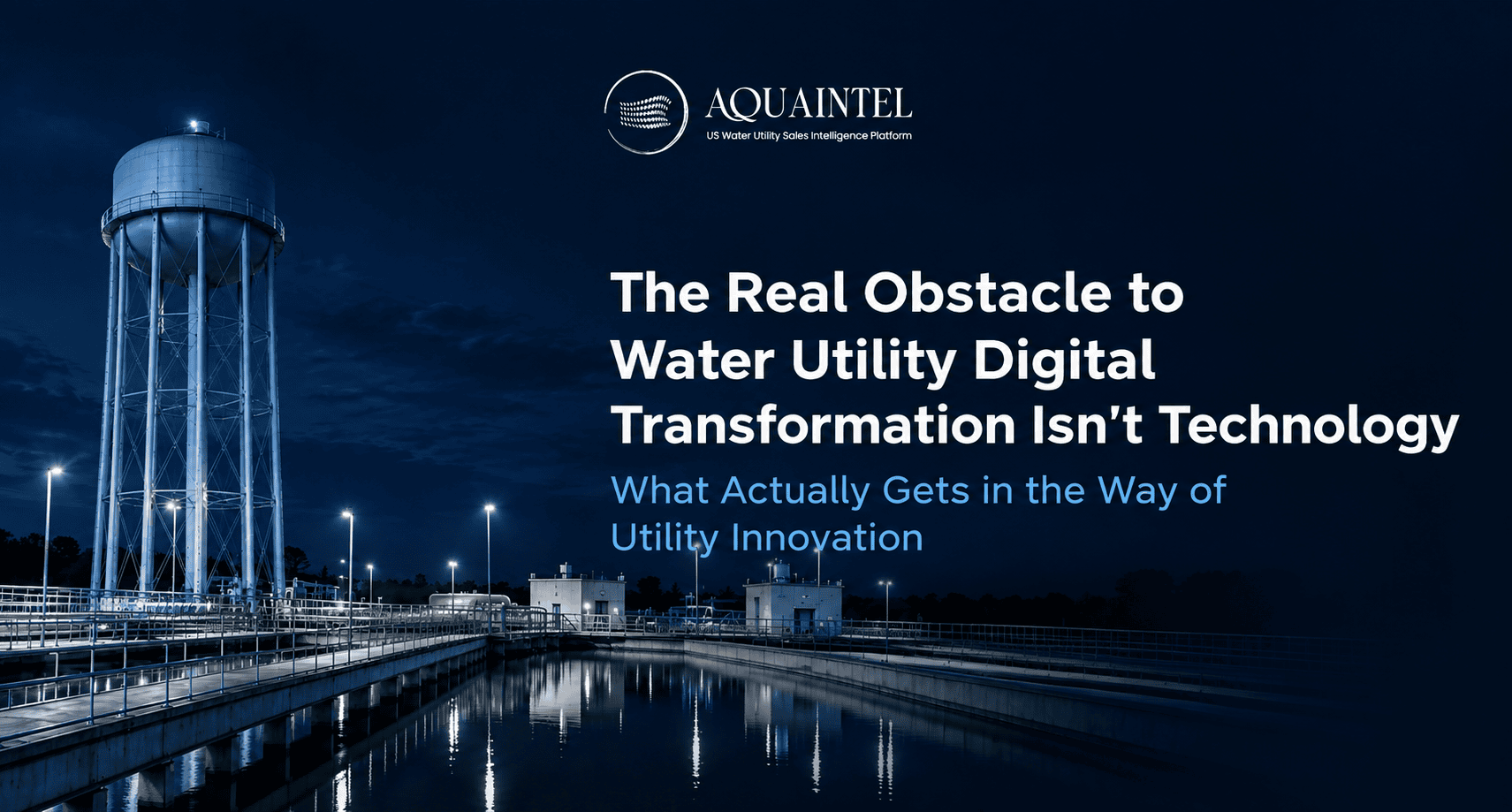

Every year, water utilities invest millions of dollars in new software, sensors, analytics platforms, and AI-powered tools with the promise of becoming smarter, more efficient, and more resilient. Yet many of these initiatives quietly fall short of expectations. Dashboards go unused, predictive analytics never influence operational decisions, and systems designed to simplify work often end up making it more complicated.
The technology itself is rarely the problem.
Most digital transformation efforts fail because organizations underestimate the scale of change required to make new technology valuable.
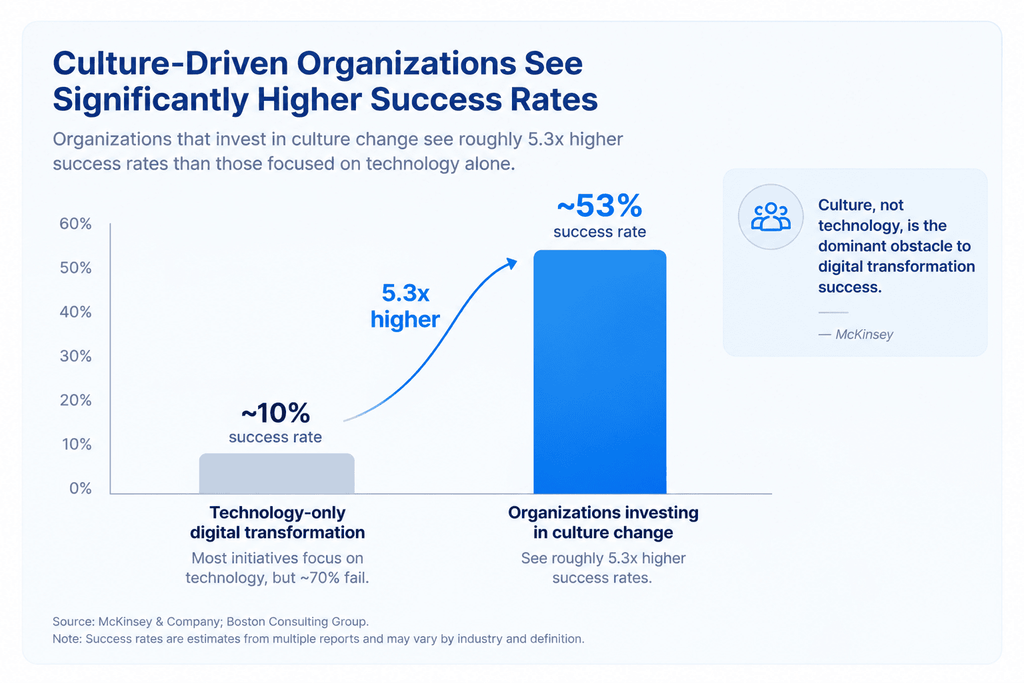
The scale of that failure is widely reported, if imprecisely measured: McKinsey and Boston Consulting Group have each repeatedly cited failure rates around 70% for digital transformation initiatives, and McKinsey’s own research consistently identifies organizational culture not technology as the dominant obstacle. Organizations that invest deliberately in culture change see roughly 5.3x higher success rates than those focused on technology alone.
Installing software is relatively straightforward. Changing how information flows across departments, how decisions are made, and how people work together is considerably harder.
Digital transformation is often presented as an IT initiative. In reality, it is an organizational one.
The Foundation Is Data, Not Technology
Every discussion about artificial intelligence, predictive analytics, or digital twins begins with the same prerequisite: reliable data.
For many utilities, this remains the biggest obstacle.
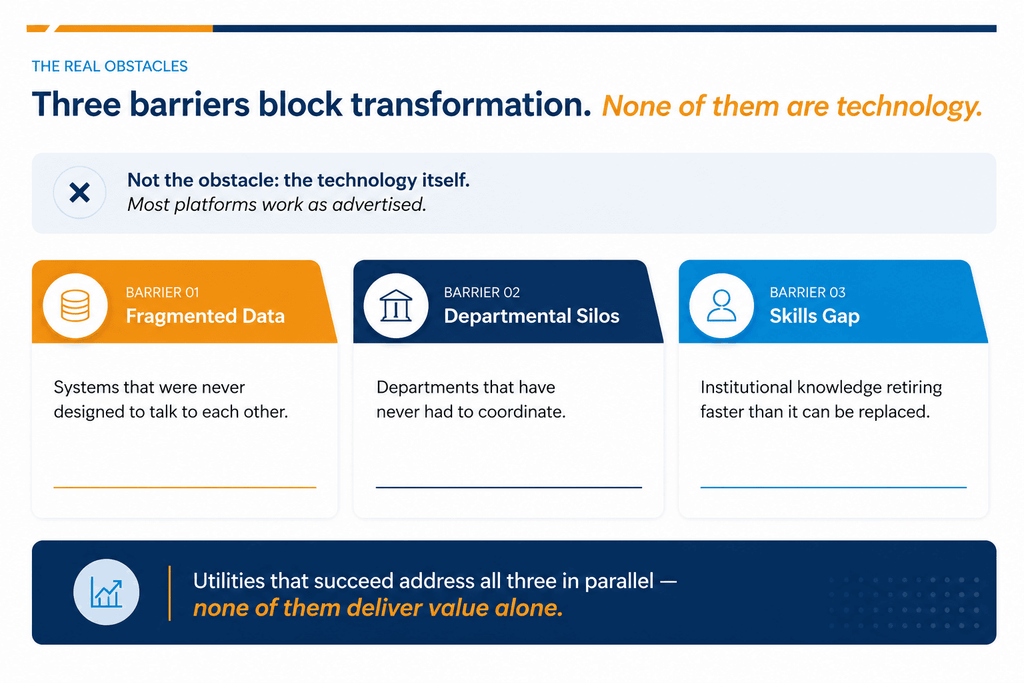
Years of independent technology purchases have left information scattered across disconnected systems.
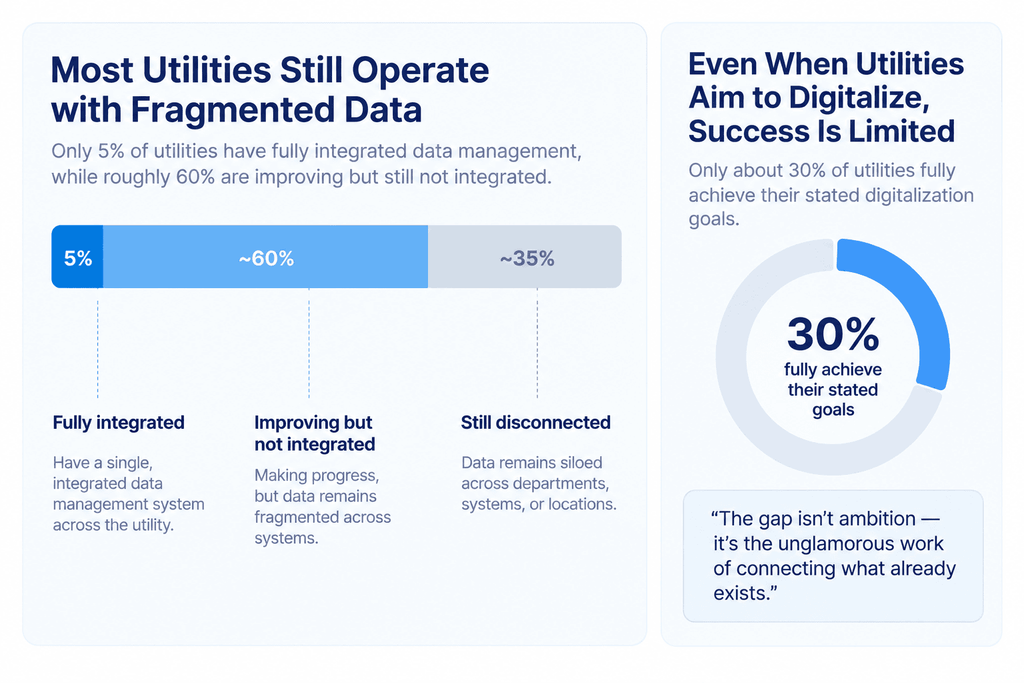
The scale of that fragmentation is well documented: only about 5% of utilities have fully integrated data management, while roughly 60% report they’re improving but still not integrated. And even among utilities that set out to digitalize, only about 30% fully achieve their stated goals. The gap isn’t ambition, it’s the unglamorous work of connecting what already exists.
Operations may rely on one SCADA platform, customer information sits in a separate billing system, finance maintains its own databases, asset management exists partly in spreadsheets, while decades of maintenance history may still be stored on paper.
The challenge isn’t simply connecting these systems. Before integration can even begin, utilities need to understand what data actually exists, whether it is accurate, whether different departments define assets consistently, and whether historical records can be trusted.
Many discover unpleasant surprises. Asset registers that haven’t been updated for years. Maintenance teams using multiple naming conventions for the same equipment. Missing inspection records. Duplicate assets. Inconsistent condition ratings.
None of this work is particularly exciting. Cleaning and standardising data is painstaking, time-consuming, and often invisible to everyone outside the project team.
Yet it is also the foundation of every successful digital initiative.
Utilities often assume they can clean their data after implementing a new platform. More often than not, they simply end up feeding poor-quality information into expensive software. The result isn’t better decisions, it’s faster access to unreliable ones.
Technology can only be as intelligent as the information it receives.
Technology Doesn’t Change Organizations. People Do.
Even with clean data and capable software, digital transformation can still fail.
Information that once remained inside individual departments suddenly becomes visible across the utility. Operational data begins informing financial planning. Finance gains greater visibility into maintenance priorities. Long-term planning relies on real-time operational information rather than periodic reports.
On paper, that sounds logical.
In practice, it requires departments that have worked independently for decades to collaborate in entirely new ways.
That difficulty is well documented: 41% of employees say collaborating across departments is harder than collaborating within their own team and the friction isn’t really about unwillingness. Nearly two-thirds of employees believe their organization should change how it works and collaborates, but don’t expect that shift to happen anytime soon. The resistance utilities encounter when finance, operations, and planning suddenly have to work from shared data isn’t unique to water. It’s the default state of cross-functional collaboration everywhere, and it takes deliberate management to overcome.
Operations teams may feel they are losing autonomy as financial considerations begin influencing operational decisions. Planning departments may have to adjust long-established processes based on field data. Finance teams become more involved in infrastructure decisions that were once considered purely technical.
Resistance in these situations is rarely about software. It is about changing roles, responsibilities, and decision-making authority.
This is why so many digital transformation projects struggle. Organizations prepare extensively for the technology but spend far less time preparing the people expected to use it.
Successful transformation requires leadership that actively manages this transition, communicates why change matters, and creates an environment where collaboration becomes part of everyday decision-making rather than an exception.
Leadership Determines Whether Technology Creates Value
The most successful utilities treat digital transformation as a strategic initiative rather than an IT project. Leadership commitment is often the difference.
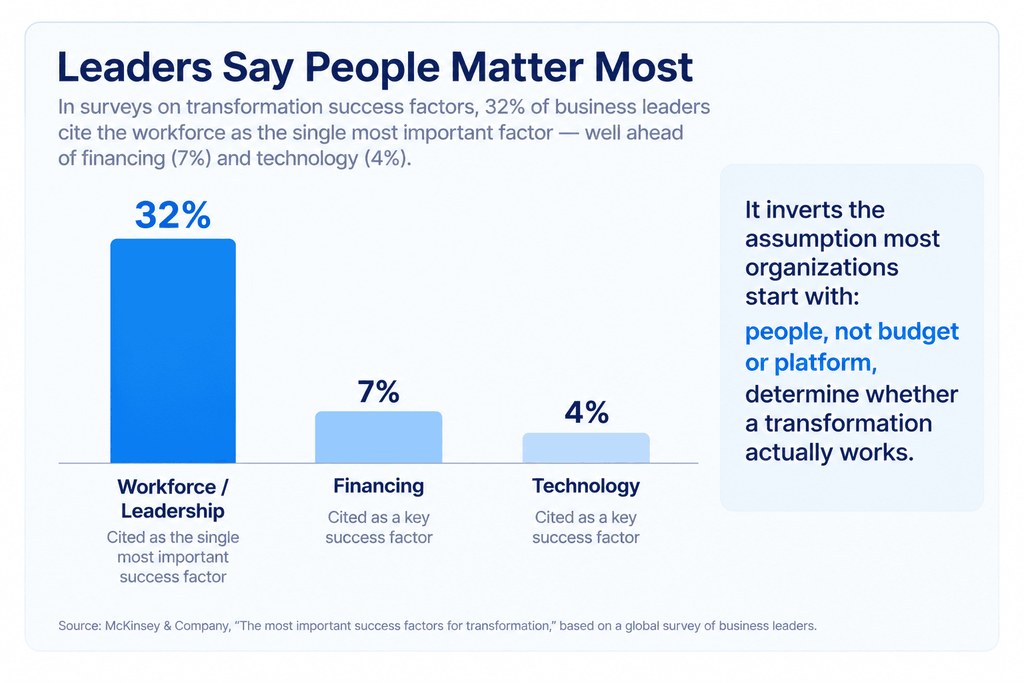
This ranking isn’t just intuition, it’s what business leaders report directly. In surveys on transformation success factors, leaders cite the workforce as the single most important factor, named by 32% of respondents well ahead of financing at 7% and technology at just 4%. It inverts the assumption most organizations start with: people, not budget or platform, determine whether a transformation actually works.
When senior leaders consistently communicate that digital transformation supports the utility’s long-term mission, departments are far more willing to adopt new ways of working. When transformation is viewed as something “the IT department is implementing,” engagement tends to disappear once the software is installed.
Equally important is aligning incentives.
Operations cannot be measured only on uptime while finance focuses exclusively on cost reduction and planning works independently toward long-term infrastructure goals. Those objectives inevitably create competing priorities.
Leading utilities increasingly establish shared performance measures, such as improving reliability while minimizing total lifecycle costs so departments succeed together rather than optimizing individual metrics at one another’s expense.
Digital transformation succeeds when organizations change the way decisions are made, not simply the tools used to support them.
What Successful Utilities Do Differently
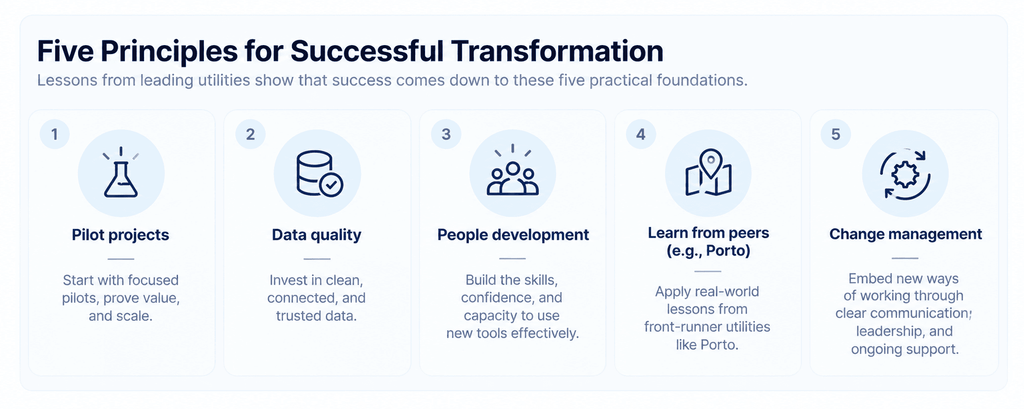
Despite differences in size and geography, utilities that consistently deliver successful digital transformation projects tend to follow the same principles.
- They start with focused pilot projects rather than enterprise-wide deployments, proving value in one treatment plant, one pressure zone, or one critical asset before expanding.
- They invest in data quality early, recognizing that accurate information is the foundation of every future digital capability.
- They develop people alongside technology, combining specialist expertise with training that allows existing staff to confidently use new systems in their daily work.
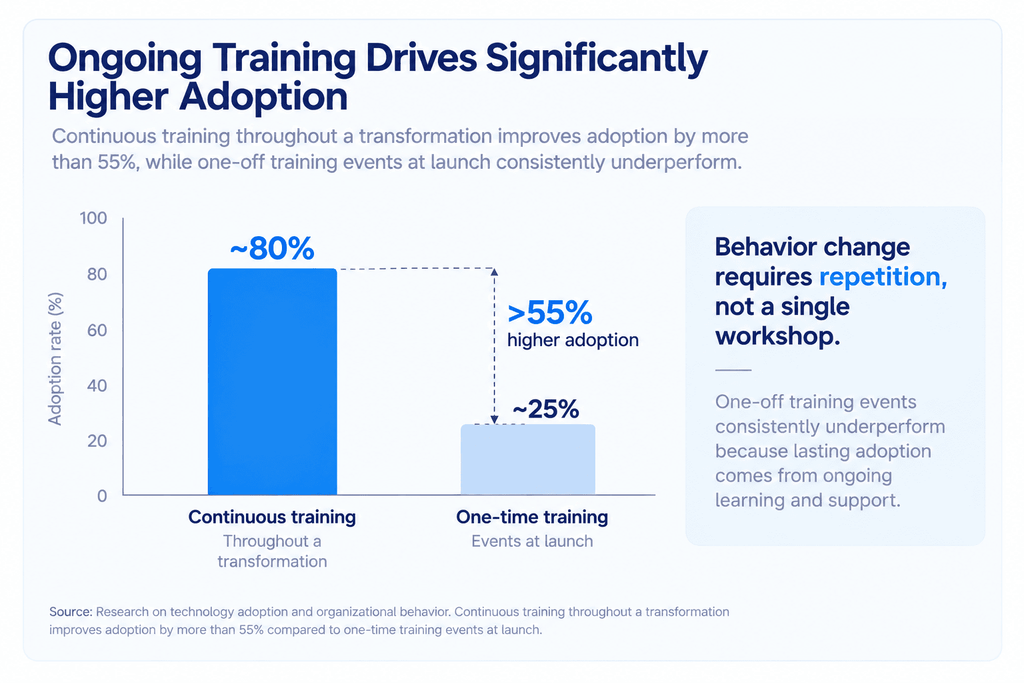
- The distinction matters more than it might seem: research on technology adoption shows continuous training throughout a transformation improves adoption by more than 55%, while one-off training events at launch consistently underperform, since behavior change requires repetition, not a single workshop.
- And they treat change management as part of implementation, budgeting time for communication, training, leadership engagement, and organizational adjustment instead of assuming adoption will happen naturally.
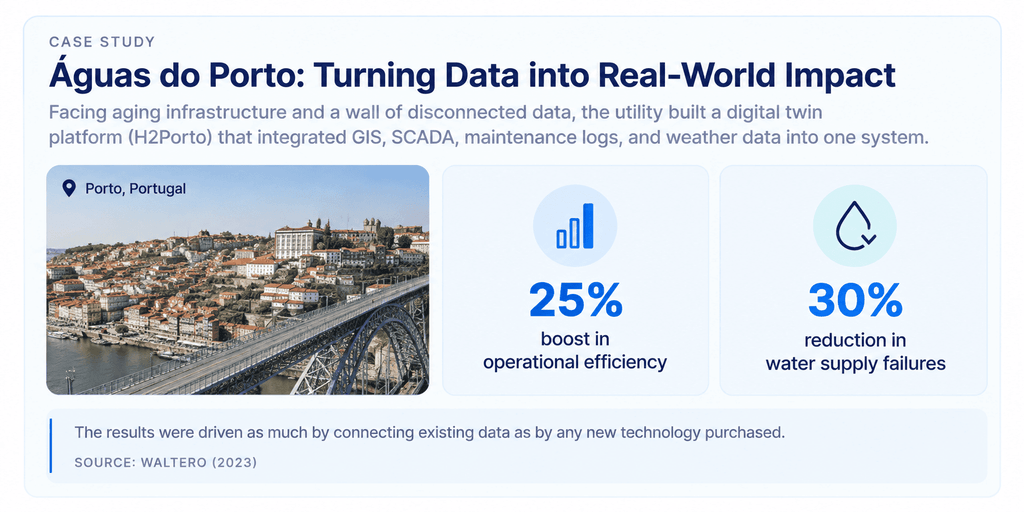
Águas do Porto, the water utility serving Porto, Portugal, offers a real example of what this looks like in practice. Facing aging infrastructure and a wall of disconnected data, the utility built a digital twin platform H2Porto that integrated GIS, SCADA, maintenance logs, and weather data into one system. The result: a 25% boost in operational efficiency and a 30% reduction in water supply failures, driven as much by connecting existing data as by any new technology purchased.
In each case, technology is only one component of the transformation. Equal attention is given to preparing the organization that will ultimately rely on it.
The Real Transformation
The water sector faces mounting challenges: aging infrastructure, increasing regulatory requirements, growing cybersecurity concerns, tighter budgets, and an experienced workforce approaching retirement. Digital technologies offer powerful tools to address these pressures, but only when organizations are prepared to use them effectively.
The greatest misconception surrounding digital transformation is that success depends on choosing the right platform.
In reality, utilities rarely fail because they purchased the wrong software. They fail because they underestimate everything required to make that software valuable.
Clean data, cross-functional collaboration, leadership commitment, training, shared incentives. These are not secondary implementation tasks. They are the transformation itself.
Technology can accelerate better decisions, but it cannot create the organizational culture needed to make those decisions.
The utilities that will lead the next decade of digital transformation will not be those investing only in the most advanced platforms. They will be the ones investing just as deliberately in their people, their processes, and the way their organizations work.
Because software doesn’t transform utilities. People do.