
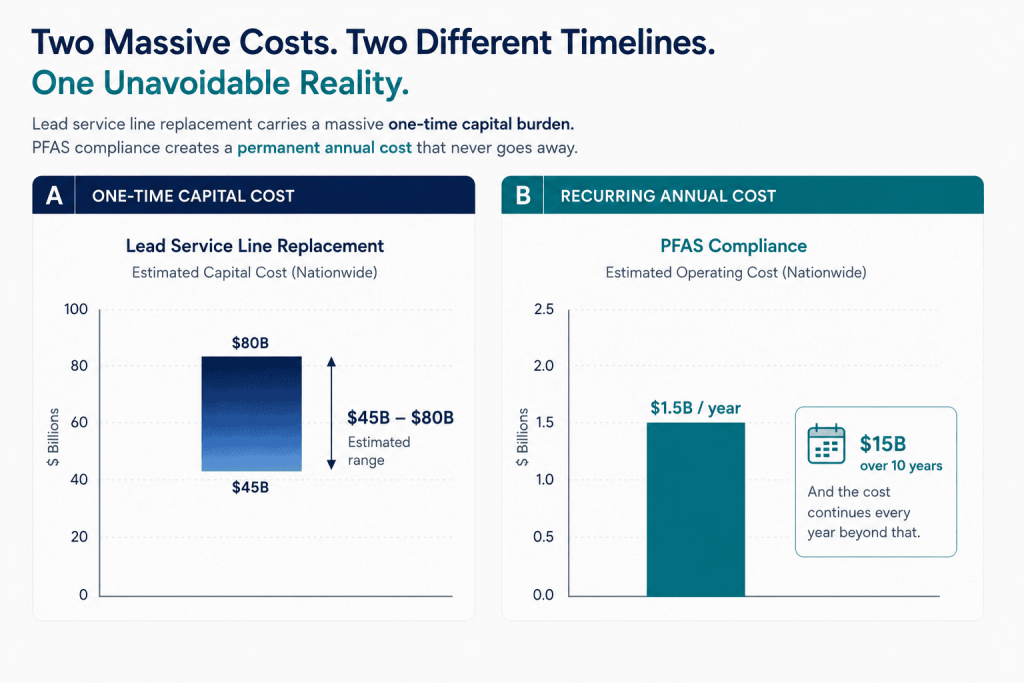
For years, selling into water utilities followed a familiar playbook. A utility identified a technical problem, issued an RFP, evaluated solutions, and selected the best fit based on performance, cost, and regulatory requirements. That playbook is starting to break down, because utilities are now facing two of the largest regulatory mandates in modern water infrastructure history at the same time: PFAS compliance and lead service line replacement. Lead service line replacement alone carries an estimated $45–$80 billion capital price tag nationwide. On top of that, PFAS compliance adds an estimated $1.5 billion in new operating costs every year, indefinitely.
Many vendors are approaching this moment as a straightforward equipment opportunity, an unprecedented wave of purchasing for filtration systems, detection technology, and pipe replacement. But the vendors who capture the largest share of this spending won’t necessarily have the best filtration media, the smartest analytics platform, or the most advanced replacement technology. They’ll be the ones who understand something the rest of the market is still catching up to, Utilities don’t just want products anymore. They want solutions that actually get implemented.
Why This Compliance Cycle Is Different
The EPA’s landmark PFAS regulation has established enforceable drinking water limits for 6 PFAS compounds, including a 4 ppt standard for PFOA and PFOS and the rule is forcing utilities nationwide to evaluate treatment, monitoring, reporting, and long-term compliance strategies.
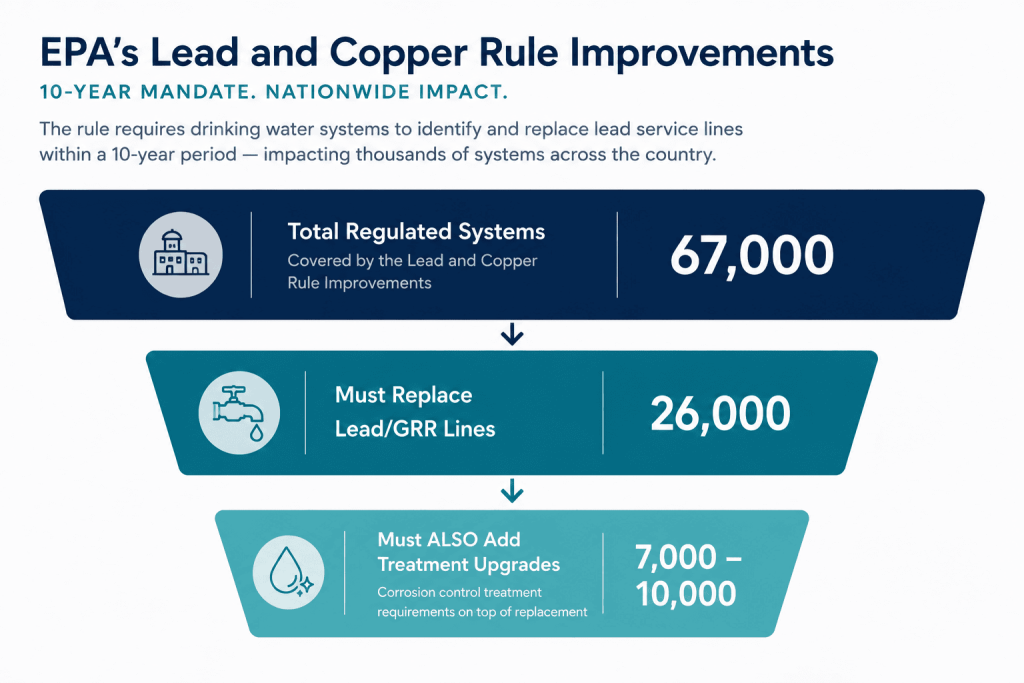
At the same time, EPA’s Lead and Copper Rule Improvements require drinking water systems nationwide to identify and replace lead service lines within a 10-year period — a mandate covering 67,000 water systems, of which roughly 26,000 must physically replace service lines, and another 7,000-10,000 systems face added corrosion control treatment requirements on top of that.
Either regulation on its own would have reshaped utility spending for years to come. Together, they’re creating something utilities rarely experience, overlapping compliance programs competing for the same budgets, personnel, contractors, engineering resources, and executive attention.
Federal funding covers only a portion of the total: the $15 billion in Bipartisan Infrastructure Law (BIL) money dedicated to lead line replacement, plus $11.7 billion in general Drinking Water State Revolving Fund support, still leaves a gap of roughly $18-$53 billion against the total estimated $45-$80 billion cost.
For vendors, this changes the competitive landscape completely. It’s no longer just about whether your technology can solve the problem. It’s about whether you can guide a utility through the entire compliance journey.
The Mistake Most Vendors Are Making
Many vendors continue to position themselves around technology capabilities. PFAS vendors lead with adsorption efficiency. Lead replacement vendors lead with detection accuracy. Software vendors lead with dashboards. Engineering firms lead with technical expertise.
But utilities aren’t struggling because they don’t know the problem exists. They’re struggling because meeting compliance requirements has become a complex operational challenge at scale.
Consider lead service line replacement. The technical task itself is straightforward, identify lead pipes and replace them. The real challenge is everything surrounding that replacement. Utilities must verify incomplete records, coordinate with homeowners, secure access permissions, manage contractors, navigate permitting requirements, communicate with communities, track funding eligibility, and report progress to regulators. The pipe replacement itself is only one piece of a much larger execution problem.
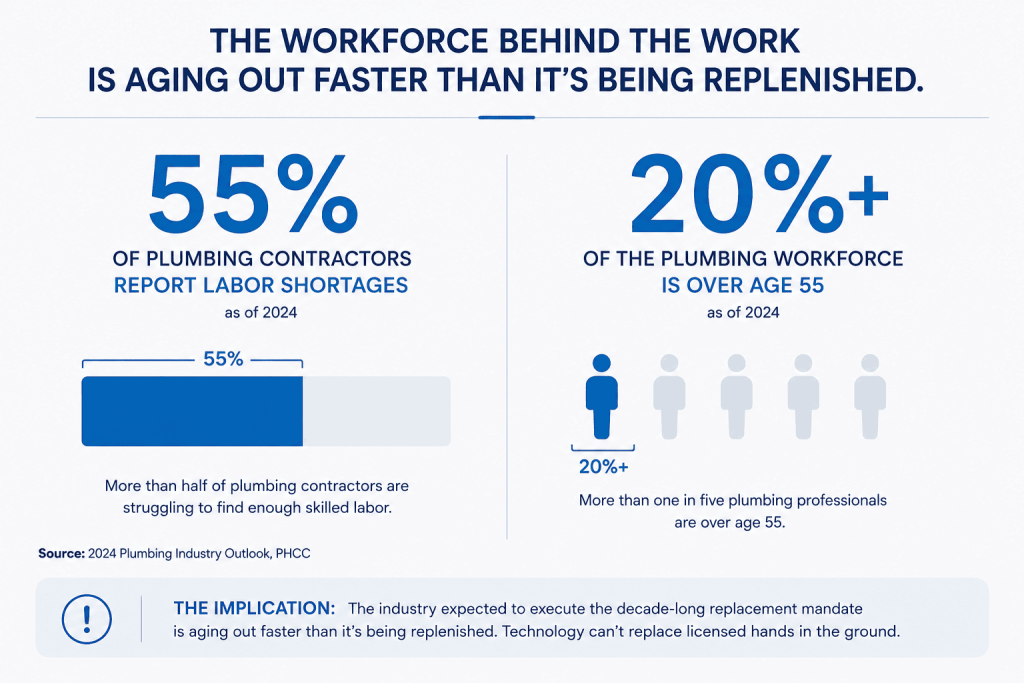
The bottleneck starts before a single pipe is dug up. As of 2024, 55% of plumbing contractors report ongoing labor shortages, and more than 20% of the current plumbing workforce is over age 55 — meaning the industry expected to execute this decade-long replacement mandate is aging out faster than it’s being replenished. Technology doesn’t solve a shortage of licensed hands in the ground.
The same pattern is emerging with PFAS. Most discussions still focus on treatment technologies, but utilities are increasingly wrestling with a different set of questions: how to build a defensible compliance strategy, what long-term operating costs will look like, how often treatment media will need replacement, how PFAS-contaminated residuals should be managed, how reporting obligations will expand over time, and how to justify the resulting rate increases to customers.
Technology is only one piece of the equation. Execution risk is becoming the deciding factor.
Where The Real Opportunity Exists
The biggest opportunities over the next decade may not sit where many vendors expect.
Tier 1: Compliance Execution Platforms
The highest-value opportunities are increasingly emerging around execution rather than equipment. Utilities need systems that help manage inventory programs, compliance workflows, contractor coordination, customer communication, documentation, funding applications, and regulatory reporting. The organizations that can reduce administrative burden and implementation complexity will occupy a strategic position across both PFAS and lead programs. Unlike treatment hardware, these solutions often become deeply embedded in utility operations, creating long-term relationships rather than one-time transactions.
Tier 2: Program Management and Consulting
Many utilities are still in planning mode, conducting inventories, evaluating treatment alternatives, assessing funding pathways, and building implementation roadmaps. This is creating significant demand for compliance strategy development, pilot program design, alternatives analysis, funding advisory services, public communication planning, and procurement support. In many cases, the consultant who helps with the roadmap influences decisions long before equipment procurement even begins, and that positioning advantage is often worth more than competing on specifications later.
Tier 3: Specialized Technology Providers
Technology remains critical, but as more vendors converge on similar performance benchmarks, technical specifications alone are becoming a less reliable way to win. Treatment systems, analytics tools, monitoring platforms, and replacement technologies remain essential components of compliance programs, but vendors that continue selling standalone products risk becoming interchangeable. The market is increasingly rewarding providers who package technology alongside implementation expertise, operational support, and measurable outcomes.
The Hidden Buying Dynamic Most Vendors Miss
One of the biggest misconceptions in the market is that utilities make purchasing decisions solely based on technical evaluation. In reality, regulatory pressure changes procurement behavior. As compliance deadlines approach, utilities become increasingly focused on reducing risk, and that shifts buying criteria.
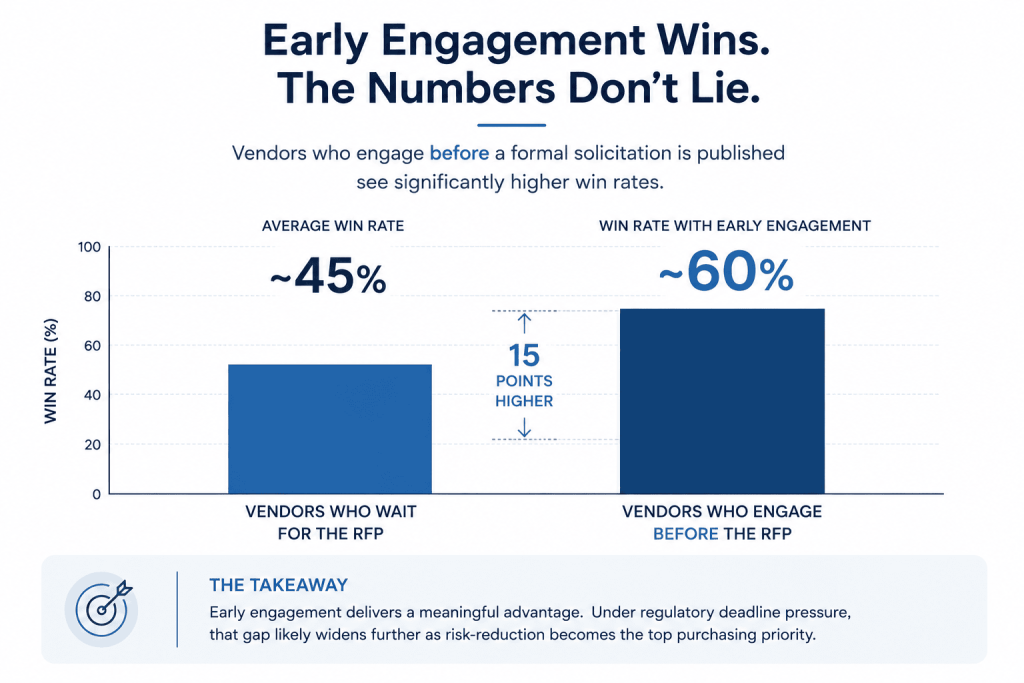
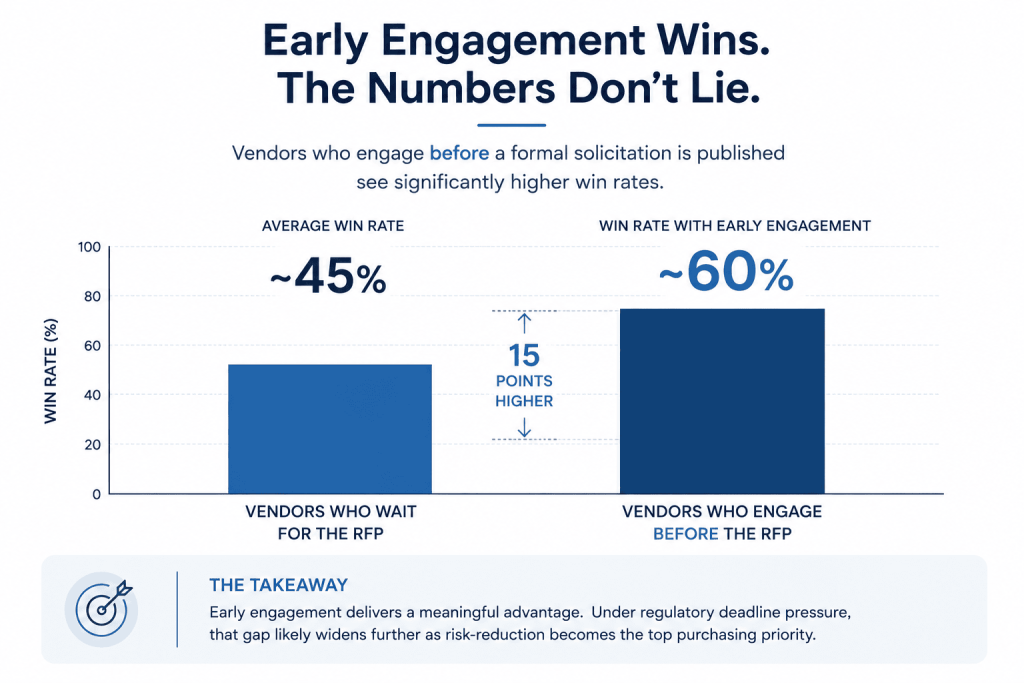
This shows up in the numbers elsewhere in public-sector procurement: vendors who engage before a formal solicitation is published see win rates closer to 60%, compared to an average around 45% for those who wait for the RFP. Under regulatory deadline pressure, that gap likely widens further, since risk-reduction becomes the dominant purchasing criterion utilities are optimizing for.
A vendor that can demonstrate how it reduces schedule delays, simplifies regulatory reporting, improves funding eligibility, or minimizes community resistance often becomes more attractive than a vendor offering marginally better technical performance.
This is particularly true for lead service line replacement, where communication, stakeholder engagement, and program management are becoming genuine competitive differentiators. That isn’t traditionally how water infrastructure markets have operated, but it’s increasingly how deals are being won.
What Vendors Should Do Next
If your growth strategy depends on PFAS or lead service line replacement spending, the opportunity itself isn’t really in question anymore. The more important question is whether your positioning reflects how utilities actually buy during periods of regulatory pressure.
Ask yourself: are you selling a product, or solving a compliance challenge? Are you entering the conversation before procurement begins? Can you help utilities secure funding, reduce implementation risk, and support long-term operations after deployment? Are you helping utilities manage stakeholders, not just infrastructure?
The vendors that can answer yes to those questions will be competing in a different market than the ones who can’t. The next decade of water infrastructure spending won’t be won by the companies with the best technology alone. It will be won by the companies that make compliance easier.
If you found this article valuable, you might also enjoy “24-Month Sales Cycles and $1,850 Per Lead: The High Cost of Selling to Water Utilities And Why Intelligence Changes the Economics”, where we take a deeper look at another challenge shaping the future of water utilities and what it means for vendors.