
The Data Disconnect: Why 70% of Water Utility Sales Efforts Miss the Mark
Something I’ve observed multiple times, while working on growth, strategy and market entry in the water sector, is that a strong product can lose to a weaker one simply because the vendor showed up too late. They had strong specs going on for them and a decent price backing their work up but none of it mattered because the opportunity was long gone.
The water utility market represents a $99.9 billion annual opportunity for equipment manufacturers, engineering firms, and service providers. And yet approximately 70% of sales efforts in this sector fail to produce results. After years of working with both vendors and utilities, I can tell you the failure almost never comes down to product quality. It comes down to a fundamental misread of how utilities actually make decisions, and a critical gap in the information vendors bring to the table.
The Traditional Approach Isn’t Working
Most vendors follow a predictable pattern: wait for a formal RFP to appear, respond with a proposal built around technical specifications, and hope the pricing lands the deal.
When outreach happens at all, it tends to follow the route of mass emails being sent to generic contact lists that rarely address what a specific utility is actually dealing with and waiting for things to get into place. Relationships, where they exist, are usually concentrated within one department, and the orientation stays resolutely short-term, focused on closing this deal rather than understanding the utility’s long-term infrastructure planning.
The results are predictable: prolonged sales cycles, high customer acquisition costs, unpredictable revenue streams, and a significant volume of effort that goes nowhere. For utilities, the consequences are usually suboptimal solutions, unnecessarily expensive procurement processes, and delays in addressing infrastructure that genuinely needs attention.
Five Disconnects Driving the Problem
After working across dozens of projects touching utilities and the vendors trying to reach them, there are five structural gaps that keep coming up.
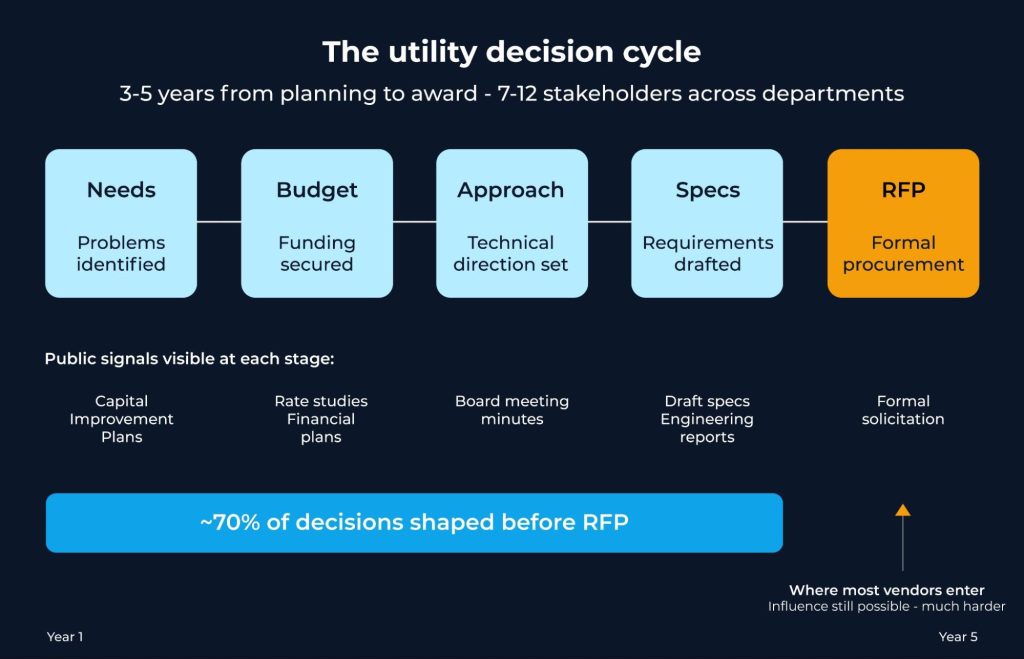
- The timing disconnect is likely the most consequential. By the time an RFP is published, approximately 70% of the key decisions have already been made with needs defined and prioritized, budgets established, technical approaches selected, specifications drafted in ways that often favor familiar solutions. Major capital projects at utilities typically follow a 3-5 year planning cycle way before any formal procurement appears. The vendors who engage only at the RFP stage are entering into an essentially finished conversation.
- The information asymmetry compounds the problem. Utilities are far from opaque institutions. They provide substantial public information about their plans and priorities:
- Capital Improvement Plans detail projects 5-10 years out.
- Board meeting minutes document infrastructure discussions in real time.
- Rate studies and financial plans indicate where funding is available and exactly when.
- Maintenance records reveal equipment performance issues and what’s likely to fail next.
Without tracking this material, vendors are working from assumptions about timing, budget, and priorities that are frequently inaccurate, leading to misaligned proposals and wasted effort on both sides.
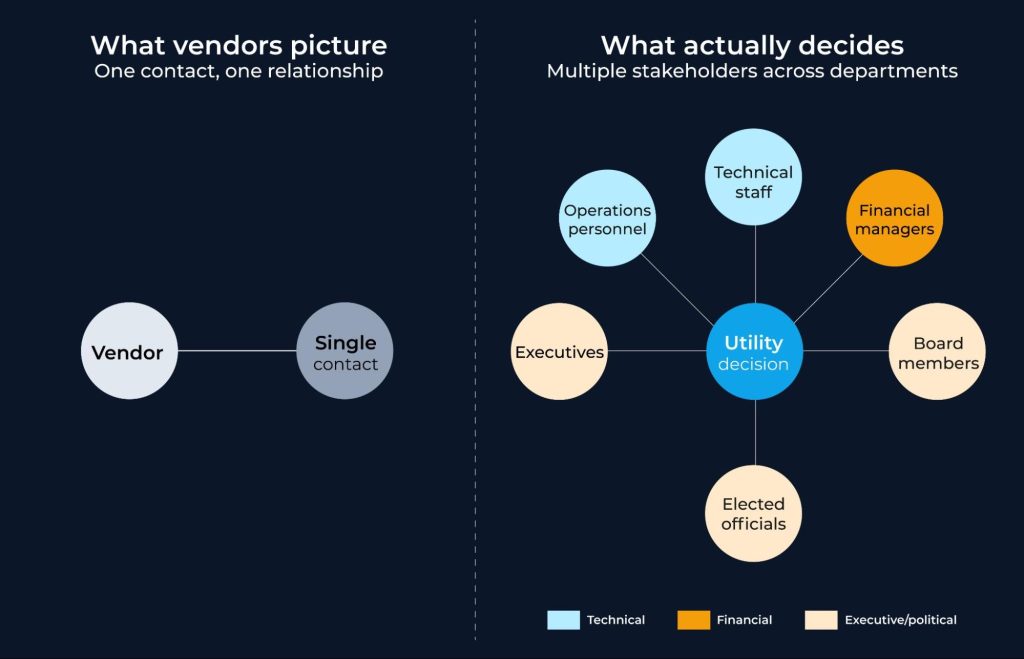
- The decision-maker misconception paves the way for another layer of underperformance. The belief that a single contact controls purchasing produces oversimplifies approaches to a great extent. In practice, water utility decisions typically involve 7-12 stakeholders across multiple departments, from technical staff, financial managers, operations personnel, to executives; all playing different but consequential roles. In public utilities, elected officials and board members add another layer of complexity. Vendors who build one relationship and treat it as sufficient miss the full network of influencers and approvers shaping what actually gets purchased.
- The value proposition mismatch is visible in almost every standard proposal. Vendors emphasise technical capabilities and cutting-edge features; utilities prioritise reliability, compatibility with existing systems, long-term vendor support, regulatory compliance, public perception, and financial sustainability. Engineering firms focus on design specifications while utility managers are thinking about rate impacts and community outcomes. These are not the same concerns, and a proposal that doesn’t address the full spectrum of them while being tailored to the different stakeholders involved, tends to land very poorly.
- The funding knowledge gap might be the most overlooked of the five. Water projects are typically financed through complex combinations of rates, bonds, loans, and grants. The State Revolving Fund alone finances billions of dollars worth of water infrastructure every year, with its own eligibility rules and timetable. Similarly, the WIFIA program and Rural Development have theirs. Grant programmes often dictate technology choices outright. Vendors who cannot engage credibly on these mechanics struggle to position their solutions within the budgetary realities utilities are actually navigating, and it shows.