
Small utility directors are frequently spoken about in the water sector. It is often that they all say the same thing: “we’re struggling to keep the lights on and somehow it is impossible to locate a cause!”
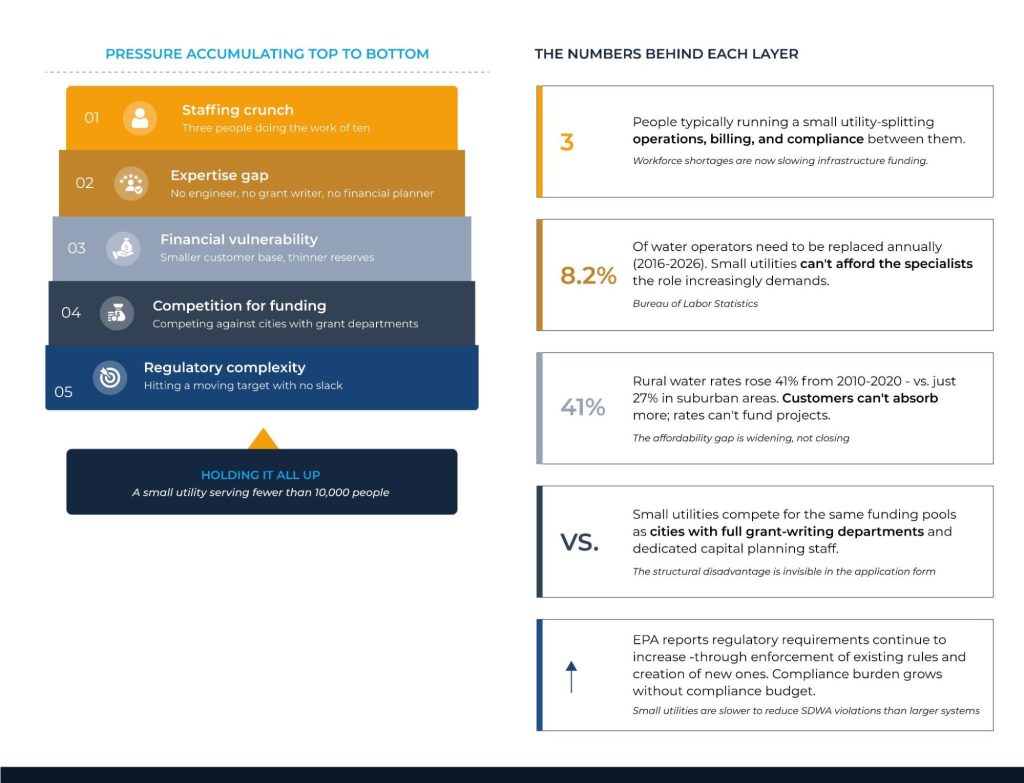
More than 80% of water systems in America serve towns consisting of less than 10,000 people. These utilities exist in an unusual space where the infrastructure is critical but the resources to maintain it are negligible. A lot of them operate with roughly three people where one of them handles operations, another does billing and another one who manages regulatory compliance and projects.
Then there’s the infrastructure itself which has pipes from decades ago, treatment equipment that is in dire need of getting replaced, compliance requirements that keep on changing while the company struggles to keep up. The most concerning bit of this intimidating web is how there is almost no budget to address any of this.
Utilities are prone to defer major projects for years because they were unable to figure out how to fund them. These projects were of great importance but the funding landscape emerged to be the greatest hurdle filled with overwhelming confusion that most staff lack the time to navigate.
What They’re Actually Up Against
Let’s be specific about what makes this so very difficult to combat.
Staffing needs to be addressed at the very beginning. Several utilities operate with skeleton crews, where someone is inevitably juggling operations, maintenance, and customer service while also being abruptly tasked with researching funding programs and writing grant applications. A 2023 study revealed that due to workforce shortages, small systems find it more difficult to get funding for their infrastructure projects.
Then there exists an expertise gap.
Nobody at the utility is an engineer, nobody knows how to write a compelling grant application and nobody understands financial planning at the level these programs require. These issues are set to leave their mark unless dealt with strategically and effectively.
The Bureau of Labor Statistics estimates that 8.2% of water operators need to be replaced annually between 2016 and 2026, but small utilities are not in the position to and neither can they afford to hire specialists.
Their finances are also quite vulnerable. With fewer customers and smaller reserves, many smaller utilities find it difficult to appear financially stable in the eyes of the financiers and donors. Water prices rose by 41% from 2010 to 2020 in rural settings while only rising 27% in suburban areas. Such rate hikes cannot be absorbed by the customers and thus, utilities cannot finance projects through rates while in dire need of grants.
Then there’s the competition problem. When applying for competitive funding, small utilities go up against proposals from major cities with entire departments dedicated to grant writing. An analysis of Safe Drinking Water Act violations found small water systems have been slower to reduce violations than larger systems and their massive lack of resources is to be blamed for it.
Regulatory complexity makes everything worse. Keeping up with new rules while managing daily operations is impossible with minimal staff. The EPA reports that regulatory requirements continue to increase through both enforcement of existing rules and creation of new ones. Small utilities are trying to hit a moving target with inadequate resources.
The Programs That Actually Exist
Small utilities don’t realize that the money does exist and it is quite abundant.

USDA Rural Development Water and Environmental Programs specifically target rural communities under 10,000 people. They offer combinations of loans and grants with terms as favorable as 75% grant funding for economically disadvantaged communities. It is the only federal program exclusively focused on rural water and wastewater infrastructure needs of communities with populations of 10,000 or less. In 2024, Congress gave USDA $4 billion last year and $1.9 billion this year specifically for rural water infrastructure.
The Small and Disadvantaged Communities Program was established under the Water Infrastructure Improvements for the Nation Act and expanded through the Infrastructure Investment and Jobs Act. It provides grants to help underserved communities meet Safe Drinking Water Act requirements. The IIJA invested more than $30 billion for drinking water capital improvements, including funds specifically for small and disadvantaged communities.
State Revolving Fund Small System Set-Asides exist in most states. They allocate a percentage of SRF funding specifically for small systems. The Infrastructure Investment and Jobs Act provides $11.7 billion through the Clean Water State Revolving Fund, with 49% available as grants or principal forgiveness. That means communities that couldn’t access traditional loans now have a pathway.
Technical Assistance Grants come through programs like EPA’s Training and Technical Assistance for Small Systems. These help small utilities build capacity and address technical challenges. The EPA’s capacity development program helps small system owners and operators, state and tribal agencies, and communities improve finances, management, infrastructure, and operations.
Emergency Community Water Assistance Grants help prevent damage or restore households’ and businesses’ access to clean drinking water in eligible rural areas and towns following natural disasters.
This Is What Actually Works
The utilities that successfully secure funding follow consistent patterns.
- Develop a capital improvement plan: A basic one documenting infrastructure needs, priorities, and estimated costs, significantly strengthens applications. It demonstrates planning capacity to funders and the asset management plans help improve decision-making. Many states require utilities to implement them as a condition of receiving public funds.
- Partner with neighboring utilities: Working with other smaller systems allows for benefits like economies of scale and sharing of expenses for expertise, which improves competitiveness. Furthermore, regional approaches might also align with the preferences of the financing entity. Working with other local water facilities, both formally and informally, improves the ability to manage infrastructure and affordability challenges.
- Use technical assistance providers: The Rural Community Assistance Partnership, National Rural Water Association, and state rural water associations provide free or inexpensive help for applications and technical specifications. The NRWA has compiled more than 100 non-federal activities that facilities could undertake without any cost via their state associations.
- Focus on compliance and public health: Projects that resolve regulatory violations or public health concerns receive higher priority for financial support. As of 2023, ten states bordering the Mississippi River have experienced an increase in violations from small water facilities. There is a need to adequately link these factors for robust applications.
- Affordability criteria: Almost all these programs have better criteria compared to Average Residential Rate based on Median Household Income and percent of use per customer relative to MHI. Smaller, marginalized communities tend to experience higher water charges since they have a smaller pool of ratepayers. It is critical to understand how your community measures up in such cases.
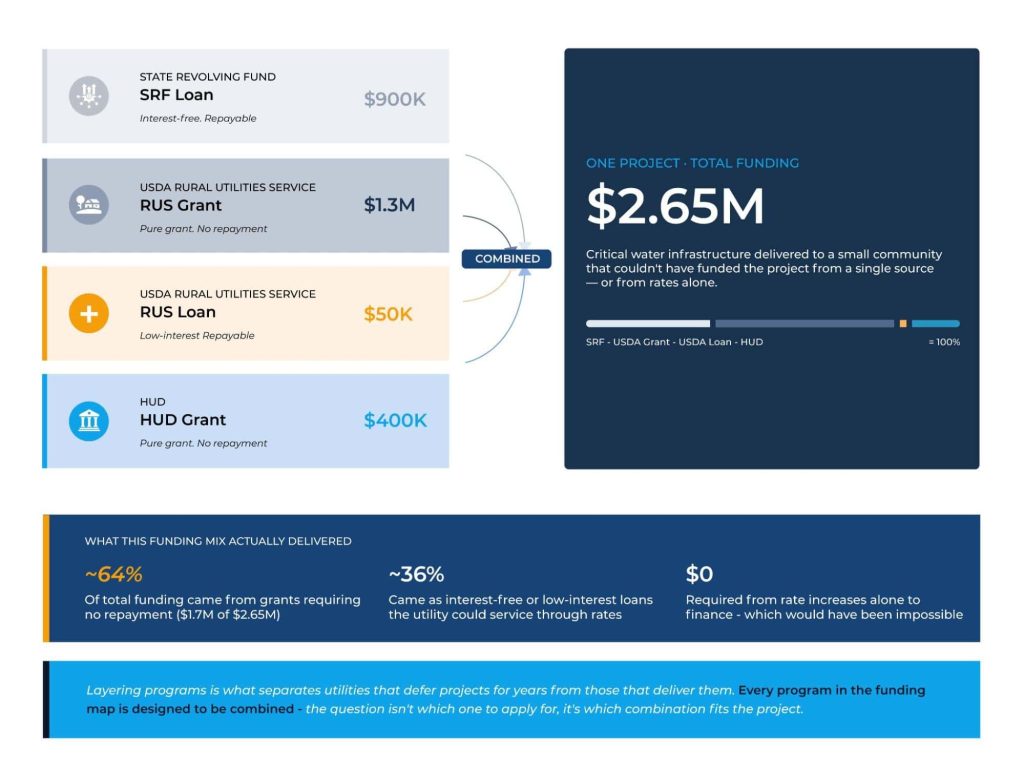
- Combine funding sources: Layering multiple programs can maximize grant components and reduce local cost burden. One example: a city qualified for a $900,000 SRF interest-free loan, received $1.3 million in grants and $50,000 in loans from federal Rural Utilities Service, plus $400,000 from HUD. That’s $2.65 million from four different sources for one project.