
PFAS and Lead service lines dominate the headlines, but there are 3 other regulatory trends reshaping how utilities operate, and they’re converging in ways that create significant challenges and opportunities for vendors who understand what’s actually happening. They carry great significance but are quite difficult to see clearly. Utilities are still figuring out how to implement them while regulators are still defining the requirements.
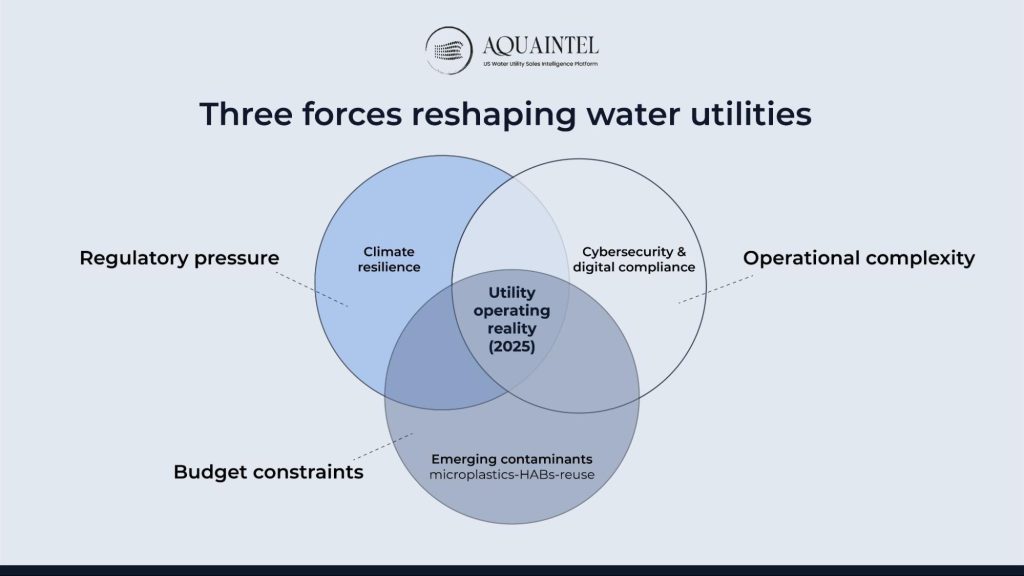
That ambiguity opens a window for the vendors who can provide clarity.
Climate Resilience: From Initiative to Requirement
Five years ago, climate resilience was something utilities pursued only if they had the budget and foresight. At present, it’s embedded in regulatory requirements and funding criteria in ways that make it pertinent.
- State Revolving Fund applications now require climate vulnerability assessments.
- FEMA’s Building Resilient Infrastructure and Communities grants heavily weight climate considerations.
- The EPA’s Creating Resilient Water Utilities initiative is establishing methodologies that are becoming de facto standards across the sector.
- Multiple states mandate climate resilience requirements for water system planning.
- America’s Water Infrastructure Act risk assessments increasingly emphasize climate factors.
The numbers tell the story: 17 states now mandate climate resilience assessments within water system master plans. This used to be 8 states in 2022. The trend is accelerating, and utilities that haven’t started thinking about climate resilience are already behind.
Utilities encounter numerous obstacles, the most urgent of which is how to convert worldwide climate models into localised operational impacts for their companies.
- Utilities also have no knowledge of how to measure the benefits of investments in resilience against the costs associated with those investments.
- They must find a way to meet their immediate compliance requirements while preparing for long-term projects or investments in the future.
Finally, how do utilities determine the best use of limited technical capacities and competing priorities contending for the same limited budgets?
The Water Research Foundation found critical gaps:
- 76% of utilities identified “quantifying resilience benefits” as their biggest challenge
- 68% cited difficulties in prioritising resilience investments against other regulatory requirements
In other words, utilities get that climate resilience matters but they lack the knowledge on how to prepare the business case for it.
What This Means for Vendors
The opportunity spans assessment, planning, infrastructure, and operations.
It involves assessment services like climate vulnerability evaluations, infrastructure criticality analysis, adaptation planning facilitation, resilience metrics development, economic impact modeling which are critical. Utilities need help translating climate risk into business language and showing how resilience investments pay off using planning technologies like:
- Scenario planning software platforms
- Climate-adjusted hydraulic modeling
- Predictive failure analysis
- Infrastructure prioritisation systems
- GIS-based vulnerability visualisation
The utilities are drowning in data and they need tools to make sense of it and make decisions. Resilient Infrastructure solutions represent the implementation phase.
Key components of resilient infrastructure include:
- Flood-resistant equipment designs
- Distributed treatment systems
- Energy-independent facilities
- Drought-resilient source development
- Heat-resistant infrastructure components
However, what truly fuels decision-making, is not resilience alone. Utilities are far more likely to approve investments that deliver multiple benefits such as improve operational efficiency or reduce energy consumption alongside resilience.
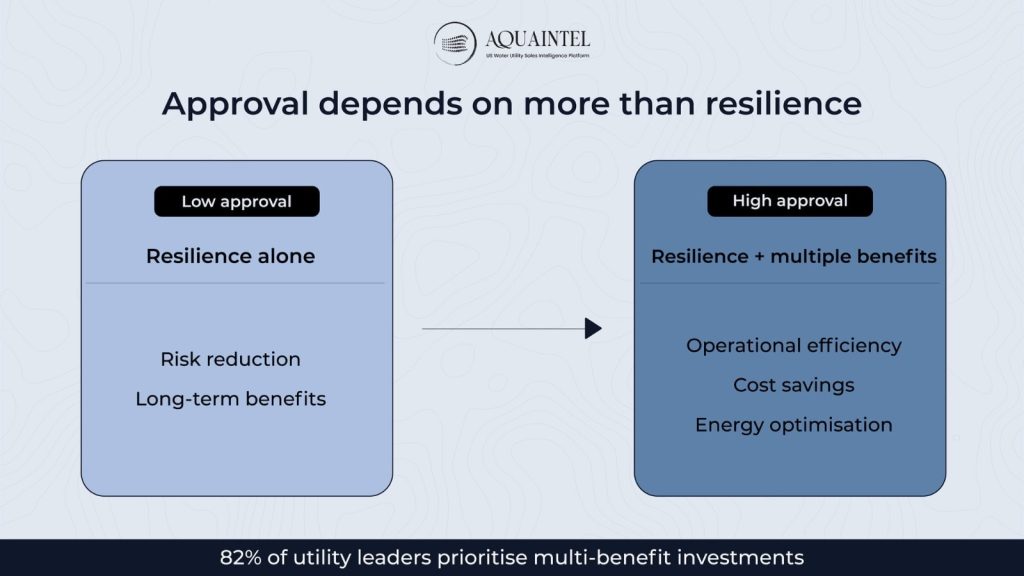
82% of utility leaders report they’re more likely to approve resilience investments demonstrating multiple benefits.
Operational resilience tools such as real-time monitoring networks, early warning systems, integrated emergency response platforms, remote operation capabilities, energy management optimisation, round out the ecosystem.
The vendors succeeding in climate resilience combine traditional engineering approaches with climate expertise, hence coming up with solutions that address both immediate operational needs and long-term resilience goals, all while remaining financially sound.
Digital Compliance and Cybersecurity: The Security-and-Reporting Challenge
Digital transformation of compliance processes has been gradual. But 2025 is the year it becomes mandatory for most utilities.
- America’s Water Infrastructure Act now requires cybersecurity assessments and emergency response plans.
- The EPA is phasing out paper reporting for NPDES and SDWA compliance.
- The Compliance Monitoring Data Portal is fully implemented.
- States require digital monitoring for critical parameters. The TSA and CISA have issued cybersecurity directives for critical infrastructure water systems.
The result: 88% of all compliance reporting for drinking water systems is expected to be conducted through digital channels by 2025, up from 54% in 2020.
The problem is real and immediate. Looking at the data:
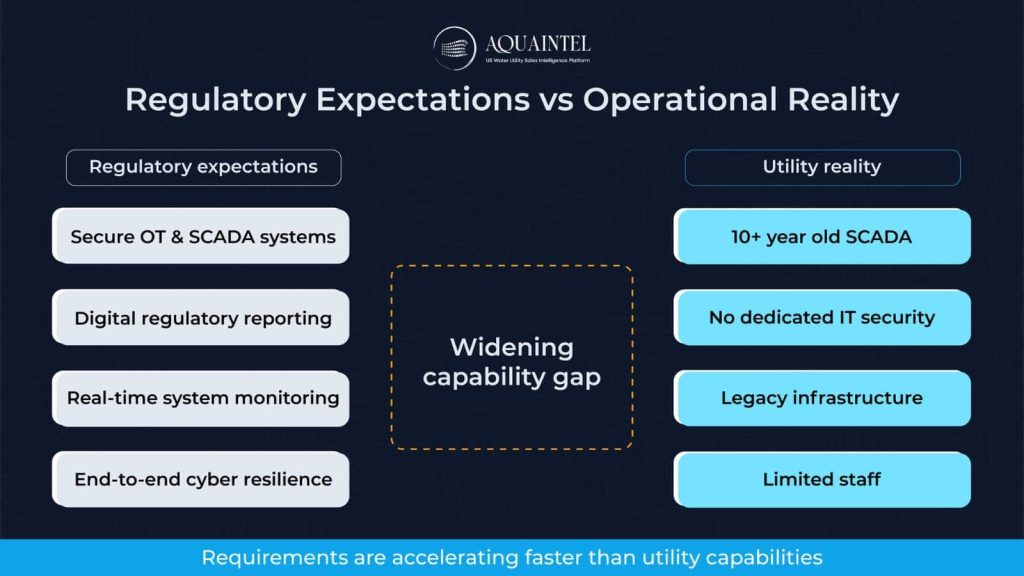
- 62% of water utilities operate SCADA systems that are at least 10 years old
- 47% lack dedicated IT security personnel
Utilities are being asked to secure systems they never designed to be secure, implement digital reporting they’ve never done before, and do it with staff they don’t have. It’s the worst possible timing.
When utilities need robust, secure and modern IT systems, they’re trying to extend the life of aging SCADA systems that were never built with security in mind. The gap between what regulators require versus what utilities can actually deliver is massive.
What This Means for Vendors
The opportunity requires understanding the fundamental gap between operational technology (OT) and information technology (IT). Most utilities have never had to bridge this gap. Vendors who understand it have a significant advantage.
Cybersecurity solutions are the starting point with:
- OT/SCADA security assessments
- Network segmentation implementation
- Threat monitoring platforms
- Security information and event management systems
- Incident response planning and simulation
Digital compliance platforms address the reporting side with:
- Automated data validation
- Regulatory reporting engines
- Compliance calendar management
- Electronic record systems
- Mobile data collection applications
Utilities need systems that translate operational data into compliance documentation automatically.
System integration services, meanwhile, bridge the gap between operational technology (OT) and information technology (IT). This includes:
- SCADA-to-compliance reporting connections
- Laboratory information management system integration
- Data historian implementation
- Cross-system data standardization
- API development for legacy systems
Training and support services complete the picture. Staff cybersecurity awareness programs, digital compliance standard operating procedures, remote monitoring and management, incident response support, virtual system administration. Utilities need partners who help them build capability, not just implement technology.
Utilities with integrated security and compliance solutions have experienced:
- 35% fewer security incidents
- 42% lower compliance reporting costs
compared to those managing these functions separately. The vendors who understand that cybersecurity and compliance aren’t separate problems but interconnected challenges requiring integrated solutions, will position themselves for significant growth.
The most valuable approaches for vendors are those scalable to smaller utility operations. Smaller utilities have even fewer resources and older systems, but they still need to comply with regulations. This is a particularly valuable but underserved segment.
Microplastics, Harmful Algal Blooms, and Water Reuse
Beyond the established regulatory programs, three emerging areas warrant close monitoring because regulatory action is coming faster than most vendors expect.
Microplastics regulation is coming. The EPA’s microplastics research and monitoring initiatives are advancing rapidly, with regulatory action likely within 2-3 years. The agency included the first standardised analytical procedure for microplastics in drinking water in its March 2024 Methods Update Rule. The vendors thinking ahead will have a significant advantage when formal regulation arrives.
Harmful algal blooms aren’t yet subject to comprehensive federal regulation, but they’re increasingly addressed through monitoring requirements, treatment technique specifications, and public notification standards. The EPA initiated a process to establish health advisories for five cyanotoxins commonly associated with HABs. Early detection systems, advanced oxidation processes, and specialized treatment technologies position vendors ahead of when utilities start needing these solutions operationally.
Water reuse is different. It is less about emergency compliance and more about long-term water supply strategy. The National Water Reuse Action Plan continues driving both regulatory streamlining and new standards. As of early 2025, twelve states have established comprehensive regulatory frameworks for potable reuse which is a great rise from the initial seven states in 2023.
Decentralised Treatment Technologies, fit-for-purpose treatment trains, and monitoring systems designed specifically for reuse applications show strong growth potential. In water-constrained regions, this is becoming a real operational need.
Strategic Positioning: The Integrated Approach
The water utility sector in 2025 is facing a fundamental transformation across multiple dimensions: treatment compliance, infrastructure replacement, operational resilience, digital security, and emerging contaminant management.
The pairing of utilities that navigate this successfully with vendors who recognise that utilities aren’t looking for point solutions but strategic partners who understand their resource constraints, their budget realities, and their need for solutions that address multiple requirements simultaneously, will thrive in the water sector.
Organisations seeking to capitalise on these regulatory-driven opportunities should:
- Develop regulatory intelligence functions.
- Establish systematic monitoring of federal and state regulatory developments.
- Build relationships with key regulatory agencies.
- Create mechanisms for translating regulatory trends into product development roadmaps. Provide customers with regulatory updates so they see you as a trusted source of information, not just a vendor.
- Focus on comprehensive solutions. Address both technical compliance and administrative requirements.
- Develop modular approaches allowing phased implementation.
- Combine products and services to create complete solutions.
- Consider partnerships to deliver integrated offerings that no single vendor can provide alone.
- Emphasise time and resource efficiency. Design solutions recognising utility resource constraints.
- Develop approaches minimising operational disruption.
- Create tools streamlining compliance documentation and reporting. Offer implementation and operational support services that help utilities succeed.
- Align with funding mechanisms. Design solutions meeting eligibility requirements for SRF, BIL, and other funding sources. Provide grant and loan application support.
- Create flexible implementation approaches matching funding timelines. Consider alternative financing and delivery models that make solutions more accessible.
This is the regulatory landscape utilities are actually navigating in 2025. It’s complex, overlapping and expensive, but for vendors who position strategically and understand that they’re not selling products but solving for utility constraints, it’s the biggest market opportunity the water sector has seen in a generation.

No comment