
State Revolving Funds are essentially the backbone of water infrastructure financing in America with over $229 billion in funding since inception. Smaller systems, in particular, find these programs quite difficult to navigate and it is high time that things change.
SRFs are state-run, federally-supported programs providing low-interest loans and, in some cases, principal forgiveness for water infrastructure projects. They offer two distinct programs:
- Clean Water State Revolving Fund (CWSRF): Wastewater treatment, stormwater management, nonpoint source pollution control, and related water quality projects
- Drinking Water State Revolving Fund (DWSRF): Drinking water infrastructure from source development through treatment and distribution
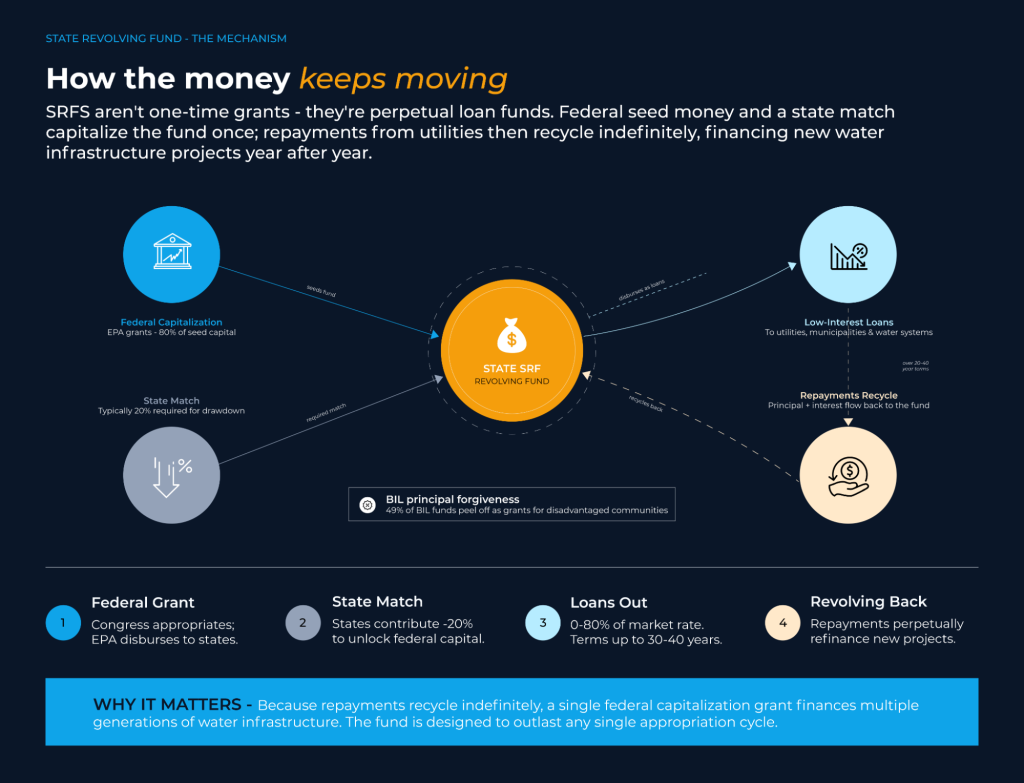
Each state runs its own SRF program using federal capitalisation grants combined with a state match which is typically 20% of the federal amount. Repaid loans cycle back into the fund, keeping the mechanism self-sustaining.
EPA Assistant Administrator for Water Bruno Pigott says:
“Water infrastructure is a critical part of our daily lives. It delivers clean, safe drinking water; it collects and treats wastewater and it helps to manage floodwater and drought impacts.”
The Bipartisan Infrastructure Law added $11.7 billion each to CWSRF and DWSRF over five years, from 2022 to 2026. Of that BIL allocation, 49% is structured as principal forgiveness or grants, with significant weight given to disadvantaged communities. In 2024 alone, the Biden-Harris Administration announced more than $11.5 billion through SRF programs.
State-level variation is wide and matters practically. Application timelines are different across states and utilities.
- Some states accept applications year-round
- Others have fixed submission windows, commonly tied to fiscal years
- Several operate on quarterly review cycles
Wisconsin’s Drinking Water SRF, the Safe Drinking Water Loan Program, uses a ranked allocation methodology prioritising projects with the greatest financial need. This allows for the utilities which can do without immediate assistance be responded to without keeping the ones in a dire situation on an unreasonable waitlist.
Interest rate structures vary too, where:
- Rates range from 0% to 80% of market rates
- Many states tier rates based on community size or economic status
- Some programs extend repayment terms to 30 or 40 years
Texas illustrates the range particularly well, its CWSRF program cuts rates 165 basis points below market for standard projects, with 0% loans for eligible small and rural disadvantaged communities. States also carry supplemental requirements that vary across asset management planning, fiscal sustainability, rate structure analysis, water conservation planning, and utility procurement intelligence climate resilience assessments.
Reviewing the current state SRF Intended Use Plan is the most direct way to understand what applies. It provides a crystal clear view into what awaits you before entering into an alliance, including Bipartisan Infrastructure Law (BIL) funding, which is essential for identifying available subsidies and eligibility. Most states have already published their 2026 IUPs which are widely accessible on their state agency websites, such as MassDEP, Indiana IFA, and Iowa SRF.

No comment