
State Revolving Funds (SRFs) are the backbone of water infrastructure financing in the United States, having provided more than $220 billion in funding since their inception — $181.4 billion through the Clean Water SRF and more than $41 billion through the Drinking Water SRF. Every year, utilities rely on these programs to upgrade treatment facilities, replace aging infrastructure, improve resilience, and maintain regulatory compliance.
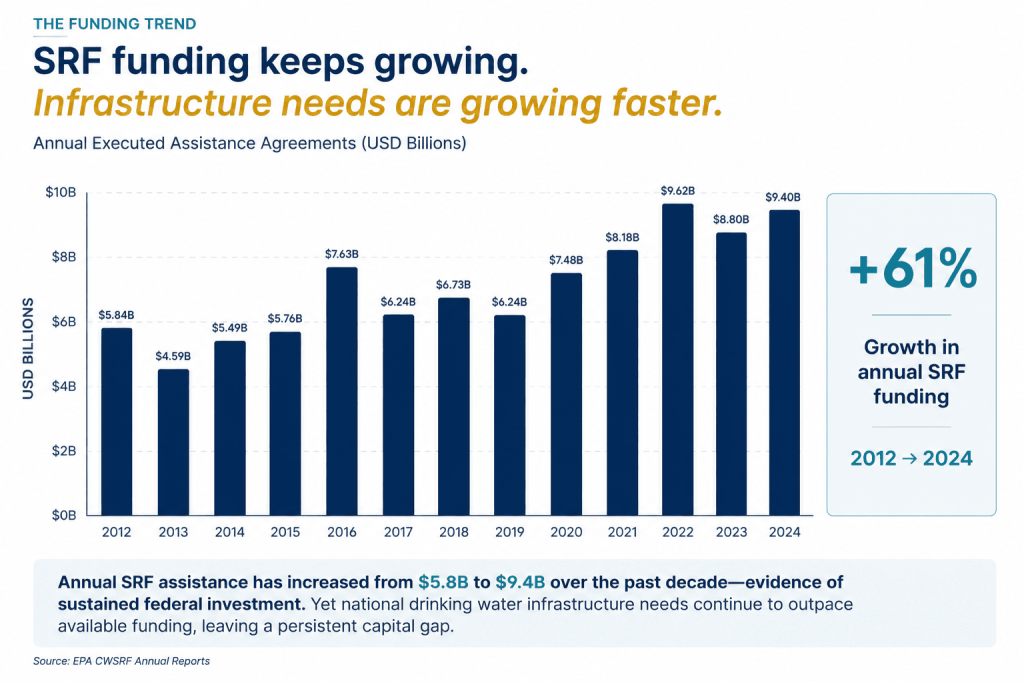
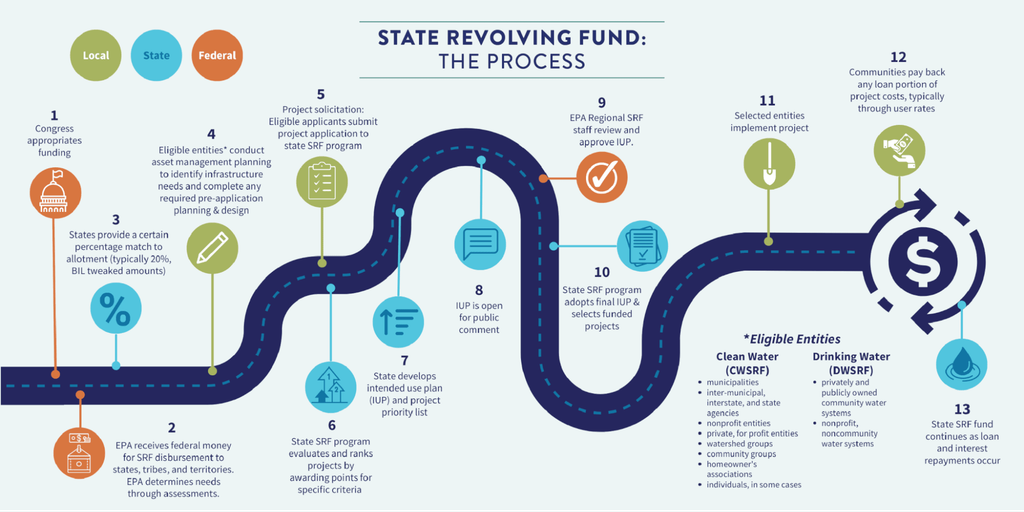
Yet despite the scale of available funding, many utilities, particularly smaller and resource-constrained systems struggle to access it. The SRF process generally follows five steps. Understanding where things slow down helps these utilities keep moving without delays.
1. Project Planning and Eligibility Assessment
Prior to the submission of any documents, utilities need to:
- Define project scope, objectives, and preliminary cost estimates with precision
- Establish eligibility based on the criteria set by the state
- For drinking water projects, ensure alignment with state priority ranking criteria
- For wastewater projects, verify consistency with water quality management plans
One of the most effective steps you can take is to reach out to your state’s SRF Program administrator well before submitting your funding application. Starting the conversation a few months in advance gives you valuable time to understand program priorities, strengthen your proposal, and position your project in line with EPA recommendations. Early communication can make the application process smoother and improve your project’s visibility during funding decisions.
2. Pre-Application and Project Ranking
In most states, a pre-application or letter of intent is required, which is then ranked on the Project Priority List or Intended Use Plan. Projects are ranked on:
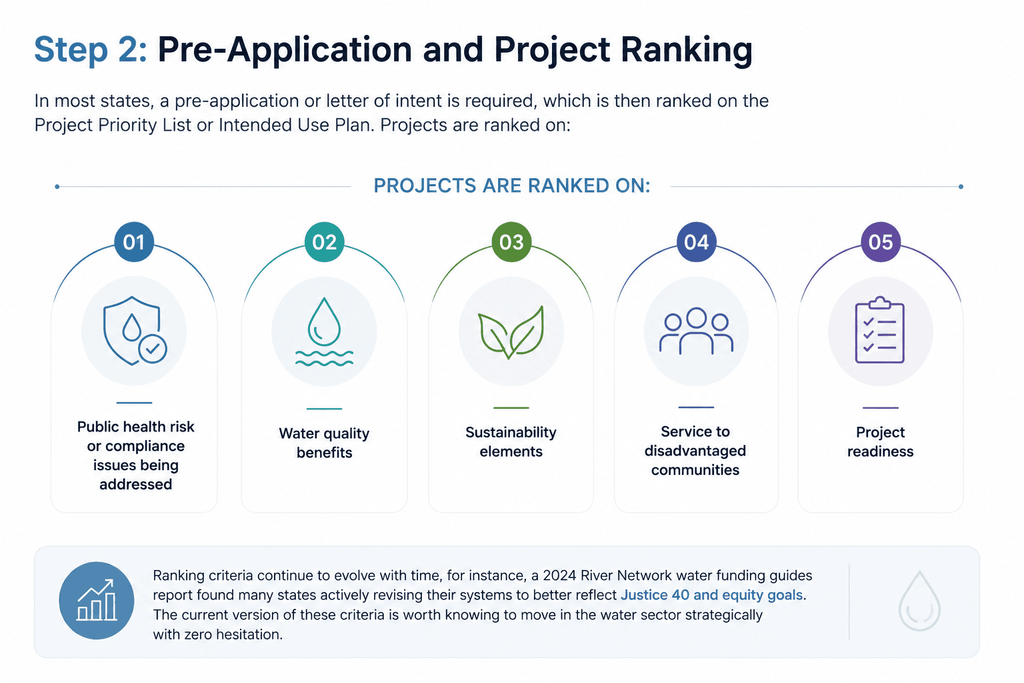
Ranking criteria continue to evolve. Under the federal Justice40 initiative, SRF programs are expected to direct 40% of overall benefits to disadvantaged communities, but a 2024 EPA Office of Inspector General audit found only 49% of states had actually incorporated climate adaptation or resilience criteria into their 2022 Intended Use Plans meaning the ranking landscape is still actively shifting state by state.
Ranking criteria continue to evolve. The Biden administration’s Justice40 initiative, in effect from 2021 until its revocation in January 2025, directed SRF programs to steer 40% of overall benefits toward disadvantaged communities — and a 2024 EPA Office of Inspector General audit found only 49% of states had incorporated climate adaptation or resilience criteria into their 2022 Intended Use Plans. With Justice40 no longer in effect, states retain broad discretion over how — or whether — equity and resilience factor into their current ranking criteria, meaning the ranking landscape continues to shift state by state.
3. Formal Application Submission
The formal application typically requires:
- Detailed project description and justification
- Engineering reports and preliminary designs
- Environmental review documentation
- Financial information demonstrating repayment capacity
- User rate analysis and projections
- Legal certifications and authorisations
- Local matching fund verification where applicable
Insufficient detail in engineering reports is among the most common reasons applications face delays. Project necessity, alternatives considered, and technical specifications all need thorough treatment.
4. Environmental Review
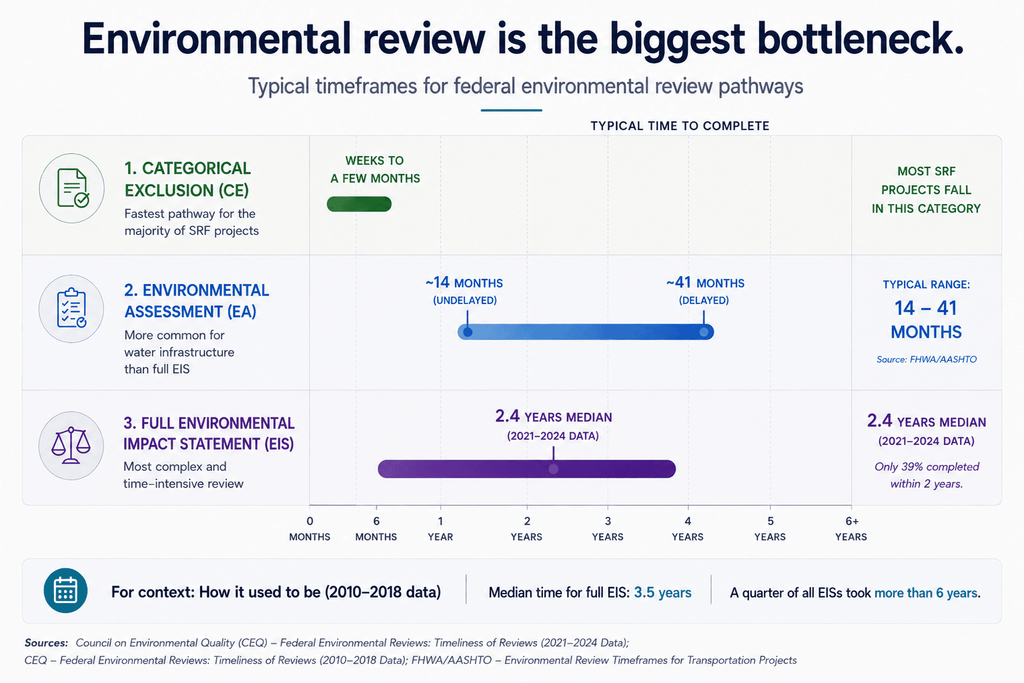
Environmental review is frequently the most significant bottleneck in the entire SRF process, and the data backs that up clearly. According to the Council on Environmental Quality’s tracking, a full Environmental Impact Statement took a median of 2.4 years to complete for EISs finalized between 2021 and 2024, with only 39% finishing within two years. Even a lighter-weight Environmental Assessment, the more common path for most SRF-funded water projects, typically takes about 14 months when nothing goes wrong, but can stretch to 41 months once complications arise. A Categorical Exclusion, by contrast, can often clear in a matter of weeks. The gap between these three paths is exactly why timing matters so much: a utility that assumes its project will qualify for a fast Categorical Exclusion, only to discover mid-application that a full EA or EIS is required, can lose years it didn’t budget for. Starting environmental review early isn’t just good practice, it’s a big lever a utility has over its own timeline.
5. Loan Execution and Project Implementation
Following approval, the process moves through loan agreement execution, final design approval, bid procurement under applicable state and federal requirements, construction, and ongoing reporting to the state SRF program.
Federal requirements that apply throughout:
- American Iron and Steel provisions
- Build America Buy America Act (BABA) requirements, effective for infrastructure projects since May 14, 2022: iron, steel, and construction materials must be entirely produced in the United States, and manufactured products must have more than 55% of their component cost sourced domestically. A narrow 5% de minimis exception exists for costs that can’t reasonably be met domestically, and small projects under $250,000 are exempt.
- Davis-Bacon prevailing wage requirements: Compels the contractors for all Federal contracts greater than $2,000 to pay the locally prevailing wage rates and benefits to the laborers and mechanics employed on the jobs.
- Disadvantaged Business Enterprise goals: The federal government sets targets for the involvement of DBEs (small firms run by socially and economically disadvantaged persons) in federally funded projects.
Where Most Projects Get Delayed
Although the SRF process appears linear on paper, project timelines rarely move from one step to the next without friction. The majority of delays occur long before loan execution, often during project preparation and review stages.
Environmental review is frequently the most significant bottleneck. Utilities that postpone environmental documentation until after submitting applications often discover that permitting requirements, public notices, or additional studies extend timelines by several months. In many cases, environmental review becomes the critical path that determines when funding can actually be accessed.
Engineering documentation is another common source of delay. Incomplete engineering reports, insufficient alternatives analysis, unclear cost estimates, or missing technical justification often trigger multiple rounds of revisions and requests for additional information. What appears to be a small documentation gap can significantly slow project approval.
Perhaps the most avoidable bottleneck is engaging with state SRF administrators too late. Utilities that begin discussions early often gain clarity on eligibility requirements, funding opportunities, and potential challenges before investing substantial time and resources into the formal application process.
Final Thoughts
The SRF approval process is often presented as a sequence of forms, reviews, and approvals. In reality, successful funding applications are rarely determined by paperwork alone.
The utilities that move through the process most efficiently are typically those that begin planning early, understand their state’s priorities, engage regulators proactively, and anticipate potential bottlenecks before they become obstacles. They recognize that environmental reviews, project ranking systems, engineering documentation, and funding cycles are not administrative details, they are the factors that ultimately shape project timelines.
As federal and state investment in water infrastructure continues to grow, competition for available funding will remain significant. Understanding the formal process is important, but understanding where delays occur is what allows utilities to plan effectively and secure funding when it matters most.
Because when it comes to SRF financing, success is rarely about completing the five steps. It is about navigating them before they slow you down.
If you found this article valuable, you might also enjoy “Five Common Reasons SRF Projects Fail to Secure Funding”, where we take a deeper look at another challenge faced by water utilities and shaping the future of the water utility market.