
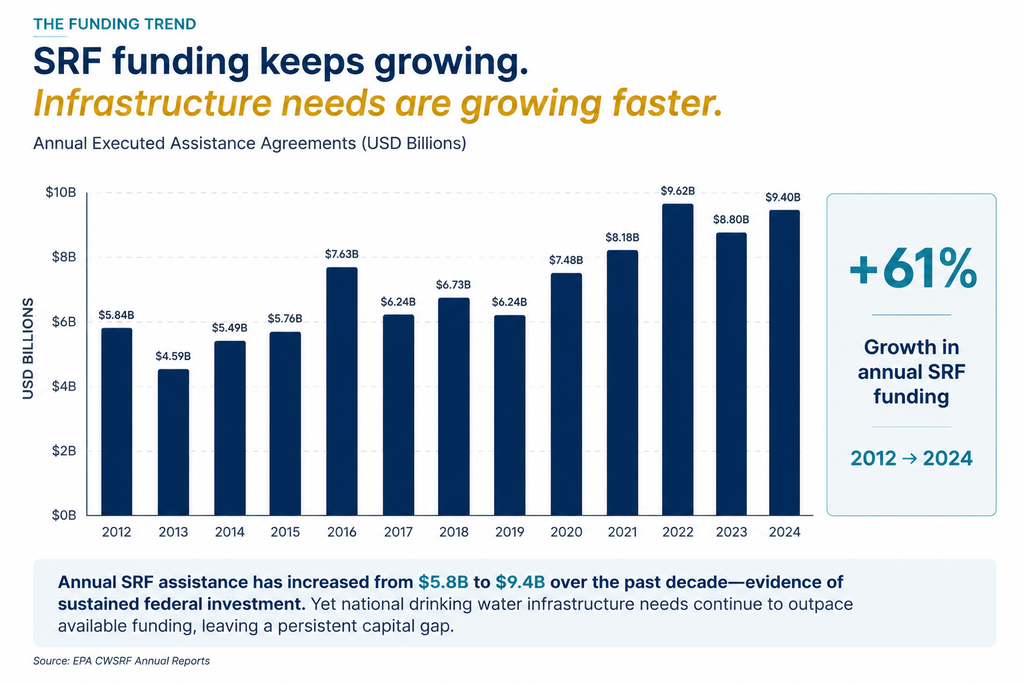
State Revolving Funds (SRFs) are the backbone of water infrastructure financing in the United States, having provided more than $220 billion in funding since their inception — $181.4 billion through the Clean Water SRF and more than $41 billion through the Drinking Water SRF. Every year, utilities rely on these programs to upgrade treatment facilities, replace aging infrastructure, improve resilience, and maintain regulatory compliance.
Yet despite the scale of available funding, many utilities, particularly smaller and resource-constrained systems struggle to access it.
While SRFs operate under a federal framework, every state administers its own program with unique timelines, priorities, eligibility requirements, funding structures, and compliance expectations. Understanding these differences is often the key factor that determines whether a project receives funding or remains stuck on the drawing board.
Understanding the Basics
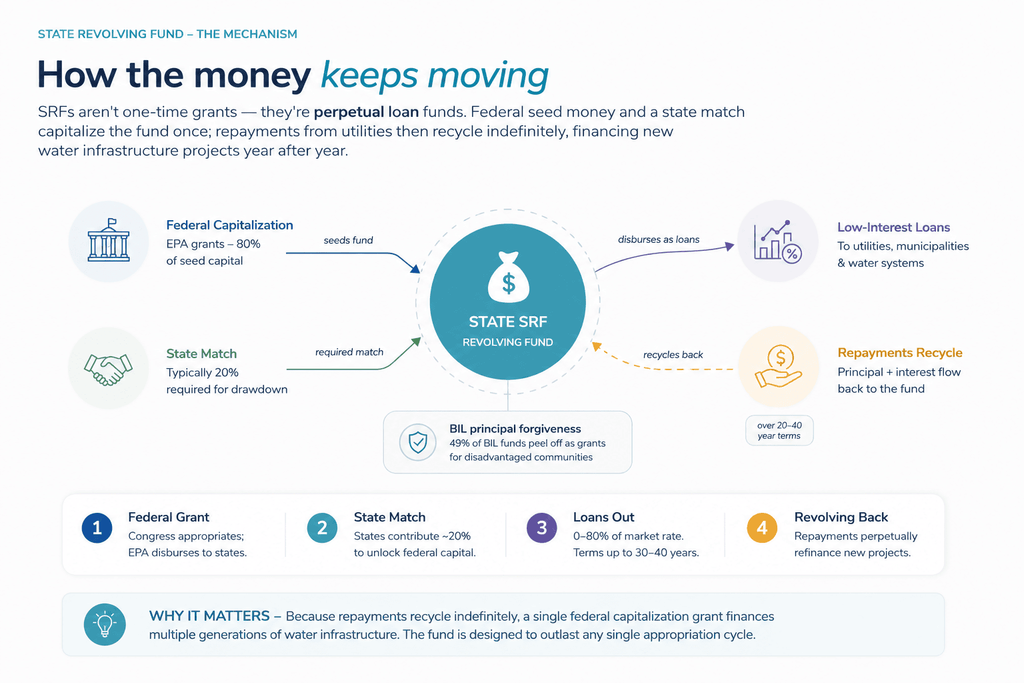
SRFs are state-run, federally supported financing programs that provide low-interest loans and, in certain cases, principal forgiveness for water infrastructure projects.
The system consists of two separate programs:
1. Clean Water State Revolving Fund (CWSRF)
Supports wastewater treatment, stormwater management, nonpoint source pollution control, and other water quality improvement projects.
2. Drinking Water State Revolving Fund (DWSRF)
Supports drinking water infrastructure, including source development, treatment facilities, storage systems, and distribution networks.
Each state receives federal capitalization grants and contributes a state match, typically equal to 20% of the federal allocation. As utilities repay their loans, the funds are recycled back into the program, creating a self-sustaining financing mechanism that continues supporting future projects.
The model has proven remarkably successful, helping communities finance critical infrastructure while maintaining affordable borrowing costs.
As EPA Assistant Administrator for Water Bruno Pigott explains:
“Water infrastructure is a critical part of our daily lives. It delivers clean, safe drinking water; it collects and treats wastewater and it helps to manage floodwater and drought impacts.”
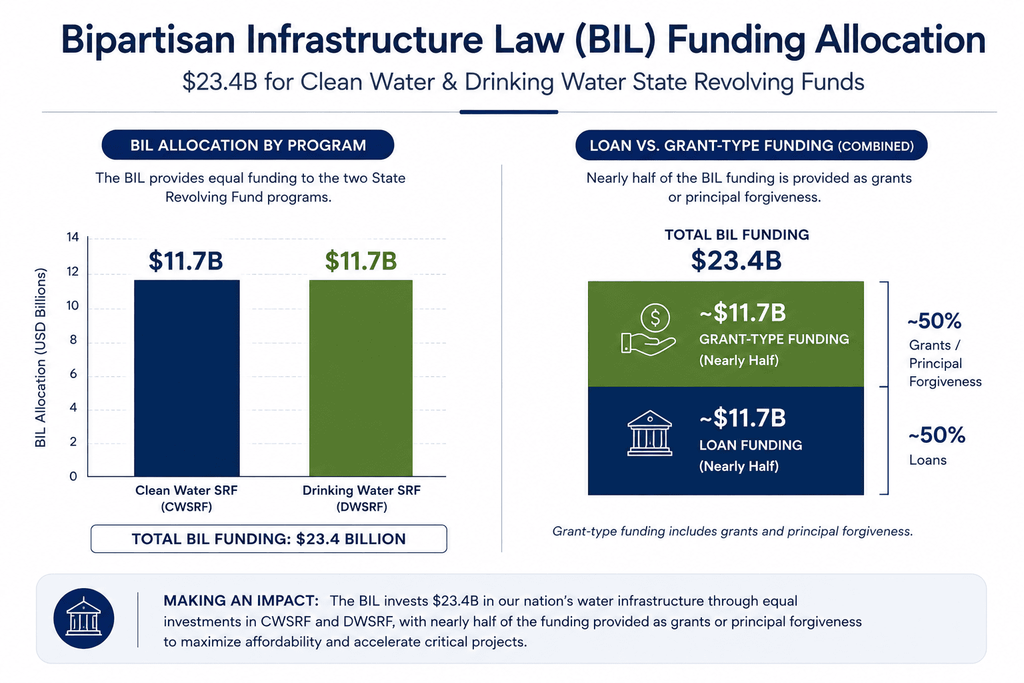
The Bipartisan Infrastructure Law (BIL) significantly expanded this support by allocating an additional $11.7 billion each to the CWSRF and DWSRF programs between 2022 and 2026.
Nearly half of this funding is structured as grants or principal forgiveness, with a particular focus on disadvantaged communities. In 2024 alone, more than $11.5 billion was made available through SRF programs.
With funding available at this scale, one might assume that securing SRF support is relatively straightforward.
In reality, this is where the complexity begins.
Many utilities approach SRFs as though they are dealing with a single national program.
In reality, they are dealing with 50 different state-level programs governed by the same federal program but administered independently by each state.
The result is a landscape where timelines, funding opportunities, eligibility requirements, and project priorities can vary significantly depending on where a utility is located.
1. Application Timelines Vary Widely
The main challenge is timing.
Some states accept applications throughout the year. Others operate on fixed annual cycles tied to state fiscal years. Several states conduct quarterly reviews and funding allocations.
For utilities with limited staff and planning resources, missing a funding window can delay a project by months or even an entire year.
Even a routine administrative detail can have major consequences for project delivery and capital planning.
2. Funding Priorities Are Different in Every State
States also determine how projects are ranked and prioritized.
Wisconsin’s Drinking Water SRF program, for example, uses a ranking methodology that places significant emphasis on financial need. This allows limited resources to be directed toward communities requiring the most immediate assistance rather than simply funding projects in the order they are received.
Other states may prioritize regulatory compliance, public health outcomes, environmental benefits, asset condition, climate resilience, or disadvantaged communities.
A project that ranks highly in one state may receive significantly different consideration in another.
3. Financial Terms Can Change Dramatically
Funding is not just about approval. It is also about the terms attached to that funding.
CWSRF loan terms can run 0% up to full market rate, with repayment periods of up to 30 years.
In practice, the average CWSRF interest rate has run well below market: 1.4% average vs. 3.5% market rate (2017 data), and more recent DWSRF data shows a similar gap (1.6% average vs. 3.3% market rate).
Texas provides a strong example of this flexibility. Its Clean Water SRF program offers rates substantially below market levels for standard projects while providing 0% interest loans for eligible small and rural disadvantaged communities.
For utilities evaluating long-term affordability, these differences can have a significant impact on overall project economics.
4. Compliance Requirements Extend Beyond the Application
Funding approval is only one part of the process.
Many states require additional planning and management activities before projects can qualify for SRF assistance. Depending on the state, utilities may need to demonstrate:
- Asset management planning
- Fiscal sustainability measures
- Water conservation strategies
- Rate structure analyses
- Climate resilience planning
- Procurement and project management readiness
These aren’t formalities utilities can assemble quickly. Nationally, only about 30% of utilities have a fully implemented asset management plan, one of the most commonly required prerequisites on that list describing that a meaningful share of applicants have to build the foundation before they can even apply.
These requirements are often designed to ensure long-term system sustainability, but they can also create additional complexity for utilities already operating with limited administrative capacity.
The Most Important Document Utilities Overlook
Given the variation across states, utilities often ask a simple question “How do we know what applies to us?” The answer is start with the Intended Use Plan (IUP).
Every state publishes an annual Intended Use Plan that outlines how SRF funding will be distributed, which projects will be prioritized, what financial assistance is available, and what eligibility requirements applicants must satisfy.
The IUP serves as the state’s roadmap for SRF implementation.
It provides visibility into:
- Project ranking criteria
- Funding priorities
- Available principal forgiveness opportunities
- Bipartisan Infrastructure Law allocations
- Application timelines
- Program-specific requirements
For utilities planning future capital projects, reviewing the current IUP is often the fastest way to understand both opportunities and obstacles before investing significant time and resources into an application.
Most states have already published their 2026 Intended Use Plans through their respective SRF agencies and environmental departments.
Looking Ahead
The opportunity presented by SRFs has never been greater in the last 12 years. Federal investment remains strong, funding programs continue to expand, and significant support exists for disadvantaged and underserved communities. The complexity of navigating these programs also continues to grow.
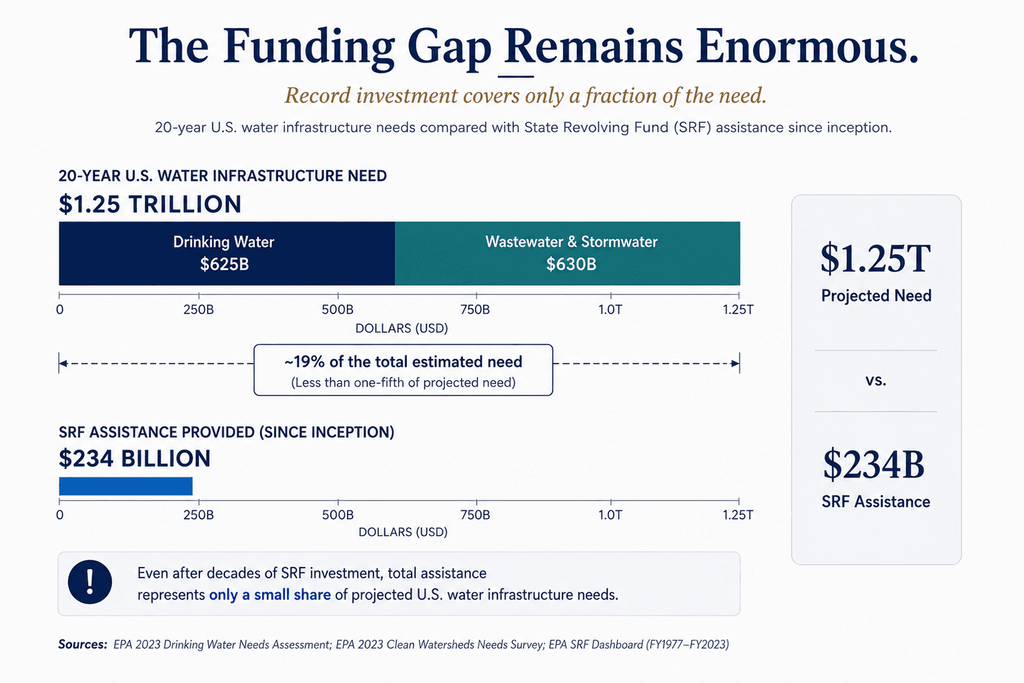
The scale makes the point plainly. EPA estimates $625 billion in drinking water needs and $630 billion in wastewater and stormwater needs over the next 20 years, a combined $1.25 trillion. Against that, total SRF assistance since the programs’ inception sits at roughly $234 billion. Even with record funding levels, the programs have addressed a fraction of what utilities still need.
Utilities that approach SRFs as a simple funding application process often find themselves overwhelmed by varying state requirements, shifting priorities, and evolving compliance expectations.
The most successful organizations take a different approach. They treat SRF funding as a strategic process that begins long before an application is submitted. They understand their state’s priorities, monitor funding cycles closely, and align projects with the criteria that drive approval decisions.
Because in today’s funding environment, the challenge is no longer finding capital.
The challenge is understanding where it is, how it is allocated, and what it takes to access it.
If you found this article valuable, you might also enjoy “Understanding the SRF Approval Process and Where Projects Get Stuck”, where we take a deeper look at another challenge faced by water utilities and shaping the future of the water utility market.