
The SRF application process is certainly manageable, but there are some consistent failure points, and knowing them in advance helps combat them better and develop suitable preventive measures.
Challenge 1: Demonstrating Financial Capacity
Many utilities struggle to document sufficient revenue for loan repayment. A solid financial capacity assessment needs to cover:
- Rate structure adequacy
- Historical collection rates
- Reserve fund policies
- Worst-case scenario modelling
- Gradual implementation strategies when required
In its report, the Government Accountability Office highlighted the need for improved financial metrics in the state SRF programs and called for the EPA to revise its guidance to better determine capacity and proceed with every possible segment kept into consideration.
Challenge 2: Technical Complexity
Smaller utilities often lack in-house expertise for the engineering analyses applications demand. Practical options include:
- Technical assistance through the Rural Community Assistance Partnership (RCAP)
- Engineering grants from USDA or state programs
- Planning loans available through many SRF programs
Colorado offers planning grants up to $10,000 alongside design and engineering grants for disadvantaged communities. Checking whether comparable state-level support exists is worth doing before assuming full self-funding of scoping work.
Challenge 3: Administrative Burden
Documentation requirements can overwhelm utility staff. The most effective responses:
- An SRF application timeline based on interim checkpoints rather than submission deadlines.
- Systems for managing data in order to store application materials.
- Regional strategies to distribute administration costs among the systems.
The report of the Clean Water Action, published in 2023, revealed that there was great inconsistency between state programs concerning the transparency and accessibility of SRFs.
Challenge 4: Competition for Limited Funds
Demand still outpaces availability in many states despite expanded BIL funding. The main levers are as follows:
- Targeting elements that improve ranking scores specifically
- Submitting early in the funding cycle
- Structuring projects to be phase-able so partial funding remains useful
As Deirdre Finn of the Council of Infrastructure Financing Authorities noted,
‘Post-pandemic construction costs have risen roughly 40%, meaning BIL funding does not stretch as far as originally anticipated.’
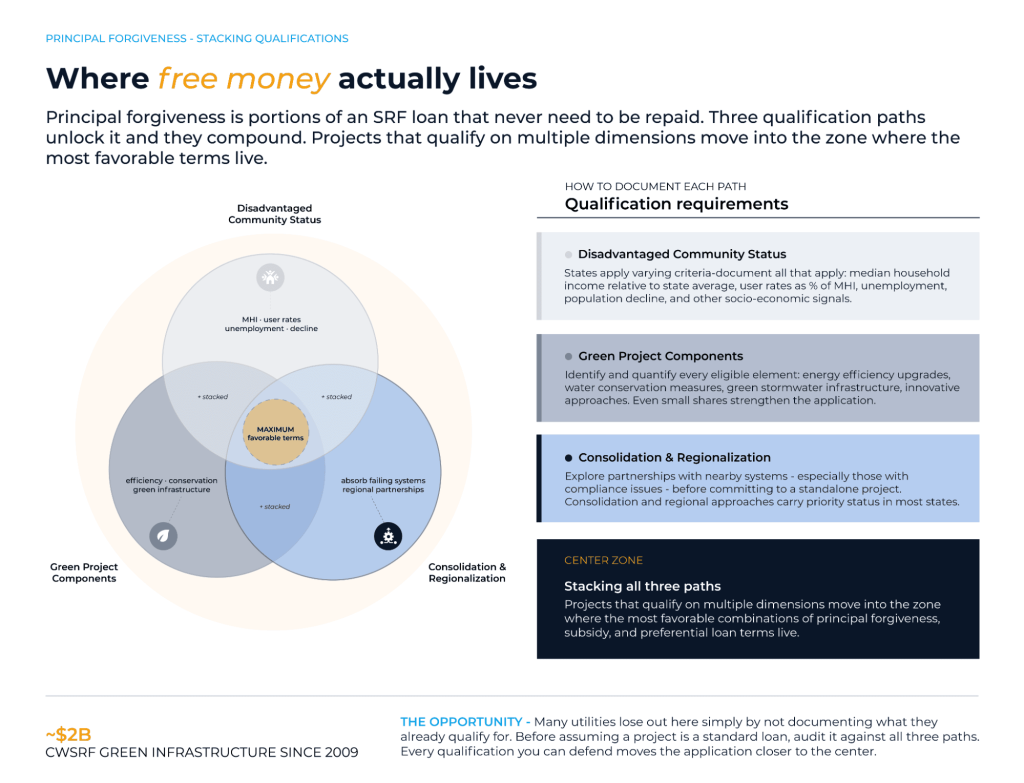
Challenge 5: Maximizing Principal Forgiveness and Favorable Terms
Many utilities lose out on profitable opportunities here by not paying close attention or putting things off for later. Three areas which deserve thorough attention:
Disadvantaged community designation: States apply varying criteria, for instance, median household income relative to state averages, user rates as a percentage of MHI, unemployment rates, population decline, and other socio-economic factors all of which should be identified and documented explicitly. The Environmental Policy Innovation Center found that while definitions vary widely, most states are working to sharpen how funds reach disadvantaged communities.
Green project components: Many states offer preferential terms for energy efficiency improvements, water conservation measures, green infrastructure, and environmentally innovative approaches. The CWSRF has directed nearly $2 billion toward green infrastructure since 2009. Even where green components form a small share of the overall project, identifying and quantifying them strengthens the application.
Consolidation and regionalisation: Projects that consolidate failing systems or adopt a regional approach often have high priority status and favorable terms. The exploration of partnering with other nearby systems, especially those with compliance issues, can prove beneficial before concluding that the project is to be done on its own.
According to the EPA, initial planning should precede funding applications, and projects that are well-prepared to move forward are favored, considering limited funding availability for BIL projects.
With the advent of modern data platforms, utilities are now supported in this task through monitoring updates in IUPs and deadlines, aligning the project components to state priority criteria, arranging application paperwork, and identifying optimal funding packages.
Programs like AquaIntel’s Utility Fund Tracker provide comprehensive views of federal and state financing options, identifying combinations that maximise grants while minimising rate impacts. Utilities that access SRF funding consistently treat it as an ongoing strategic process rather than a one-time effort:
- A multi-year capital improvement plan aligned with SRF priorities
- Relationships with state SRF administrators built before funding is urgently needed
- Standardised processes for assembling common application elements
- Outcomes reviewed each cycle, strategies adjusted accordingly
- State and federal guidance monitored for shifting priorities
The SRF programs offer low rates, long terms, and in qualifying cases, funds that require no repayment. Utilities that understand the process, tailor applications to their state’s requirements, and use available resources are well-positioned to make the most of them.