
On November 3, the board of the San Antonio Water System (SAWS) got a briefing titled “High Volume Requests.” Its slides, in the board packet posted on October 28, set out what the utility means to do about data centers on its recycled water system: limits on “water intensive cooling technologies,” a “Fee by Agreement” bridge for the infrastructure new customers need, an expedited cost of service study in 2027 and a recycled water impact fee “during 2028 update.” Three days later the San Antonio Express-News reported the plan. A week before that, the City Council had voted 9 to 2 to require council approval, case by case, for every new data center, the San Antonio Report wrote.
The numbers behind it reached the board in March. A 15-slide briefing titled “Data Centers,” from Donovan Burton, the utility’s senior vice president for water resources, showed data centers using 211 acre-feet of drinking water in 2023, 176 in 2024 and 98 in 2025. Their recycled water use went the other way, from 196 to 243 to 297 acre-feet. By November, requests on file came to about 600 acre-feet of drinking water and “~3,000+” of recycled water, “some under negotiations.”
I believe the San Antonio case is worth reading for any utility with a data center in its pipeline, because SAWS already did what most people ask for. It moved the cooling demand off drinking water. The board packets show what happens next: the cheaper water has a limit too, and it was priced to attract customers.
Why the data centers moved to the purple pipe
SAWS has run a direct recycled water system since 1999. A July 2026 board slide describes “130 miles of purple pipe,” 114 customers, 122 million gallons a day of pumping capacity and 12.1 million gallons of storage. Recycled water “offsets nearly 10 percent of potable water demand,” staff told the board in September. The pipes are purple, which is how the system got its name.
The utility made that water cheap on purpose. The March briefing put the recycled rate at 39.6% of the residential potable rate, 46.8% of the general rate (multifamily, commercial and industrial) and 20.5% of the irrigation rate. In 2026 the standard recycled rate is $2.3772 per 1,000 gallons for the first 748,000 gallons a month, per the rate schedule in the October packet. Recycled customers also skip the water supply fee and the Edwards Aquifer Authority fee, according to SAWS’s recycled water user handbook (p. 37). The Express-News, reporting Burton’s explanation, called the discount “intentional, because SAWS wants large users to use the treated wastewater instead of using large amounts of drinking water for uses that don’t require it.”
For data centers it worked. The drinking water figure fell by more than half in two years while recycled use grew by half (derived from the briefing’s table). The November slide puts data centers at 0.1% of SAWS’s potable water use and 1.25% of its recycled water use today. With the pending requests, it projects 0.3% and 12%.
- 2023: 407 (Drinking water 211 AF; Recycled water 196 AF)
- 2024: 419 (Drinking water 176 AF; Recycled water 243 AF)
- 2025: 395 (Drinking water 98 AF; Recycled water 297 AF)
How much recycled water there is to sell
The supply of recycled water is set by how much wastewater the city sends to the treatment plants. As the Express-News put it on November 6, SAWS “only has as much wastewater as its customers produce.” Staff told the board in September that recycled flows “have not significantly increased despite the city being 40 percent larger than 30 years ago.”
The March briefing shows where the 2025 output went. The water recycling centers produced 157,834 acre-feet. Fifty thousand was reserved for CPS Energy, the city-owned power utility, for its Calaveras and Braunig lakes, and another 50,000 “was allocated for downstream flows under SAWS’ bed and banks permit,” per the draft minutes. Recycled water demand was 19,322 acre-feet, which left 38,512 “available for other uses.”
Values
| Tier | Acre-feet, 2025 |
|---|---|
| Allocated to CPS Energy | 50,000 |
| Allocated to downstream flows | 50,000 |
| Recycled water demand | 19,322 |
| Available for other uses | 38,512 |
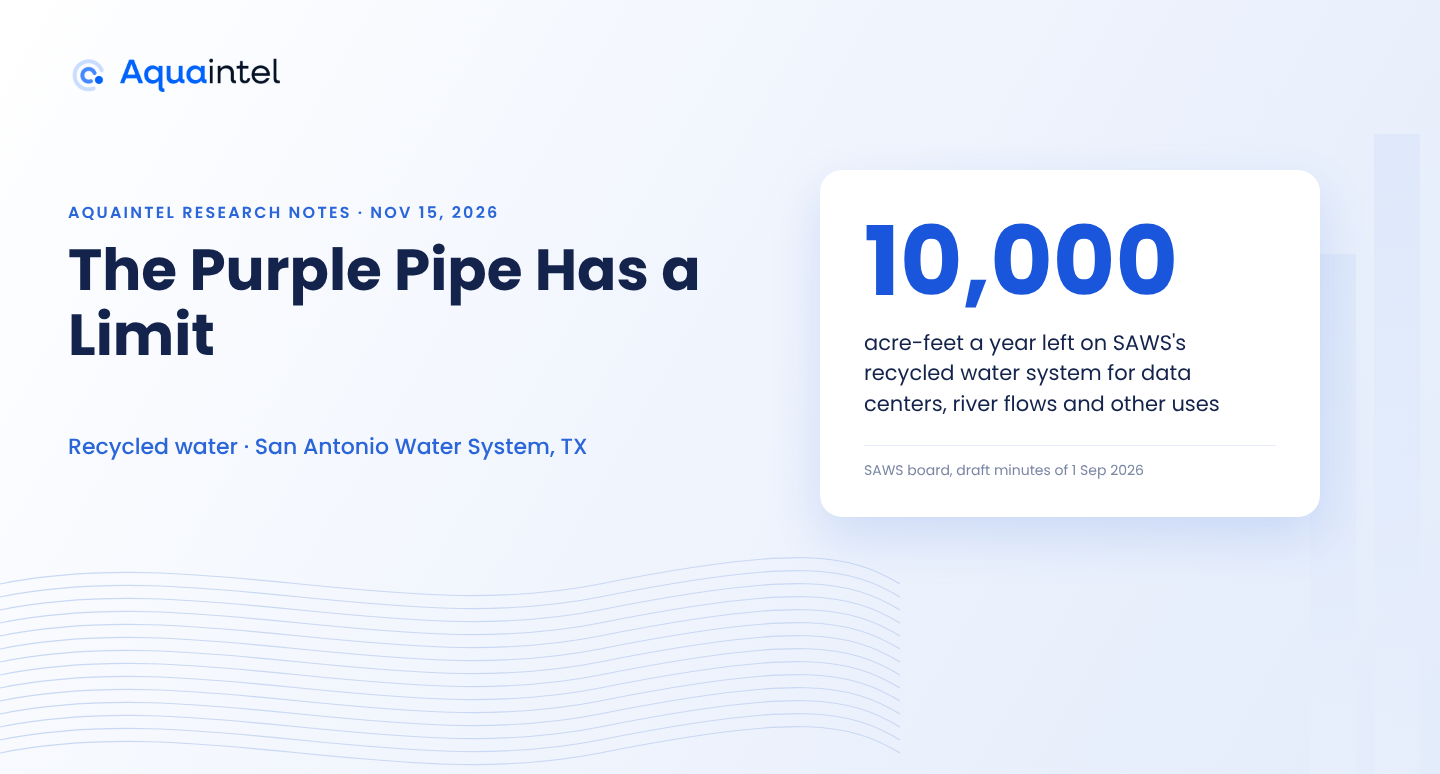
The limit is in the pipe. Burton told the board on September 1 that the system “was planned for about 30,000 acre-feet annually,” and that “with roughly 20,000 acre-feet used last year, about 10,000 acre-feet remains available for data centers, river flows, and other uses.” The November slide redraws the March bar the same way: “Current Recycled Water System: 30,000” and “Future Use: ≈ 27,500.” In February and March, Burton had described the network’s capacity as 35,000 acre-feet; the packets do not explain the change. The pending recycled requests alone, about 3,000 acre-feet, would take close to a third of that 10,000 (derived), and the 10,000 is shared with river flows.
Capacity is also uneven. “The recycled water system generally has capacity on the west leg but limited capacity in parts of the east leg,” Marisa Palmer, SAWS’s director of plans and major projects, told the board, and availability for new customers “must be evaluated site by site.” At the April meeting, as the minutes record it, Mayor Gina Ortiz Jones said SAWS “may need to revisit recycled water infrastructure sooner rather than later, particularly if current capacity may only serve two hyperscale users.”
Who pays for the next pipe
The March briefing’s cost recovery slide makes the pricing problem specific. For 2026, SAWS budgeted $6,790,659 to provide recycled water service and $6,487,599 in recycled water revenue. The slide’s title: “Recycled Water Revenue to Cover 95% Cost of Service in 2026.” The gap is $303,060, or 4.7%. For 2027 the board was asked to raise recycled rates up to 10%, which staff estimated at $640,000 of new revenue and said would cover 92% of recycled water service costs, including a new master plan.
That plan is the first large cost. On July 7 the board awarded Garver a contract of up to $1,500,000 for a 2026 Recycled Water System Master Plan, with a condition assessment, capacity expansion needs and “a capital improvement plan … for a 30-year planning period,” per the July packet. The vote was not unanimous: Chairwoman Jamison and trustee Mann voted against. The hydraulic model it will update was last revised in 2022. Burton told the Express-News that SAWS also wants a new line between the Leon Creek and Clouse treatment plants to connect the east and west legs, and more pumps.
The board saw the pressure in January. In the draft minutes of the January 13 meeting, Mayor Jones asked staff to justify investments “particularly for large load customers like data centers, so the budget accurately reflects the main drivers of costs.”
The November slides split the next steps between the utility and the city. For SAWS’s board: “Limitations on water intensive cooling technologies,” and designating data centers “Significant Industrial Users,” with “potential pre-treatment of wastewater.” For the City Council: address the code requirement for “Substitute Water,” the backup supply SAWS must plan for if recycled service fails; implement the recycled water impact fee in the 2028 update; a “Fee by Agreement” bridge; and an expedited cost of service study in 2027. A second slide proposes changing the Utility Service Regulations, because the state certificate “requires provision of potable retail water service, non-potable uses not included.”
The council’s process began with water in its brief. Councilmember Ric Galvan’s Council Consideration Request of October 29, 2025, asked staff for “the water consumption and planning requirements associated with” data centers and for partnerships with “municipal utilities” to “better understand and track data center resource needs,” and the staff memo for the Governance Committee on December 11, 2025, said Development Services “will coordinate with San Antonio Water System (SAWS) and City Public Service (CPS Energy).” Four stakeholder sessions followed. The ordinance the council took up on October 29, 2026, dealt with siting. The staff draft, item 5 on the agenda, set setbacks and kept data centers off the Edwards Aquifer Recharge Zone, and staff had recommended allowing them by right where those standards were met. The draft says nothing about recycled water. The recycled water decisions sit with the SAWS board and the fee items it sends to the council.
Why SAWS does not want to push them out
Burton also said the opposite pressure out loud. If data centers locate outside San Antonio, in places like Medina County with no recycled system, they draw on the Edwards Aquifer, SAWS’s largest drinking water source. “There are impacts that we have by disincentivizing them coming into San Antonio and being on the recycled water system,” he told the Express-News. “It’s a balance.”
The American Water Works Association’s new report, Cooling the Cloud: Considerations for Water Utilities Evaluating Data Center Development, written with Carollo Engineers, frames the same work as four steps: evaluate each project’s cooling technology and its average and peak demands, determine whether the community can accommodate the demand, understand the financial impacts and contracts while “protecting existing customers from financial impacts”, and engage the community early. SAWS’s two briefings touch the first three: cooling technology, supply and cost recovery.
Other states are starting at the first step. New Jersey’s Assembly passed A3966, which asks the Department of Environmental Protection to study data center water use over three and seven years, including “impacts on public water systems, ratepayers, or infrastructure upgrades required to meet demand,” ROI-NJ reported on November 6. It still needs the Senate. SAWS’s own legislative briefing on November 3 lists Texas initiatives for the 2027 session, including public water usage reporting and “Don’t shift infrastructure costs onto consumers.”

 Accounts / Cedar Hollow Water Authority / Large-load water

If you sell to utilities
- Ask the utility how it counts large-load requests, and whether it has briefed its board on them. SAWS’s March and November packets carry a table of requests by acre-foot; many utilities will have the same list in a staff memo before it reaches a rate case.
- A recycled water system with data center demand needs pipe, pumps, storage and controls. In San Antonio, the Leon Creek to Clouse connector between the east and west legs and the Garver master plan’s 30-year capital plan are the projects to follow.
- Watch the service rules and the fee items. A change to the Utility Service Regulations and the cooling technology limits go to the SAWS board; the fee by agreement and the impact fee go to City Council.
What I don’t know yet
- What the board said on November 3. The draft minutes will be in the December packet.
- The text of the Utility Service Regulations change and of the fee by agreement.
- Why the system’s capacity went from 35,000 acre-feet in Burton’s February and March remarks to 30,000 in September and November.
- The adopted text of the council’s October 29 ordinance and the vote record, which are not yet posted.
- Which data centers the requests belong to. The briefings do not name them.
All of this is as of November 10, 2026.
At AquaIntel we read board packets like the ones SAWS publishes before each meeting, because a staff briefing with a table of requests usually reaches the board months before a fee, a rule change or a capital project does.
Sources
- San Antonio Water System, Board of Trustees meeting packets: 3 Mar 2026, “Data Centers” briefing (PDF pp. 123 to 138) and draft minutes of 13 Jan 2026 (p. 26); 19 May 2026, draft minutes of 3 Mar 2026 (PDF pp. 21 to 24); 2 Jun 2026, draft minutes of 7 Apr 2026 (PDF p. 15); 7 Jul 2026, master plan contract memo and slides (PDF pp. 54, 74, 95 to 103); 1 Sep 2026, draft minutes of 7 Jul 2026 (PDF pp. 16 to 17); 6 Oct 2026, recycled water rate memo and Schedule F (PDF pp. 134, 151 to 152); 3 Nov 2026, draft minutes of 1 Sep 2026 (PDF pp. 12 to 15), “High Volume Requests” briefing (PDF pp. 208 to 221) and “2027 State Legislative Session” briefing (PDF p. 229). All retrieved 9 Nov 2026.
- City of San Antonio, City Council A Session, 29 Oct 2026, item 5 (file 26-224818): agenda memo, staff presentation and draft ordinance, on PrimeGov, retrieved 9 Nov 2026.
- City of San Antonio, Governance Committee, 11 Dec 2025, item 7, Council Consideration Request by Councilmember Ric Galvan on Data Center Response Planning and Policy, agenda memo, on PrimeGov, retrieved 10 Nov 2026.
- San Antonio Express-News, “SAWS considers changing data center regulations, adding new fees”, 6 Nov 2026, as syndicated by GovTech, retrieved 9 Nov 2026.
- San Antonio Report, council vote on data center construction, 29 Oct 2026, retrieved 9 Nov 2026.
- San Antonio Water System, Recycled Water User Handbook, Dec 2020, p. 37, retrieved 9 Nov 2026.
- American Water Works Association, Cooling the Cloud: Considerations for Water Utilities Evaluating Data Center Development, Oct 2026, report page, retrieved 9 Nov 2026.
- New Jersey Legislature, A3966 (2026), as introduced; ROI-NJ, 6 Nov 2026, retrieved 9 Nov 2026.
Part of Last Week in US Water Utilities, November 15, 2026, from AquaIntel Research Notes.
If you sell into utilities and want records like these for the accounts in your territory, talk to us→