
On Friday, November 13, the board of Central Alabama Water voted 5 to 2 for a 3.4% increase in base and usage charges, starting January 1. WBRC reported that the utility’s consultants had recommended 6.4%. BirminghamWatch put the increase at about $1.61 a month for a customer using about 3,000 gallons.
At the same meeting, the utility’s chief reliability officer, Ray Sloan, told the board that non-revenue water had dropped below 50% after reaching as high as 55.5%. “I don’t want to pretend that that’s good. It’s not,” he said, per ABC 33/40.
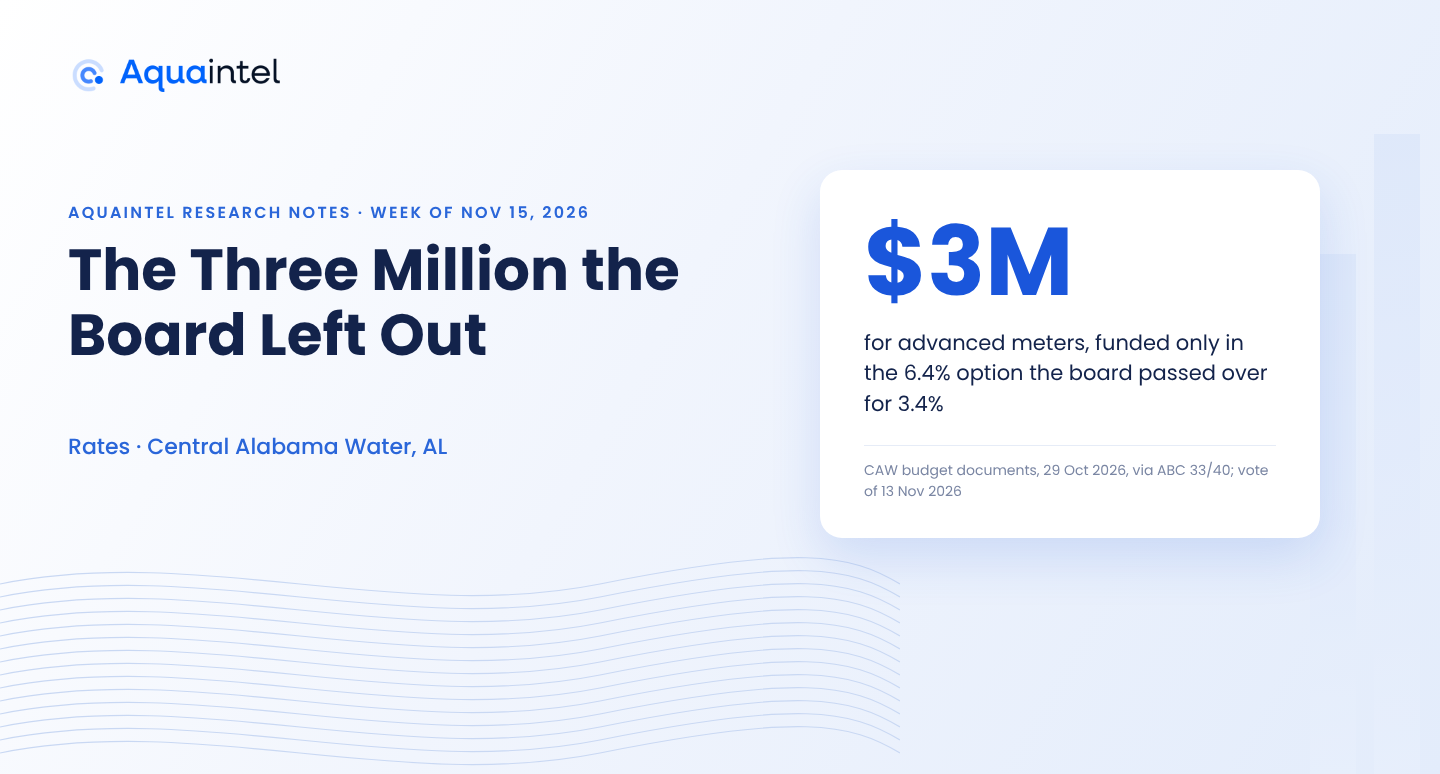
Central Alabama Water is the former Birmingham Water Works. It serves 653,322 people through 217,774 connections, according to EPA’s Safe Drinking Water Information System. The two decisions on November 13 are connected by one line in the budget documents: $3 million for advanced meters, which only the 6.4% option paid for.
I believe a rate vote is easiest to read as a list of what each option buys, because that list is what the utility will do next year.
What each option paid for
The board had three options in front of it: no increase, 3.4% and 6.4%. Budget documents for an October 29 special-called meeting, obtained by ABC 33/40, lay out what each one funds. Operating expenses stay at about $126.7 million in all three. Debt payments are about $63.5 million in 2027. What changes is the money left for infrastructure: $26.3 million with no increase, $33.9 million at 3.4% and $36.9 million at 6.4%. The utility’s own agenda for November 13 asked the board to adopt “rate resolution Option 1” and to approve an operations budget of $126,644,372.03 and a capital budget of $56,219,020.
- 0%: $26.3M (Other infrastructure 26.3 M; Advanced meters 0 M)
- 3.4% (adopted): $33.9M (Other infrastructure 33.9 M; Advanced meters 0 M)
- 6.4% (recommended): $36.9M (Other infrastructure 33.9 M; Advanced meters 3 M)
The step from no increase to 3.4% adds $7.6 million (derived). Per the documents, it pays for $4.3 million of treatment work at the Putnam and Western plants, $1.17 million to inspect about 22 miles of raw-water pipeline from Inland Lake, $500,000 of corrosion protection on the Sipsey transmission system and $1 million of treatment plant planning. The step from 3.4% to 6.4% adds $3 million (derived), and that is the meter line.
Bills will also change for a reason that is not in the percentage. On October 9 the board adopted a uniform residential rate structure, which starts at the same time. Its consultants said it raises bills for nearly 90% of residential customers, and WBHM reported that the heaviest 10% of users see bills fall. In ABC 33/40’s example, a $47.19 bill becomes $52.09 under the new structure alone, and $53.86 with the 3.4%. So the $1.61 is the increase from the vote. A household’s January bill will show both.
The rate path the utility’s own model set
Birmingham Water Works published its rate history in its budget books. The fiscal 2024 book lists every annual increase from 2005 to 2024. The board raised rates every year in that table except 2021, and the largest was 13.2% in 2009.
- 2005: 6.5 %
- 2006: 8.75 %
- 2007: 7.75 %
- 2008: 7.7 %
- 2009: 13.2 %
- 2010: 6.9 %
- 2011: 6.9 %
- 2012: 3.9 %
- 2013: 4.9 %
- 2014: 3.9 %
- 2015: 3.9 %
- 2016: 4.9 %
- 2017: 3.9 %
- 2018: 2.9 %
- 2019: 3.9 %
- 2020: 3.9 %
- 2021: 0 %
- 2022: 3.9 %
- 2023: 3.9 %
- 2024: 4.8 %
- 2025: 4.9 %
- 2026: 0 %
- 2027: 3.4 %
The same book has a forward path. “Based on the BWW’s RSE Model,” it says, meaning the rate stabilization model the board adopted in 2006, “customer water rates should increase by 4.8% for FY2024. Beginning in FY2025 through FY2026, 5.8%, in FY2027 5% and 4.3% in FY2028.”
- Model path, FY2024 budget: 2024: 4.8 %; 2025: 5.8%; 2026: 5.8%; 2027: 5%; 2028: 4.3%
- Adopted: 2024: 4.8%; 2025: 4.9%; 2026: 0%; 2027: 3.4%; 2028: no figure
The board adopted 4.8% for 2024, as planned. Then the utility changed hands. A state law in May 2025 replaced the nine-member board, most of it appointed by the City of Birmingham, with a seven-member regional board. The 2025 increase was 4.9% for residential customers. For 2026 there was none: the new law requires a consulting engineer to review any increase, and BirminghamWatch reported in September 2025 that one could not be done in time. The 3.4% for 2027 is below the model’s 5%.
Three years under the path adds up. On my arithmetic, the model’s 2025 to 2027 steps compound to 17.5%, and what the board adopted compounds to 8.5% (both derived). I am not saying the model was right. Revenue requirements change, and a new board is entitled to its own view. But the gap shows up somewhere, and in 2026 it showed up in the capital budget. In March 2026 the board cut that budget by 54%, from $75.8 million to $35 million, and main replacement from $15 million to $2.1 million, per BirminghamWatch. The utility’s presentation for that revision shows ten years of capital budgets against what was spent, and spending came in under budget every year. About $14.6 million of the revised $35 million was external funding.
- Capital budget: 2016: 60.4 $M; 2017: 61.2 $M; 2018: 64 $M; 2019: 63.9 $M; 2020: 81.5 $M; 2021: 81.5 $M; 2022: 77.1 $M; 2023: 72.3 $M; 2024: 83.7 $M; 2025: $115.6M; 2026: 35 $M; 2027: $56.2M
- Actual spending: 2016: 48.9 $M; 2017: 58.1 $M; 2018: 52.5 $M; 2019: 49.7 $M; 2020: 60 $M; 2021: 50.7 $M; 2022: 55 $M; 2023: 58 $M; 2024: 79.4 $M; 2025: 94 $M
S&P made the same point from the outside. In a May 2026 credit update, it said the ten-year capital plan, adopted at $1.25 billion, had already been revised down to $953.7 million, and it called water loss “extremely high at 53%.”
Non-revenue water, and the part meters can find
Non-revenue water is water a utility treats and pumps but does not bill. It has two parts. One is real loss, water that leaks out of pipes. The other is apparent loss, water that reaches a customer and is never charged for, because a meter reads low, an account is billed wrong or the use is never recorded.
The numbers in the public record do not line up cleanly, and I want to be clear about which is which. Sloan’s “below 50%” is the latest. BirminghamWatch’s account of the same meeting says 53% of the system’s water revenue is lost, with about 58.3 million gallons a day unbilled or leaking. In May 2025 the board’s consultant, Arcadis, said that on a five-year average the utility did not bill for 48.5% of the water it pumped, and that leaks were “probably close to 40%,” according to BirminghamWatch’s report of that session. The same consultant put the national average for utilities at 20% to 30%.
If those 2025 figures hold, roughly 40 points of the loss is leakage and about 8.5 points is the rest (derived). Meters go at the second part, and they make the first part easier to find, because a district with accurate meters shows where the water goes missing.
The utility is working on both. Sloan’s presentation described an acoustic leak survey of about 15% of the system that found 136 confirmed leaks, and a review of 18,500 accounts that showed zero use. The system has more than 4,150 miles of main, some laid in 1873, and Sloan said it breaks at about 29 times per 100 miles a year, against about 14 that a system should see. Over the last 15 years it replaced 171 miles of main against the roughly 600 that industry standards would call for.
Every customer meter in the system was read by hand as of December 2024, BirminghamWatch reported then. The advanced meter project started with a $7.96 million consulting agreement in December 2024, was targeted for 2028, and was stopped in July 2025 for lack of money. WBRC reported in October that a five-year meter replacement program starting in late 2027 would cost $65 million to $70 million. The utility’s own rate workshop deck from May 29, 2026 gives a larger number: about $120 million budgeted for a full automated meter reading transition, still targeted for 2028, to end manual reading and the billing errors that came with it. I could not find a document that reconciles the two figures. The $3 million in the 6.4% option was the first piece of either.
What I would watch
The board said it will revisit rates in May 2027. Raftelis, its rate consultant, told the board on November 13 that “3.4% is fine” for this year, but that more than inflationary increases would likely be needed for the capital work, per WBHM.
If you sell meters, leak detection or pipe to utilities, the May revisit is the date. Three documents should be on the board’s agenda before then: the water loss report behind Sloan’s “below 50%”, a scope for the meter program, and the next capital budget. The question I would ask the utility is how much of the 50% it attributes to apparent loss today. That number decides how much revenue meters would recover, and it is the case for the $3 million.
The utility posts its agendas and some presentations, but as of November 16 the November 13 board packet, the rate presentation and the minutes were not on its public site, and neither was a Raftelis rate study or a 2027 budget book. The options and the water loss figures from that meeting come from four local newsrooms that covered it. When the packet is posted I will check these numbers against it.
Sources
- WBRC, “Central Alabama Water board approves 3.4% rate increase for 2027”, 13 Nov 2026, and “Central Alabama Water delays vote on rate increase for 2027”, 23 Oct 2026.
- ABC 33/40, “‘It’s not good’: CAW acknowledges massive water losses as rates rise”, 13 Nov 2026, and “What would a CAW rate increase mean for your water bill? Three options under review”, 29 Oct 2026.
- BirminghamWatch, “CAW raises water rates by average $1.61 per month”, 13 Nov 2026.
- BirminghamWatch, “40% of Water Lost to Leaks, New Birmingham Water Works Board Learns”, 20 May 2025.
- BirminghamWatch, on the 2025 increase (21 Nov 2024), the board restructuring (14 May 2025), the 2026 rate outlook (9 Sep 2025), the meter project (20 Dec 2024, 15 Oct 2025), the 2026 budget (11 Dec 2025), the rating (11 Feb 2026) and the budget cuts (21 Mar 2026).
- WBHM, “Central Alabama Water board hikes rates 3.4%, bars public from speaking during meeting”, 14 Nov 2026, and “Suggested rate-structure change could increase water bills for Birmingham-area residents”, 11 Oct 2026.
- Central Alabama Water, agenda, regular board meeting of 13 Nov 2026; FY2026 revised budget presentation; rate workshop presentation, 29 May 2026.
- S&P Global Ratings, credit update on Central Alabama Water, 11 May 2026.
- Birmingham Water Works, Approved FY2024 Operation and Maintenance and Capital Budgets, pp. 51 and 185.
- US EPA, Safe Drinking Water Information System, Central Alabama Water (PWSID AL0000738), retrieved 16 Nov 2026.
Part of Last Week in US Water Utilities, week of November 15, 2026, from AquaIntel Research Notes.
If you sell into utilities and want records like these for the accounts in your territory, talk to us→