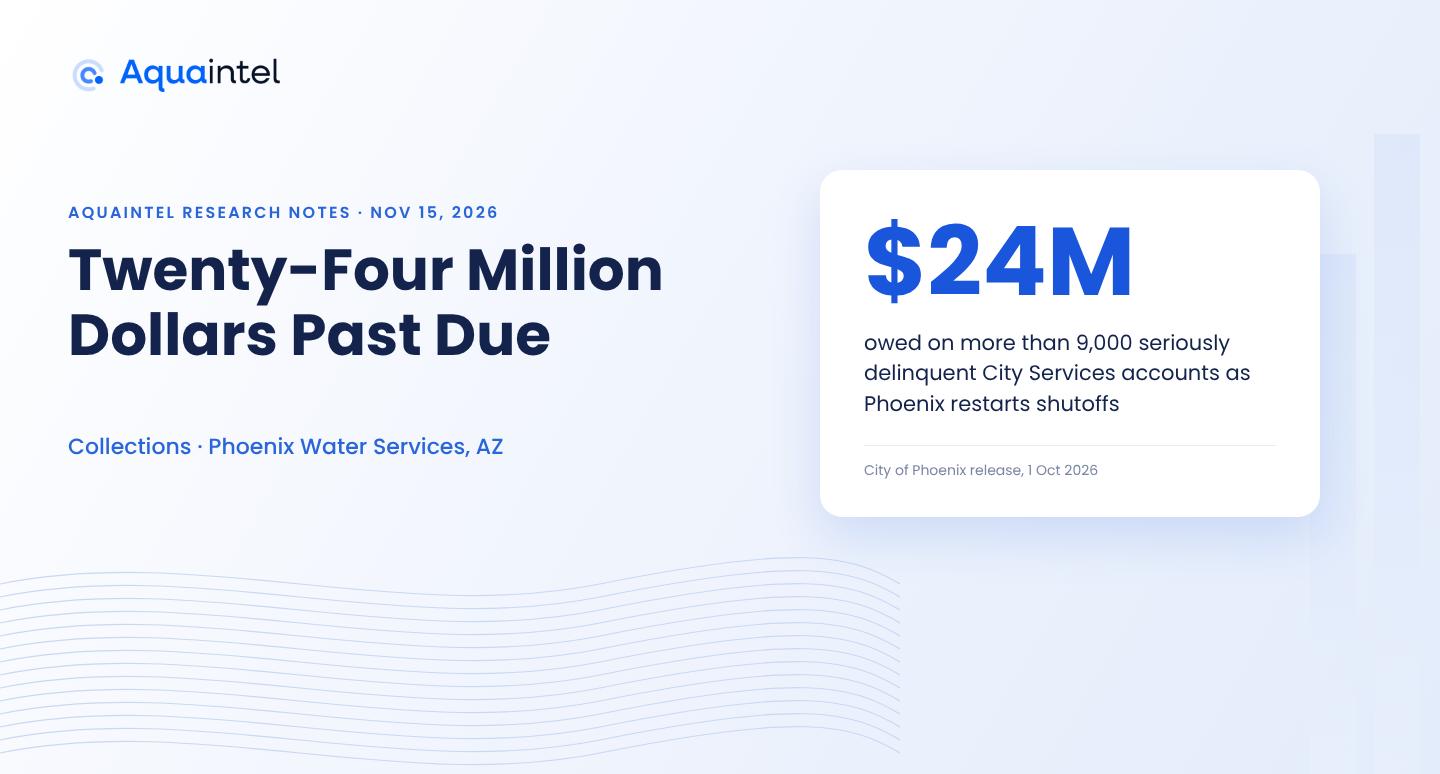

On October 1, the City of Phoenix announced that its Water Services Department would resume residential disconnections for unpaid bills “beginning in November 2026.” It had stopped in March 2020. The city’s release gives the size of the problem: “more than 9,000 accounts are seriously delinquent, representing nearly $24 million in past-due City Services balances.” ABC15 reported on November 7 that the shutoffs start on November 16, for accounts more than four months behind.
The release also says that by the city’s own review, Phoenix is “the only water utility in Arizona” that does not disconnect residential customers for large unpaid balances.
I believe a utility’s collections policy belongs in the same file as its capital plan. Most coverage of shutoffs is about households, and that is where it should start. But an unpaid bill is also revenue the utility budgeted and did not receive, and Phoenix said so in its release: “Unpaid balances do not eliminate the cost of providing service; they place additional financial pressure on the utility and, ultimately, its customers.” Its director, Brandy Kelso, put it in one line: “Financial resiliency is part of water resiliency.”
What the council packets counted
The pause began as a staff report. At a council policy session on March 30, 2020, Water Services Director Kathryn Sorensen explained that after March 10, single-family customers who had been disconnected “were reconnected and provided with a low-flow water service adequate for drinking, cooking and sanitary purposes,” and that late fees had stopped. She proposed deferring payments from April to August and spreading the balance over a year: about $570 for the average customer, or $40 a bill. City Manager Ed Zuercher told the council that “the costs must be covered,” and that if too many customers fell behind, “it may result in a fee increase,” per the minutes (pp. 8 to 10). The minutes record no vote on the item.
Phoenix tracked the balance closely during the pandemic. From June 2021 to April 2022, the City Manager’s office put a memo titled “Equity and Affordability: Status of City Services Bill Delinquencies and Assistance Programs” into the council’s General Information Packets every few weeks. Those memos are on the city’s legislative site, and they give a baseline.
On September 1, 2019, total City Services delinquency was $1,910,748. The January 2022 memo adds: “Historically the delinquency level has been approximately $2 million-$3 million.” By June 14, 2021, it was $9,073,944 across 18,603 accounts. In January 2022 the memo’s table showed $11.9 million, and on April 1, 2022, $8,704,184 across 15,780 accounts.
- Sep 2019: $1.9M (All delinquent accounts (council memos) 1.91 M; Seriously delinquent only (2026 release) 0 M)
- Jun 2021: $9.1M (All delinquent accounts (council memos) 9.07 M; Seriously delinquent only (2026 release) 0 M)
- Jan 2022: $11.9M (All delinquent accounts (council memos) 11.92 M; Seriously delinquent only (2026 release) 0 M)
- Apr 2022: $8.7M (All delinquent accounts (council memos) 8.7 M; Seriously delinquent only (2026 release) 0 M)
- Oct 2026: ~$24M (All delinquent accounts (council memos) 0 M; Seriously delinquent only (2026 release) 24 M)
The 2026 figure is defined differently. It counts only “seriously delinquent” accounts and includes water, wastewater, solid waste and the taxes and fees on the bill. So the two series cannot be joined into one trend line. What they do show is that the balance never went back to the $2 to $3 million the city called normal.
The memos stop in April 2022, and the city’s audited financial reports carry the record forward in a different form. Each year’s receivables note gives the Water System fund’s allowance for doubtful accounts, the part of its billings the city does not expect to collect. It was $2.1 million on June 30, 2019, and $9.9 million on June 30, 2025, about 4.8 times as much (derived). Wastewater’s allowance went from $1.2 million to $5.7 million over the same years, and solid waste’s from $1.5 million to $6.2 million.
- Water System allowance for doubtful accounts: 2019: $2.1M; 2020: 2.605 M; 2021: $5.4M; 2022: 6.136 M; 2023: 5.884 M; 2024: 7.195 M; 2025: $9.9M
The memos also record what Phoenix tried in place of shutoffs. A deferred payment program launched in March 2020 let single-family customers enroll themselves; when it closed on September 30, 2021, it held $10,298,430 across 11,139 accounts. Council-funded Project Assist credits of $2 million reached 3,657 customers and were used up by March 2, 2021. By April 1, 2022, $7,794,624 of assistance had reached 19,240 customers, much of it federal relief money. The January 2022 memo also describes a low-flow device program, which “provides enough water for basic sanitation and cooking,” in place of a full shutoff.
Phoenix almost restarted once before. In January 2022 the city said it would notify customers 31 days past due and resume shutoffs in February, then postponed, citing rising COVID-19 cases, Fox 10 reported. The 2026 restart starts much later in the cycle, at more than 120 days.
Rates went up in the same years
On June 28, 2023, the City Council adopted Ordinance G-7128, which amended the City Code “to increase rate revenue by 26 percent over the next two fiscal years,” per the council minutes (item 178, matter 23-1556 on phoenix.legistar.com). The rate advisory committee’s letter lays out the steps: 6.5% in October 2023, 6.5% in March 2024 and 13% in March 2025, with wastewater rising 6.5%, 6.5% and 7%. The vote was 7 to 2.
In the same meeting, Deputy City Manager Ginger Spencer told the council that “money was added to aid residents who qualify for the City’s Project Assist Program,” in the minutes’ summary. The January 2022 memo described Project Assist as paying “up to $400 within a 12-month period,” funded by the Water Services and Public Works departments and by customer donations. The program’s page today limits it to households at or below 200% of the federal poverty income level, and enrollment runs through appointments with the Human Services Department that “are limited,” with phone lines opening at 7 a.m. on Monday mornings. When staff updated a council subcommittee on May 27, 2026, the minutes record that “the median payment doubled from FY 2024 to FY 2025,” that about $400,000 was carried over, and that staff “do not accept applications if there is no funding available.” The minutes do not mention shutoffs.
So the same household that the shutoff pause protected also saw three rate steps, and the assistance per household is counted in hundreds of dollars. Jessica Berg of St. Vincent de Paul in Phoenix told ABC15 that by the time people come to her group, “it is a lot of money that they need, it’s a lot of months of not paying the water bill.”
What a restart looks like from the outside
The city’s release describes the steps in general terms: advance notice, a chance to pay or set up a payment arrangement, Project Assist for those who qualify, a final disconnection notice, then disconnection. It says the city “will use a phased approach that prioritizes accounts based on the amount owed and how long the account has been delinquent.” ABC15 reported that letters and calls had started.
What the release does not publish is the schedule between the steps, the reconnection fee, or whether low-flow devices are still part of it. The city’s FAQ says that once an account goes “from low-flow to shut-off,” the customer must pay the full balance for water to be restored.
Phoenix is not the only large city working through this in the same week. On November 2, Atlanta’s Department of Watershed Management relaunched a relief program for single-family customers at least 61 days overdue, with interest-free payment plans of up to 36 months, CBS News reported. A city audit found $236.4 million in past-due water and sewer balances across 60,168 accounts as of April 2026, up from $198 million in 2023, Atlanta News First reported. The Watershed commissioner put the figure nearer $184 million, because the department leaves out accounts in installment plans, adjustment or legal dispute. Atlanta resumed residential shutoffs in 2023 after about 12 years without them.
If you sell to utilities
- Delinquency is a budget line, and it shows up in council packets before it shows up in a rate case. In Phoenix the series is in the General Information Packets of 2021 and 2022, and the allowance for doubtful accounts in the receivables note of each year’s financial report. Look for both at the utilities you follow.
- A collections restart is operational work: letters, calls, payment plans, field orders and same-day reconnections when a customer pays by 4 p.m., per the city’s FAQ. The fiscal 2027 budget’s list of added positions for Water Services has one, a human resources analyst, and nothing for billing or collections. The 2026-27 detail budget gives the department’s Customer Services area $27.7 million for fiscal 2027, up 4.0% from the 2025-26 estimate of $26.6 million and up from $21.4 million spent in 2024-25.
- The Phoenix release ties the decision to the Colorado River and to “major investments in drought resilience, conservation, infrastructure and future water supplies.” The capital program is where recovered revenue goes. The water capital plan for fiscal 2026 to 2031 totals $3.17 billion, with $775 million for Colorado River resiliency and $440 million for a new North Gateway water treatment plant, per the February 2026 subcommittee item. The budget puts Water System revenue at $726.1 million for fiscal 2027, up 4.8%. I found no new base rate proposal posted; the drought surcharge the city expects to start in January is separate.
What I don’t know yet
- The exact first shutoff date. ABC15 says November 16; the city’s release says November.
- How many of the 9,000 accounts will reach a disconnection, and what the past-due balance was in 2023, 2024 and 2025. The financial reports give the allowance, and I found no council report on the balance after April 2022.
- Whether Phoenix will propose a new base water rate. The November 10 Phoenix Water Supply and Demand Update (matter 26-2446) was an information item. Its staff report sets out a Stage 2 drought surcharge of $2.10 a unit above 20 units a month for homes, which the city expects to start in January.
- Whether a council member has asked for the restart to be reviewed. I found no council item on it.
All of this is as of November 10, 2026.
At AquaIntel we keep a utility’s council packets, rate ordinances and financial reports together with their dates, so a change like this one can be read against the revenue and capital plans it affects.
Sources
- City of Phoenix, “Phoenix Water Services to Resume Residential Service Disconnections for Delinquent Accounts”, 1 Oct 2026, retrieved 9 Nov 2026.
- ABC15, “Phoenix water shutoffs resume Nov. 16 for overdue accounts”, 7 Nov 2026, retrieved 9 Nov 2026.
- City of Phoenix, General Information Packets, “Equity and Affordability: Status of City Services Bill Delinquencies and Assistance Programs”, memos of 14 Jun 2021 (matter 21-1694), 10 Jan 2022 (matter 21-3393) and 4 Apr 2022 (matter 22-0204), on phoenix.legistar.com, retrieved 9 Nov 2026.
- City of Phoenix, City Council Formal Meeting minutes, 28 Jun 2023, items 176 to 181 (Ordinance G-7128), pp. 234 to 240; Water and Wastewater Rate Advisory Committee letter, 10 May 2023 (matter 23-1349, attachment B).
- City of Phoenix, City Council Policy Session minutes, 30 Mar 2020, item D, “Report on Low Flow Water Service Program”, pp. 8 to 11 (matter 20-1166), and Community Services and Education Subcommittee summary minutes, 27 May 2026, item 7, pp. 5 to 6 (Attachment A to matter 26-1406), on phoenix.legistar.com, retrieved 9 Nov 2026.
- City of Phoenix, Annual Comprehensive Financial Reports, fiscal 2019 to 2025, notes to the financial statements, Receivables, retrieved 9 Nov 2026.
- City of Phoenix, Proposed Water Capital Improvement Program FY 2026-2031 (matter 26-0142, Attachment A), 18 Feb 2026; City Manager’s budget schedules for 2026-27, Schedule 2 (matter 26-1173, Attachment E), and trial budget additions, Attachment B, 11 Mar 2026, retrieved 9 Nov 2026; 2026-27 Detail Budget, Water Services department summary, p. 259, retrieved 10 Nov 2026.
- City of Phoenix, Water Services FAQ and Project Assist, retrieved 9 and 10 Nov 2026.
- Fox 10 Phoenix, “City of Phoenix water service shut-offs for non-payment to resume”, 5 Jan 2022.
- Atlanta News First, report on the Atlanta City Auditor’s water billing audit, 18 Sep 2026, retrieved 9 Nov 2026.
- CBS News Atlanta, “Atlanta relaunches water bill relief program with waived fees and longer payment plans”, 2 Nov 2026, retrieved 9 Nov 2026.
Part of Last Week in US Water Utilities, November 15, 2026, from AquaIntel Research Notes.
If you sell into utilities and want records like these for the accounts in your territory, talk to us→