
On November 3, 2026, the Glendale City Council heard public comment on a proposed water rate increase and voted to delay action to its next meeting, on November 10, the Crescenta Valley Weekly reported. The increase averages about 53% in the first year, from January 1, 2027, followed by 11%, 10%, 10% and 7% on each January 1 through 2031. Under Proposition 218, written protests from a majority of affected parcels would block it, and protests are accepted until the hearing closes. On November 10, more than 40 people spoke, most of them against, NBC Los Angeles reported, and no decision was made that night, with the item expected back the following week, KTLA reported.
I could not open the city’s cost of service study or its staff reports; the city’s website refused automated requests. What follows rests on the rate tables in the city’s own water bill estimator, which says they come from the Proposition 218 notice of August 27, 2026, on rate documents from the Metropolitan Water District of Southern California (MWD), on EPA data, and on local reporting of staff presentations.
I believe the rate tables say more than the headline percentage, because they show which part of the bill moves. In Glendale, the part that moves most is the fixed charge for the meter.
Where the increase lands
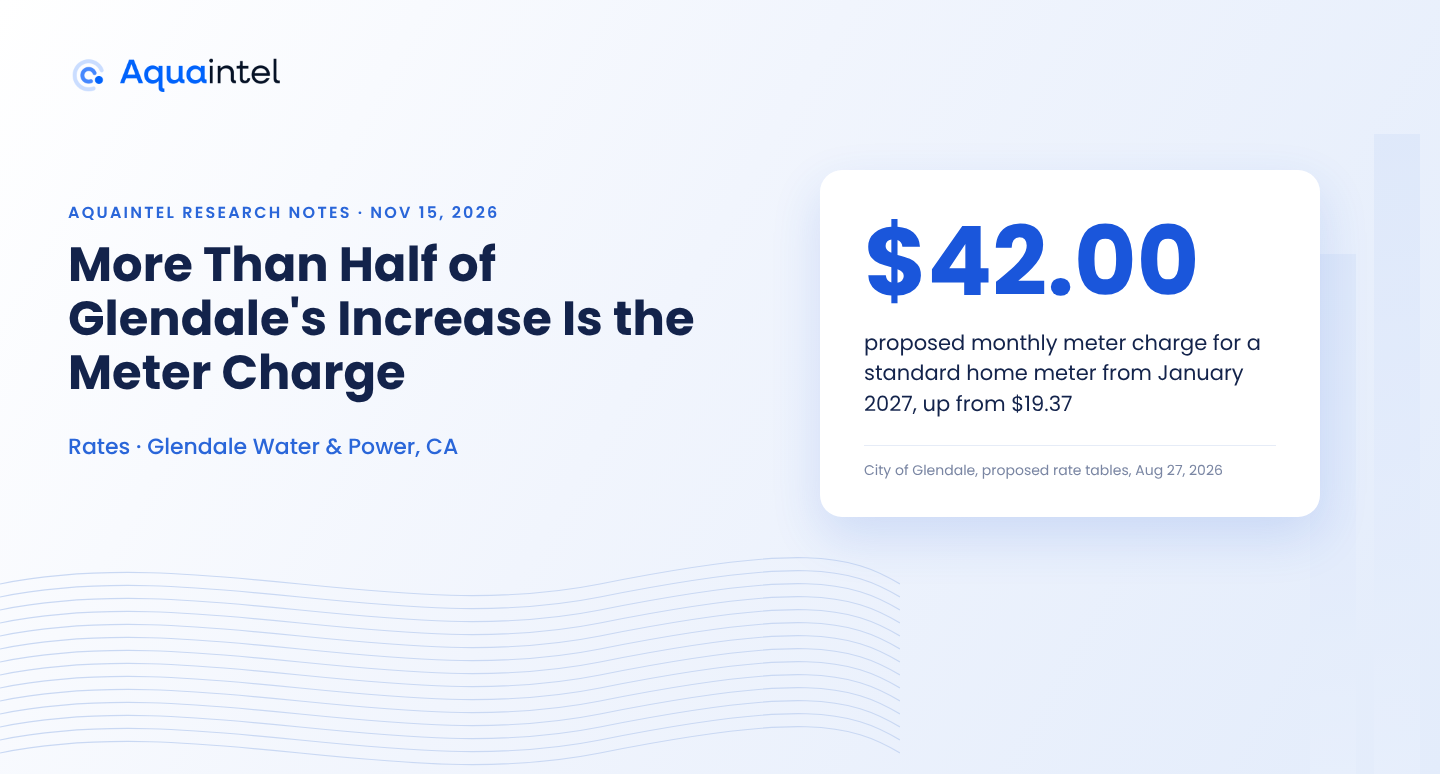
The proposal keeps usage tiers and sets the fixed charge by meter size. For the 5/8-inch meter on most homes, the monthly charge goes from $19.37 to $42.00, an increase of 117% (derived). The 5/8-inch, 3/4-inch and 1-inch meters all pay $42.00 from 2027, so the 1-inch charge falls slightly, from $42.37.
The usage rates rise too. For single-family homes, Tier 1 goes from $2.80 to $4.09 per hundred cubic feet (HCF, 748 gallons), and Tier 2 from $4.11 to $6.92. The current Tier 3 is dropped, and so is the $0.45 per HCF drought surcharge now in effect. A new pumping surcharge runs from $0.05 per HCF in the lowest zone to $5.08 in the highest.
- 2026: $73.19 (Meter charge 19.37 per month; Water used 47.47 per month; Drought surcharge 6.35 per month)
- 2027: $111.27 (Meter charge 42 per month; Water used 69.27 per month; Drought surcharge 0 per month)
- 2028: $123.51 (Meter charge 46.62 per month; Water used 76.89 per month; Drought surcharge 0 per month)
- 2029: $135.82 (Meter charge 51.28 per month; Water used 84.55 per month; Drought surcharge 0 per month)
- 2030: $149.44 (Meter charge 56.41 per month; Water used 93.03 per month; Drought surcharge 0 per month)
- 2031: $159.85 (Meter charge 60.36 per month; Water used 99.5 per month; Drought surcharge 0 per month)
At 14.1 HCF a month, the bill comes to $111.27 in 2027, close to the $111.30 average reported from the staff presentation, which is why I used that amount of water. The bill rises $38.08 in the first year, and $22.63 of that is the meter charge, about 59% (both derived). By 2031 the same bill is $159.85, more than double today’s $73.19 (derived).
A fixed charge is paid whatever a household uses, so the share a home pays rises as its use falls. At 10 HCF a month, the meter charge is half of the 2027 bill (derived).
What staff say a rate dollar buys
The Crescenta Valley Weekly reported the split staff presented to the council on September 1.
Water bought from MWD is the largest single share. The paper’s November 5 report adds that Glendale’s water rates had risen 7.5% since 2019, against inflation of 29.2% over the same period, while imported water cost 45% more and electricity 57% more. The last comprehensive water rate study was in June 2018. One councilmember called the plan “a bare minimum” for 212 miles of pipe laid in the 1950s or earlier.
The wholesale side
MWD’s board adopted overall rate increases of 6.2% for January 1, 2027 and January 1, 2028. Its rate for full-service treated water falls in 2027, because MWD moved cost from the treatment surcharge into the supply rate.
- Treated: 2025: $1,395; 2026: $1,528; 2027: $1,420; 2028: $1,514
- Untreated: 2025: $912; 2026: $984; 2027: $1,030; 2028: $1,106
The treated rate goes from $1,528 per acre-foot in 2026 to $1,420 in 2027, down 7.1%, and the untreated rate rises 4.7% (both derived). How much of each Glendale buys is not in anything I could read. On these numbers, MWD’s price alone does not account for a 53% step in 2027. The cost of service study would show the rest, and the staff split points at capital: 21 cents of each dollar for cash-funded projects and 8 cents for bonds.
From our data
EPA’s 7th Drinking Water Infrastructure Needs Survey lists $409.6 million of needs over twenty years for Glendale’s water system, which it counts at about 205,500 people (total derived from the categories).
Distribution and transmission account for $229.5 million and storage for $163.7 million. In EPA’s drinking water records, Glendale’s primary source is purchased surface water, like that of 445 community systems in California which together serve about 16 million people, 40% of the state’s community-system population (derived).
If you sell to utilities
- Read the Proposition 218 notice. It is the earliest public rate document with dollar tables by class, meter and year, and it goes out at least 45 days before the hearing.
- Follow the capital split. Staff put 29 cents of each dollar into capital and debt. The cost of service study will name the projects, and the needs survey points to pipes and storage.
- Watch the hearing record. A rate plan that clears protest sets five years of revenue at once.
What I don’t know yet
- The council’s vote, now expected after November 10, and the count of written protests.
- Who prepared the cost of service study, and what “53% on average” measures: revenue, the average bill, or an average across classes.
- The capital plan behind the increase, by project and year.
- Reserves. A speaker at the November 3 hearing said the water fund holds $136 million and that the study would raise the reserve target from $11.3 million to nearly $40 million. I have not been able to check either figure against the budget.
The next dates are the vote, if protests fall short, and the first step on January 1, 2027.
At AquaIntel we read rate notices, wholesale rate schedules and needs data together for each utility, so a vendor can see what a rate increase is meant to pay for before the projects are bid.
Sources
- City of Glendale, Water Bill Estimator (rate tables from the Notice of Public Hearing and Proposed Water Rate Changes, 27 Aug 2026), retrieved 10 Nov 2026.
- Crescenta Valley Weekly, reports of 3 Sep 2026, 30 Oct 2026 and 5 Nov 2026.
- NBC Los Angeles, report on the proposed rates, 23 Oct 2026.
- Metropolitan Water District of Southern California, Rate Structure Administrative Procedures Handbook, FY2025/26, Table 1; press release on the adopted two-year budget, 14 Apr 2026.
- Municipal Water District of Orange County, Resolution No. 2171 (MWD rates adopted for 2027 and 2028).
- NBC Los Angeles, “Glendale water rate hike could raise bills 53% in year one”, 11 Nov 2026, and KTLA, “Glendale residents push back on proposed 53% water bill increase”, 11 Nov 2026, retrieved 12 Nov 2026.
- US EPA, 7th Drinking Water Infrastructure Needs Survey and Assessment, system-level data (PWSID CA1910043).
- US EPA, Safe Drinking Water Information System, public water system data (download of 9 Jul 2026), active community water systems by primary source.
Part of Last Week in US Water Utilities, November 15, 2026, from AquaIntel Research Notes.
If you sell into utilities and want records like these for the accounts in your territory, talk to us→