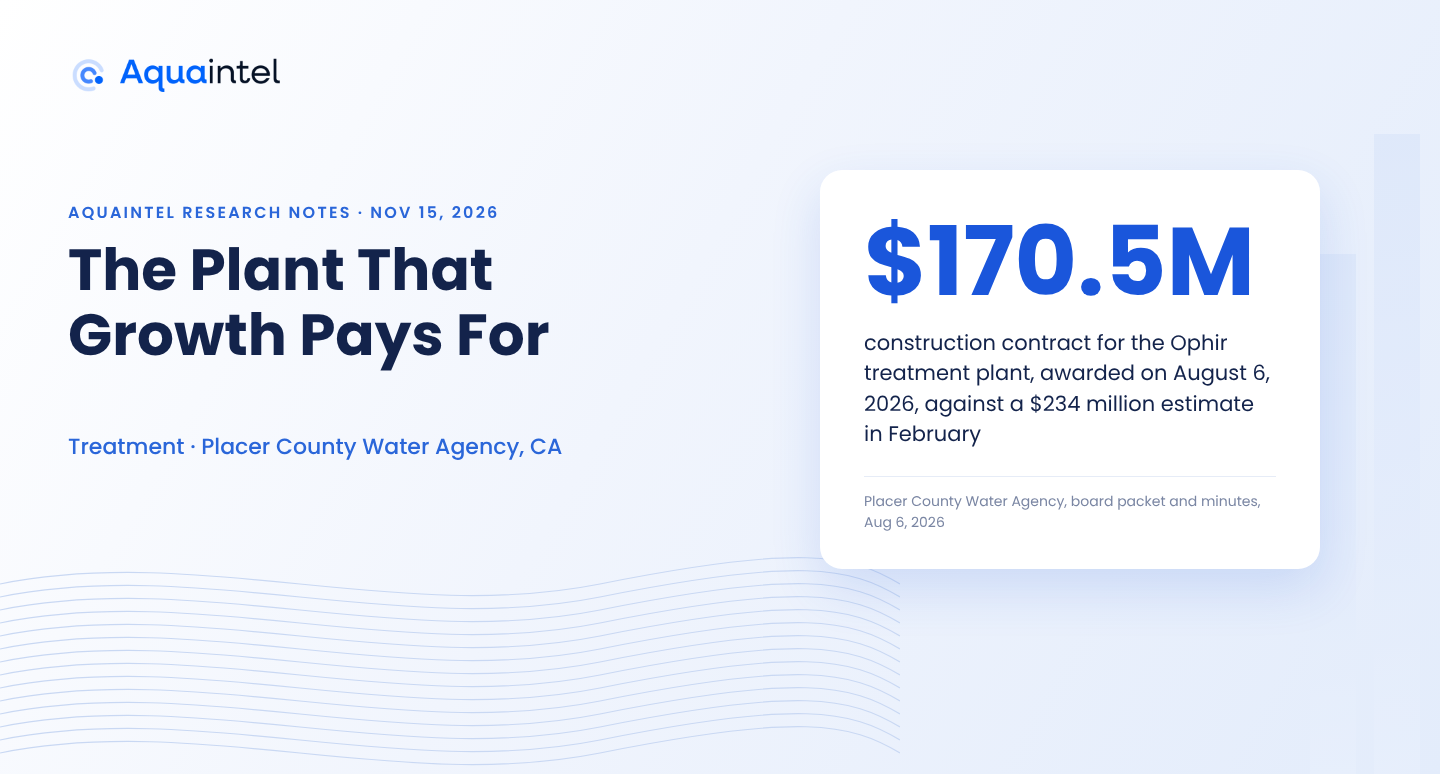

On August 6, 2026, the board of the Placer County Water Agency (PCWA) voted 5-0 to award Construction Contract No. 2025-02 for the Ophir Water Treatment Plant to W.M. Lyles Co., for $170,476,040. The trade press reported the award. The agency’s board packets carry the longer record: a plant designed three times since 2006, a construction estimate that nearly doubled in one design cycle and came back down after bids, and a financing plan that has changed twice since June because new homes paid for more of it than staff projected.
I believe the Ophir file shows how growth-funded capital moves at a California water agency. The money comes from connection charges that developers pay, plus an advance from the City of Lincoln, so the timing of the debt follows the pace of home building. For a vendor, the construction contract is now signed, and the next decisions on the record are the change orders and the bonds.
Why the plant is needed now
PCWA’s lower treated water system, which serves the Foothill, Sunset and future Ophir plants, can treat 65 million gallons a day (mgd). The capacity report in the board packet of August 20, 2026 shows 1.248 mgd left uncommitted after that meeting’s requests, down from 1.357 mgd in June. PCWA’s February 2026 release says the Foothill plant, its largest, “currently operates near capacity during high-demand summer months” and that current demand projections show a new plant “is needed by 2030”.
Ophir’s first phase adds 10 mgd, about eight times the uncommitted capacity left today (derived). The site is master planned for 30 mgd and its pipelines are sized for 60 mgd. The first phase will serve Lincoln, Loomis, Rocklin and unincorporated western Placer County, with raw water from PCWA’s Middle Fork American River Project. The agency’s project page puts it plainly: “Ophir addresses treatment and delivery capacity.”
The plant has been needed before. A 2006 design was for 30 mgd at an estimated $89 million. A 2015 redesign cut the first phase to 10 mgd at $75 million. A 2023 joint release with Lincoln says the need date slipped from about 2010 to 2020 to 2030, first with the recession and then with the drought.
Five bids against a moving estimate
- 2006: $89M
- 2015: $75M
- Feb 2025: $217M
- Feb 2026: $234M
- Aug 2026: $206M
- Contract: $170.5M
In February 2025, with the design at 95%, a third-party estimate put construction at $217 million, “excluding any soft costs”, up from $124 million. PCWA then took about $10 million out through value engineering: changes to the operations building and parking, to chemical piping, and to a hoist in the chemical building. By February 2026 the total project estimate was $234 million, of which $211 million was construction. The board-approved project budget was $230 million.
Six general contractors and five electrical subcontractors were prequalified in December 2025. The project was advertised in March 2026, and five bids were opened on June 30.
The spread from the lowest to the highest base bid was $23.5 million, about 14% (derived), and Lyles was low by about $4.2 million. The award is the base bid. The board did not buy Bid Alternate A, builder’s risk insurance for acts of God such as earthquakes above magnitude 3.5, which staff left out “due to the high cost”. After the bids, PCWA put the total project at about $206 million, $28 million below the February estimate, and the staff report shows $42.7 million of the $230 million budget left after the award.
One number in the record does not match. The staff memo asked for authority to approve change orders up to $1,710,000, “approximately 1% of the contract value”. The motion in the approved minutes reads “not to exceed a cumulative $3.42 million”, exactly twice that.
Developers paid early, so the bonds wait
PCWA sums up the project’s funding in four words: “growth pays for growth.” The sources are water connection charges, which developers pay per unit of capacity, the advance from Lincoln, and debt. Lincoln paid $40 million upfront in July 2023 for its share of the capacity; invested, it had grown to $45 million by June 2026.
- June 2026 plan: $234M (Cash on hand 82 M; Certificates of participation 152 M)
- November 2026 update: $206M (Cash on hand 83 M; Certificates of participation 123 M)
In June 2026 the plan was $82 million in cash and $152 million in certificates of participation, which staff described as “the largest debt issuance in the Agency’s history”. The board chose to split it into two issues, and a competitive sale was planned for August 18. No sale took place.
In September the board raised the lower Zone 6 connection charge from $25,815 per unit of capacity. The staff memo of November 5 says many developers with existing agreements “paid early to avoid the increase, which brought in more revenue than expected.” Connection charge revenue for 2025 and 2026 to date reached $60.3 million, $14.3 million more than the projection for all of 2025 through 2027. With the lower cost estimate and the extra cash, the debt needed fell to about $123 million, and staff recommended deferring the sale with a target of mid-2028 or sooner.
- 2026: $15.0M (Connection charge cash 15 M; Bond proceeds 0 M)
- 2027: $41.4M (Connection charge cash 41.4 M; Bond proceeds 0 M)
- 2028: $70.4M (Connection charge cash 26.5 M; Bond proceeds 43.9 M)
- 2029: $59.9M (Connection charge cash 0 M; Bond proceeds 59.9 M)
- 2030: $18.8M (Connection charge cash 0 M; Bond proceeds 18.8 M)
Cash covers the $56.4 million of construction spending planned for 2026 and 2027 and lasts into the third quarter of 2028, when spending peaks. The November item was an update to the board, and its minutes had not been posted when I checked on November 10.
From our data
EPA’s 7th Drinking Water Infrastructure Needs Survey, published in 2023, lists $57.2 million of treatment needs over twenty years for PCWA’s Foothill system, which it counts at about 126,000 people. The Ophir construction contract alone is about three times that (derived). The survey records what each system reported when it was taken. PCWA’s construction estimate for Ophir went from $124 million to $217 million in a single design cycle.
If you sell to utilities
- Read the bid tabulation in the award packet. At PCWA it lists every bidder, the base bids and the alternates on one page.
- Follow the change orders. The authority is either $1.71 million or $3.42 million on a $170.5 million contract, and either one is a defined amount the board will hear about.
- Watch the debt. The certificates are now targeted for mid-2028, and the official statement will describe the project, its schedule and its risks in one document.
- Watch the connection charge. The September increase pulled revenue forward, and a full update of the charge study was planned to follow it.
What I don’t know yet
- The engineer’s estimate for the bid. It is not in the staff report or the slides.
- Whether the change-order authority is $1.71 million or $3.42 million.
- When construction started. The staff memo and the project page say September 2026, and the award release said October. The ceremonial groundbreaking was October 15.
- The adopted connection charge. The September packet proposes $30,052 and the November memo says $30,512.
- Whether the board voted on deferring the bonds on November 5.
The next marks on the calendar are the board meetings of November 19 and December 7, and a bond sale by mid-2028.
At AquaIntel we read board packets, minutes and financing presentations together for each utility, so a vendor can see where a project stands between the award and the debt.
Sources
- Placer County Water Agency, Board packet, 6 Aug 2026 (staff memo and bid table, pp. 45 to 49), and approved minutes, 6 Aug 2026, Book 30, pp. 272 to 273.
- Placer County Water Agency, board packets of 5 Feb 2026 (Ophir workshop, pp. 42 to 49), 18 Jun 2026 (financing plan, pp. 225 to 230), 20 Aug 2026 (capacity report, p. 59), 17 Sep 2026 (connection charge update, pp. 54 to 55) and 5 Nov 2026 (financing update, pp. 62 to 69). Board minutes of 2 Jul and 4 Sep 2025 and 19 Feb, 2 Apr and 18 Jun 2026.
- Placer County Water Agency, news releases of 19 Jun 2023, 5 Feb 2026, 6 Aug 2026 and 15 Oct 2026; Ophir WTP project page. All retrieved 10 Nov 2026.
- US EPA, 7th Drinking Water Infrastructure Needs Survey and Assessment, system-level needs data (PWSID CA3110025).
Part of Last Week in US Water Utilities, November 15, 2026, from AquaIntel Research Notes.
If you sell into utilities and want records like these for the accounts in your territory, talk to us→