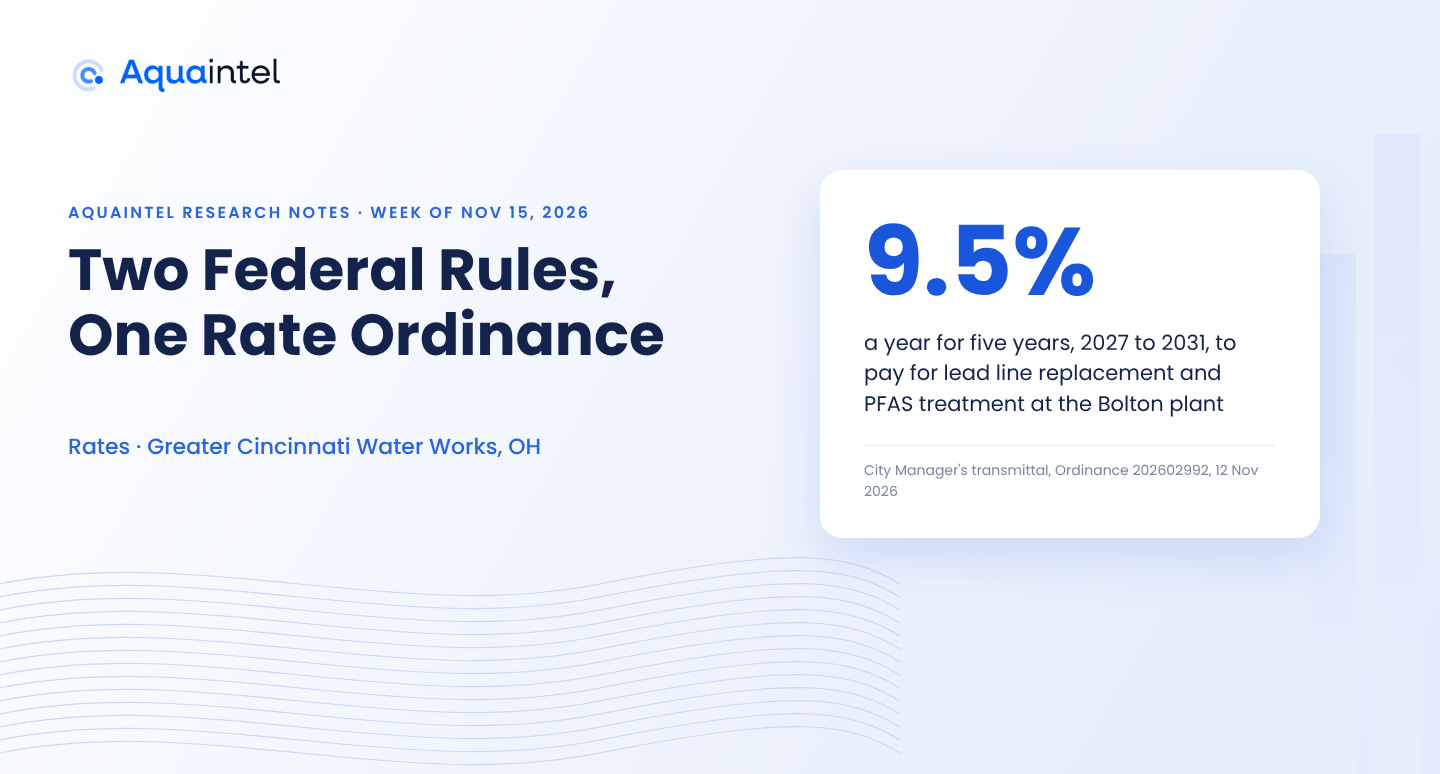

On November 12, Cincinnati City Manager Sheryl Long sent council an ordinance that sets water rates for 2027 through 2031. Her transmittal is one page. It asks for “an annual 9.5% increase in water-related rates,” and it says why in one sentence: the increases are needed “to remove all lead service lines in the water system from 2027-2037 and to install treatment to remove PFAS at GCWW’s Bolton Plant in Fairfield, Ohio to below the new 4 ppt threshold in 2029.”
The next line puts a number on it: “over $200 million in compliance costs to GCWW over the next five years.”
Council’s Budget, Finance and Governance Committee heard the proposal from Greater Cincinnati Water Works (GCWW) Executive Director Andrea Yang on November 9 and held it without a vote. The committee held it again on November 16. GCWW’s own notice said council was scheduled to decide on November 18, but the ordinance was not on that day’s council calendar, and as of November 19 the city’s legislative record still listed it as held in committee.
I believe the transmittal is the first document to read when a utility asks for a rate increase. Council votes on it, so it has to say what the money is for, in a sentence or two. This one names two federal rules and one plant.
The presentation GCWW gave the committee on November 9 fills in the numbers behind that sentence. One slide lists six cost drivers and how much more each will cost in 2027 to 2031 than in the five years before. The two federal rules are on it. The largest single increase, though, is the cost of replacing 1% of water mains a year, which Cincinnati has done since a 1987 recommendation. The transmittal says 32 miles of main cost $32 million in 2021 and $64 million in 2026. The presentation gives $40 million and $78 million for the same comparison. Both say the cost has about doubled.
How big 9.5% is for Cincinnati
GCWW raises rates every few years through a multi-year ordinance, and it has shown council its own history. A 2021 presentation to the Budget and Finance Committee has a slide titled “Past rate increases” going back to 2008. Put that next to the ordinance and 9.5% is the largest annual increase in the series. The previous high was 8.5% in 2012, the year after a zero.
- 2008: 6 %
- 2009: 5.9 %
- 2010: 3 %
- 2011: 0 %
- 2012: 8.5 %
- 2013: 7.25 %
- 2014: 5.5 %
- 2015: 4 %
- 2016: 5 %
- 2017: 3.75 %
- 2018: 3.75 %
- 2019: 3.75 %
- 2020: 3.75 %
- 2021: 3.75 %
- 2022: 3.75 %
- 2023: 5.55 %
- 2024: 5.55 %
- 2025: 5.55 %
- 2026: 5.55 %
- 2027 (proposed): 9.5 %
- 2028 (proposed): 9.5 %
- 2029 (proposed): 9.5 %
- 2030 (proposed): 9.5 %
- 2031 (proposed): 9.5 %
The 19 adopted years from 2008 to 2026 average 4.73% (derived). The current plan, adopted in 2021, ran 3.75% in 2022 and 5.55% a year after that. Five steps of 9.5% compound to 57.4% (derived), so the rates page’s example bill of $41.30 would be about $65 a month in 2031 if usage stays the same.
The transmittal states the bill impact in dollars: an average monthly increase per single-family residence of $3.14 in 2027, rising each year to $4.50 in 2031. Those five add up to $18.88 a month by 2031 (derived). The 2022 to 2026 plan added $9.19 over its five years (derived from the 2021 transmittal).
- 2022: 1.21 $/month
- 2023: 1.83 $/month
- 2024: 1.94 $/month
- 2025: 2.05 $/month
- 2026: 2.16 $/month
- 2027: 3.14 $/month
- 2028: 3.41 $/month
- 2029: 3.74 $/month
- 2030: 4.09 $/month
- 2031: 4.5 $/month
One number did not reconcile when I worked it through. GCWW’s rates page uses a household on a 5/8-inch meter using 8.3 CCF a month (about 6,230 gallons), with a bill of $41.30. Applying the ordinance’s 2027 tables to that household gives $45.38, an increase of $4.08 (derived). The transmittal says $3.14. A household using about 6.2 CCF a month gets the transmittal’s figure (derived). My guess is that the transmittal’s “average” household uses less water than the rates page example. That is an inference, and if you are reading this for a customer-facing story, ask GCWW which household the $3.14 describes.
Lead: 30,000 lines and an 11-year window
The first item in the transmittal is lead. EPA’s Lead and Copper Rule Improvements, issued in October 2024, require systems to identify and replace lead pipes within ten years. GCWW and the transmittal both put the end date at 2037.
Cincinnati has been at this since 2018. GCWW replaced its first lead line under the current program in February 2018, and in an August 2026 release it said it had passed 10,000. The same release says about 30,000 remain and that the utility replaces about 2,500 a year.
Values
| Tier | Lead service lines |
|---|---|
| Replaced since 2018 | 10,000 |
| Still in the ground | 30,000 |
At 2,500 a year, 30,000 lines take 12 years (derived), which lands a year past 2037. The November 9 presentation says EPA requires 10% of the remaining lines, 3,000, to be replaced each year starting in November 2027, and puts the cost at $23 million a year for ten years, $230 million in all. That is a 20% step up from today’s pace (derived), and it explains why lead sits at the top of the list.
Some of this money already moves outside the rate ordinance. Council put $8.5 million into the private-side lead line fund in December 2025 and $20 million more in June 2026, and approved up to $8 million of state revolving fund money, about half of it principal forgiveness, for lead work the same month.
PFAS: what EPA’s samples show at Bolton
GCWW runs two treatment plants. The Richard Miller plant draws from the Ohio River and already has granular activated carbon. The Charles M. Bolton plant in Fairfield draws from wells in the Great Miami Aquifer.
The public record on PFAS at both plants comes from EPA’s fifth round of unregulated contaminant monitoring (UCMR 5). The final occurrence data has four samples from Miller with no PFOA or PFOS detected. It has two from Bolton, both in 2023, with PFOS at 4.2 and 6.1 parts per trillion. PFOA was not detected at either plant. EPA set the PFOS limit at 4.0 in April 2024.
- 22 Jun 2023: 4.2 ppt
- 6 Nov 2023: 6.1 ppt
- Federal limit, 4.0 ppt
Two samples are not a compliance result. Compliance is judged on running annual averages of quarterly samples. But EPA’s own July 2026 summary of the data compares a two-sample average to the limit for groundwater sites, and Bolton’s average is 5.15 (derived). On that method Bolton is over the PFOS limit and Miller is not. That is why the transmittal names Bolton, and only Bolton.
The November 9 presentation puts the cost of Bolton treatment at $90 million to $120 million to build, using granular activated carbon, and $2 million a year to run. Bolton supplies 12% of GCWW’s water, and the presentation gives its average PFOA and PFOS level as 6 ppt. Spent carbon from Bolton would go to the reactivation furnace at Miller. GCWW also says it is receiving $31 million from settlements with DuPont, 3M and other PFAS manufacturers, which covers about a quarter to a third of the capital cost (derived). The city’s adopted capital budget for fiscal 2026 to 2031 has $519.1 million for Water Works and no line for PFAS or Bolton. Its treatment lines add up to about $52 million over six years. That budget was adopted before this proposal, so the Bolton project is either new money in the next capital budget or it sits inside a line I could not separate.
The date also has some give in it. In May 2026 EPA proposed to keep the PFOA and PFOS limits but let systems request two more years to comply. If that rule is finalized, 2029 could move to 2031. The transmittal says 2029, and the presentation says EPA requires the limit to be met “measured beginning April 2028.”
What I would watch
If you sell to utilities, the transmittal and the capital budget give you three things to follow in Cincinnati.
- When the committee releases the ordinance, and whether council trims the percentage or the term. Council’s next meeting is November 25. The ordinance’s rate tables are already written for all five years.
- The Bolton project. A PFAS treatment plant at a wellfield goes through design, then procurement, and a 2029 date leaves little room. The next capital budget is where it should first appear as a line item.
- Meters. The adopted capital budget has $88.9 million for meter improvements over six years, and the ordinance lists “replacing aging meters” among the reasons for the increase.
The presentation answers the split the transmittal leaves out. Over 2027 to 2031 it has $67 million more for lead and $90 million to $120 million for Bolton, plus $91 million for smart meters that the transmittal does not mention.
As of November 19, council had not voted. I will update this piece when it does.
Sources
- City of Cincinnati, Ordinance 202602992 and City Manager’s transmittal, 12 Nov 2026.
- City of Cincinnati, Budget, Finance and Governance Committee, minutes of 9 Nov 2026 and agenda of 16 Nov 2026.
- GCWW, “Water Rate Increase Proposal (2027-2031)”, presentation to the Budget, Finance and Governance Committee, 9 Nov 2026 (Legistar matter 202602974).
- GCWW, “GCWW Proposes Rate Increases for 2027-2031”, 9 Nov 2026.
- GCWW, “Water, Stormwater & Sewer Service Charges”, retrieved 16 Nov 2026.
- GCWW, “GCWW Marks Major Milestones in Lead Replacement”, 26 Aug 2026.
- GCWW, “Setting Water Rates for 2022-2026”, presentation to the Budget and Finance Committee, 7 Jun 2021, and the City Manager’s transmittal for Ordinance 202102132, 9 Jun 2021.
- City of Cincinnati, Approved FY 2026-2027 Biennial Budget, Volume 2: Capital.
- City of Cincinnati, Ordinances 0392-2025 (10 Dec 2025), 0228-2026 and 0198-2026 (17 Jun 2026), via the city’s legislative record.
- US EPA, UCMR 5 occurrence data, including the UCMR 5 Data Summary, July 2026 (PWSID OH3102612).
- US EPA, Lead and Copper Rule Improvements.
- US EPA, Safe Drinking Water Information System, Cincinnati Public Water System, retrieved 16 Nov 2026.
Part of Last Week in US Water Utilities, week of November 15, 2026, from AquaIntel Research Notes.
If you sell into utilities and want records like these for the accounts in your territory, talk to us→