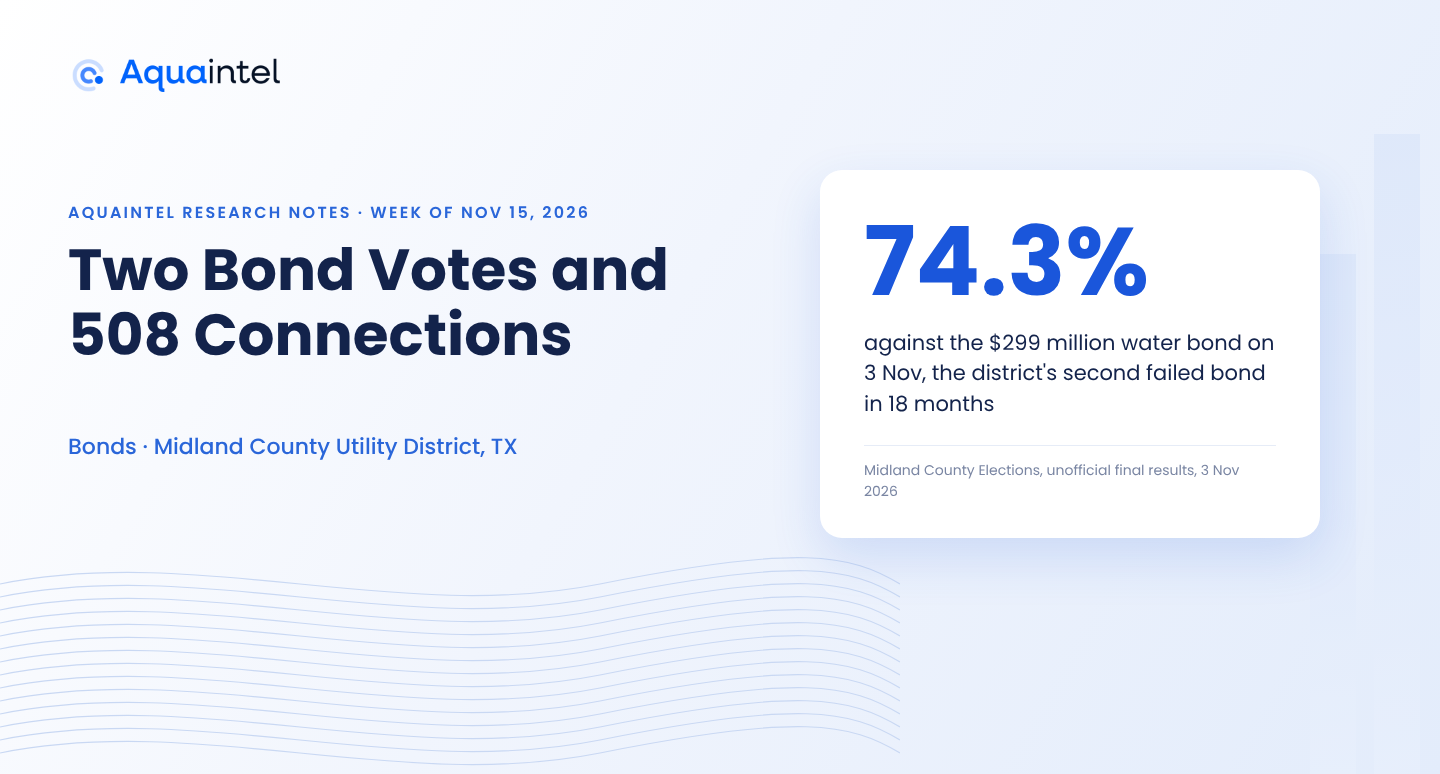

On election night, November 3, Midland County’s results page showed Proposition A for the Midland County Utility District failing 3,547 to 1,226. That is 74.3% against, on 4,773 votes, in the county’s unofficial final count. The proposition would have authorized up to $299,015,000 in bonds to bring water lines to unincorporated areas south and east of Midland.
It was the district’s second failed bond. In May 2025, voters turned down $645.8 million for the whole system, with about 76% against, according to The Permian Press. The Greenwood Ranger’s headline after this one: “General manager says water expansion could now take decades.” Norman Ashton, who runs the district, told YourBasin the program will now likely take 20 to 30 years, and that without the bond money the district does not qualify for certain grants it would otherwise have been eligible for. He put the result down to cost-of-living worries: “People are hurting for food; they’re hurting for gas and groceries.”
The district already has a working system. It turned on its first water on April 30, 2026, from its own wells and a reverse osmosis plant, and it bills about 508 connections, mostly the Greenwood school district and the new county jail. The question after November 3 is how a district that exists, has a plant and sets rates grows from 508 connections toward the 46,880 its plan calls for.
A district fifteen years in the making
The Texas Legislature created the district in 2011, in Chapter 9016 of the Special District Local Laws Code, as a special district with a five-member board. Voters confirmed it in 2013. I wrote last week about the 1,527 municipal utility districts in Texas, most of which a developer creates and the developer’s bonds pay for. This district went the other way. The area was already built and lived in, and the district has to win a public vote to borrow.
The need is plain in the local reporting. Greenwood is unincorporated, so neither the county nor the City of Midland supplies its water. Homes rely on private wells, a private utility, or water hauled in. Some Greenwood wells have failed, and south of Midland a chromium plume has made some private wells unusable, per The Permian Press. The district covers about 84.5 square miles and about 35,000 residents.
Who votes and who pays are two different groups. Only registered voters who live in the district vote on its bonds, while property owners inside it pay its tax whether or not they are connected. A consultant put the district’s registered voters at about 12,500 in August, which would make turnout on the proposition about 38% (derived). Countywide turnout on November 3 was 46.1%.
Values
| Tier | May 2025, $645.8M | Nov 2026, $299M |
|---|---|---|
| For | 24% | 25.7% |
| Against | 76% | 74.3% |
What the $299 million would have bought
The board approved an engineering report on July 16 and called the election the same day. The Permian Press summarized the report in August. The bond covered three phases:
- Greenwood, $91.2 million and about 1,675 connections. That includes $20.1 million to triple the plant from 0.5 to 1.5 million gallons a day, and $35 million set aside to buy or build nearby water and sewer systems.
- The chromium plume area south of Midland, $39.8 million and about 2,116 connections.
- The areas in between, $148.4 million and about 4,902 connections, including $47.7 million to double the plant again to 3 million gallons a day.
Financing costs added $19.7 million. After that come 19 more projects worth $890.6 million in today’s dollars, among them two new treatment plants and a potable reuse expansion. The whole program is about $1.19 billion (derived), which matches the $1.2 billion figure the general manager, Norman Ashton, has used.
Values
| Tier | Capital program, $M |
|---|---|
| The $299M bond: three phases and financing | 299 |
| 19 later projects | 890.6 |
So the bond was about a quarter of the program, and it would have reached roughly 8,700 connections of the 46,880 at full buildout. The plan was always to use the bond for the areas with the greatest need, start billing, and then pay for later phases with revenue bonds, federal WIFIA loans (which can cover up to 49% of eligible costs) and state loans and grants. The district said in September that it would send a WIFIA letter of interest in November whatever the result.
- Today: 508 connections
- Bond phases: 8,693 connections
- Buildout: 46,880 connections
What a customer pays
The district adopted its first rates on July 16, designed to mirror the City of Midland’s rates for customers outside city limits: a $34.89 monthly base that includes the first 2,000 gallons, then $9.87 per 1,000 gallons up to 10,000, and a $2,000 connection fee that can be financed at $125 a month for 16 months, per The Permian Press. Ashton estimated the combined bond tax and water bill at about $131 a month for the average home.
- Adopted, Jul 2026: 2000: $34.89; 4000: 54.63 $; 5000: $64.50; 7000: 84.24 $; 10000: $113.85
- Proposed, May 2026: 5000: about $43; 10000: $75.90
On my arithmetic, a household using 5,000 gallons pays $64.50 a month under the adopted schedule (derived). That is higher than the $50 to $60 Ashton had estimated for 5,000 to 7,000 gallons, and well above the May proposal, which would have charged about $43 at 5,000 gallons. The bond would have added a property tax on top of that. The district’s voter information document, which Texas requires for a bond election, shows the district had no debt and no debt service tax when the election was ordered. It estimated interest of $391.4 million at 5%, and a maximum tax increase of $545.01 a year on a $100,000 homestead, on what it calls conservative assumptions. YourBasin reported that the average homeowner would have paid about $68 a month more.
What I would watch
For anyone who sells to small and growing Texas systems, Midland County is worth following through the winter, because the next steps will each leave a record.
- The official canvass. It was on the district board’s November 17 agenda, but no certified count had been posted by November 19.
- The WIFIA letter of interest, which would show how much of the program the district thinks it can finance without general obligation bonds.
- A pending application to the Texas Water Development Board for about $21 million for a water line, which the board approved in June. Its outcome was not public when I checked. The Texas Water Development Board’s 2027 drinking water intended use plan lists the district for $2.5 million of planning and design money.
- Park Water, the private utility that holds the service rights for parts of Greenwood. The district and Park Water settled their court fights in July, and the district has said it may buy the system. Phase 1 of the bond set aside $35 million to buy or build systems like it, so any purchase now needs other money.
As of November 19, the district had posted nothing about its next steps after the vote, and its board documents sit on a site that needs a sign-in. Almost everything above comes from the district’s own website and one local newsroom, The Permian Press, which has covered every board meeting. The plant is running, and most of the people it was built for are not yet connected to it.
Sources
- Midland County Elections, unofficial final election night results, 3 Nov 2026, MCUD Proposition A.
- Texas Legislature, Special District Local Laws Code, Chapter 9016, Midland County Utility District.
- Midland County Utility District, history, projects and news pages.
- The Permian Press, “MCUD report details what $299M water bond would build”, 12 Aug 2026.
- The Permian Press, “MCUD sets water rates, estimates $131 monthly cost”, 30 Jul 2026.
- The Permian Press, “MCUD confirms it may buy Park Water as court fights end”, 28 Jul 2026.
- The Permian Press, on the May 2026 rate proposal (8 May 2026), the bond campaign and voter estimates (13 Aug 2026, 22 Aug 2026), the financing plan (16 Sep 2026) and countywide turnout (5 Nov 2026).
- Midland County Utility District, Notice of Bond Election with voter information document, order of 15 Jul 2026.
- YourBasin (KMID/KPEJ), “Midland County Utility District regrouping on water distribution plans after bond failure”, 10 Nov 2026.
- Texas Water Development Board, SFY 2027 Drinking Water State Revolving Fund Intended Use Plan, project 17315.
- Greenwood Ranger, “MCUD’s $299 million bond fails; general manager says water expansion could now take decades”, 5 Nov 2026.
Part of Last Week in US Water Utilities, week of November 15, 2026, from AquaIntel Research Notes.
If you sell into utilities and want records like these for the accounts in your territory, talk to us→