
On November 9, the commission of the Milwaukee Metropolitan Sewerage District received an audit of the company that runs its two treatment plants, Jones Island and South Shore. The auditor, EMA, asked three questions. Did Veolia comply with the contract? “Partially.” Did MMSD oversee it properly? “Partially.” Is the 2028 contract on the right track? “Largely,” if some gaps are closed in negotiation and MMSD can enforce it. The report makes 64 recommendations.
The audit landed late in the game. The commission had already voted 11 to 0 on September 28 to give the next ten-year operating contract to Jacobs, starting March 1, 2028. Veolia had sued in federal court seventeen days before that vote, and the contract has not been signed while the case runs.
MMSD owns its plants and pays a company to run them. Its own release in April said it has used a private operator since the late 1990s, through successive long-term contracts, with about 250 district staff and about 230 at the operator. The district’s 2026 budget puts the Veolia operations and maintenance fee at about 40% of its operating budget, and the district pays 75% of the energy costs under the contract on top of that. That makes this audit worth reading for anyone who sells to utilities, because it shows what a district can and cannot prove about its own operator after ten years of monthly reports.
What the audit found
Permit compliance was the strong part. In the 100 months from March 2018 to June 2026, EMA found two weekly exceedances of permit limits, one for fecal coliform and one for total suspended solids. Two other events, a 2018 bypass and a 2025 overflow, also discharged above limits. All four were at South Shore. Combined sewer overflows stayed within the permit’s six a year every year. “No regulatory fines were levied.”
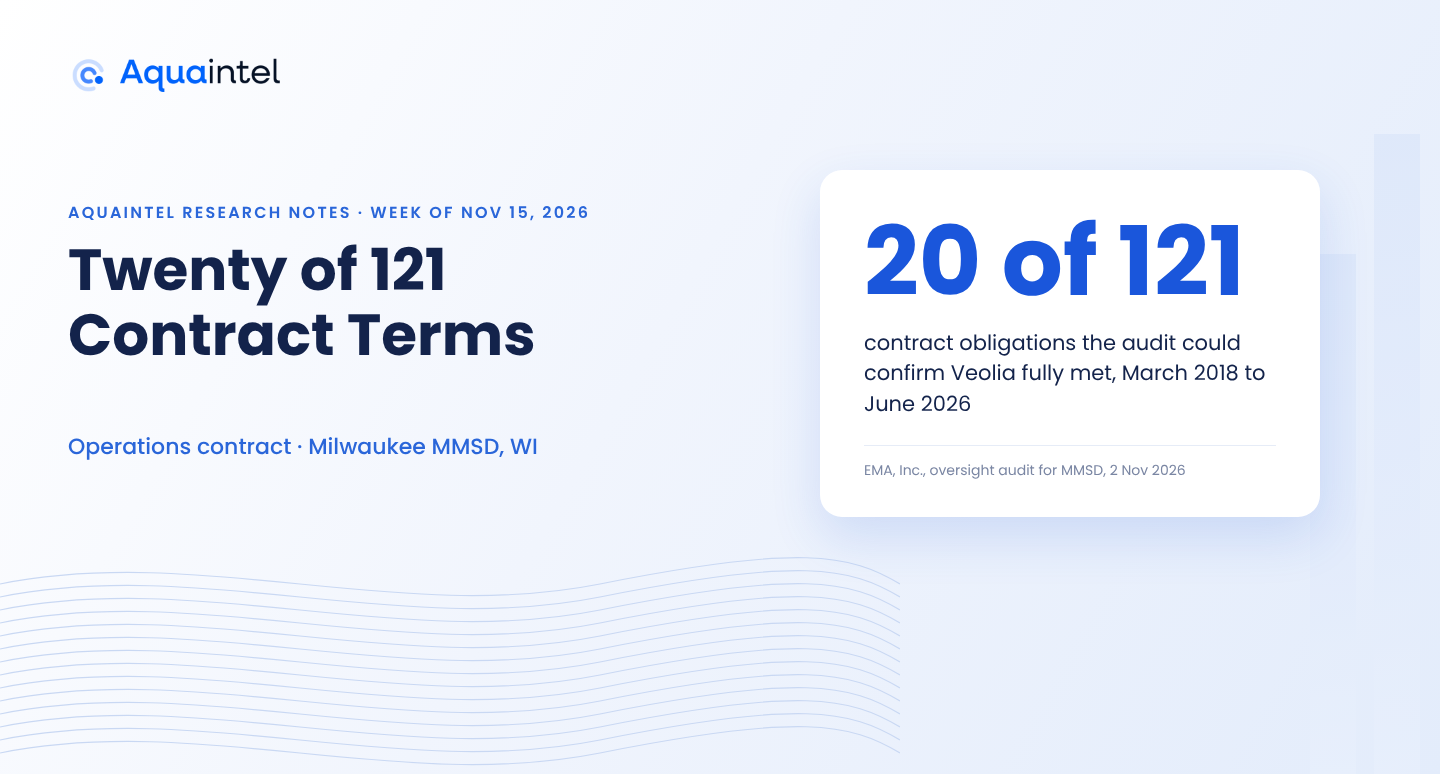
The contract was a different picture. EMA listed 121 obligations Veolia had under the 2016 extension and sorted each by the evidence. In the report’s words, “only one in six obligations could be confirmed as fully met, and more than a third could not be confirmed either way because the records needed to demonstrate compliance were incomplete, inaccurate, unavailable or beyond the audit scope.”
Values
| Tier | Obligations |
|---|---|
| Met | 20 |
| Partly met, or indicated but not proven | 60 |
| Could not verify | 21 |
| Not met | 20 |
The specifics are mostly about people and maintenance:
- The contract sets a minimum of 216 positions. Staffing was below 216 in almost every month since March 2018, by about six on average. Five key positions, including the plant operations manager and the safety manager, must be filled at all times, and that was not met about 20% of the time. Penalties for the shortfalls “were not applied.”
- About 150 material capital repair projects sit in a backlog. Up to five of the eight bar screens at Jones Island were out at once over about five months, where six are needed for full capacity.
- South Shore ran below its design capacity in 328 of 405 weeks (81%), and Jones Island in 193 (48%). EMA notes that design capacity is far above most days’ flow, and recommends a root-cause study for South Shore.
- Classic Milorganite, the fertilizer the district sells from its biosolids, missed its particle-size standard in 93 of 100 months.
The oversight finding cuts the other way. EMA found the district’s contract compliance office under-resourced, found that MMSD had loosened two South Shore effluent standards and a Milorganite specification by amendment, and found staff who disagreed among themselves on whether to enforce every term or only the ones tied to the permit. The commission chair’s statement on the audit page said the findings “confirm what we have long known: MMSD operates at a high level,” crediting its employees. Veolia said the report confirms it complied with environmental requirements. It had also paid for its own review, by Exponent, dated October 19. Exponent found both plants within permit effluent limits for more than 99.9% of sample results since 2016. It also found that plant capacity was frequently reduced by equipment that was out of service, though it did not find a systemic flaw in Veolia’s maintenance program.
- 2018: 6 CSOs
- 2019: 2 CSOs
- 2020: 2 CSOs
- 2021: 2 CSOs
- 2022: 1 CSOs
- 2023: 1 CSOs
- 2024: 1 CSOs
- 2025: 1 CSOs
- 2026 to date: 3 CSOs
- Permit limit, 6 a year
What EPA’s database shows
I also pulled the district’s combined discharge permit, WI0036820, from EPA’s ECHO database. It tells a less comfortable story than the audit’s permit section. ECHO flags the permit in significant noncompliance for seven of the last 12 quarters, and it is still flagged. Three of those quarters are for discharge monitoring reports not received, and the last four are for a monthly-average effluent limit, tied to total suspended solids removal in August 2025. EPA also cited the district’s industrial pretreatment program in September 2025. ECHO records no formal enforcement and no penalties.
These are different counts. The audit measured weekly permit exceedances over about eight years, and ECHO flags reporting gaps and open violations by quarter. Both are public. Anyone quoting “met its permits” should know the ECHO record exists.
The next contract
The 2028 contract went through a long procurement. In April 2024 the commission stopped studying a return to public operation. Veolia, Jacobs and Inframark qualified, Inframark withdrew in June 2025, and the request for proposals went out on September 30, 2025. A committee of five former commissioners scored the final offers in August 2026 and recommended Jacobs unanimously.
Price carried 60 of the 100 points. Jacobs’ estimated ten-year cost was $625.1 million and Veolia’s was $679.2 million, a gap of $54.1 million (derived), and Jacobs won 96.8 to 84.9 on the committee’s average score, per the award file. Veolia scored higher on regional partnership, the smallest category.
- Jacobs: 96.8 (Price 60 points; Company approach 22.8 points; Staffing, training, culture 9.3 points; Regional partnership 4.7 points)
- Veolia: 84.9 (Price 55.2 points; Company approach 17.6 points; Staffing, training, culture 7.1 points; Regional partnership 5 points)
The gap is where the fight is. Commissioner Milele Coggs told the meeting, per Urban Milwaukee, “In my 18 years of service, I’ve never seen a gap so big between competitive bids.” The price sheets show one reason. For cleaning 24 to 48 inch gravity sewers, Jacobs bid $5.54 a foot and Veolia $54.00, on the same estimated 483,000 feet. MMSD staff wrote in their evaluation that “it is unclear to staff how Jacobs can offer such good pricing,” and that there may be future disputes over task order items.
- Jacobs, $5.54 a foot: 2.68 $M
- Veolia, $54.00 a foot: 26.08 $M
Veolia’s suit, Veolia Water Milwaukee v. MMSD, No. 2:26-cv-01660, was filed September 11 in the Eastern District of Wisconsin. It asks the court to block the award and restart the procurement, and says MMSD broke its own procurement rules and took Jacobs’ pricing without checking it line by line. MMSD denies the claims. On September 14, Judge Brett Ludwig denied Veolia’s request for a temporary restraining order. The district agreed in court not to sign a service agreement until the case is decided, and it can keep negotiating in the meantime. Both sides agreed to go straight to the merits on the papers: principal briefs are due December 1 and responses December 15, and the judge said he expects to rule by the end of January 2027.
What I would watch
The audit was meant to inform the next contract, and the next contract is awarded but not signed. That leaves a few records worth following.
- The briefs on December 1 and December 15, and the ruling the judge expects by the end of January, which decide whether MMSD signs with Jacobs or starts over. The new contract is due to begin 13 months after that.
- Which of the 64 recommendations make it into the final Jacobs terms. MMSD’s own lessons-learned review had already produced 109 changes, and EMA found 61% fully reflected in the draft.
- The new contract’s minimum staffing plan, with credits to the district for vacancies, and its automatic fee reductions for missed standards. Those are the terms that answer this audit.
- The commission’s next regular meeting on November 23, and the November 9 minutes, which were still in draft on November 16.
The transition itself is a large job. A new operator takes over two plants that treat the region’s wastewater, a maintenance system the district now owns, and a staff the trade press says Jacobs plans to rehire in large part. Every step of that will be in the commission’s files.
Sources
- EMA, Inc., Contracted Wastewater Operations and Maintenance Oversight Audit, 2 Nov 2026, published by MMSD.
- MMSD, Audit: Operations and Maintenance Oversight, 9 Nov 2026, with statements by the commission chair and the executive director.
- MMSD, “MMSD Selection Process for the 2028 Operations and Maintenance Contract,” news release, 1 Apr 2026, and 2028 Operations and Maintenance Contract Information.
- MMSD legislative file 26-096-9, Award of Contract P-3216: legislative file, Jacobs price sheet, Veolia price sheet and staff comparative evaluation, Sep 2026.
- MMSD Commission minutes, 28 Sep 2026 (roll call 11 to 0).
- MMSD legislative files 26-083-6 (audit authorized, 8 Jun 2026), 26-094-7 (audit contract, 13 Jul 2026), 26-112-9 (change order, 14 Sep 2026) and 24-057-4 (public operation study ended, 22 Apr 2024).
- EPA ECHO, Detailed Facility Report for NPDES permit WI0036820, retrieved 16 Nov 2026.
- Urban Milwaukee, “Despite Lawsuit, MMSD Picks New Private Operator”, 28 Sep 2026; “Veolia Sues MMSD, Alleges Biased Contracting Process”, 11 Sep 2026; “MMSD Denies Unfair Contracting Practices”, 7 Oct 2026; “Audit of Sewerage District Finds Problems”, 9 Nov 2026.
- U.S. District Court, E.D. Wis., Veolia Water Milwaukee, LLC v. Milwaukee Metropolitan Sewerage District, No. 2:26-cv-01660: docket and court minutes and order, 14 Sep 2026.
- MMSD, 2026 proposed operations and capital budget.
- Exponent, Inc., for Veolia Water Milwaukee, Jones Island and South Shore Water Reclamation Facilities: Targeted Compliance Evaluation, 19 Oct 2026.
- Wastewater Digest, “Jacobs selected for Milwaukee wastewater operations contract amid Veolia lawsuit”, 30 Sep 2026.
Part of Last Week in US Water Utilities, week of November 15, 2026, from AquaIntel Research Notes.
If you sell into utilities and want records like these for the accounts in your territory, talk to us→