
Billions of dollars are available through State Revolving Funds (SRF) each year still many utilities struggle to secure financing, not because projects lack merit, but because they underestimate the barriers built into the application process.
Challenge 1: Proving Financial Readiness
Before approving funding, SRF programs need confidence that a utility can repay its loan while continuing to provide reliable service. This means demonstrating not only current financial stability but also the ability to manage future operational and financial risks.
Utilities should focus on:
- Assessing rate structure adequacy to ensure revenues are sufficient to support both operations and debt repayment.
- Demonstrating strong financial performance through historical collection rates, reserve fund policies, and audited financial statements.
- Preparing for uncertainty by including worst-case scenario modelling and contingency planning.
- Planning phased implementation strategies where immediate rate increases or large capital expenditures may not be feasible.
A 2015 GAO report (GAO-15-567) found that EPA lacked sufficient financial indicators to properly assess state SRF programs’ long-term sustainability, and recommended EPA revise its guidance accordingly, a recommendation EPA agreed to act on.
Challenge 2: Building Technical Capacity
Many small and rural utilities lack the engineering expertise required to develop project scopes, prepare technical documentation, and complete SRF applications. Without this capacity, otherwise eligible projects may struggle to move beyond the planning stage.
Utilities can strengthen their technical capacity by:
- Leveraging technical assistance programs such as the Rural Community Assistance Partnership (RCAP).
- Applying for engineering and planning grants offered through USDA and state funding programs.
- Using SRF planning loans to finance feasibility studies, engineering reports, and preliminary design work.
- Exploring state-specific support programs, such as Colorado’s planning grants of up to $10,000 and design assistance for disadvantaged communities.
RCAP’s reach is substantial: its network of more than 350 technical assistance providers has served over 4.1 million rural and tribal residents across more than 2,600 communities. Given that 72% of the nation’s roughly 150,000 public water systems serve communities of 500 people or fewer, this kind of hands-on technical support often makes the difference between an eligible project that gets built and one that never leaves the planning stage.
Building technical capacity early allows utilities to develop stronger applications and reduce delays during project development.
Challenge 3: Managing Administrative Complexity
SRF applications require extensive documentation, environmental reviews, financial records, engineering reports, and compliance certifications. For utilities with limited administrative staff, managing these requirements can become one of the biggest barriers to securing funding.
Utilities can simplify the process by:
- Developing a project timeline based on internal milestones rather than waiting for submission deadlines.
- Creating centralized systems to organize engineering, financial, and regulatory documentation throughout the application process.
- Sharing administrative resources regionally, particularly among neighboring utilities with similar funding needs.
- Reviewing state-specific application requirements early to avoid delays caused by missing documentation.
A 2023 Clean Water Action report found significant variation among state SRF programs in transparency, accessibility, and administrative requirements, reinforcing the importance of understanding each state’s unique process before applying.
Challenge 4: Competing for Limited Funding
Although the Bipartisan Infrastructure Law significantly increased SRF funding, demand continues to exceed available resources in many states. Successful applications are often distinguished by how well they align with state funding priorities rather than simply by project need.
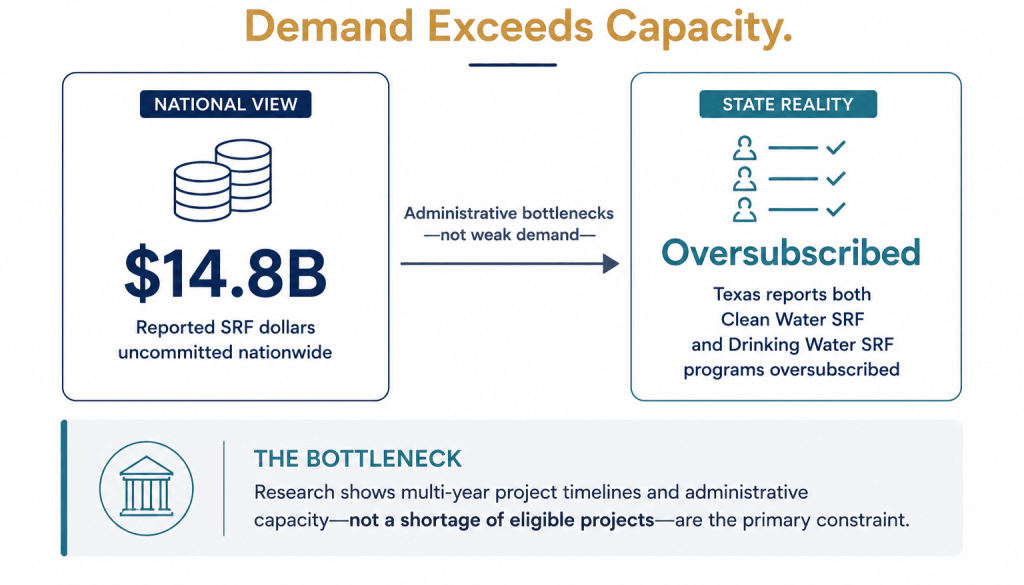
The scale of that gap is real: even with a reported $14.8 billion in “uncommitted” SRF dollars nationally, states like Texas report both their Clean Water and Drinking Water SRF programs heavily oversubscribed. The uncommitted balance isn’t a sign of weak demand; research from the Environmental Policy Innovation Center shows the bottleneck is usually administrative capacity and multi-year project timelines, not a shortage of eligible projects competing for the money.
Utilities can improve their competitiveness by:
- Designing projects to maximize state ranking criteria, including public health, compliance, affordability, and environmental benefits.
- Submitting applications early in the funding cycle before available allocations become oversubscribed.
- Structuring projects into phases, allowing partial funding to support immediate progress while additional funding is pursued later.
- Monitoring state Intended Use Plans (IUPs) to understand annual funding priorities and scoring methodologies.
As Deirdre Finn, Executive Director of the Council of Infrastructure Financing Authorities, noted:
“Post-pandemic construction costs have risen roughly 40%, meaning BIL funding does not stretch as far as originally anticipated.”
This makes a well-prepared, strategically positioned application more important than ever.
Challenge 5: Securing Better Financing Terms
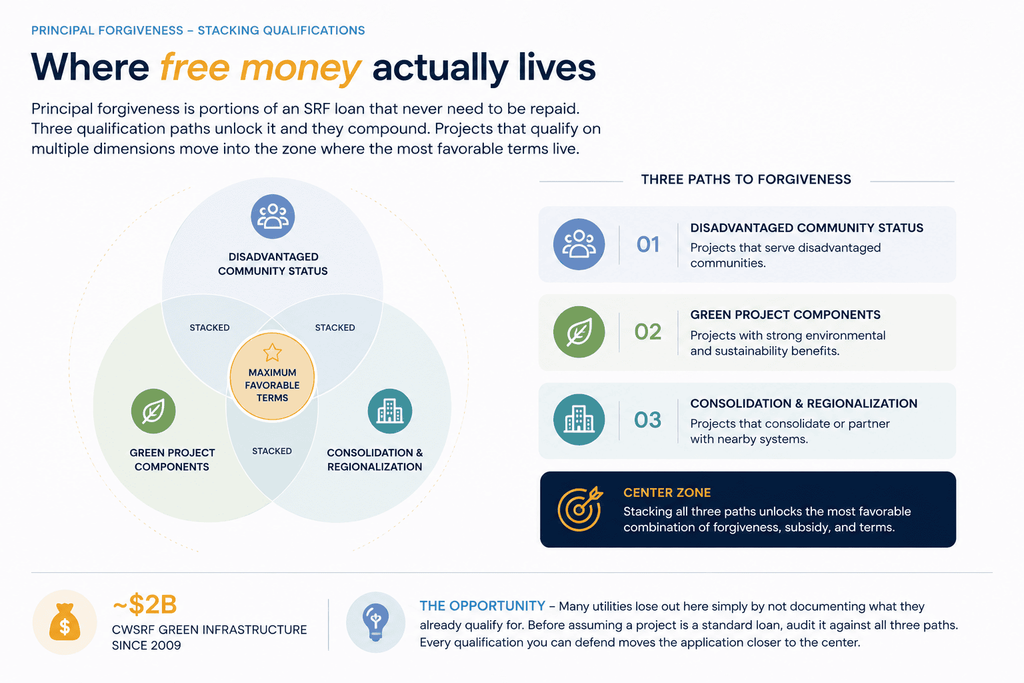
Many utilities focus primarily on obtaining funding but overlook opportunities to secure principal forgiveness, lower interest rates, or other favorable financing terms. Understanding how states prioritize applicants can significantly improve both funding success and long-term project affordability.
Utilities should carefully evaluate:
- Disadvantaged Community Eligibility: Each state applies its own criteria, including median household income, affordability metrics, unemployment, population trends, and socio-economic indicators. Properly documenting eligibility can improve access to principal forgiveness and reduced interest rates. The Environmental Policy Innovation Center (EPIC) notes that while definitions differ across states, many are refining their criteria to better direct assistance toward disadvantaged communities.
- Green Project Components: Many SRF programs provide preferential financing for projects incorporating energy efficiency, water conservation, green infrastructure, or environmentally innovative technologies. Since 2009, the Clean Water State Revolving Fund (CWSRF) has directed nearly $2 billion toward green infrastructure projects. Even relatively small sustainability components can strengthen a funding application.
- Regionalization and System Consolidation: Projects involving regional partnerships or the consolidation of struggling water systems often receive higher priority because they improve long-term operational sustainability. Utilities should evaluate opportunities to collaborate with neighboring systems before pursuing standalone projects.
By understanding how states evaluate these factors, utilities can often secure more favorable financing terms while improving the overall competitiveness of their applications.
According to the EPA, initial planning should precede funding applications, and projects that are well-prepared to move forward are favored, considering limited funding availability for BIL projects.
Because these challenges span funding criteria, deadlines, documentation, and program requirements, many utilities are turning to data-driven tools to manage the process more strategically.
Programs like AquaIntel’s Utility Fund Tracker provide comprehensive views of federal and state financing options, identifying combinations that maximise grants while minimising rate impacts. Utilities that access SRF funding consistently treat it as an ongoing strategic process rather than a one-time effort.
The SRF programs offer low rates, long terms, and in qualifying cases, funds that require no repayment. Utilities that understand the process, tailor applications to their state’s requirements, and use available resources are well-positioned to make the most of them.
If you found this article valuable, you might also enjoy.The Funding Crisis That Isn’t Actually About Money. Why America’s Small Water Utilities Keep Missing Millions in Available Funding, where we take a deeper look at another challenge faced by water utilities and shaping the future of the water utility market.