
Identifying a promising utility or project is only half the battle. The real competitive advantage comes from what you do next. This is the stage where most vendors either create momentum or lose it altogether.
You’ve done the homework. You’ve identified a utility showing early signs of a capital project, whether through board discussions, funding applications, asset failures, or updates to its capital improvement plan. The temptation is to immediately reach out with a product pitch. But at this stage, the utility isn’t looking for vendors, it is still defining the problem, evaluating options, securing funding, and building internal consensus.
Your goal isn’t to sell. It’s to understand. Before the first conversation happens, you need a complete picture of the utility’s priorities, financial constraints, stakeholders, and decision-making process. The better your homework, the more valuable every future interaction becomes.
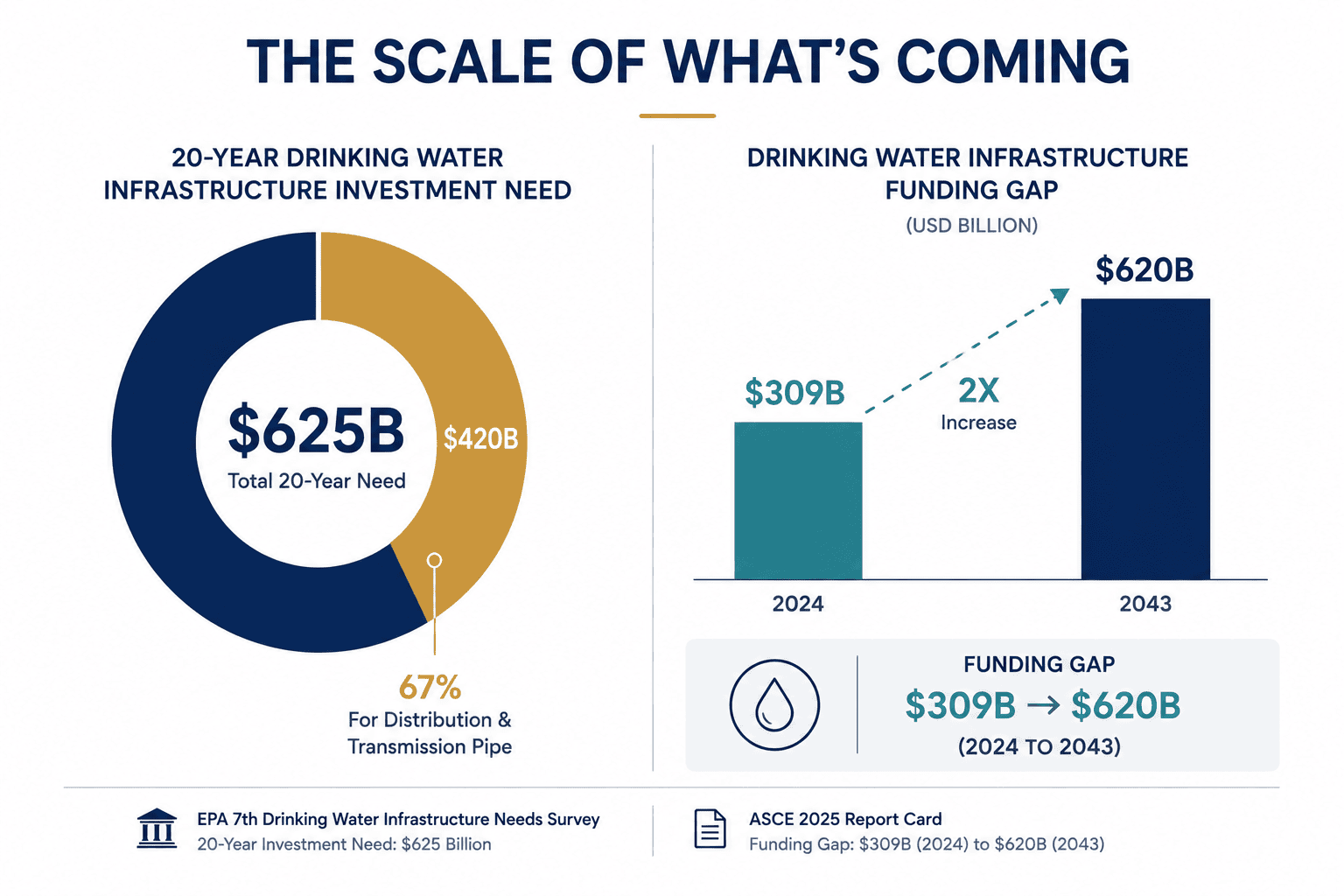
The scale of what’s coming makes this preparation worthwhile. EPA’s 7th Drinking Water Infrastructure Needs Survey estimates that U.S. drinking water systems will require $625 billion in infrastructure investment over the next 20 years, a 32% increase from the previous survey with more than $420 billion needed for transmission and distribution pipelines alone. Meanwhile, ASCE’s 2025 Infrastructure Report Card gives U.S. drinking water infrastructure a C- and estimates the industry’s funding gap will grow from $309 billion in 2024 to $620 billion by 2043. The opportunity is enormous, but so is the competition. Winning increasingly depends on engaging long before procurement begins.
Verify the Signal, Build Context, and Qualify the Opportunity
Prior to any attempt at outreach, the opportunity must be validated as legitimate, and sufficient context must be gathered so that the opportunity can be understood well enough to be maximally beneficial. This is what is referred to as enrichment. The step-by-step approach to enrichment is:
- Cross-referencing signals from different sources
- Building a comprehensive profile of the utility’s current assets and challenges
- Identifying related past projects and their implementation approaches
- Researching the utility’s financial capacity and typical funding mechanisms
It’s what allows your first conversation to start from “we understand what you’re dealing with” rather than “let me tell you about our product.” The former opens doors. The latter closes them.
Context alone isn’t enough. Early identification also gives vendors something they rarely have during a traditional procurement process: the ability to choose which opportunities are actually worth pursuing.
The window for this kind of selectivity is real. Pre-RFP signals often appear in budget documents, board agendas, engineering studies, and capital improvement plans 12 months or more before procurement begins, while many utility Capital Improvement Plans (CIPs) span 5 to 20 years. The information exists long before the RFP, it simply needs to be connected.
That means every identified project should also be qualified before significant sales resources are committed.
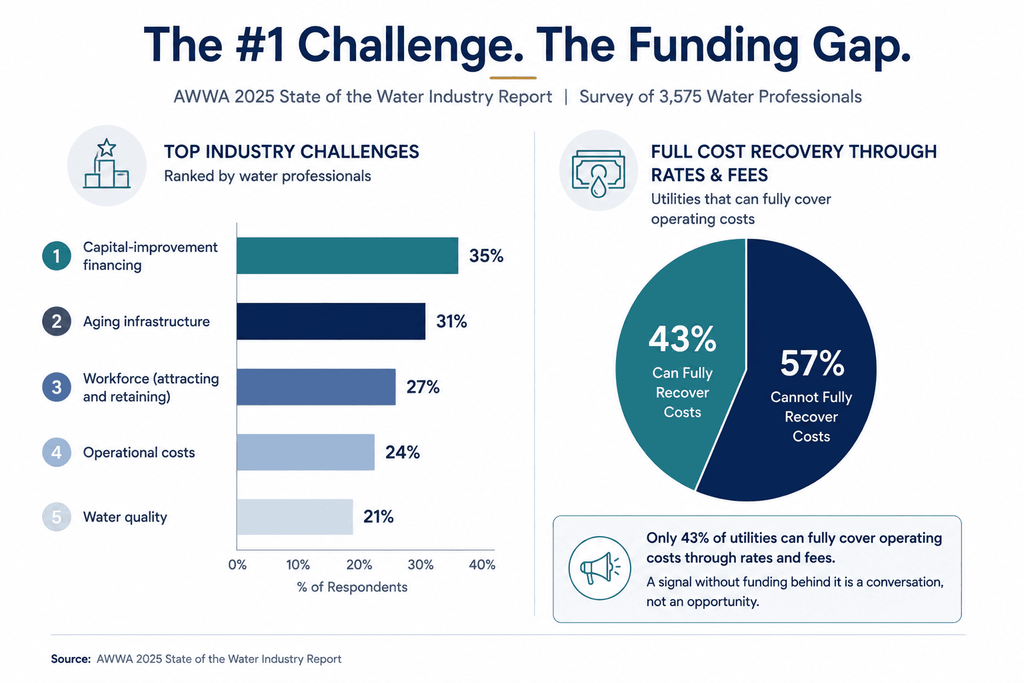
AWWA’s 2025 State of the Water Industry Report, based on responses from more than 3,500 water professionals, identified capital financing as the industry’s single biggest challenge, ranking ahead of aging infrastructure itself. The survey also found that only 43% of utilities fully recover operating costs through rates and fees. In other words, a signal without funding behind it is simply a conversation not yet an opportunity.
Map the right stakeholders
Before any outreach, develop a comprehensive water utility decision-making stakeholder network understanding of the decision ecosystem. Early-stage projects involve a completely different cast of people than active procurements, and misreading this is one of the most common ways early engagement efforts fall apart.
As Susan Moisio, Global Water Leader at Jacobs Engineering, puts it:
“The decision-making infrastructure at utilities is often more complex than the physical infrastructure they manage. Understanding those networks is critical to effective early engagement.”
What this mapping looks like in practice:
- Identifying the full network of influencers and decision-makers
- Researching stakeholders’ backgrounds, priorities, and previous positions
- Mapping reporting relationships and committee structures
- Analyzing past project approvals to understand typical decision patterns
Early-stage projects typically start with operations staff who are closest to the problem, then expand to engineering and finance as the project develops shape. If you’re starting with the procurement director, you’ve already misread the room.
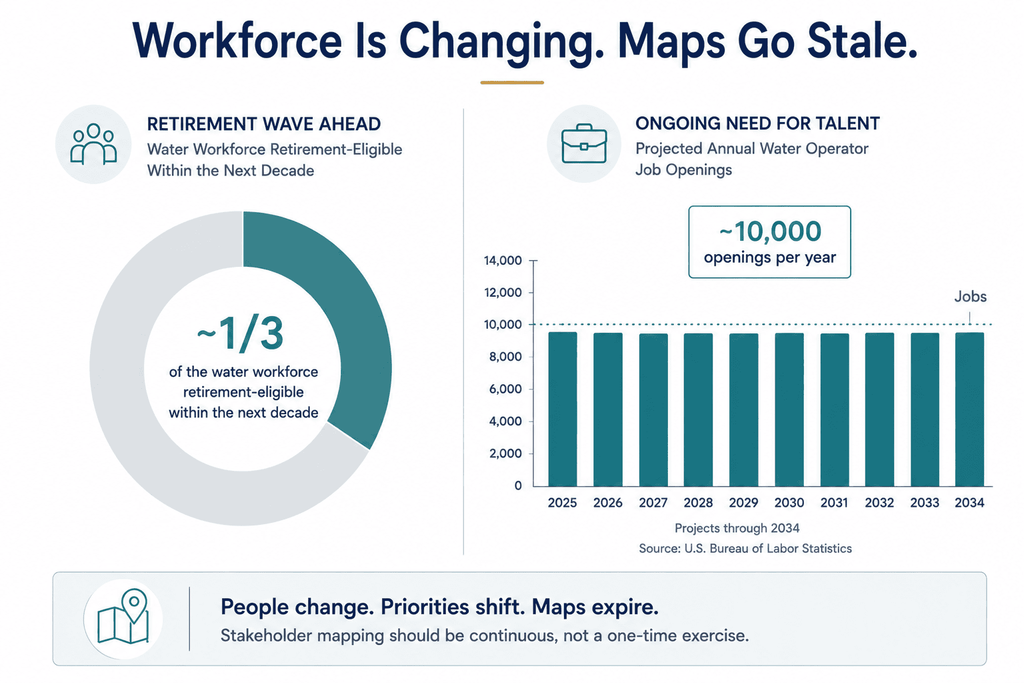
These maps also go stale faster than most vendors realize. Roughly a third of the water workforce becomes retirement-eligible within the next decade, and BLS projects around 10,000 water operator openings per year through 2034. A stakeholder map built eighteen months ago may already be missing the people who now own the problem treat mapping as a continuous process, not a one-time exercise.
Lead with education, not product
This is the part that makes the biggest difference and that most vendor teams resist the most. Early engagement should not look like selling. Develop a tailored approach focused on utility needs rather than product features:
- Craft educational content addressing the specific challenges you’ve identified for the utility
- Prepare case studies from similar utilities facing comparable issues
- Develop ROI analysis based on the utility’s actual operational context instead of generic benchmarks
- Create phased implementation scenarios aligned with potential funding sources
Early engagement should focus on education and problem exploration rather than explicit selling, positioning your organization as a trusted advisor.
Build presence across the organization through multiple touchpoints
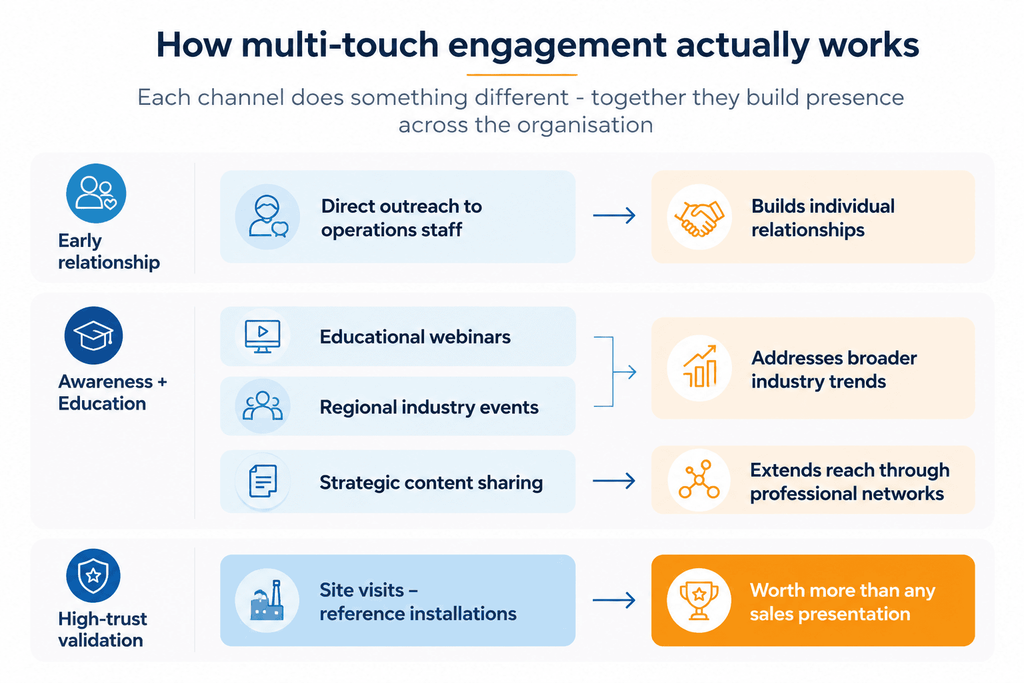
Successful water utility vendor relationship strategies don’t rely on a single relationship. It creates multiple touchpoints, gradually building relationships across the organization rather than focusing on a single contact. The practical channels:
- Direct outreach to operations staff facing the identified challenge
- Educational webinars addressing broader industry trends related to the issue
- Participation in regional industry events attended by the utility
- Strategic content sharing through professional networks
- Site visits to reference installations addressing similar challenges
Each of these does something different. Direct outreach builds individual relationships but events build organizational awareness. The reference visits let the utility’s own team see your solution working in a real-world context which is worth more than any sales presentation.
What this looks like when it works
One of our clients (water utility infrastructure vendor) used data intelligence to identify South Florida’s Water District’s emerging concerns with disinfection byproducts two years before any regulatory violations occurred, through analysis of water quality reports and board meeting minutes.
- Rather than pitching, they engaged the operations director with educational material on treatment alternatives. When testing confirmed increasing DBP levels six months later, BlueTech had already established themselves as knowledgeable advisors.
- They worked collaboratively with the district engineer to evaluate options, conducted jar testing at no cost, and helped document grant eligibility for their solution. Their early collaboration helped ensure the final specifications reflected current technology capabilities and the utility’s operational requirements. They won the $1.2 million contract against three competitors who were engaging for the first time at the RFP stage.
The following example is based on real-world scenarios. Names, figures, and identifying details have been modified to protect client privacy.
How AquaIntel Makes Early Engagement Systematic
Executing this playbook manually is possible but it is rarely scalable. Every opportunity requires monitoring dozens of information sources, connecting scattered signals, identifying stakeholders, and continuously updating utility profiles. Doing this across hundreds or thousands of utilities quickly becomes impossible.
AquaIntel systematizes this process through four connected steps:
1. Identify early signals.
Continuously monitor board meetings, capital improvement plans, funding announcements, regulatory filings, consultant activity, and other public sources to identify projects long before procurement begins.
2. Build complete utility intelligence.
Transform individual signals into a comprehensive utility profile by combining infrastructure data, funding history, operational challenges, stakeholder networks, consultant relationships, and historical procurement patterns.
3. Prioritize the right opportunities.
Evaluate each project based on funding probability, project maturity, strategic fit, competitive landscape, and potential value so sales teams focus where they are most likely to win.
4. Enable informed engagement.
Equip sales teams with the context they need before every conversation—from likely decision-makers and project drivers to funding pathways and similar historical projects—so outreach starts with insight rather than introductions.
Early engagement isn’t about contacting utilities earlier. It’s about showing up better prepared than everyone else.
And that preparation begins with the homework. AquaIntel helps vendors do that homework continuously, so by the time the first conversation happens, they already understand the project, the people behind it, and the path to procurement.