
Where Data Intelligence Changes the Equation
The vendors who consistently outperform in the water utility market share one characteristic: they know considerably more about their target utilities than those utilities might expect. They are not simply responding to procurement opportunities. They are anticipating them.
While many vendors begin engaging only after an RFP is released, the strongest performers recognise that procurement is merely the final stage of a decision-making process that often begins years earlier. By the time specifications are written, funding has been discussed, operational needs have been identified, and relationships with trusted advisors have already begun to form. Vendors who enter only at this stage are rarely competing on equal footing.
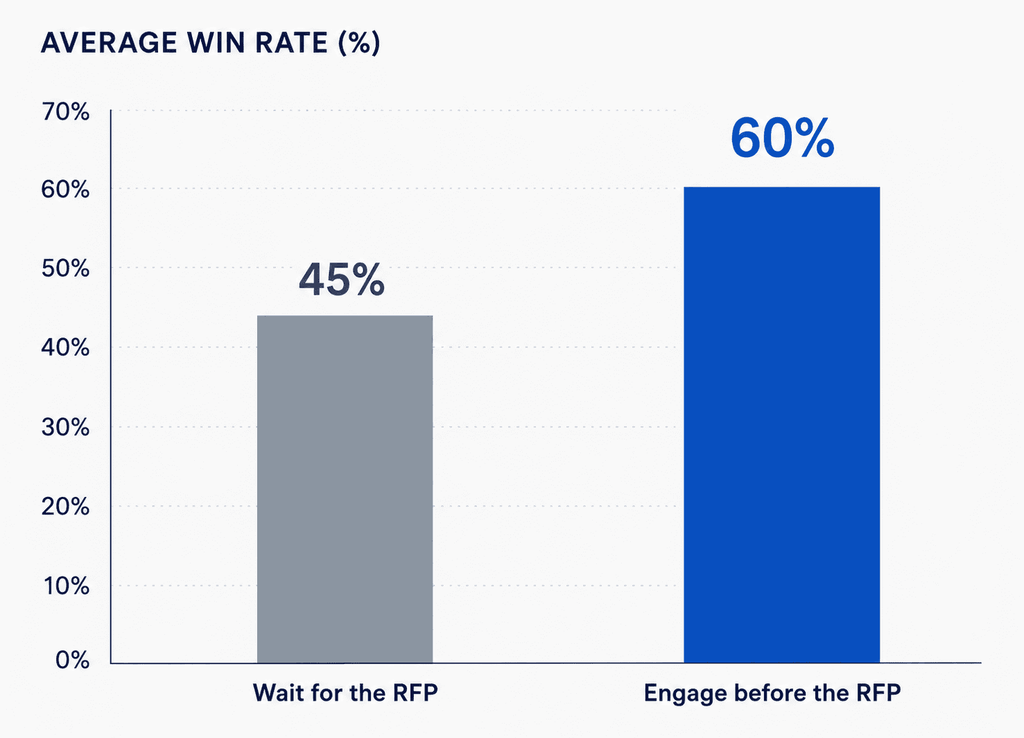
This shows up directly in outcomes: across public-sector procurement, vendors who engage before a solicitation is published see win rates near 60%, compared to roughly 45% for those who wait for the RFP.
Instead, successful vendors build intelligence long before procurement begins. They continuously monitor utilities, map stakeholder networks, and align their engagement with capital plans, regulatory pressures, and funding timelines. None of this is left to chance because in a market where projects can take years to materialise, informed timing is often as valuable as technical capability.
Building Intelligence Before Opportunities Become Procurements
Modern data intelligence platforms have transformed what was once a manual process into a systematic one. Rather than waiting for procurement notices, they monitor thousands of public information sources to identify projects one to five years before an RFP appears.
This intelligence is assembled from a wide range of publicly available information, including:
- Capital Improvement Plans
- State Revolving Fund (SRF) applications and awards
- Board meeting discussions around infrastructure priorities
- Regulatory compliance challenges that are likely to drive future investment
The advantage is not simply knowing that a project exists. It is understanding why it exists, when it is likely to move forward, how it will be funded, and which operational challenges are shaping the utility’s priorities.
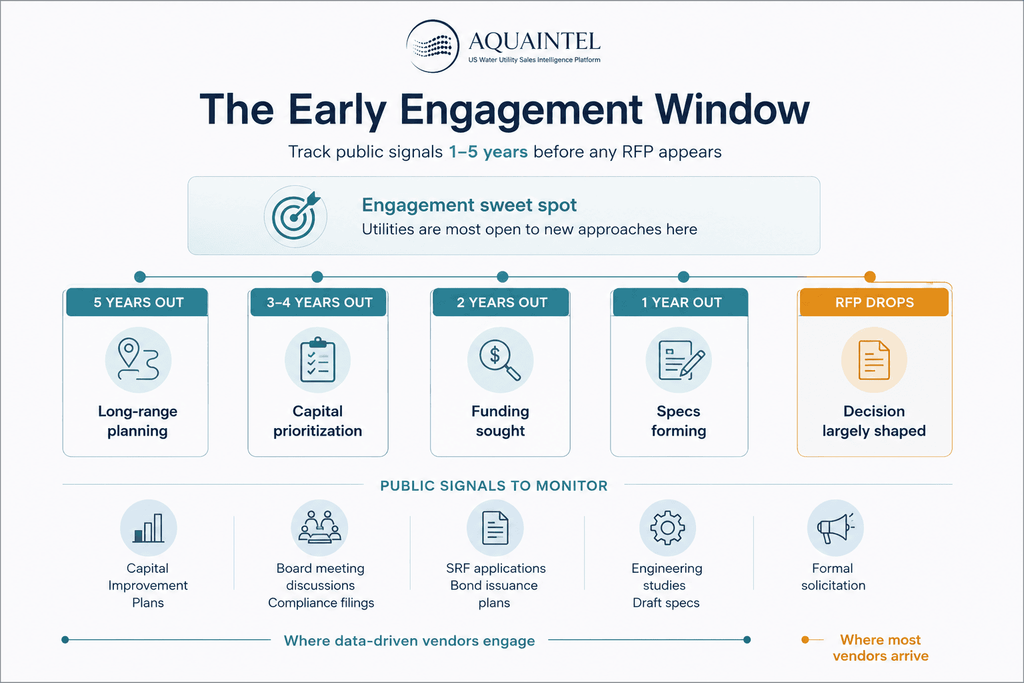
Early visibility creates something far more valuable than additional sales time, it creates the opportunity to build credibility while utilities are still exploring potential approaches, long before procurement specifications narrow the field of possible solutions.
Understanding the Utility Better Than the Utility Understands Itself
Project intelligence is only one part of the equation.
Leading platforms also build comprehensive utility profiles by consolidating information on asset inventories, operational performance, financial health, regulatory compliance, capital investments, and historical infrastructure decisions. The resulting picture allows vendors to understand not only what a utility is planning, but also the broader operational context behind those decisions.
Ironically, many utilities struggle to assemble this same picture internally.
According to Trinnex, 90% of utilities cannot easily access their own operational data because it remains fragmented across disconnected IT systems, spreadsheets, and paper records. Nearly half report that these data challenges directly limit their ability to manage operations and maintenance effectively.
This creates an unexpected opportunity. Vendors who arrive with a well-informed understanding of a utility’s operational landscape can contribute meaningful insights from the very first conversation. Instead of beginning with a product demonstration, they begin with an informed discussion about the utility’s existing challenges and future priorities.
Intelligence Only Creates Value When It Shapes Engagement
Knowing more about a utility is valuable only if that knowledge changes how vendors engage with it.
One of the most overlooked aspects of utility procurement is that purchasing decisions are rarely made by a single individual. Engineering teams, operations staff, finance departments, executive leadership, consultants, and elected officials all influence major infrastructure investments, often with very different priorities.
Sophisticated intelligence platforms therefore extend beyond project identification to stakeholder mapping. They analyse organisational structures, reporting relationships, committee memberships, previous project approvals, and external consultant relationships to identify the broader network influencing procurement decisions.
That understanding allows vendors to tailor conversations rather than repeating a generic value proposition.
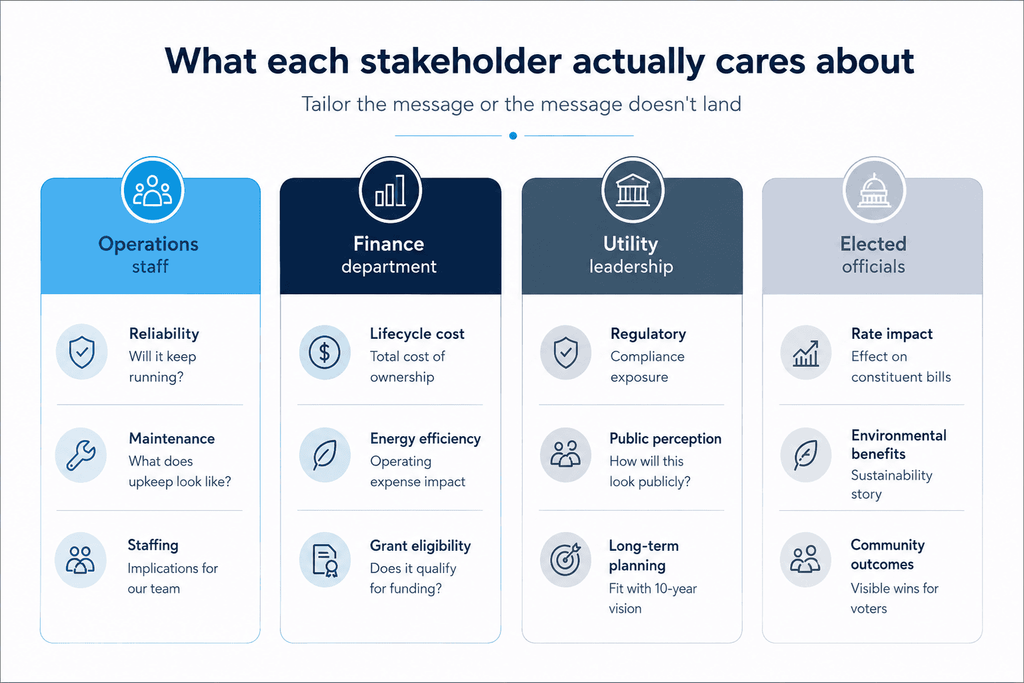
- Operations teams are primarily concerned with reliability, maintenance requirements, and staffing implications.
- Finance departments focus on lifecycle costs, energy efficiency, funding eligibility, and long-term return on investment.
- Utility leadership evaluates regulatory compliance, strategic planning, and organisational resilience,
- While elected officials often prioritise community outcomes, environmental benefits, and customer rate impacts.
The product may remain the same, but the value proposition should not. Effective engagement begins with understanding what success looks like for each stakeholder involved in the decision.
Timing Matters as Much as Technology
Even the strongest solution cannot move forward if funding is unavailable.
High-performing vendors therefore monitor more than infrastructure plans, they monitor capital availability itself. They track SRF priority systems, federal grant programmes, bond issuances, WIFIA opportunities, and project-specific funding awards to understand not only whether a project is technically justified, but whether it is financially viable.
WIFIA alone is a meaningful piece of that picture: as of early 2026, the program has closed 152 loans totaling $23 billion in credit assistance, supporting $51 billion in water infrastructure projects nationwide — financing that typically comes at below-market interest rates.
This enables conversations to occur when utilities are actively preparing to invest rather than when funding remains uncertain. Proposals aligned with actual funding availability consistently outperform those that arrive at the wrong stage of the investment cycle.
Why This Advantage Is Becoming Easier to Build
The competitive advantage described here no longer depends on maintaining large research teams or manually reviewing thousands of public documents.
McKinsey has estimated that generative AI and related technologies have the potential to automate work currently consuming 60-70% of employees’ time. In water utility sales, much of that work consists precisely of collecting, organising, and interpreting structured public information spread across planning documents, funding announcements, regulatory updates, and stakeholder records.
Rather than replacing relationship-building, these technologies allow sales teams to spend less time searching for information and more time acting on it.
This shift arrives as the industry itself faces growing complexity. Aging infrastructure, increasing operational costs, evolving regulatory requirements, and persistent data silos continue to reshape utility priorities. As infrastructure investment accelerates over the coming decade, vendors capable of understanding these pressures at the individual utility level will be positioned very differently from those relying solely on reactive sales processes.
What This Means in Practice
For vendors serious about improving performance in the water utility market, several shifts make a material difference:
- Evaluate honestly how opportunities are currently identified and whether engagement begins after key decisions have already been made.
- Expand the planning horizon to monitor projects one to five years before procurement begins.
- Build comprehensive utility profiles that combine operational, financial, regulatory, and capital planning intelligence.
- Understand funding mechanisms as thoroughly as technical specifications, including SRF programmes, WIFIA financing, grant cycles, and bond planning.
- Map the full stakeholder ecosystem rather than focusing only on formal procurement contacts.
- Assess whether existing sales processes rely primarily on manual research and individual relationships, or whether they systematically leverage available intelligence.
The water utility market has no shortage of opportunity. Infrastructure investment is growing, regulatory expectations continue to evolve, and utilities face increasingly complex operational challenges.
The difference between vendors is no longer simply the quality of their technology. It is the quality of their understanding.
The data exists. The platforms are increasingly accessible. The intelligence gap separating vendors who anticipate opportunities from those who merely react to them continues to widen.
Closing that gap is not a marginal operational improvement. It is increasingly becoming the difference between participating in procurement and shaping it.