

Every sales leader has experienced the same frustration.
You know opportunities exist. Projects are moving. Budgets are being discussed. Internal decisions are taking shape. Yet none of it appears in your CRM.
Instead, you’re managing the pipeline you can see while knowing that much of the market remains invisible. Sales forecasts are built around known opportunities, account plans revolve around existing contacts, and resource allocation depends on whatever signals happen to surface first.
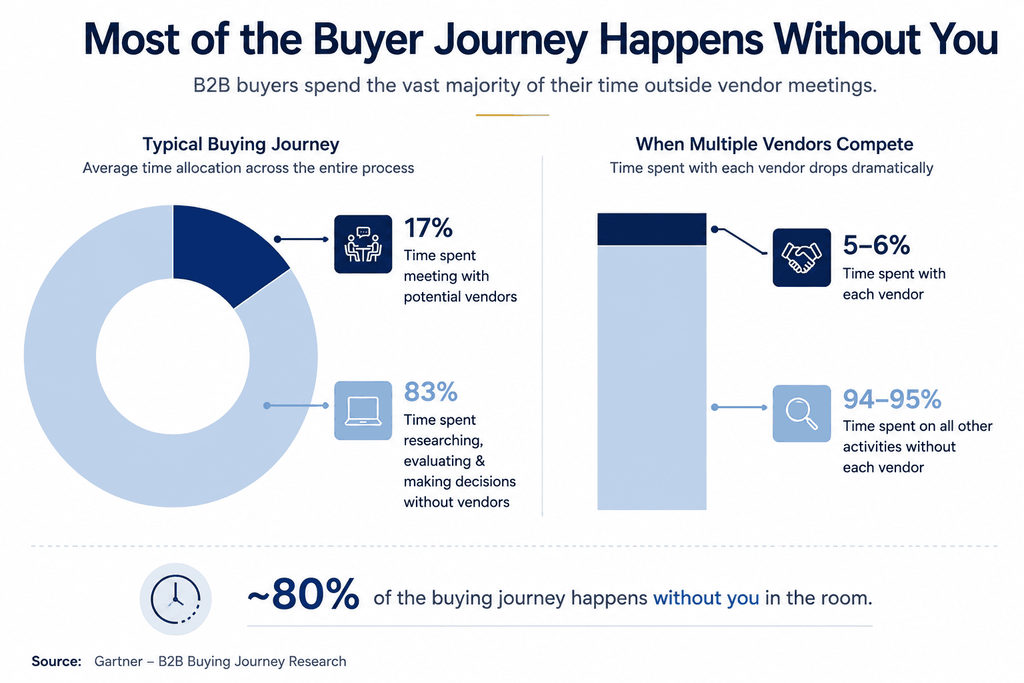
In water utility sales, Gartner’s research finds that roughly 80% of the buying journey happens without the vendor in the room, giving you minimal pipeline visibility. Nearly two-thirds of the projects, planning activity, stakeholder discussions, and investment decisions happening across target accounts remain outside their field of view.
That lack of visibility doesn’t just affect reporting. It fundamentally changes how effectively an organization can compete.
The Cost of Operating Blind
Most opportunities become visible only after they reach familiar milestones; a phone call from an existing contact, a publicly released RFP, or a project that has already entered procurement. What remains largely hidden are the months, and often years, of planning that precede those events.
The consequences ripple across the entire sales organization.
Forecasting becomes unreliable because revenue projections are built only on visible opportunities rather than the broader pipeline that is actually developing. This isn’t hypothetical concern Gartner research finds only 45% of sales managers have high confidence in the accuracy of their own pipeline forecasts, and the gap traces directly back to incomplete visibility into what’s actually happening across their accounts. Teams overestimate performance when visible deals stall and underestimate future revenue when unseen projects suddenly emerge.
Resource allocation becomes equally reactive. Without understanding which utilities are entering capital planning, securing funding, or addressing new regulatory pressures, attention naturally shifts toward the loudest signals rather than the highest-value opportunities.
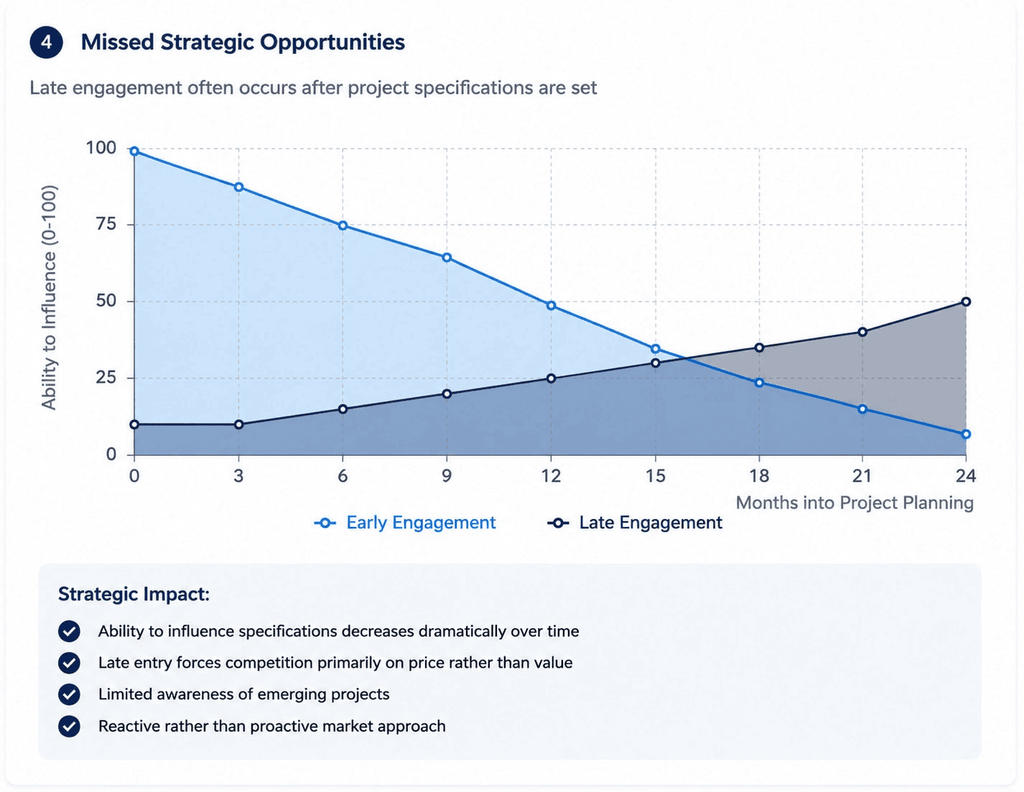
Competitive surprises become routine. A competitor wins a project you didn’t know existed. A utility you believed was inactive suddenly releases an RFP with specifications shaped by months of conversations you were never part of. By the time the opportunity becomes visible, the most influential decisions have already been made.
Perhaps most importantly, early engagement becomes impossible. If the first indication of a project is the RFP itself, vendors lose the opportunity to help shape requirements, understand stakeholder priorities, or establish credibility during the planning phase. The math explains why this matters so much: Gartner’s research on B2B buying finds that buyers spend only about 17% of their total purchasing time meeting with potential vendors and when several suppliers are competing, that drops to just 5-6% per vendor. Most of the decision happens without you in the room.
They aren’t participating in the decision. They’re responding to it.
When the Pipeline Becomes Visible
Intelligence platforms fundamentally change that picture by increasing pipeline visibility. Rather than relying solely on public procurement notices, sales teams gain continuous visibility into capital improvement plans, board meeting discussions, funding awards, regulatory developments, and other public information that signals future infrastructure investment.
Projects are no longer discovered at procurement. They are identified years earlier and transform how organizations operate.
Utilities planning major infrastructure investments can often be identified years before formal procurement begins. Capital improvement plans typically cover a 5-to-20-year horizon, and equipment suppliers and engineering firms that track these plans consistently can identify specific projects and start building relationships long before an RFP is ever issued.
That period becomes an opportunity to understand operational challenges, contribute technical expertise, build trusted relationships, and engage while specifications are still evolving.
Resource allocation becomes proactive rather than reactive. Sales leaders can see which accounts are accelerating, where competitors are becoming active, which projects require technical support, and where commercial resources will have the greatest impact.
Forecasting also becomes substantially more reliable because revenue projections are grounded in a much broader understanding of actual market activity rather than the limited portion already visible inside the CRM.
Visibility doesn’t simply improve reporting. It improves decision-making.
Why Visibility Changes Win Rates
The relationship between pipeline visibility and sales performance is remarkably direct. Teams engage earlier because they know earlier.
When projects are identified during planning rather than procurement, vendors have time to understand the utility’s challenges, develop relationships across the buying committee, and influence conversations before purchasing criteria become fixed.
The impact on outcomes is substantial.
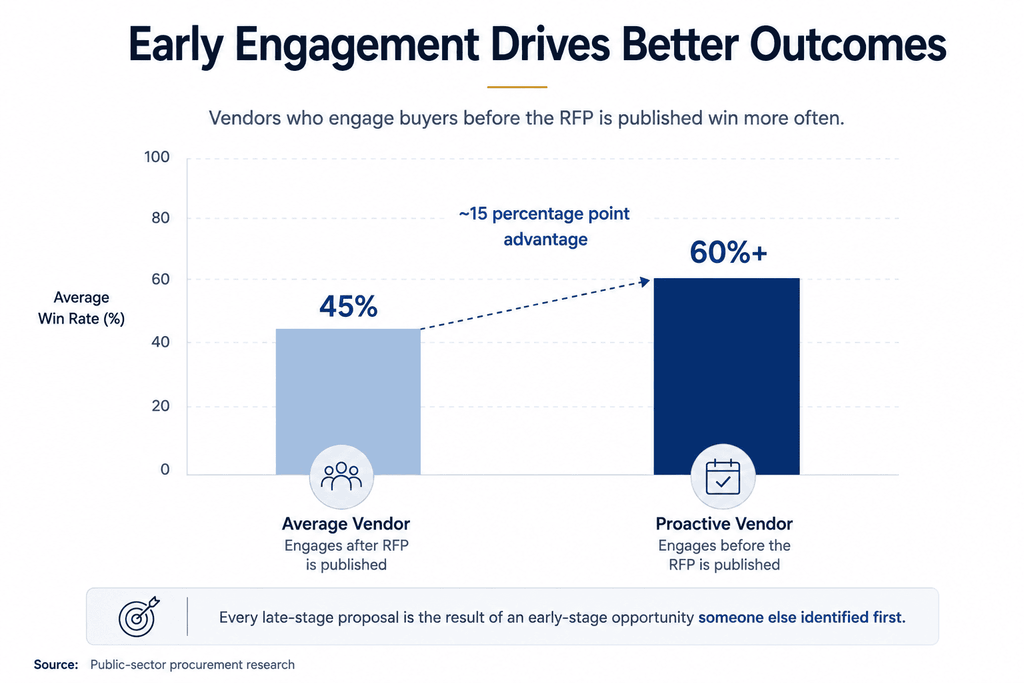
Broader public-sector procurement research backs this up directly: the average win rate for vendors sits around 45%, but vendors who engage the buyer before the solicitation is published push that closer to 60%. Every late-stage proposal is the result of an early-stage opportunity someone else identified first.
How Visibility Changes the Way Sales Teams Operate
The greatest impact of pipeline visibility extends beyond individual deals.
It changes how the entire commercial organization functions.
Instead of different teams working from different versions of reality, everyone operates from a shared understanding of the market. Sales, technical specialists, business development, and leadership can see the same opportunities, understand the same timelines, and prioritize the same accounts.
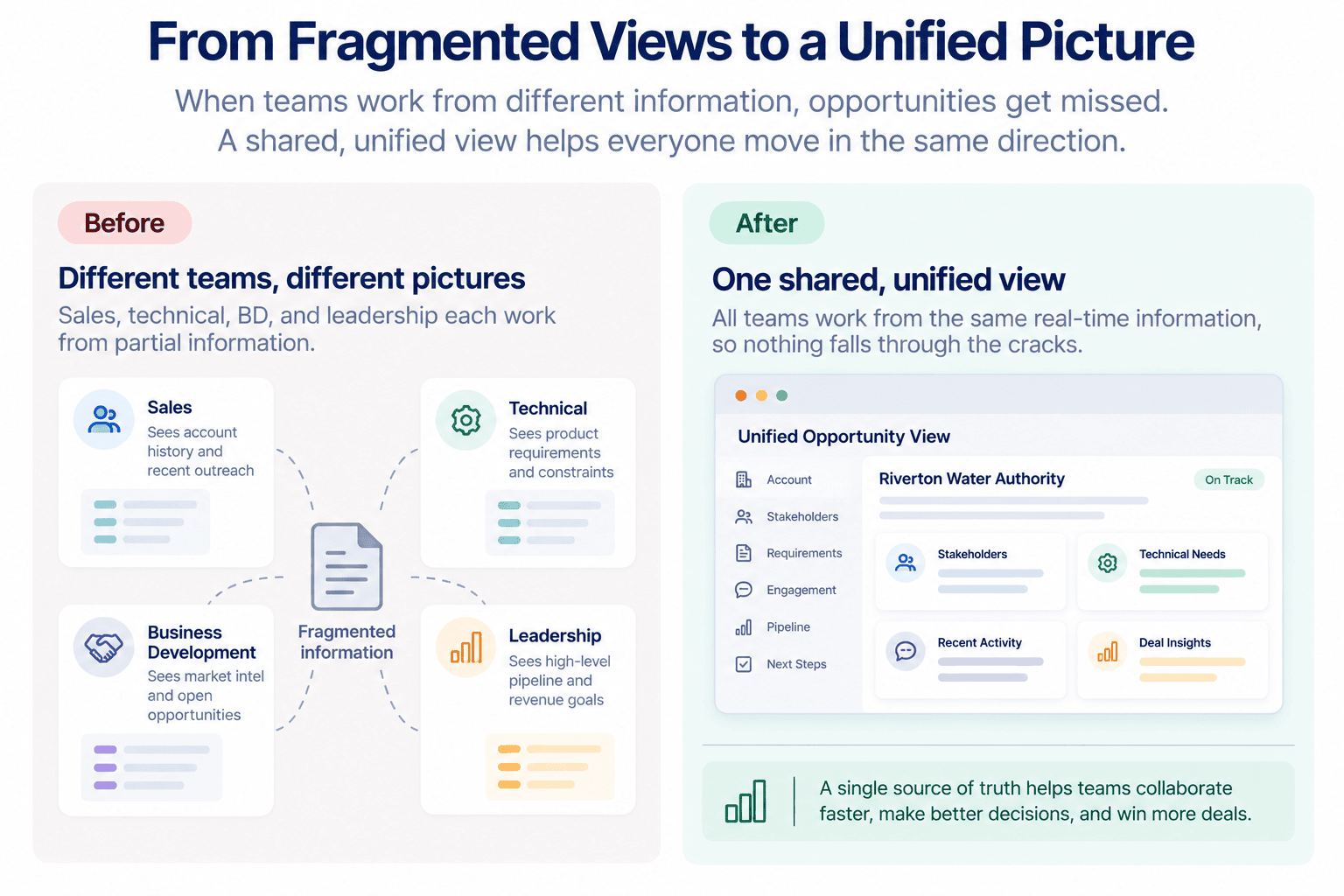
The payoff for that shift is well documented: companies with strong internal alignment achieve 19% faster growth and 15% higher profitability, while poorly aligned organizations see revenue actually drop by 4%. Misalignment isn’t a soft cost, it’s directly measurable. One estimate puts the lost productivity from teams working off different data at up to $1 trillion annually across the broader economy.
Conversations change as a result.
Sales reviews become discussions about strategy rather than debates over incomplete information. Account planning shifts from intuition to evidence. Instead of asking whether an opportunity exists, teams spend their time discussing how to win it.
Visibility also creates accountability.
Early-stage engagement can be measured. Research activity becomes transparent. High-priority accounts can be tracked to ensure they receive appropriate attention. Managers no longer rely solely on anecdotal pipeline updates because the underlying market activity is visible to everyone involved.
The organization spends less time searching for information and more time acting on it.
Visibility Is More Than a Reporting Metric
Pipeline visibility is often treated as a reporting metric.
In reality, it is a competitive advantage.
You cannot prioritize opportunities you cannot see.
You cannot influence projects you do not know exist.
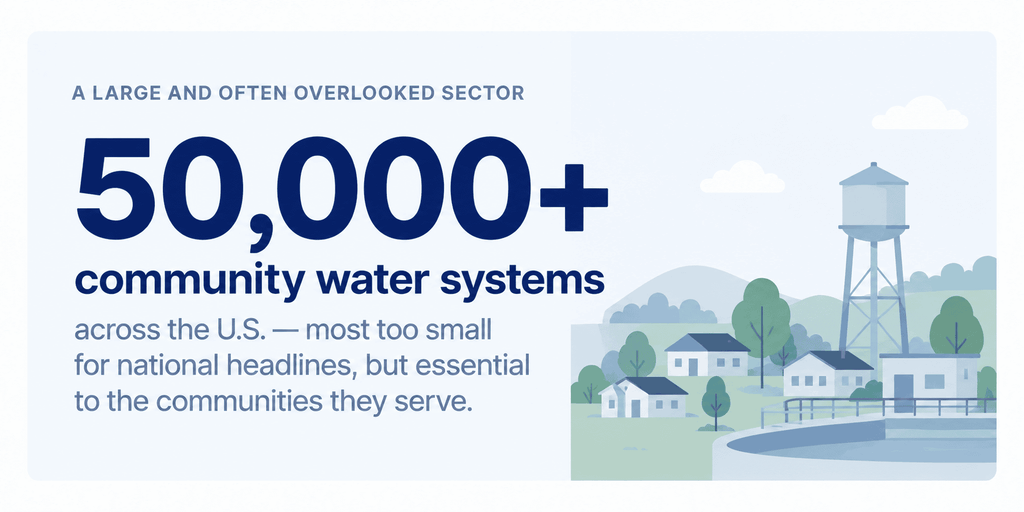
And you cannot reliably forecast a market that remains largely invisible. That market is not small. Roughly 50,000 community water systems operate across the U.S. most too small to ever generate national headlines, but each one moving through the same planning, funding, and procurement cycle. No sales team can watch that many accounts manually; visibility at scale is the only way to compete for more than a fraction of it.
Visibility does not create opportunities. It reveals the opportunities that were already there.
The organizations that consistently outperform are not necessarily selling harder than their competitors.
They are simply seeing more of the market and acting on it sooner.