
If you want to know what utilities will be doing in four years, stop looking at what’s being marketed and look at what exactly the constraints demand for. Utilities in 2030 will face the same fundamental pressures, just worse. Older pipes, less experienced staff, tighter budgets, more climate stress, tighter regulations.
The numbers already tell that story. ASCE’s 2025 Infrastructure Report Card puts the median age of the water sector workforce at 48 older than the national average across occupations with roughly a third eligible to retire within the decade. On the infrastructure side, the average U.S. water main is now around 45 years old, and even with improvement, only about 70% of utilities currently run a formal pipe replacement program. The pressures aren’t hypothetical. They’re already here, just accelerating.
The technologies that matter won’t be the flashiest. They’ll be the ones utilities simply can’t afford to operate without.
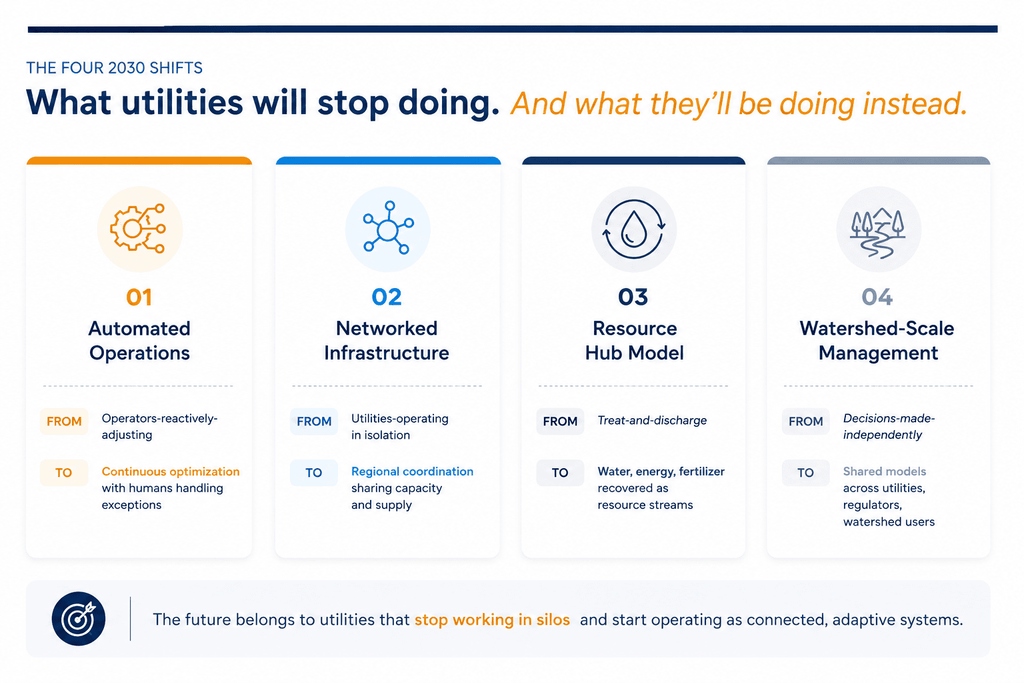
Water utilities in 2030 will move beyond isolated operations toward automation, shared infrastructure, resource recovery, and ecosystem-wide management.
Automation That Doesn’t Replace People
One significant shift observable is towards automation of routine operations. Systems can deal with the continuous optimisation of operations while humans handle exceptions and strategy.
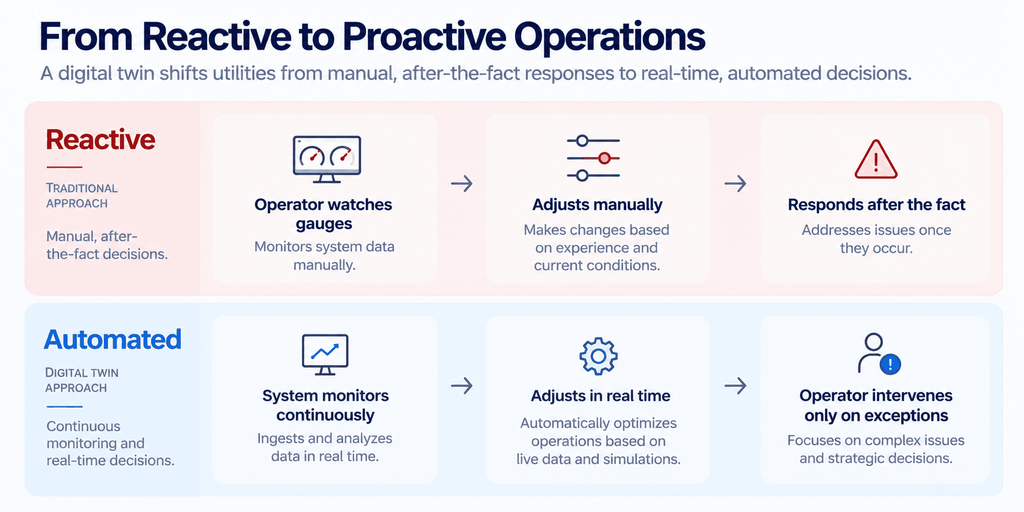
Right now, an operator adjusts pump speeds, opens and closes valves, adjusts chemical dosing, manages pressure based on experience, training, and watching gauges. That works but is reactive, you adjust based on what you’re seeing, not in anticipation.
Future systems will handle much of this automatically. If flow demand changes, the system adjusts pump speeds to maintain efficiency. If water quality shifts, the system adjusts chemical feeds to maintain compliance. If energy prices change, the system optimises when processes run to take advantage of cheaper power. An operator monitors these systems and intervenes when something unexpected happens, but routine optimisation is automated.
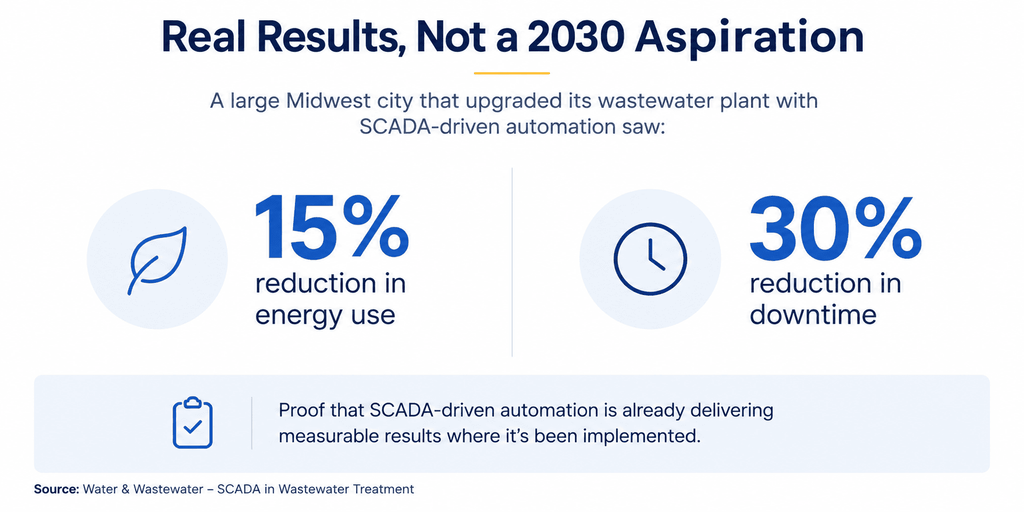
This isn’t theoretical. A large Midwest city that upgraded its wastewater plant with SCADA-driven automation saw a 15% reduction in energy use and improved effluent quality, while the system’s automated fault alerts cut downtime by 30% proof that the automation described here isn’t a 2030 aspiration, it’s already delivering measurable results where it’s been implemented.
This matters for utilities with aging staff. One person can oversee operations that historically required two or three, because the system handles heavy computational and continuous-adjustment work.
It also requires robust safeguards. Automation in critical infrastructure has to fail safely. If something breaks, the system moves into a safe state, not continuing making bad decisions. That’s being learned from failures in other sectors, making implementations more careful and better designed.
From Independent Utilities to Connected Water Networks
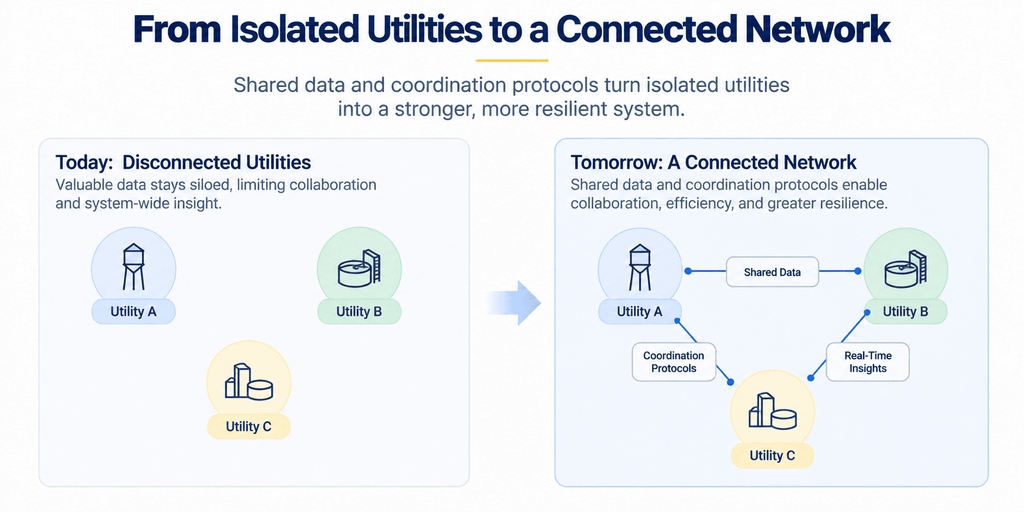
Today, most water utilities operate as independent systems. Utility A manages its treatment plant, distribution network, and customers. Utility B does the same. Even neighbouring utilities often function in isolation, each responding to its own operational challenges despite sharing the same regional water resources.
This independent model of utilities is beginning to change. The next generation of water infrastructure won’t simply make individual utilities smarter—it will make them better connected.
Imagine a neighbouring utility experiencing an unexpected equipment failure. Instead of managing the disruption alone, surrounding utilities could temporarily increase supply until repairs are complete.
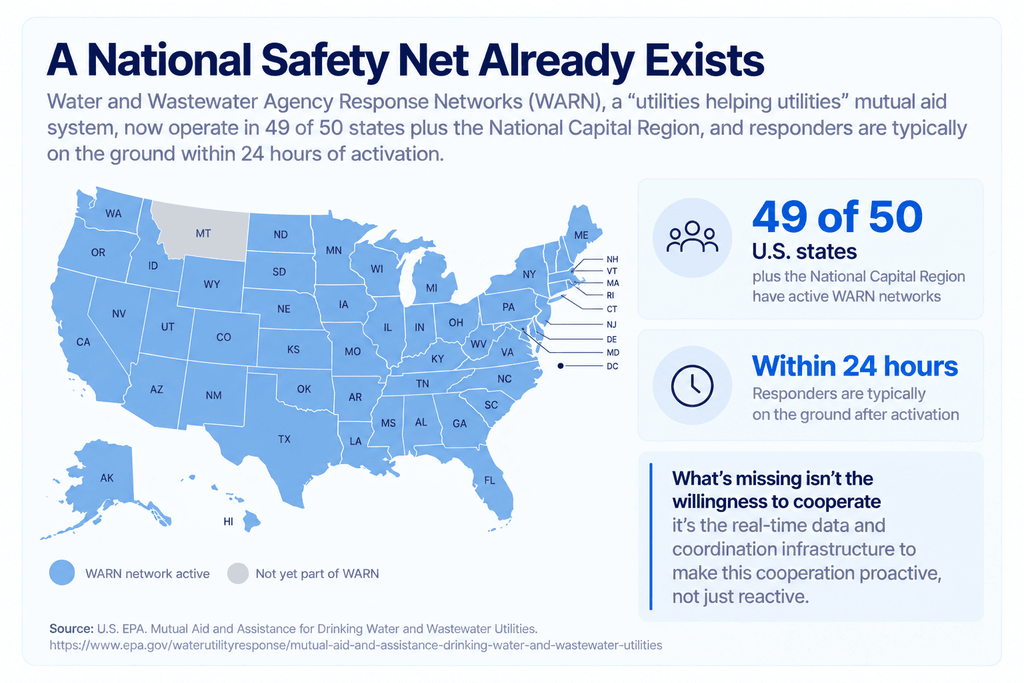
This isn’t purely hypothetical; the foundation already exists. Water and Wastewater Agency Response Networks (WARN), a “utilities helping utilities” mutual aid system, now operate in 49 of 50 states plus the National Capital Region, and responders are typically on the ground within 24 hours of activation. What’s missing today isn’t the willingness to cooperate, it’s the real-time data and coordination infrastructure that would let that cooperation happen proactively, before a failure occurs, rather than reactively, after one already has.
During periods of drought, regional systems could coordinate water transfers to direct limited resources where they’re needed most. During floods or other extreme weather events, utilities could work together to balance flows and minimise disruption across the network.
The technology to enable this coordination is rapidly maturing, but technology alone isn’t enough. Regional collaboration depends on standardized data, interoperable communication systems, shared operating protocols, and, perhaps most importantly, trust between utilities willing to manage resources collectively rather than independently.
For decades, water infrastructure has been managed as thousands of individual systems solving individual problems. Increasingly, it will operate as interconnected regional networks capable of sharing information, coordinating resources, and responding collectively to challenges that no single utility can address as effectively on its own.
The result is infrastructure that is not only more efficient, but substantially more resilient.
From Water Provider to Resource Manager
For decades, the role of a water utility was relatively straightforward: treat water, deliver it safely, collect wastewater, treat it again, and discharge it. That linear model is steadily giving way to something far more dynamic.
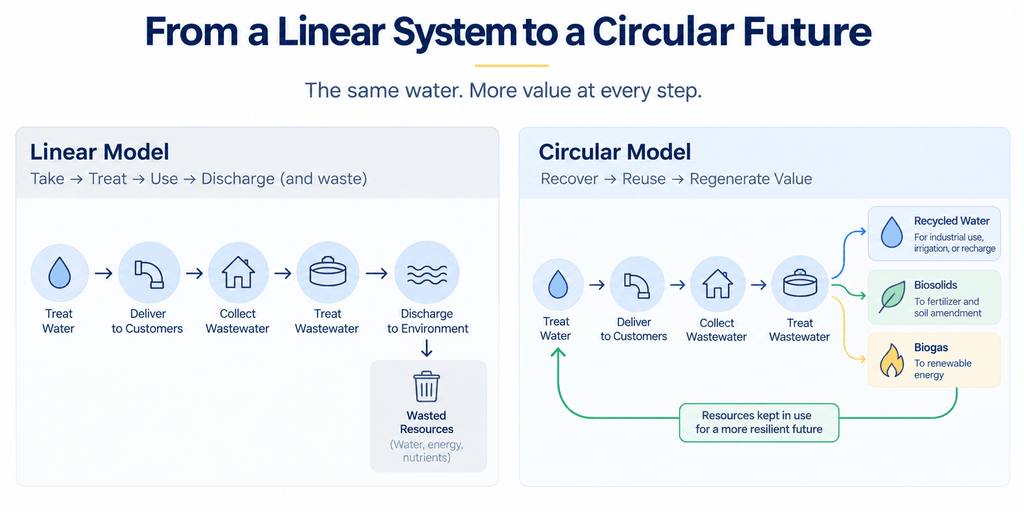
Forward-looking utilities are beginning to view every output of the treatment process as a potential resource rather than waste. Treated wastewater becomes a source of water for irrigation, industrial processes, or groundwater recharge. Biosolids become marketable fertilisers. Biogas generated during wastewater treatment becomes renewable energy capable of offsetting operating costs or powering utility operations.
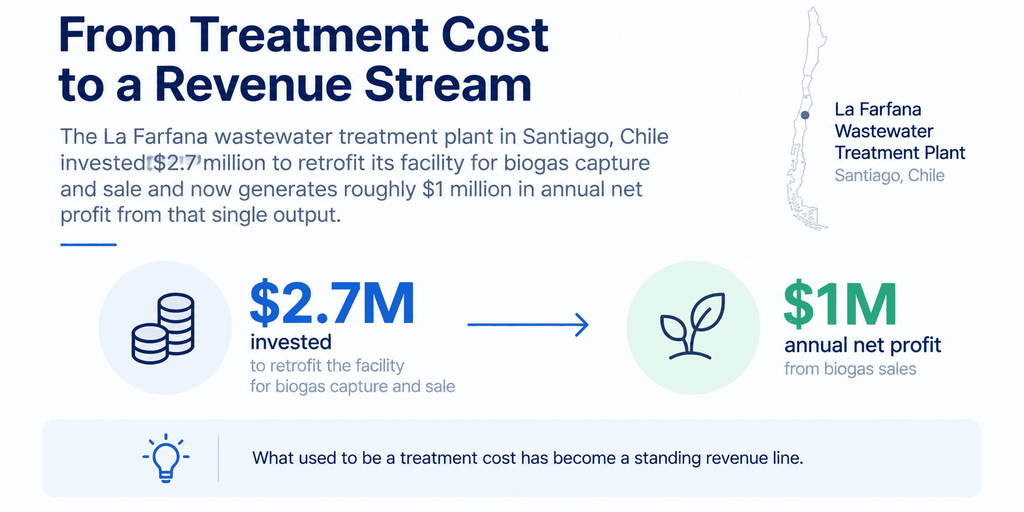
This isn’t a hypothetical revenue stream. The La Farfana wastewater treatment plant in Santiago, Chile invested $2.7 million to retrofit its facility for biogas capture and sale and now generates roughly $1 million in annual net profit from that single output. What used to be a treatment cost has become a standing revenue line.
This shift isn’t simply about sustainability. It is fundamentally changing how utilities think about the assets they already own.
Managing these interconnected resource streams, however, is far more complex than managing a traditional treatment plant. Energy generation depends on treatment performance, demand for recycled water and biosolids fluctuates over time, requiring utilities to continuously balance supply, quality, market demand, and operational priorities. That level of coordination is difficult to achieve manually.
Intelligence platforms are beginning to make it possible by bringing these previously disconnected streams together into a single operational view. Instead of managing drinking water, wastewater, biosolids, and energy as separate activities, utilities can optimize them as parts of one integrated system.
This transformation is already underway. Washington, D.C.’s Blue Plains Advanced Wastewater Treatment Plant generates renewable energy and produces marketable biosolids, while many California utilities increasingly manage groundwater, recycled water, stormwater, and surface water as complementary resources rather than isolated supply sources.
The utilities of the future won’t simply deliver water. They’ll manage an interconnected portfolio of water, energy, and recoverable resources—extracting greater value from every part of the treatment cycle while building more resilient and sustainable systems.
What This Means for Solution Providers
The old models were straightforward: sell a product, deliver it, move on. That model no longer holds. Utilities today are not buying pumps or sensors or software licences. They are buying outcomes like reduced energy costs, extended equipment life, fewer unplanned failures, cleaner compliance records. The distinction sounds subtle, but in practice, it reshapes everything about how solution providers need to operate.
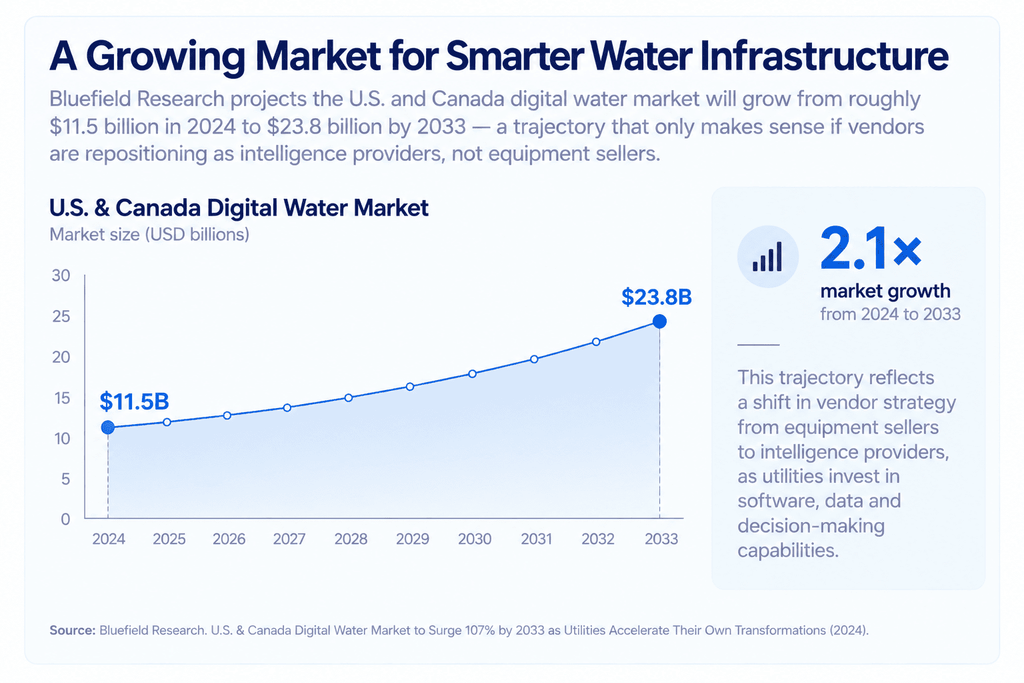
The digital water market itself reflects this shift in scale: Bluefield Research projects the U.S. and Canada digital water market growing from roughly $11.5 billion in 2024 to $23.8 billion by 2033 a trajectory that only makes sense if vendors are repositioning as intelligence providers, not equipment sellers.
It means vendors must understand utility economics as well as they understand their own technology, develop internal intelligence capabilities, know a utility’s financial position, its procurement history, its operational pain points, before walking in the door. It means building relationships that extend beyond the sale, because proving value over time is now the product.
Some traditional vendors are navigating this shift well. Others are finding it genuinely difficult, because decades of thinking like an equipment manufacturer do not easily translate into thinking like a long-term operational partner. The consolidation currently visible across the digital water market is a direct reflection of this tension: larger players acquiring analytics firms, equipment companies investing in software and services, the market reorganising itself around a new definition of what it means to be useful to a utility.
The scale of that reorganization is concrete and recent. Ecolab acquired Ovivo’s Electronics business for $1.8 billion to expand into digital treatment capabilities; ABB acquired sensor and monitoring company Real Tech; and Diehl Metering acquired PREVENTIO, an AI-powered predictive maintenance startup, to fold analytics directly into its hardware line. These aren’t isolated deals — they’re the same pattern repeating across the industry: equipment manufacturers buying their way into software and intelligence rather than building it from scratch.
The providers that come out ahead will be those that treat intelligence not as a sales tool, but as the foundation of every client relationship.
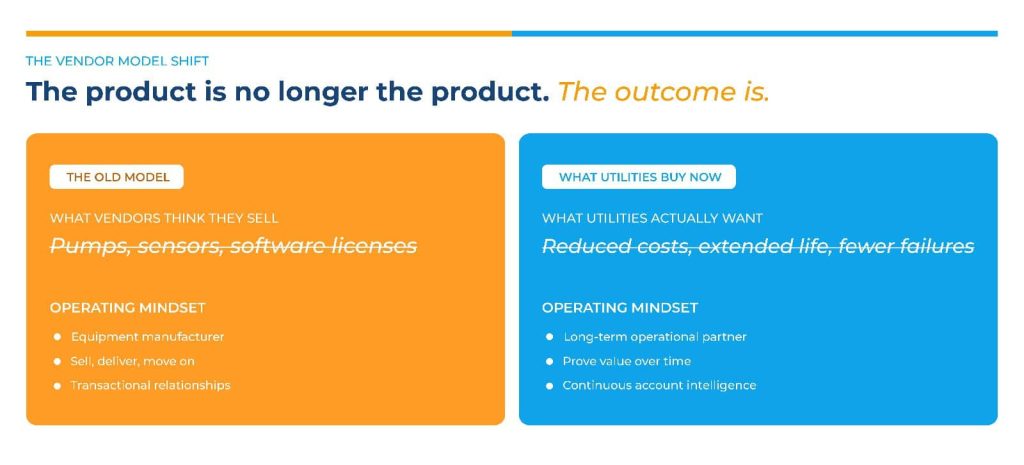
Water utilities no longer buy standalone products—they invest in partners that deliver long-term operational outcomes and measurable value.
All these changes point towards one direction: water infrastructure is becoming more intelligent, more interconnected, and more optimisation-focused. The utility of 2030 that’s succeeding, isn’t operating the way utilities operated in 2005. It’s using data and technology to do things impossible without them.
The utilities that will struggle are those trying to keep operating the old way. With older infrastructure, less experienced staff, and less money, you cannot operate efficiently.
Starting From Where You Are
Guess what? You don’t need to get to 2030 immediately and perfectly. You can proceed in this direction with whatever capacity you currently have. The key is movement. Utilities that started their digital transformation are seeing benefits now and positioning themselves for the future. Those that haven’t are falling behind.
The water sector in 2030 won’t be unrecognisable. You’ll still have pipes, plants, and people doing essential water work. But the way decisions get made, how operations are managed, and how utilities coordinate will be transformed by intelligence.
That future is not something that just ‘happens’ to utilities. It’s something utilities build, step by step, by recognising constraints and adopting tools that actually address them. It’s quite a tedious path but sticking to it will only yield wonderful things for you and the ambition fuelling you. Predictive maintenance will be one of the strongest drivers of that shift.
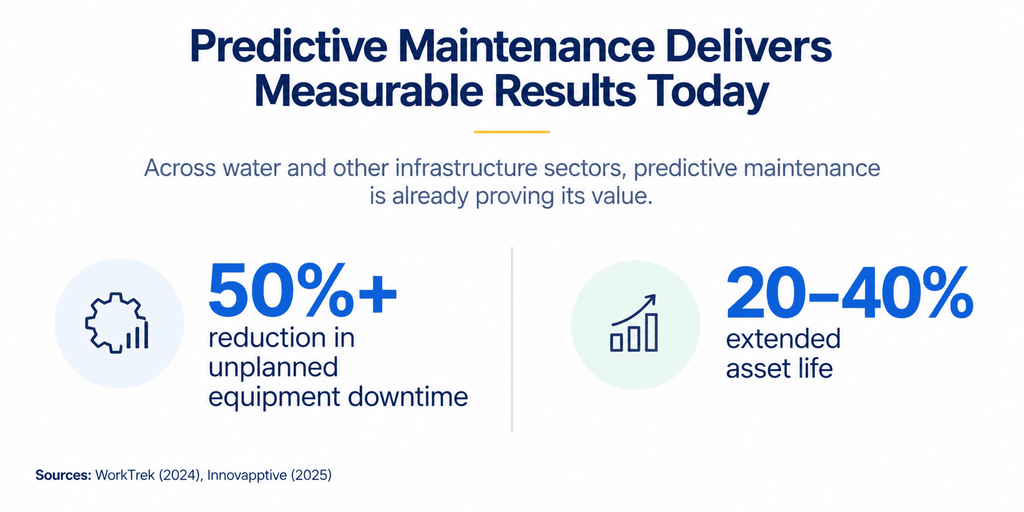
That’s not speculation, it’s already measurable. Predictive maintenance has been shown to reduce unplanned equipment downtime by more than 50% while extending asset life by 20 to 40%, with similar approaches in the energy sector cutting forced outages by as much as 40%. The utilities moving fastest toward 2030 are the ones already putting those numbers to work today.