
From Visibility to Foresight
For years, the biggest challenge facing water utilities wasn’t a lack of data. It was a lack of visibility.
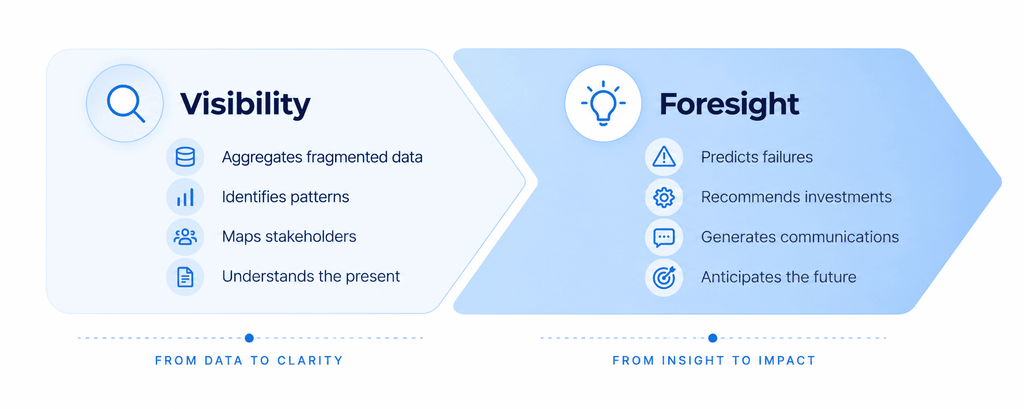
Utilities knew information existed, buried in maintenance records, inspection reports, board minutes and regulatory filings. But bringing those pieces together into something useful required enormous manual effort. The first generation of intelligence platforms emerged to solve exactly that problem. They aggregated fragmented information, identified patterns, mapped stakeholders, and gave utilities and vendors a clearer understanding of what was happening across their operations and the broader market.
That alone represented a significant step forward but the next transformation is already underway.
The competitive advantage is shifting from understanding the present to anticipating the future.
Tomorrow’s intelligence platforms won’t simply tell utilities which assets are aging or which projects are entering procurement. They will help predict equipment failures before they occur, recommend investment decisions before problems escalate and generate communications tailored to different stakeholders. In other words, intelligence is evolving from visibility to foresight.
Over the next few years, 4 technologies will drive that transition:
- Predictive asset intelligence,
- Generative AI,
- Augmented decision support and
- Digital twins.
Individually, each is impressive. But together, they represent a fundamentally different way of managing water infrastructure.
Intelligence That Predicts
Water utilities have traditionally managed infrastructure in a reactive way.
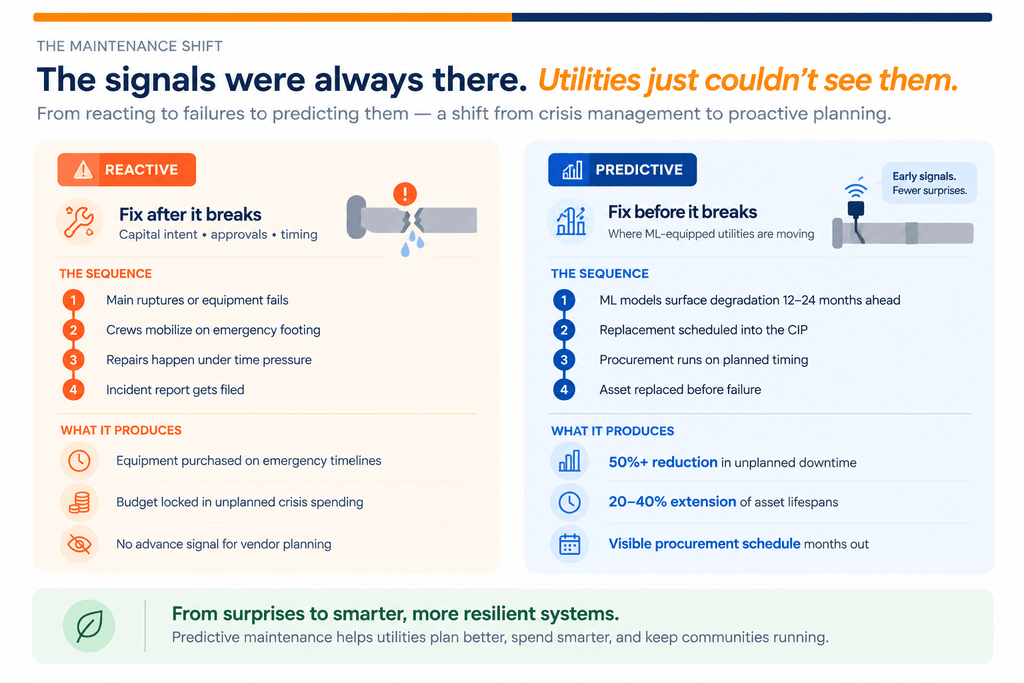
A water main breaks, crews respond, repairs are made, and the incident is documented. The problem is that failures rarely happen without warning.
In most cases, the signals have existed for months but they are scattered across different systems, buried inside maintenance logs, or too subtle for operators already managing dozens of competing priorities to notice. That is precisely where predictive intelligence changes the equation.
By combining historical asset performance, maintenance history, operational data, environmental conditions, and machine learning, modern predictive models can identify patterns that humans would struggle to detect on their own.
For Example, A section of water main may exhibit slight pressure fluctuations alongside known soil conditions and pipe age. Individually, none of those indicators appear unusual. Together, they may point to a high probability of failure within the next twelve to twenty-four months.
Predictive intelligence doesn’t replace operators. It gives them earlier visibility into problems they would otherwise discover much later. That shift carries significant operational implications.
Utilities move from emergency repairs to planned maintenance. Instead of responding to unexpected failures that disrupt operations and consume emergency budgets, they can schedule interventions during planned maintenance windows, reduce service interruptions, and allocate resources more efficiently.
The technology is becoming increasingly sophisticated in another important area as well.
Rather than relying on generic asset life tables, “replace after 50 years”, new models estimate the remaining useful life of individual assets using actual operating conditions, inspection history, maintenance records, and performance trends.
Two pumps installed on the same day may have completely different replacement timelines depending on how they’ve been operated over decades. Intelligence platforms are beginning to recognise that distinction. The benefits are already becoming measurable.
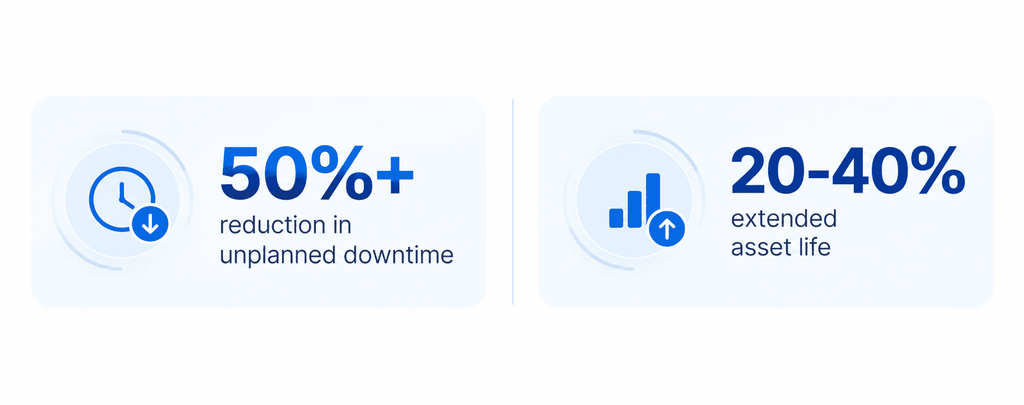
Studies suggest predictive maintenance can reduce unplanned equipment downtime by more than 50% while extending asset life by 20-40%. Similar approaches have already transformed industries such as energy, where predictive analytics have reduced forced outages by as much as 40%. Water utilities are now following a similar trajectory.
For utilities, the value is obvious: fewer emergency repairs, lower maintenance costs, and more resilient infrastructure.
For vendors, however, the implications are equally significant.
Utilities that can predict failures no longer purchase replacement equipment only after something breaks.
They purchase according to planned investment schedules supported by data. That fundamentally changes the sales conversation. Instead of responding to emergencies, vendors have the opportunity to engage months before procurement begins, helping utilities evaluate options while replacement strategies are still being developed.
The competitive advantage shifts from reacting quickly to anticipating what customers will need next. Prediction becomes more valuable than response.
Intelligence That Explains; Rise of Gen AI
Predictive intelligence tells utilities what is likely to happen. The next challenge is helping them explain those decisions to everyone else.
That is where generative AI is beginning to create value. Much of the conversation around generative AI has focused on chatbots and content creation. Within water utilities, the opportunity is far more practical.
Utilities communicate with a remarkably diverse group of stakeholders: engineers, regulators, elected officials, funding agencies, operations staff, and residents. Each group needs different information, different terminology, and a different level of technical detail.
- A funding application submitted to the EPA cannot read like a presentation to a city council.
- A public explanation of a rate increase cannot sound like an engineering report.
- A regulatory compliance update should not resemble a community newsletter.
Historically, preparing these different communications has required significant staff time, something many smaller utilities simply don’t have.
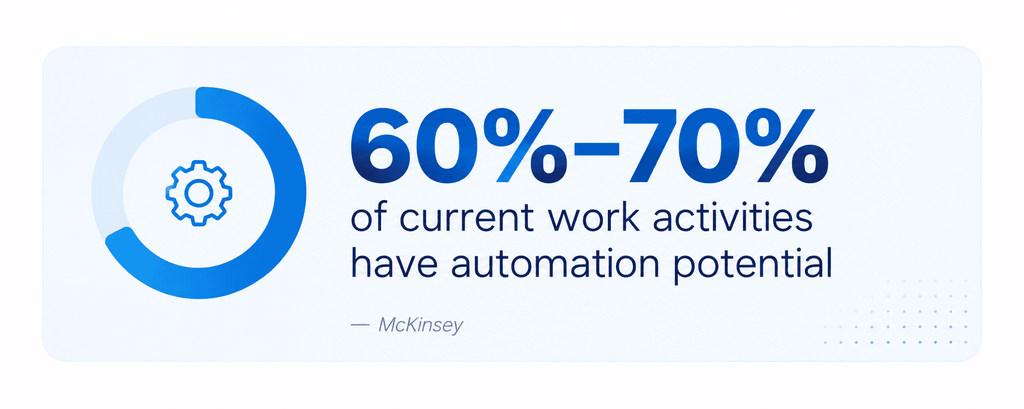
The scale of that burden is well documented outside water specifically: McKinsey estimates that generative AI and related technologies have the potential to automate work currently consuming 60 to 70 percent of employees’ time and drafting, translating, and reformatting the same underlying facts for different audiences is exactly the kind of repetitive knowledge work that estimate is built on.
Generative AI changes that dynamic.
Rather than replacing technical expertise, it helps utilities translate technical information into communications appropriate for different audiences while preserving the underlying facts.
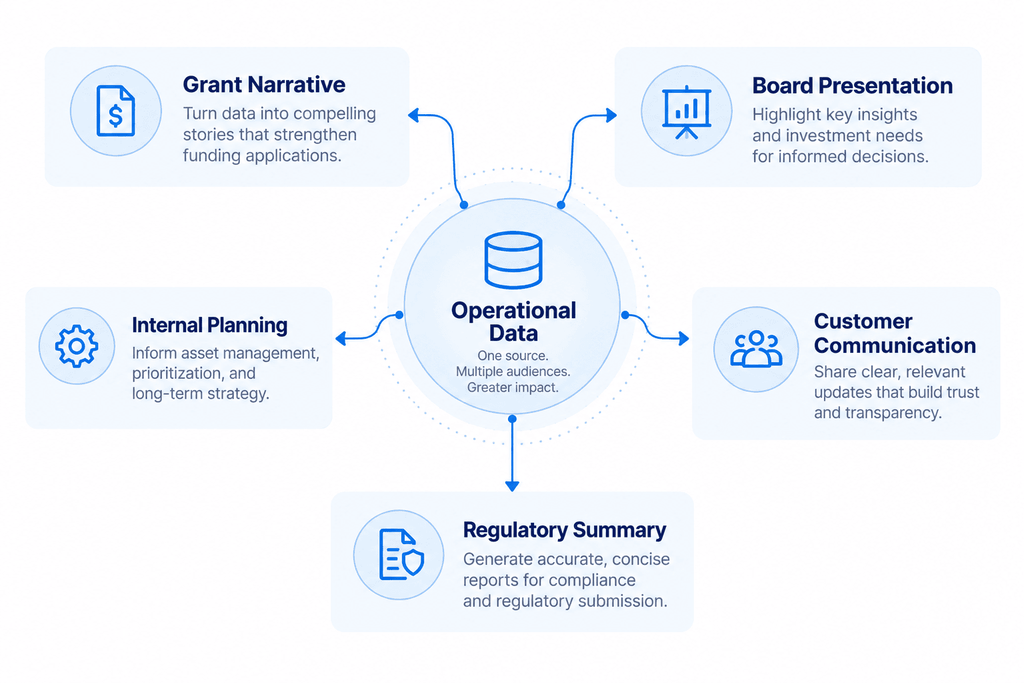
The same operational data can become a grant narrative, a board presentation, a customer communication, or a regulatory summary, each framed for its intended audience.
Technology doesn’t decide which projects deserve funding. It helps utilities present stronger evidence for the projects they already know they need. For smaller organizations without dedicated communications or grant-writing teams, that capability could fundamentally change how effectively they compete for limited funding.
Instead of spending valuable staff time rewriting the same technical information for different audiences, they can focus on what matters most: operating the utility itself.
Intelligence That Strengthens Decisions
If predictive intelligence helps utilities anticipate problems, the next step is deciding what to do about them.
This is where the conversation around artificial intelligence often becomes misleading.
Much of the public narrative assumes AI is gradually replacing human decision-making. In water utilities, the opposite is proving true. The greatest value lies not in replacing experienced engineers or operators, but in helping them make better-informed decisions.
The Water Environment Federation echoes the same principle: AI should supplement human expertise, not supplant it.
Replacing a treatment process isn’t simply an engineering decision. It involves capital cost, operating cost, environmental impact, regulatory compliance, public disruption, staffing implications, asset lifespan, and long-term resilience, all of which influence one another.
Traditionally, evaluating those trade-offs required weeks of engineering analysis, multiple consultants, and considerable manual modelling.
Decision-support systems are changing that.
Modern platforms can evaluate dozens of variables simultaneously, comparing alternative scenarios and highlighting trade-offs that may otherwise remain hidden. Rather than producing a single recommendation, they help decision-makers understand the consequences of different choices.
A utility evaluating two treatment upgrades, for example, may discover that one option offers lower construction costs while another provides greater energy savings over twenty years. A traditional analysis might focus on the upfront investment. An augmented decision-support system evaluates the entire lifecycle, making trade-offs far more visible.
Perhaps even more valuable is the ability to explore “what-if” scenarios.
- What happens if population growth exceeds current projections?
- How does the system perform if drought conditions become more frequent?
- What if future PFAS regulations become even more stringent?
Questions like these have always been important.
The difference is that utilities no longer need to commission a separate engineering study every time they want to explore them. Decision-support platforms allow planners to model multiple futures quickly enough for those scenarios to become part of everyday strategic planning rather than occasional long-term studies.
Another emerging capability deserves more attention than it currently receives: decision confidence.
Engineering recommendations are often presented with an implied certainty that the underlying data doesn’t always justify.
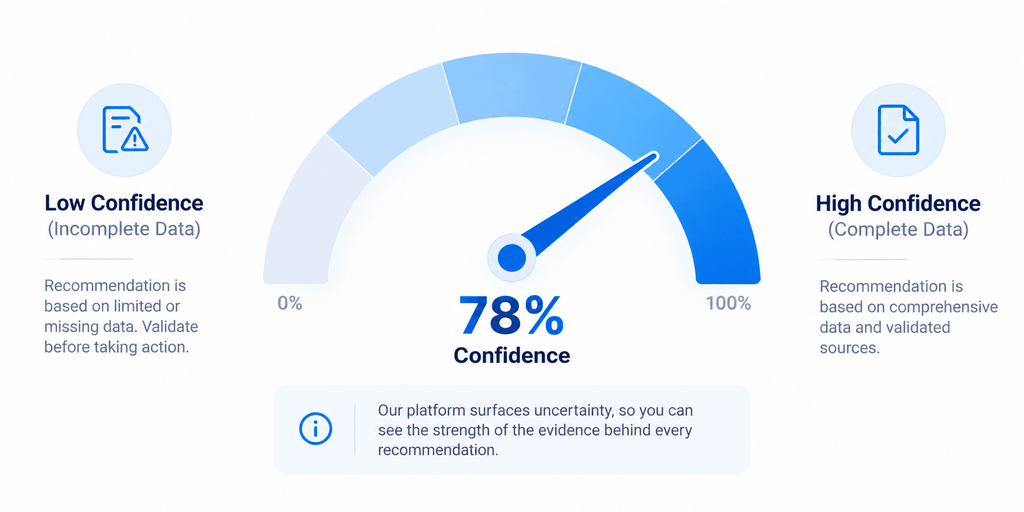
Intelligent decision-support systems make that uncertainty visible.
If an investment recommendation relies on incomplete inspection records, outdated asset information, or limited operational data, the platform can explicitly flag lower confidence and identify where additional information would strengthen the decision.
Rather than creating false certainty, intelligence platforms increasingly help utilities understand how confident they should be in the choices they are making.
That may prove just as valuable as the recommendation itself.
Intelligence That Simulates Reality; Digital Twins
Prediction answers one question, decision support answers another. Digital twins answer perhaps the most important one of all.
What happens if we actually do this?
For years, digital twins have been discussed largely as futuristic concepts; virtual copies of treatment plants or distribution networks that mirror physical infrastructure.
When digital twins are connected to live operational data, predictive analytics, and decision-support systems, they become far more than static engineering models. They evolve into living representations of utility operations, continuously updating as conditions change.
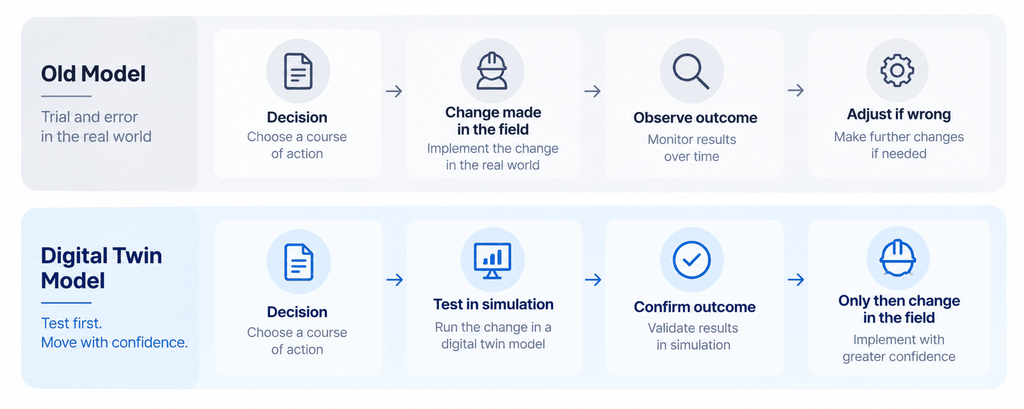
Instead of relying solely on historical information, utilities can observe how a proposed decision is likely to affect the real system before implementing it.
- A new pressure management strategy can be tested virtually before changing valve settings.
- Chemical dosing adjustments can be evaluated before operators alter treatment processes.
- Pump schedules can be optimized digitally before equipment settings are modified in the field.
Nothing changes physically until confidence is high. That ability fundamentally changes how risk is managed. Instead of learning through operational trial and error, utilities learn through simulation.
Why Integration Changes Everything
Across the industry, these capabilities are already demonstrating measurable results. Utilities are using digital twins to improve stormwater operations, model watershed behaviour under different climate scenarios, optimize treatment performance, and strengthen long-term infrastructure planning. The technology has also been recognised by the World Economic Forum as one of the foundational tools shaping the future of water management.
The measured impact is already real: WEF reports that digital twin technology can reduce maintenance time by up to 30% and maintenance costs by up to 25% with case studies like China’s Lushan Water Supply Company, which used a digital twin to modernize a 1980s-era system now serving 25,000 tons of water daily.
For vendors, digital twins create an entirely different commercial environment. Utilities increasingly expect to evaluate equipment inside virtual operating environments before making purchasing decisions. Technical specifications remain important, but they are no longer enough on their own.
The vendors best positioned for this future will provide detailed performance data, interoperable equipment, and digital models that integrate seamlessly into utility planning platforms.
Sales conversations begin to shift.
Instead of saying, “Trust our specifications.” Vendors will increasingly be able to say, “Here’s how your system performs before you buy it.”
That is a very different proposition.
Each of these technologies is valuable on its own. Together, they become something far more powerful.
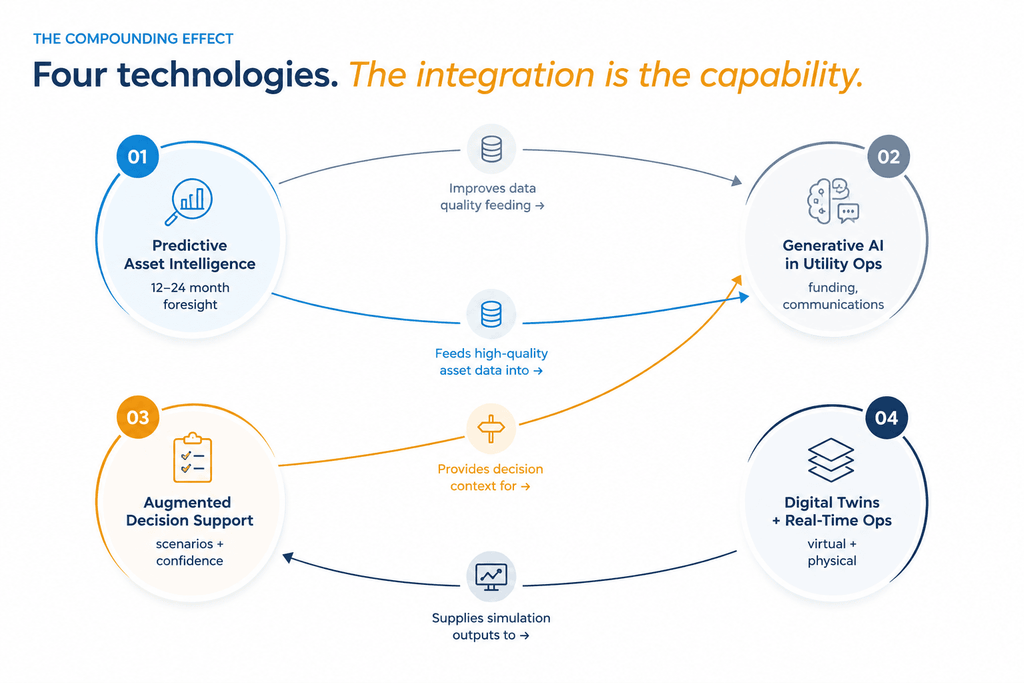
- Predictive intelligence identifies potential failures before they occur.
- Those predictions feed digital twins that simulate different responses.
- Augmented intelligence evaluates the trade-offs between those responses and recommends the most appropriate course of action.
- Generative AI then helps communicate those decisions—to regulators, funding agencies, elected officials, engineers, and the public—in language each audience understands.
The value doesn’t come from any single capability. It comes from how they reinforce one another. This is the shift many discussions about AI overlook.
The future of water utility intelligence isn’t about deploying more algorithms.
It is about creating an integrated decision-making ecosystem where prediction, simulation, recommendation, and communication operate as one connected process.