
Identifying the signal is only the beginning. Successful organizations follow a structured process to convert that intelligence into meaningful engagement, and most of them get this part wrong.
Done right, early engagement builds the kind of trust that makes formal procurement a formality. Here’s how it should play out:
Step 1: Verify the signal and build real context
Prior to any attempt at outreach, the opportunity must be validated as legitimate, and sufficient context must be gathered so that the opportunity can be understood well enough to be maximally beneficial. This is what is referred to as enrichment, which is essentially the context needed for effective opportunity prioritization. This means:
- Cross-referencing signals from different sources
- Building a comprehensive profile of the utility’s current assets and challenges
- Identifying related past projects and their implementation approaches
- Researching the utility’s financial capacity and typical funding mechanisms
It’s what allows your first conversation to start from “we understand what you’re dealing with” rather than “let me tell you about our product.” The former opens doors. The latter closes them.
Step 2: Map the right stakeholders
Before any outreach, develop a comprehensive water utility decision-making stakeholder network understanding of the decision ecosystem. Early-stage projects involve a completely different cast of people than active procurements, and misreading this is one of the most common ways early engagement efforts fall apart.
As Susan Moisio, Global Water Leader at Jacobs Engineering, puts it:
“The decision-making infrastructure at utilities is often more complex than the physical infrastructure they manage. Understanding those networks is critical to effective early engagement.”
What this mapping looks like in practice:
- Identifying the full network of influencers and decision-makers
- Researching stakeholders’ backgrounds, priorities, and previous positions
- Mapping reporting relationships and committee structures
- Analyzing past project approvals to understand typical decision patterns
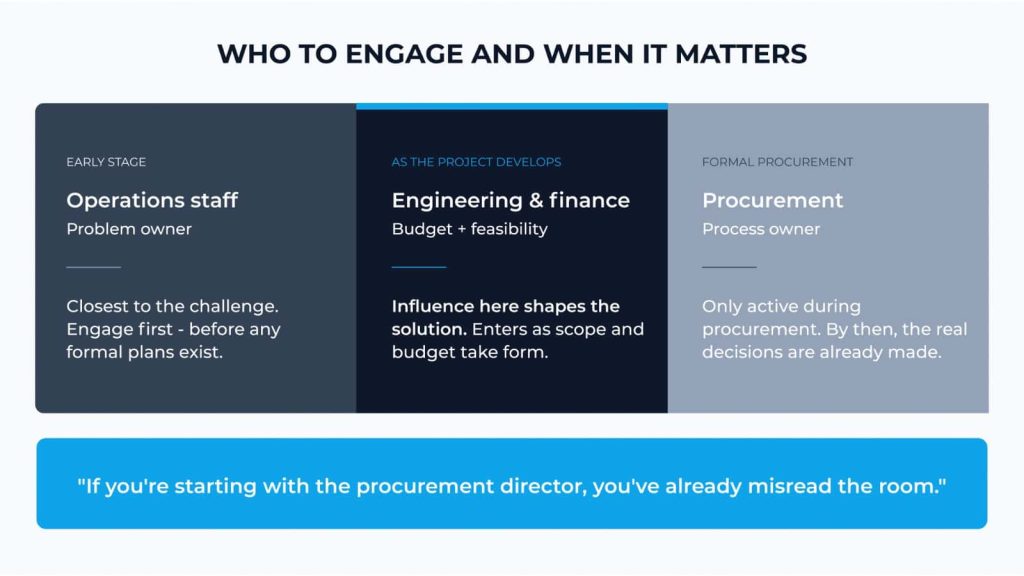
Early-stage projects typically start with operations staff who are closest to the problem, then expand to engineering and finance as the project develops shape. If you’re starting with the procurement director, you’ve already misread the room.
Step 3: Be judicious about which opportunities to pursue
Not every early-stage signal warrants a full pursuit.
A 2023 McKinsey & Company report found that top-performing water sector companies qualify opportunities 2.5 times more rigorously than their peers, leading to 40% higher win rates and 35% lower pursuit costs.
Early identification makes genuine selectivity possible. Evaluate opportunities based on :
- Alignment with your solution capabilities
- Project scale and potential contract value
- Timeline to implementation
- Competitive landscape and incumbent relationships
- Funding probability based on utility financial health
- Organizational capacity to properly nurture the opportunity
Early identification allows more selective pursuit, allowing for resources on truly winnable opportunities rather than responding to every RFP.

Step 4: Lead with education, not product
This is the part that makes the biggest difference and that most vendor teams resist the most. Early engagement should not look like selling. Develop a tailored approach focused on utility needs rather than product features:
- Craft educational content addressing the specific challenges you’ve identified for that utility
- Prepare case studies from similar utilities facing comparable issues
- Develop ROI analyses based on the utility’s actual operational context instead of generic benchmarks
- Create phased implementation scenarios aligned with potential funding sources
As David LaFrance, CEO of the American Water Works Association, explains:
“The most effective early engagement strategies create value through educational approaches focused on the utility’s specific challenges. Vendors who help utilities explore solutions rather than selling products build the trust necessary for long-term relationships.”
Early engagement should focus on education and problem exploration rather than explicit selling, positioning your organization as a trusted advisor.
Step 5: Build presence across the organization through multiple touchpoints
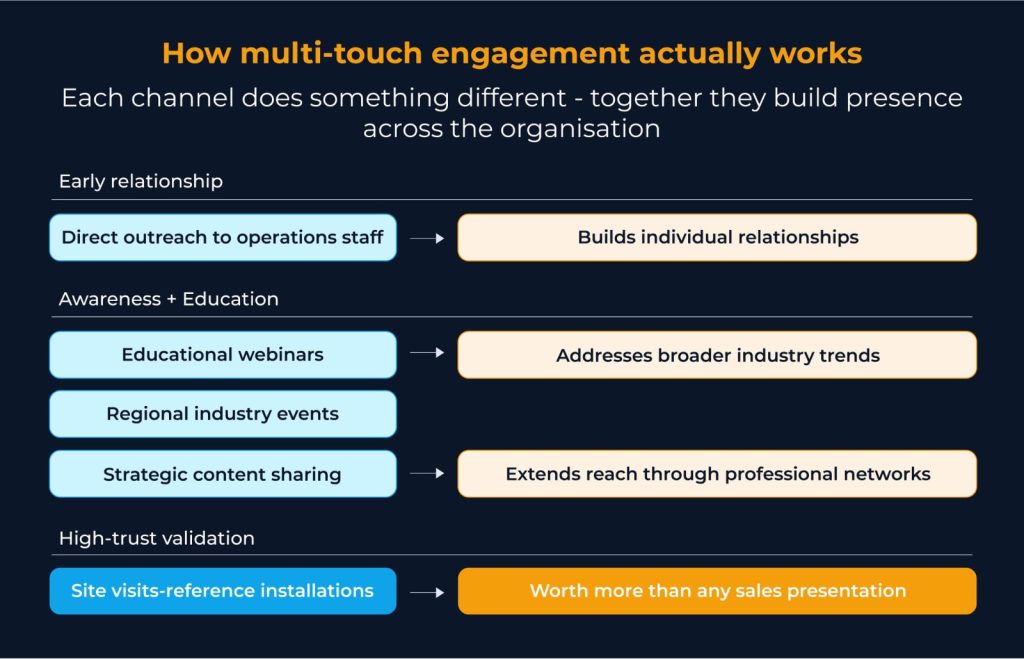
Successful water utility vendor relationship strategies don’t rely on a single relationship. It creates multiple touchpoints, gradually building relationships across the organization rather than focusing on a single contact. The practical channels:
- Direct outreach to operations staff facing the identified challenge
- Educational webinars addressing broader industry trends related to the issue
- Participation in regional industry events attended by the utility
- Strategic content sharing through professional networks
- Site visits to reference installations addressing similar challenges
Each of these does something different. The direct outreach builds individual relationships. The events build organizational awareness. The reference visits let the utility’s own team see your solution working in a real-world context which is worth more than any sales presentation.
What this looks like when it works
Two examples illustrate the difference early engagement makes.
BlueTech Solutions used data intelligence to identify Mason County Water District’s emerging concerns with disinfection byproducts two years before any regulatory violations occurred, through analysis of water quality reports and board meeting minutes.
- Rather than pitching, they engaged the operations director with educational material on treatment alternatives. When testing confirmed increasing DBP levels six months later, BlueTech had already established themselves as knowledgeable advisors.
- They worked collaboratively with the district engineer to evaluate options, conducted jar testing at no cost, and helped document grant eligibility for their solution. When the project finally reached the formal RFP stage, their solution was already incorporated into the specifications. They won the $1.2 million contract against three competitors who were engaging for the first time at the RFP stage.
Northeast Controls identified Riverside Utility Authority’s plans to renovate an aging pump station through analysis of maintenance records and SRF application documents, 28 months before any formal procurement.
- Rather than immediately pushing their solution, Northeast arranged an educational site visit to a similar installation at a neighboring utility. Through that visit, Riverside’s operations and engineering teams gained valuable insights about design considerations and potential pitfalls.
- When Riverside began developing specifications, they invited Northeast to provide input on the control system requirements. That collaborative approach ensured the final RFP reflected current technology capabilities rather than outdated standards. Northeast secured the $875,000 contract and delivered the project three months ahead of schedule, largely because of how deeply they understood the utility’s needs before it ever went to market.
The bigger picture
This shift from reactive RFP answers to proactive early engagement represents a fundamental transformation in water utility sales strategy. Organizations that master this approach enjoy significant competitive advantages, higher profit margins from collaborative solution development, and stronger relationships with their utility clients. Perhaps the most significant advantage of this approach is the ability of the water industry to address the massive infrastructure challenges currently facing communities throughout America.
The companies succeeding consistently have stopped waiting for someone to hand them an RFP and build systems to find opportunities while there’s still time to shape them. They work towards showing up as the advisors utilities actually trust, instead of vendors who are simply here to score a buck.