
There’s a version of this business where one would chase everything. Every RFP that comes out, every project that looks remotely relevant, every utility that might conceivably need what you sell. All of these reveal something and hence you go after it ruthlessly. The logic seems reasonable; you get more shots, more chances and cast a wide net.
The reality is quite the opposite. Predictive intelligence for water utility sales requires qualification before pursuit, fills your pipeline with low-probability pursuits, and produces a win rate that makes no sense given the effort going in.
In the water sector, this problem is remarkably acute. There are long sales cycles, complex deals, multiple stakeholders, and formal procurement processes that can stretch for months. When you invest that kind of time and resource into a deal you were never going to secure, the cost ends up ranking to enormous levels. This is after the direct cost of bid preparation and proposal writing. The opportunity cost of deals you could have won but didn’t pursue properly because your team was busy chasing something that was wired for an incumbent from day one.
The case that illustrates this best is of a company running at about a 23% win rate on an intuitive qualification approach. All smart people who were coming up with good solutions. But they were making qualification decisions based on project size, location, and gut instinct. The result was a lot of effort going into a lot of deals that ultimately went nowhere.
What Data-Driven Qualification Actually Looks Like
This shift is building a scoring model that objectively evaluates each opportunity against the factors that actually predict success.
Utility profile fit: This matters a lot more than what is made known to the public. Does this utility match the profile of utilities where you’ve succeeded before? Variables like size, geography, infrastructure type, procurement history speak a lot about whether your solution is a natural fit or a stretch that is just not realistic.
Competitive landscape: This also needs to be paid regard to. Try to realise if you are up against an entrenched incumbent with a decade of relationships inside the account or a relatively open field where relationships are there to be built. These are very different situations requiring very different decisions about whether to pursue and you must proceed judiciously.
Funding and timeline: Is this project actually going to happen? Is it funded or still aspirational? Is the timeline realistic or perpetually deferred? A project with solid funding and a defined schedule is a very different opportunity than one still waiting for budget approval. Both of these require widely different approaches with no room for major last minute changes.
Engagement timing: Did your early engagement strategy for water utilities begin early enough to add real value? Or did you find out about this project three weeks before the RFP dropped, giving you no time to build relationships or influence specifications? Where you land into a utility and at what time determines a majority of how things are worked on and you must know it on the very first day.
Machine learning models: Water utility market intelligence platforms can help weigh dozens of variables ranging from a utility’s past procurement patterns to the presence of internal champions or predicting win probability. Organizations effectively using analytics for sales planning are 1.5x more likely to achieve above-average growth than their peers, largely because they focus energy on the right deals.
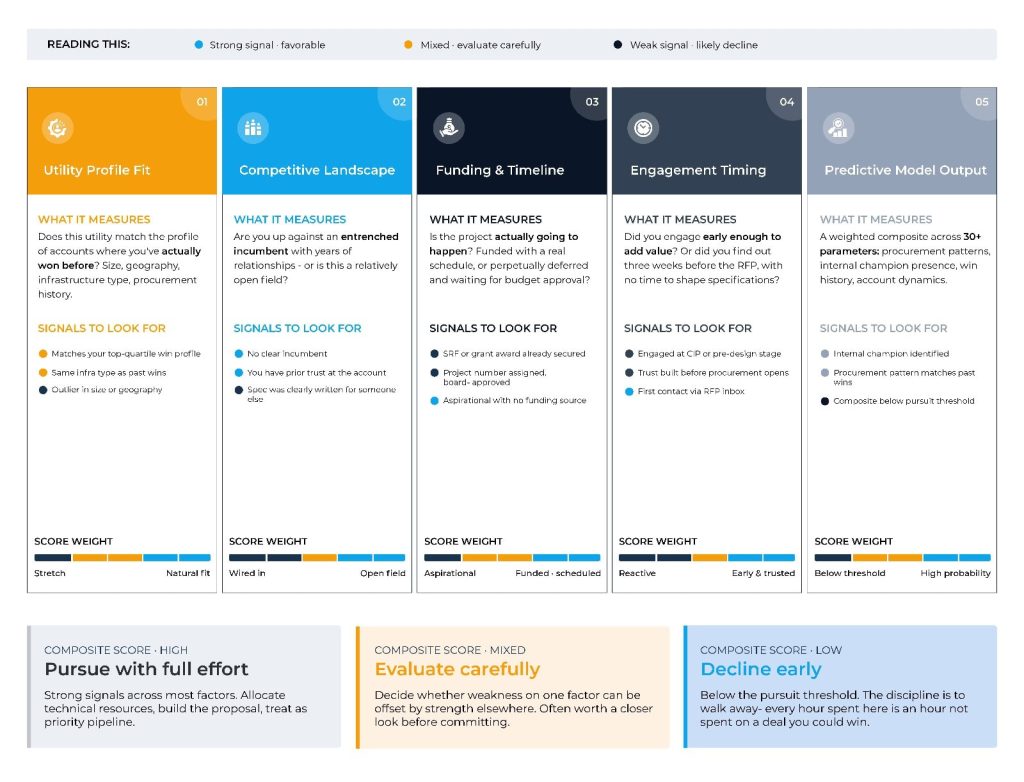
The company in our case study built a qualification model analyzing over 30 parameters per opportunity. Deals scoring below a certain threshold were declined early, regardless of superficial appeal. The win rate jumped from 23% to 41%. They reduced by 68% the number of deals pursued only to be cancelled by the utility or stalled indefinitely. Technical hours spent on bids that went nowhere dropped by 42%. With fewer futile pursuits, technical staff utilization on viable projects improved by 36%.
What This Requires
Rigorous qualification requires discipline that goes against instinct. The instinct is always to pursue, to never leave an opportunity on the table or to never let go of anything without giving it a shot, but it is pertinent that you remember that every pursuit has a cost. Time, attention,technical resources, proposal effort. When those costs go into a deal you were unlikely to win, you’re not losing out on a deal but devoting your resources to a void that can yield nothing.
In 2023, 43% of B2B sales leaders reported longer sales cycles. Many cited the need to tighten qualification processes to combat deal slowdowns. Intelligent qualification is a direct response to that reality because when you are unable to afford deals that stall or collapse after months of investment, you need a disciplined process for deciding which deals deserve that investment in the first place.
The companies investing in advanced analytics achieved up to 5 percentage points higher return on sales than less analytical peers. That’s what smarter resource allocation compounding over time brings in.