
Most water utility sales approaches have a contact problem.
This is by no means a shortage of contacts but more of a narrowness to it. The sales team knows someone in operations, maybe an engineer. They send proposals to procurement, assume that the solution is good enough or passable, and rely on those contacts to carry it forward.
They won’t and it is not because they have something against you but because water utility purchasing decisions have never and won’t ever work that way.
Research shows that modern B2B purchasing involves an average of three to five decision-makers and water utilities are no exception to this. In fact, they’re often worse. Water Research Foundation procurement decision studies Major infrastructure projects routinely involve operations staff, engineering leadership, finance directors, procurement managers, executive leadership, consulting engineers, public works committees, and in many cases elected board members. Missing any of these people in the cycle creates a vulnerability that is impossible to close after a certain point of time.
The case study that illustrates this best involved a company typically engaging one to two contacts per utility. They were leaving the rest of the network completely unattended. Finance directors who would ultimately influence project approval had never heard of them, consulting engineers who would write the specifications were already working with competitors and the board members who would vote on the funding had no relationship with the vendor at all.
The result was deals that looked promising and then disappeared because the internal consensus never formed. Someone in the network, someone the vendor had never talked to raised concerns that eventually killed the deal.
Building the Actual Map
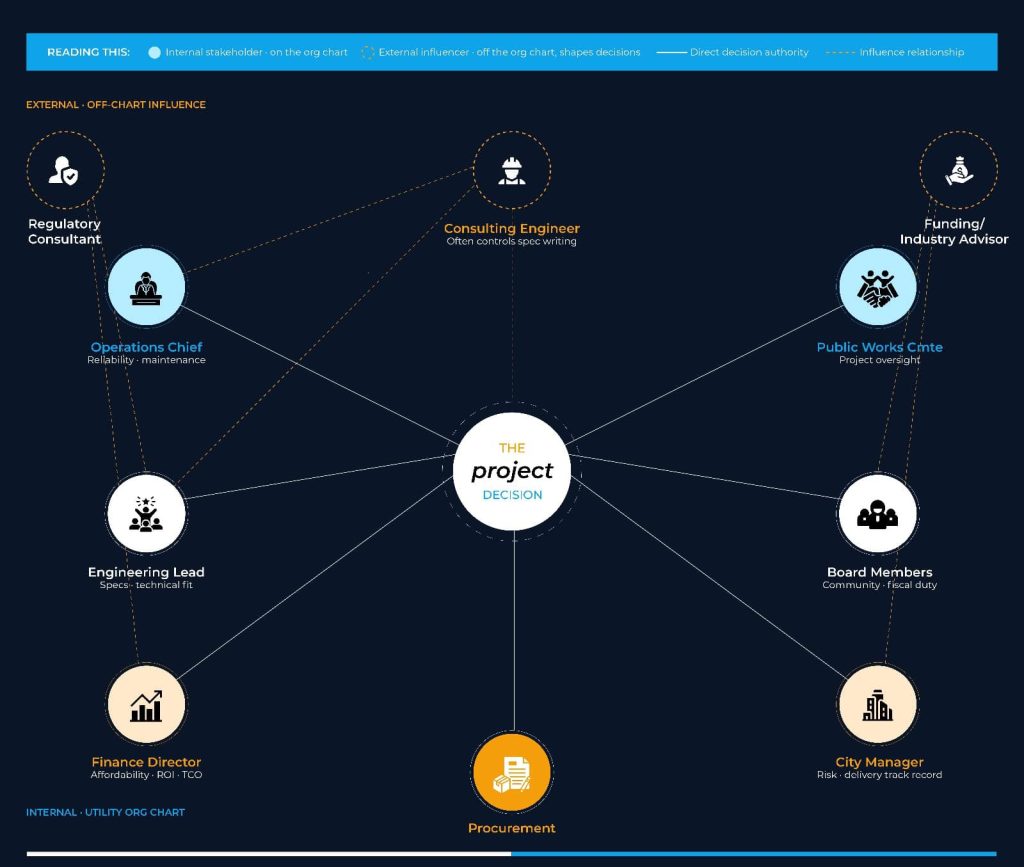
Stakeholder mapping starts with building an honest org chart of each target utility. Who’s in operations →Who leads engineering →Who controls finance →Who handles procurement→ Who sits on the regulatory affairs team.
Then you go deeper. Through research and past project data, you map who actually and definitively influences decisions for different project types:
- A CFO or finance manager may heavily influence any project over a certain budget threshold, even if operations initiated it
- A consulting engineer retained by the utility may effectively control specification development, a role frequently highlighted by the American Council of Engineering Companies
- AWWA water utility governance and procurement a board member with a background in finance may scrutinize rate impacts in ways that can slow or kill a project
External contributors have a role to play too. Which consulting engineering firms advise that utility and could influence technology selection? Which regulatory consultants are helping them navigate compliance requirements? These relationships don’t show up on the utility’s org chart but they shape decisions constantly and must navigate and work around them readily.
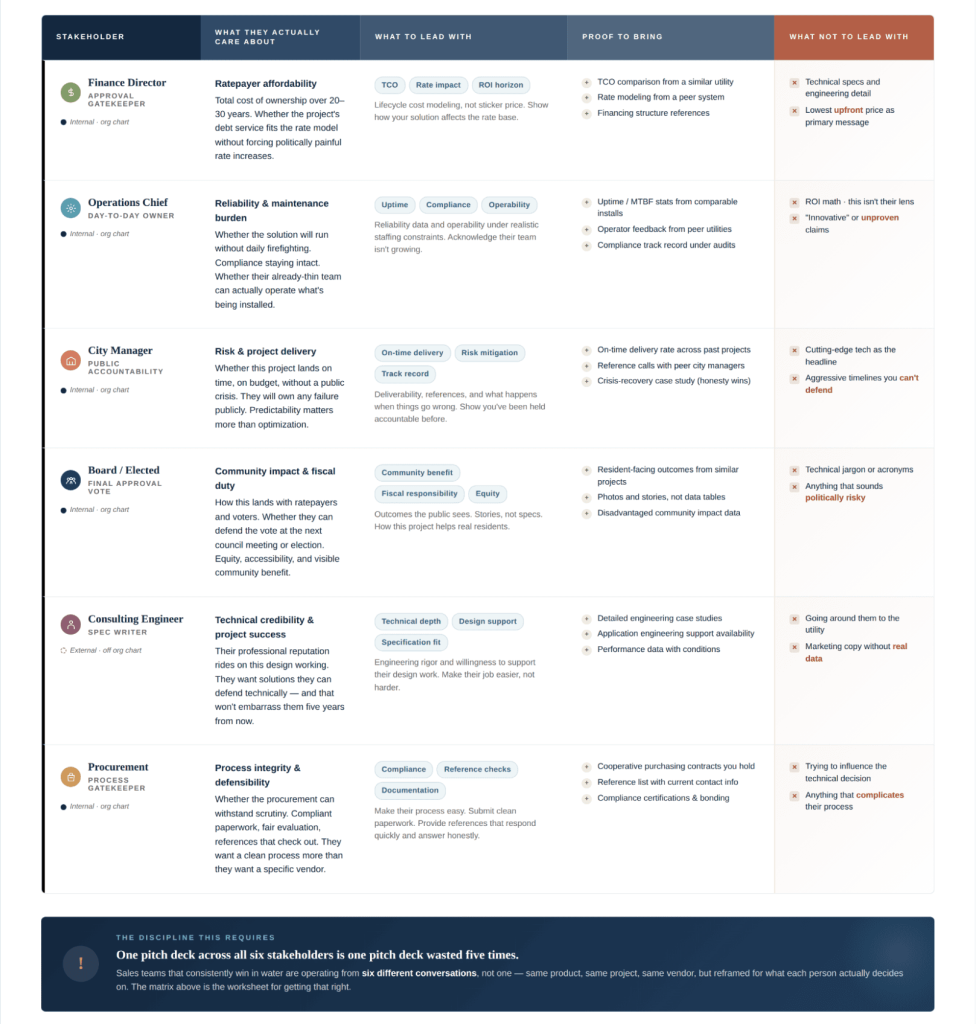
Once the network’s all mapped out, try to engage different stakeholders with genuinely different value propositions. Do anything but show up with the age old one-size-fits-all pitch delivered to everyone. You must be equipped with tailored conversations that address what each person actually cares about:
- Finance director: ratepayer affordability, total cost of ownership, and ROI
- Operations chief: reliability, compliance, and maintenance burden
- City manager: risk mitigation and project delivery track record
- Board: community impact and fiscal responsibility0
As Larry Goldstein of Salesforce’s Energy and Utilities division put it: “Be rigorous in mapping your stakeholders — the people who make decisions, influence decisions, or who can shut you down. Understand who they are, what their title is, what their concerns are, and what their motivations are.”
What Changes When You Do This
The company in our case study went from engaging an average of 1.8 contacts per utility to over five contacts per utility. Seventy-three percent of pursuits included engagement with financial decision-makers, up from a small minority previously. The team identified true project drivers, the underlying business or regulatory pain point motivating the project, 64% more often. Hence, the proposals could be aligned to what actually mattered rather than what was written in the spec.
There was a 38% improvement in early access to key influencers. People who previously appeared only at final contract ap proval were now in the conversation months earlier. This resulted in unexpected vetoes and last-minute losses to drop significantly.
A recent industry survey found out that 72% of B2B sellers have seen customer buying journeys become more complex, with more touchpoints and voices involved. The recommendation is: equip sales teams with targeted content and proof points for every stakeholder in the process.
In water utility sales, this might mean providing a chief engineer with detailed technical case studies while giving the procurement officer references on total cost of ownership. Sharing success stories from similar utilities prove that other systems achieved their KPIs using your solution which inevitably builds confidence across the board.
The broader shift is from being one-dimensional to being consultative. When you understand the full network, when you’re having real conversations with every person who influences the outcome, you stop being a bidder. You become an embedded part of how the utility thinks through its decisions. That’s a very different position to be in when the formal procurement process starts.