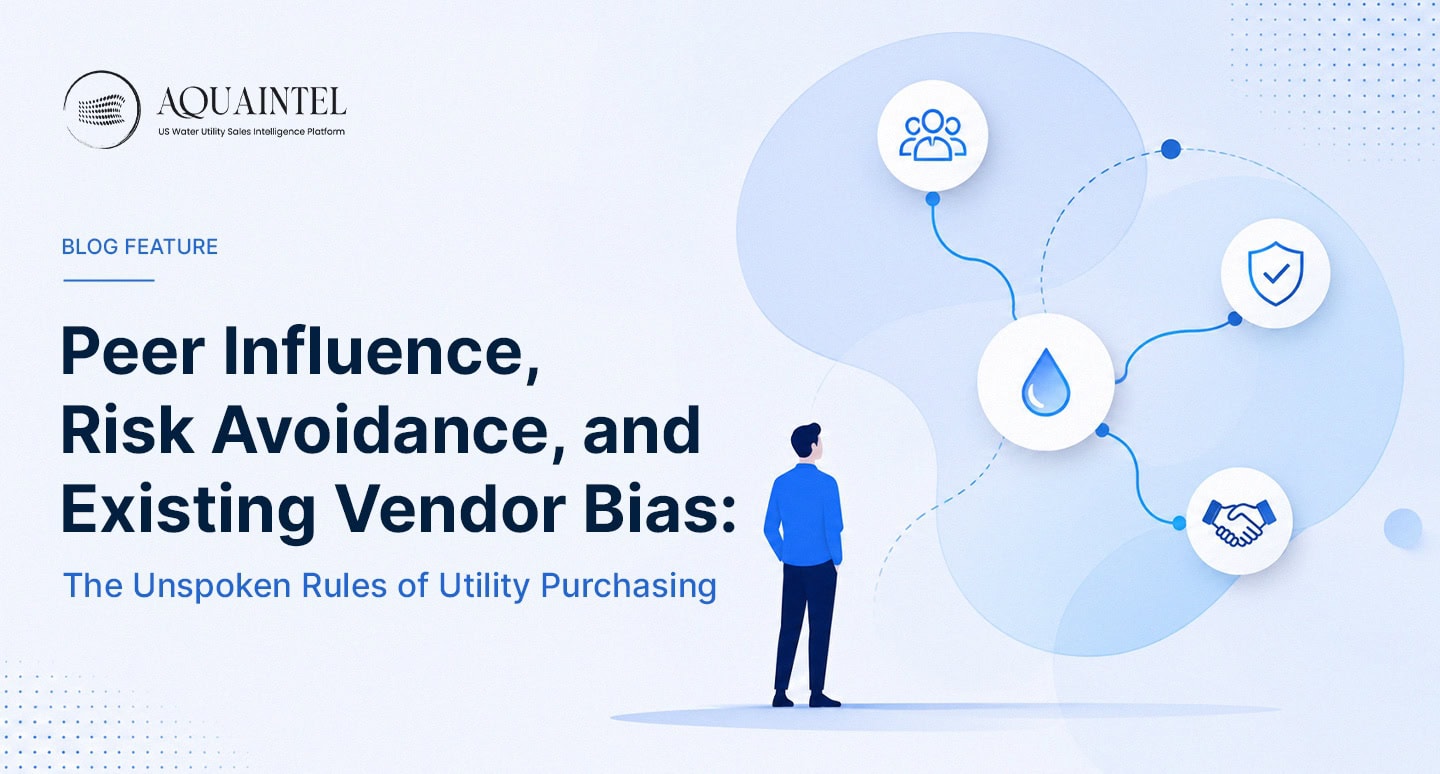

Water Utility Purchasing
You can have the best product, the most compelling pitch, and meetings with all the right people. And you’ll still lose the deal.
Why? Because beyond the formal decision-making process, there’s an entire layer of unspoken rules governing how water utilities actually choose vendors. These hidden dynamics don’t show up in RFPs or procurement policies, but they determine outcomes more often than technical specifications ever will.
After 15 years working across the water sector, I’ve seen technically inferior solutions win repeatedly. Not because of better sales tactics, but because the vendor understood something fundamental: utilities don’t just buy solutions. They buy risk mitigation, peer validation, and continuity.
Let me walk you through the dynamics that actually drive purchasing decisions, the ones nobody puts in writing.
The Hidden Forces Shaping Utility Purchases
Previous Experience Bias: The Incumbent Advantage
Here’s a data point that should fundamentally change how you think about market entry: utilities show an overwhelming preference for vendors and solutions with proven track records in their systems. Analysis of procurement data reveals:
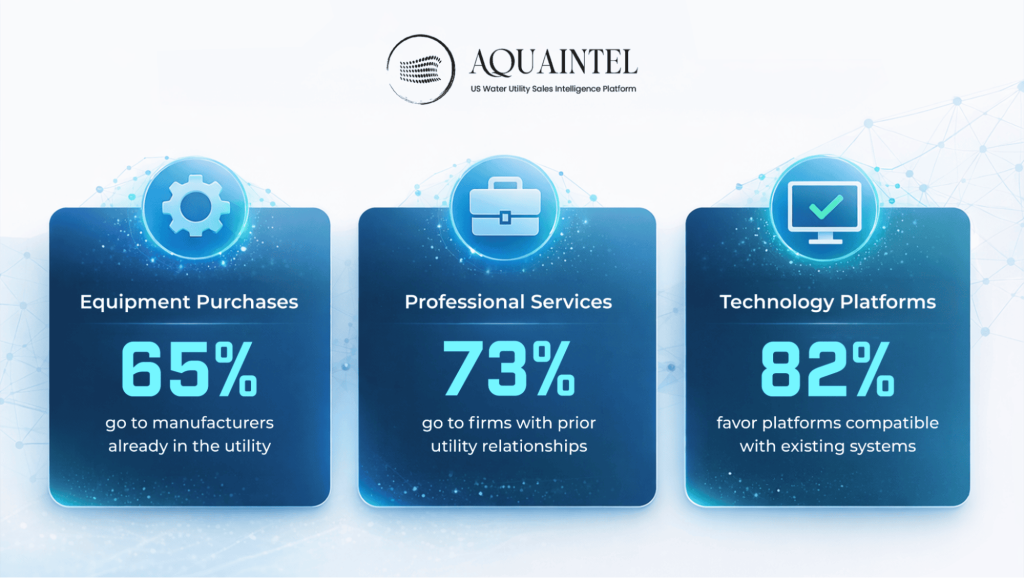
Think about what this means. If you’re not already in the door, you’re fighting against a 35% chance on equipment, 27% on services, and 18% on technology. Those aren’t great odds.
David LaFrance, CEO of AWWA, told me something that crystallized this reality: “The first sale to a utility is always the hardest. Once you’re in the door and have proven yourself, subsequent sales become exponentially easier.”
Why this happens:
Utilities are striving to manage operational risk in an environment where failure has serious consequences. When you already have a vendor’s equipment running successfully in your plant, you know:
- Parts are readily available
- Your team knows how to maintain it
- Performance characteristics are predictable
- The vendor responds to your calls
- Integration challenges have been solved
Switching to a new vendor means accepting uncertainty in all those areas. For a utility operator who gets called at midnight when something breaks, that’s not a risk to take lightly.
Strategic implications:
Document and leverage any existing presence within the utility, however small. You have a small piece of equipment that was installed five years ago? Use it to demonstrate reliability, responsiveness, and long-term commitment.
If you’re truly starting from zero, your job is to get something, however small, installed and proven. Take it as your pilot project or a trial period. Once you’re inside and performing well, expansion becomes dramatically easier.
Peer Utility Influence: Trust Your Neighbor
Water professionals trust each other much more than they trust vendors.
This peer reliance manifests in hard numbers:
- 78% of utilities consult peer references before major purchases
- 64% of new technology adoptions follow successful implementations at peer utilities
- Regional clusters of similar solutions frequently develop through informal networks
I’ve watched this play out dozens of times. A utility implements a successful solution, and suddenly three neighboring utilities are asking about it. This is because they had the courage to converse and present themselves at a regional meeting.
The peer network effect:
Water professionals operate in close-knit communities. They attend the same conferences, participate in the same associations, and face the same challenges, but when it comes to making a decision, they rarely start with Google. It usually starts with a phone call to someone running a similar system.
This creates a multiplier effect for successful implementations. A happy customer is an active advocate within their professional network. Conversely, one bad installation can poison an entire region against your product.
Strategic implications:
Try to cultivate and leverage customer advocates, particularly those with strong industry connections and association involvement. Identify the utilities in your customer base that are well-respected in their regions or sectors and support their conference presentations about your solution. Make sure to feature them prominently in case studies and webinars.
When targeting a new utility, map the peer network. Who do they regularly interact with? Which utilities do they consider comparable? Can you get them on a call with a peer who’s using your solution successfully?
The peer reference isn’t a step in your sales process but often the most critical factor in the entire decision.
Risk Avoidance Culture: When Caution Is Your Mission
The water sector’s risk aversion is built into the fundamental mission of providing safe drinking water to the public. This creates purchasing patterns that confound vendors coming from other industries:
- Proven technologies with extensive track records typically prevail over newer innovations
- Solutions with redundancy and reliability features receive preferential consideration
- Utilities frequently select oversized equipment to ensure performance margin
- Familiar vendors are often preferred over newcomers despite higher costs
George Hawkins, former CEO of DC Water, says:
“The water industry’s risk aversion isn’t just cultural—it’s baked into their mission. When failure means public health impacts, caution becomes a professional responsibility” .
What this looks like in practice:
A utility engineer evaluating two pumps of equal technical specifications will choose the one from the established manufacturer, even at a 20% cost premium. Why? Because if it fails, nobody questions the choice. If the newer, cheaper option fails, suddenly you’re explaining yourself to the board.
Contrary to how this might feel, this is deeply rational given the incentive structure. In water utilities, the penalty for visible failure far exceeds the reward for incremental improvement. There aren’t any promotions you get for saving 15% on a pump purchase, but you might just get fired if that pump falters.
Strategic implications:
Emphasize risk mitigation, reliability features, and long-term support capabilities throughout the sales process. Don’t just talk about what your solution does, but about what happens when something goes wrong. Focus on:
- What’s your response time for service calls?
- How quickly can you get replacement parts on-site?
- What’s your uptime track record across your installed base?
- How many utilities have been running your solution for 10+ years?
For innovative solutions, acknowledge the risk explicitly and then systematically address it. Offer extended warranties, provide redundancy options, share detailed failure mode analysis and reference similar installations in peer utilities.
Moving Beyond the Myths
These hidden dynamics explain why so many conventional approaches fail. Success requires abandoning several persistent myths about decision-making:
Myth 1: “We just need to find THE decision-maker.”
Reality: Decisions emerge from water utility decision-making stakeholder networks of influence across engineering, finance, operations, leadership, & external advisors rather than a single person.
A study by the Water Research Foundation found that even in small utilities, major purchases involve an average of 6.8 stakeholders. You can’t succeed by identifying and convincing a single person. It is essential that a consensus is built across a network of people with various priorities and perspectives.
Vendors fixate on getting a meeting with the GM, believing that’s the key to securing a deal. They finally get that meeting, deliver a great presentation, and feel confident, but end up losing the deal because the operations team disliked their solution and the GM listened to them.
The decision-maker is a committee where consensus has to emerge before anyone commits.
Myth 2: “Technical superiority wins the day.”
Reality: While technical performance matters, compatibility, risk, and relationships often carry greater weight.
Non-technical factors actually drive more than half of all utility purchasing decisions. This means that over 50% of the time, the final choice depends on variables like vendor stability, ease of implementation, or long-term support rather than a 15% bump in efficiency.
This gap between perception & reality is where most vendors lose deals:
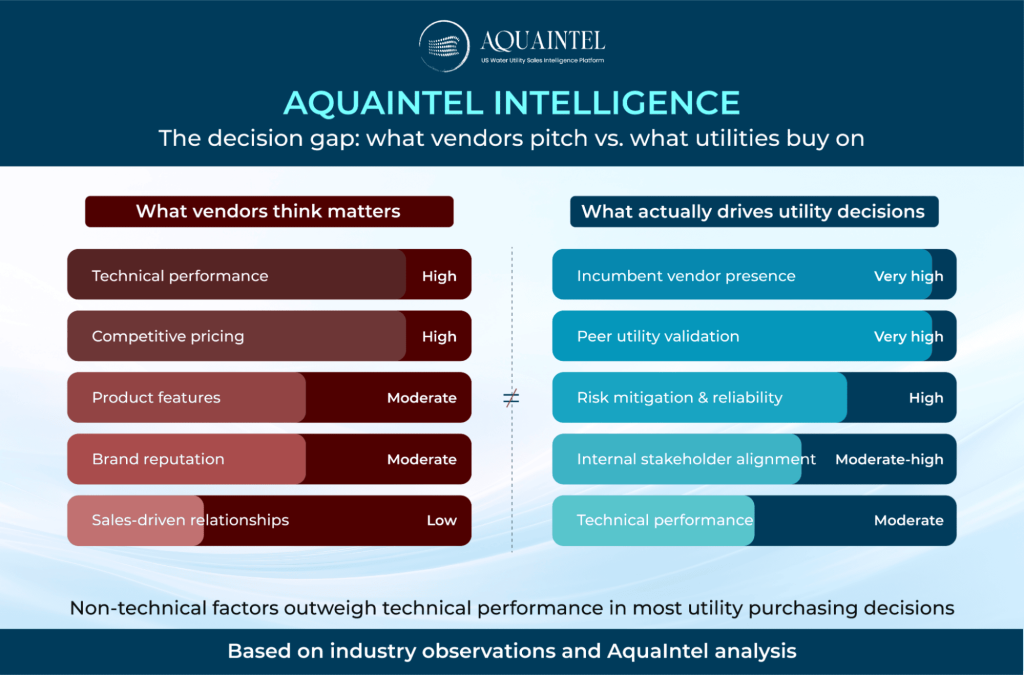
Success in this market requires winning over the procurement office just as much as the engineering team.
I’ve watched technically superior solutions lose to inferior competitors because:
- The inferior solution was compatible with existing systems (no integration headaches)
- The competing vendor had a local service presence (faster response times)
- The competitor’s equipment was already installed elsewhere in the utility (familiar to operators)
- The competing firm had worked with the utility’s consulting engineer before (established trust)
Technical performance creates the permission to compete. But compatibility, risk management, and relationships determine who wins.
Myth 3: “The purchasing department makes the buying decision.”
Reality: Purchasing typically manages a process whose outcome was largely determined earlier through technical specifications.
By the time purchasing gets involved, the engineering team has usually already written specs that effectively narrow the field. Sometimes those specs are written so specifically that only one or two vendors can even respond.
I’m not implying anything evil here. Specs are written based on what the engineer knows will work, what the engineer is comfortable with, and what the engineer’s technical requirements demand. If you’re not involved in the early engineering discussions on the specs, then you’re not arriving early enough.
Purchasing’s role is to make sure the process is fair and compliant. The problem is, they’re conducting a competition whose rules were set before they became involved.
Myth 4: “Board approval is mere formality.”
Reality: Governance bodies can and do reject staff recommendations, particularly when public perception issues arise.
The AWWA Utility Benchmarking Program documents that boards modify or reject approximately 18% of capital project recommendations. That’s nearly one in five. Those aren’t great odds if you’ve already counted on the revenue.
Boards get influenced by things that never appeared in the technical evaluation:
- Community concerns about rate increases
- Political considerations about vendor selection
- Questions about local economic impact
- Environmental advocacy group input
- Media coverage of the project
You can have unanimous staff support and still lose at the board level if public perception turns negative. It doesn’t happen often, but when it does, it tends to happen on exactly the high-value projects you’ve invested the most in pursuing.
Myth 5: “Our existing utility contacts can totally handle internal selling.”
Reality: Most utility staff lack the time, motivation, and sometimes the influence to effectively champion vendor solutions.
I hear this constantly: “We’ve got a great relationship with the chief engineer. He’ll sell it internally for us.”
You must understand that your contact within the utility organization has a full-time job, and their job doesn’t include being an advocate for your solution. They have projects to run, emergencies to fix, meetings to attend, and their own set of politics to contend with. While they may love your solution, they aren’t going to expend significant political capital on an inside sales job unless they are personally motivated to do so.
Plus, they might not have the influence you think they do. That chief engineer who loves your solution might have a rocky relationship with the GM, maybe the finance director doesn’t trust his cost estimates or maybe the board views him as too focused on technical complexity rather than practical solutions.
Internal champions are ultimately insufficient. You still need to build relationships across the decision network and ensure your solution has support from multiple stakeholders.
Why Your Approach Isn’t As Secure As You Think
Most water utility vendors are operating with a mental model that’s fundamentally wrong.
They think decision-making is:
- Linear: Need identified → solution evaluated → decision made
- Rational: Best technical and financial option wins
- Hierarchical: Authority flows down the org chart
- Transparent: The RFP tells you what matters
The reality is that decision-making is:
- Networked: Multiple stakeholders with different priorities interact continuously
- Political: Consensus building and relationship dynamics matter more than objective criteria
- Influenced: Peer validation and risk mitigation drive choices
- Opaque: The real decision factors don’t show up in procurement documents
If your approach assumes the first model, you’re probably losing deals you should win but if it addresses the second model, you’re positioning yourself for success even when your product has areas it needs working on before your first meeting.
Technology-Enabled Decision Intelligence
A silver lining amidst all of this is how modern data platforms are transforming how organizations understand these hidden dynamics.
We’re now seeing:
Automated Decision Network Mapping: Advanced analytics can process board minutes, staff reports, and procurement documents to automatically generate comprehensive influence maps. Gartner recently identified this as one of the top emerging technologies for sales intelligence.
Predictive Stakeholder Analysis: Machine learning models can predict which stakeholders will be involved in specific project types based on historical patterns.
Relationship Intelligence: Digital platforms can map connections between utility staff, consultants, and industry organizations to identify relationship pathways.
Engagement Optimization: Analytics can determine optimal messaging, timing, and channels based on stakeholder roles and preferences.
Collaborative Team Alignment: Shared intelligence platforms ensure sales teams maintain consistent approaches across complex stakeholder networks.
Rita Sallam, VP Analyst at Gartner, notes:
“Data-driven decision intelligence is revolutionizing how companies understand and navigate complex B2G sales cycles. Organizations using these platforms are seeing 35% higher conversion rates and 28% shorter sales cycles”.
What used to require months of relationship building and inside knowledge can now be surfaced through systematic analysis of public documents and network mapping. You can understand who influences whom, which consultants have the utility’s trust, what peer utilities they look to for guidance, and where the incumbent vendors are vulnerable, all before your first meeting.
Here’s how that works in practice:

The Path Forward
By replacing simplistic myths with comprehensive decision intelligence, organizations can transform their approach to water utility sales. Understanding who truly controls budgets creates the foundation for effective engagement strategies that address the full spectrum of influences shaping utility purchasing decisions.
Yet understanding the formal decision-makers is only half the battle. Previous vendor relationships, peer influence, and risk avoidance culture, often determine outcomes more than any technical evaluation.
Start by mapping not just the decision-makers, but the hidden dynamics at play:
- What vendors already have a presence in the utility?
- Which peer utilities influence this one’s decisions?
- What’s the risk tolerance culture like?
- Who are the real champions and skeptics?
- What informal networks shape opinions?
Then build your strategy around reality rather than myths. Because in this market, the vendors who win aren’t always the ones with the best solution. They’re the ones who understand how decisions actually get made.