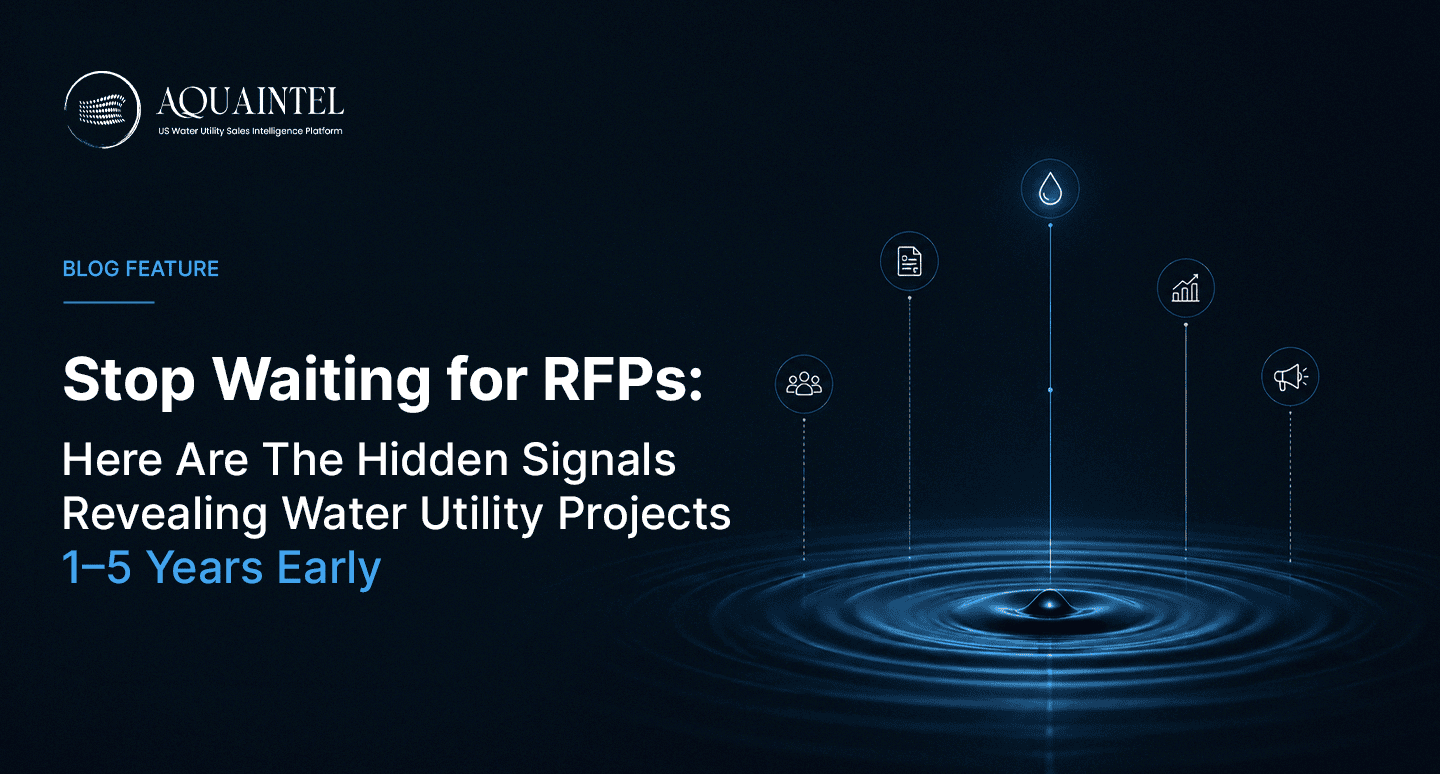


Most companies selling into the water utility market are playing an identical losing game. They wait for an RFP to drop, scramble to put together a response, and wonder why margins keep getting squeezed. What’s unfortunate is that by the time an RFP is published, the real opportunity which shapes the solution, builds the relationship, and influences the spec, has already passed.
The companies consistently winning in this market figured something out a long time ago. They don’t wait for RFPs. They identify projects 1–5 years out, engage early, and build a water utility decision-making stakeholder network before formal procurement begins. This approach improves win rates and enables collaborative solution development that benefits both vendors and utilities.
The companies that identify and engage with water utility projects 1–5 years before RFPs are published experience 3.2x higher win rates on pursued opportunities, 37% larger contract values through scope expansion and value engineering, 42% shorter sales cycles once RFPs are published, and 65% lower customer acquisition costs through more targeted efforts.
As Mark Alpert, Executive Director of the Water Design-Build Council, puts it:
“Early contractor involvement ultimately leads to better project outcomes for all stakeholders. The era of throwing designs over the wall and hoping for the best is giving way to collaborative approaches that begin well before formal procurement.”
It’s not solely beneficial for vendors. Early vendor engagement delivers equally valuable benefits to utilities:
- Access to innovation and industry best practices during solution development
- More accurate budgeting based on current market intelligence
- Reduced engineering costs through vendor expertise
- Higher-quality RFPs leading to better-aligned proposals
- Faster implementation timelines after procurement
The challenge has traditionally been identifying these early-stage opportunities in a fragmented market of 50,000+ utilities. Modern data intelligence platforms are transforming this landscape, making systematic early identification possible.
So where do you actually look?
Projects Leave Tracks: Know Where To Look.
Water utility projects leave distinct digital footprints across numerous public sources that, when properly monitored and analyzed, reveal clear patterns of future investment. The problem is that most sales teams either don’t know where these signals live, or they don’t have a systematic way to monitor them.
And even when they do, they assume these signals appear in sequence. They don’t, but run in parallel.
The timeline shows when each becomes detectable, not the order in which you monitor them.

What the real intelligence reveals:
1. Capital Improvement Plans (CIPs)
Capital improvement plan analysis for vendors is one of the most direct signals you’ll find.. These documents outline a utility’s investment plans over a 5–10 year horizon and are typically published on utility websites, within municipal budget documents, or as appendices to master plans. Most are updated annually as part of the budget process. Yet only 53% of water professionals actively review CIPs from utilities in their target markets, which means there’s a real competitive edge available to anyone willing to do this systematically.
When you’re reading a CIP, you want to focus on:
- Project descriptions, estimated costs, and proposed timelines
- Prioritization metrics showing which projects will advance first
- Funding sources identified for each project
- Projects listed as “unfunded needs” are often the best candidates for vendor financing conversations
Modern platforms monitor thousands of utility websites to capture CIP updates immediately, extract project details, and alert users to relevant opportunities. Doing this manually at any real scale is essentially impossible.
2. Asset Management Programs
Utilities with formal asset management planning systems are essentially publishing their future capital needs. These reports show up in board presentations, regulatory filings, and formal asset management plans and need to be detected by you very cautiously.
As Dr. Jennifer Stowe, Director of Infrastructure Research at the Water Research Foundation, explains:
“Predictive maintenance data is the new gold standard for forecasting capital needs. The transition from reactive to predictive approaches is creating unprecedented visibility into future replacement timelines.”
What to look out for:
- Assets approaching end-of-useful-life timeframes
- Maintenance cost trends showing increasing expenses
- Reliability metrics highlighting problematic equipment
- Risk matrices identifying highest-priority replacements
Advanced analytics can interpret maintenance records and asset age data to predict replacement needs before utilities themselves have formally recognized them. That’s the window.
3. Regulatory Drivers
Water utility regulatory compliance drivers initiate approximately 45% of major water infrastructure projects. And unlike discretionary capital spending, regulatory-driven investments aren’t optional — they happen on mandated timelines. Recent PFAS limits represent the fastest-growing category right now.
The signals show up in EPA consent decree databases, administrative orders, permit renewal applications, and correspondence with regulatory agencies. Specifically:
- New or revised permit limits that current processes cannot meet
- Compliance schedules with mandated improvement deadlines
- Monitoring data showing approaches to regulatory thresholds
- Regulatory agency comments indicating future requirements
By tracking both utility compliance status and broader regulatory trends, modern platforms can predict compliance-driven projects 2–3 years before they appear in any formal plan.
4. Funding Applications and Awards
Infrastructure financing activity is one of the clearest signals that a project is advancing. The EPA’s State Revolving Fund programs alone fund approximately $13.8 billion in water and wastewater projects annually, with detailed project information available through state-level Intended Use Plans.
You’re looking for:
- Projects appearing on SRF Intended Use Plans
- Grant applications detailing project scope and timelines
- Bond issues describing planned capital improvements
- Project rankings on state priority funding lists
Comprehensive tracking across all 51 state SRF programs, including Washington DC, enables immediate notification when projects receive funding priority. That’s a signal most competitors miss entirely and you can utilize it by being cautious and strategic.
5. Board and Council Discussions
This one is consistently underused. Water utility board meeting analysis often surfaces emerging projects well before they make it into formal documentation.. The average major capital project appears in governance discussions 16 months before it enters the formal CIP.
Where to find them: meeting minutes, video recordings, agenda packets, and presentation materials. What to look for:
- Staff presentations on infrastructure challenges
- Board member questions about specific system components
- Budget discussions regarding future capital needs
- Consultant engagement for preliminary engineering
Natural language processing can now analyze thousands of meeting transcripts to identify early project discussions and track them through governance approval processes; something that would have taken a full research team even a few years ago.
Technology transforming early identification
water infrastructure market intelligence platforms are revolutionizing the early opportunity identification process across all five of these signal types:
- Automated Monitoring: Advanced systems continuously scan thousands of public sources, from utility websites to regulatory databases, capturing new information within hours of publication
- Pattern Recognition: Machine learning algorithms recognize project signals across diverse document types, connecting related information from multiple sources
- Predictive Analytics: Statistical models apply historical patterns to predict project advancement timelines and funding probabilities
- Stakeholder Mapping: Relationship intelligence features automatically generate comprehensive influence networks and decision patterns
- Personalized Alerts: Customized notification systems deliver only relevant opportunities based on solution capabilities, territories, and utility types
These capabilities can change early opportunity identification from a rare and labor-intensive activity into a systemic approach for entire sales organizations.
Building your early identification system
If you are looking to deploy this method within your organization, you will want to go through these steps:

- Define Your Ideal Opportunity Profile: Identify the types of utility, types of projects, and timelines you want to target
- Inventory Information Sources: Identify the key public documents and databases that contain relevant signals for your specific solution area
- Establish Monitoring Processes: Develop systematic approaches for capturing and analyzing early project indicators, utilizing technology platforms and/or manual processes
- Create Qualification Protocols: Establish criteria for evaluating early-stage opportunities and determining appropriate resource investment
- Design Engagement Playbooks: Develop standardized approaches for initial outreach and relationship building based on opportunity type and stage
- Implement Tracking Systems: Ensure long-term opportunities are properly monitored and nurtured through their extended development cycles
- Measure Long-Cycle Effectiveness: Adapt traditional sales metrics to account for the extended timelines of early engagement approaches
The shift from reactive RFP responses to proactive early engagement represents a fundamental transformation in water utility sales strategy.