
The conventional approach to utility funding is reactive: You identify a gap, find a program that might help, you apply and keep your friends crossed hoping for things to get aligned just right.
That unfortunately doesn’t work anymore. The funding landscape is too complex, the programs are too numerous and the deadlines are a little too easy to miss.
The utilities that are actually solving their infrastructure problems are approaching this very differently. They’re using technology to identify funding automatically, layering programs strategically and approaching things systematically instead of hoping something sticks.
A foolproof method like this is essential to building a secure and prosperous utility.
How Technology Is Changing the Game
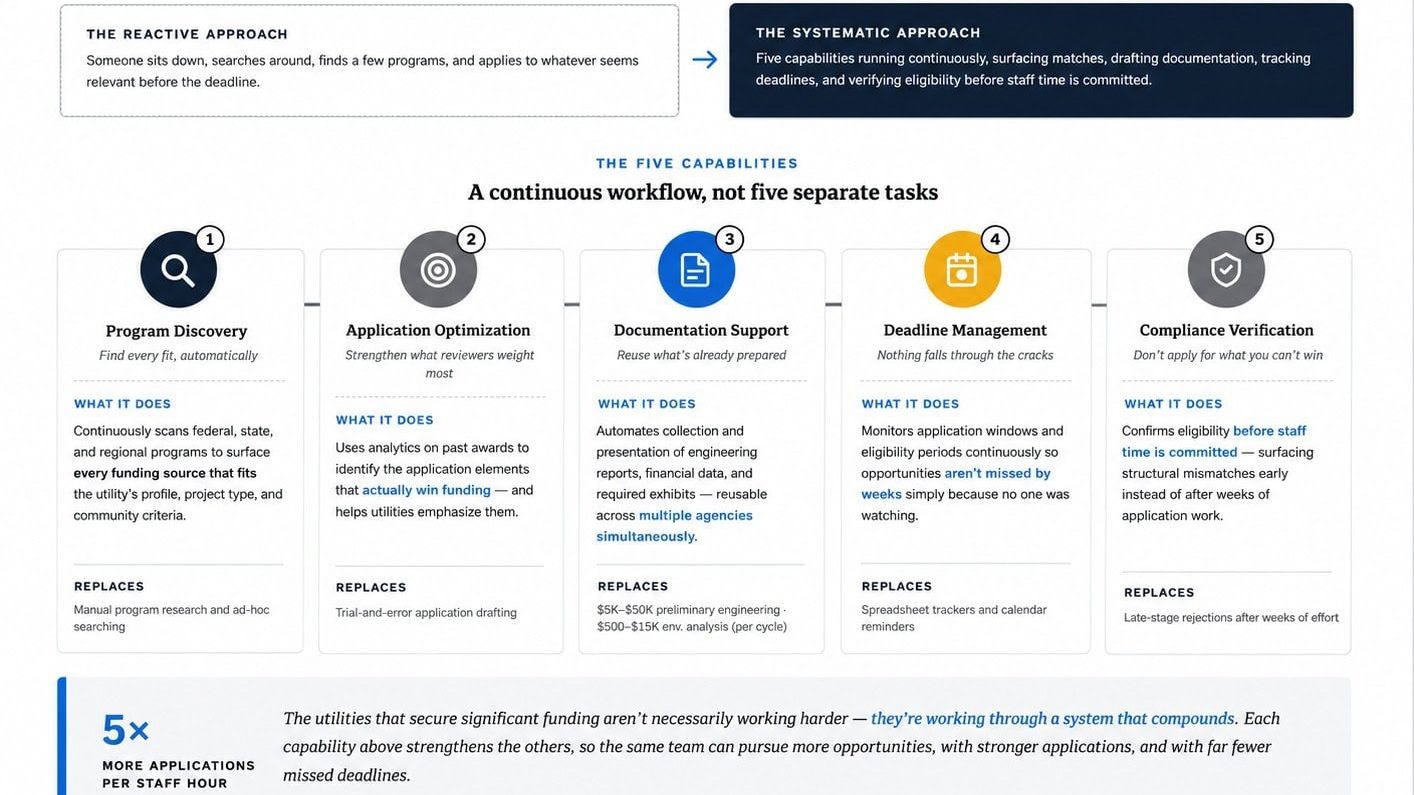
For years, finding funding opportunities looked like this: someone sat down, searched around, found a few programs, and applied to the ones that seemed relevant. It goes without saying that this arrangement is time-consuming, incomplete and prone to missing significant opportunities. Modern data intelligence platforms are changing that entirely.
High-end systems have the ability to find out programs that fit the requirements of a utility, saving precious hours of research. The EPA’s Water Finance Center has tools for helping communities find the right funding source. However, there are systems that go an extra mile.
- Application Optimization is the process of using analytics to find out the most impressive aspects in applications that should be highlighted. Such systems work well when small utilities encounter applications with similar requirements.
- Documentation support streamlines the gathering and presentation of data required for applications. Engineers have estimated that preparing additional preliminary engineering work alone could cost anywhere from $5,000 to $50,000, and additional environmental analysis could add $500 to $15,000 to a community’s costs. Technology reduces those costs greatly by automating data collection and presentation.
- Deadline management prevents missed opportunities.The automated monitoring of application periods and eligibility ensures that nothing is missed. Federal and state agencies have worked to develop coordinated processes, including a standard engineering report communities can use to apply to multiple agencies simultaneously.
- Compliance verification usually happens upfront. Technology can verify eligibility requirements before investing staff time in applications which directly addresses the reality that rural communities typically pay for infrastructure through user rates but often don’t have enough users to share the cost of major projects while keeping rates affordable.
What Braiding Funding Sources Actually Looks Like
It might not be obvious but tangible power comes from layering programs strategically.
This includes one case study of a city that was eligible for a $900,000 interest-free loan through the SRF program, $1.3 million in grants and loans from the U.S. Rural Utilities Service, and an additional $400,000 from HUD. Mind you, this was all under one project. That’s what braiding is.
The math works differently from traditional single-source funding. You’re not asking which program will fund this project but which combination of programs can be layered together. It is essential that you know about the ones which coexist and how you can structure the project to maximize grants and minimize local burden.
It is necessary for one to comprehend the guidelines of the individual programs. There are some programs that seek to establish themselves as the main funders. Others are comfortable sitting next to other programs while others have conditions regarding the amount of additional funding that should be considered.
Real Examples of Small Systems That Got This Right
The Coventry Fire District No. 1 in Vermont has been granted a total of $1.3 million, which includes a loan of $298,000 and a grant of $992,000, through USDA Rural Development for upgrading its water system. This project will entail installing a new pipe system and constructing a system that will remove arsenic, iron, and manganese from the water. It has proven that loans and grants can make the impossible possible.
The city of Justin in Texas successfully applied for a SWIFT loan in 2017 for water loss control and conservation. They received $12 million for design and construction of major water mains, utilizing the program’s flexibility to secure low-interest financing for a project addressing multiple problems at once.
Woodland-Davis Clean Water Agency in California assessed potential climate impacts using the EPA’s Climate Resilience Evaluation and Awareness Tool. They evaluated drought management strategies to strengthen their system’s operational resilience against extreme drought conditions. That positioned them to access climate resilience funding many utilities miss entirely.
The Okieville Highland Acres Mutual Water Company, which is located in California, and was dependent upon drought-prone private wells, established its new water system in 2016 and obtained an emergency community water assistance grant amounting to $500,000 from USDA for developing water infrastructure.
Centerville is an Iowan city that has a population of 5,500 people and used data analysis to determine the best sources of financing and obtained $8.2 million for improving their water systems. Grants and forgivable loans account for 75% of the total money received.

Where to Start
- Assess your infrastructure requirements, your financial ability, and your technical skills honestly. Do not try to hide anything. Just let people know what needs to be done and how much money you will need to make it possible.
- Prepare a capital improvements plan showing your priorities and schedules for implementation. Not a complicated plan by any means, but one that shows that you have given things serious consideration.
- Research which programs align with your community’s profile and needs. Actually, take a good look at the programs, understand eligibility, see which ones apply and then proceed accordingly.
- Connect with technical assistance providers and neighboring utilities. Organizations exist specifically to help small utilities navigate this and you must learn to make good use of them.
- Consider how data intelligence tools can streamline the process as they can save enormous amounts of staff time.
- Prepare applications emphasizing compliance, public health, and community impact. Be clear about why the project matters, what problem it solves, and who it serves.
- Develop systems to track deadlines, requirements, and documentation. This is so important because funding windows close, requirements change and you need something to keep track. A spreadsheet, a tracker, maybe a notepad even. Something is essential. Work towards securing that and you’ll have a huge burden off your shoulder.
Small utilities face real challenges but remember that the funding exists. The utilities that secure it are getting things done by being systematic and committed, there’s no magic happening behind-the-scenes, I promise.
It’ll be a long process but little by little you will know what’s available, learn to layer programs and prepare genuine applications that answer the question the funder is actually asking.
This is what’s available to any small utility willing to approach this seriously and I wish you the best of luck in getting everything just right.