
Two moments where water utility sales generally fall apart are:
The proposal: When your solution is one of the best in the market but the proposal doesn’t connect it to anything the utility actually cares about, it all goes to vain. The proposal’s features and specifications, technical merit and capability statements appear just fine but how does it fit into the utility? How is your proposal different from the one your competitor sent in? How is it predicted to perform in alternate conditions at a different time frame altogether? Make sure your proposal has no gaps that need to get repaired or it’s better to not send one in at all.
After the win: The deal closes, the project gets delivered and then out of nowhere the vendor disappears until the next procurement cycle. The relationship that took years to build gets neglected just like that. You are unfortunately not allowed any breaks during this period. It is mere seconds before a competitor comes and takes over this and all other subsequent projects.
Both problems stem from treating utility relationships as transactions rather than partnerships. The fix requires two things working together: tailoring the value conversation to each utility’s specific situation, and then maintaining intelligence on that account continuously so you’re never caught flat-footed.
Making the Value Case Specific
Generic pitches don’t work in water utility sales. Utilities pressed by economic constraints and regulators care less about features and more about tangible outcomes such as cost savings, reliability improvements and compliance assurance.
The shift is building proposals around the utility’s actual data like operational metrics, leak rates, energy costs, violation history, strategic goals from public reports and master plans.
Instead of saying that your solution reduces non-revenue water, the pitch should highlight how your utility’s water loss is 30% against a 15% national peer average. Say ‘our leak detection platform can help recover an estimated $1.2 million in lost revenue annually!’ Instead of claiming efficiency improvements, you model how your solution cuts that specific utility’s pump energy use by 10%, saving them $200,000 annually given their local electricity rates.
This matters because water utilities’ digital technology adoption is driven primarily by expected economic benefits, followed by regulatory pressure. Thus, framing value in concrete financial and risk terms dramatically increases a proposal’s appeal.
Tools that support this:
- Performance benchmarking databases to compare the utility’s metrics to similar systems.
- Financial modeling templates that input the utility’s actual rates and budget data.
- Regulatory analysis that quantifies compliance risk. If a utility faces upcoming PFAS limits, show them what non-compliance costs and how your treatment solution averts it.
- Utility executives care about KPIs: customer satisfaction, cost per gallon, reliability.
- Tailoring the value proposition to show KPI impact, with proof from other utilities, turns the discussion from inputs to outcomes.
The results of this approach are significant. The company in our case study saw a 62% improvement in proposal-to-win conversion after revamping proposals to include utility-specific analytics and ROI projections, displaying results like:
- Average contract value increased by 28% as utilities expanded project scopes.
- Price-related pushback during negotiations dropped 45%. When a proposal demonstrates clear cost-benefit and unique fit, utilities are far less inclined to choose on lowest bid alone.
Seventy-eight percent of the successful ventures came to include implementation or consulting services, up from 34%. Utilities saw the vendor as a partner ensuring success, not just a supplier delivering equipment.
Keeping the Account Alive And Flourishing
Securing the deal is just the beginning. What happens after determines whether the relationship deepens or erodes.
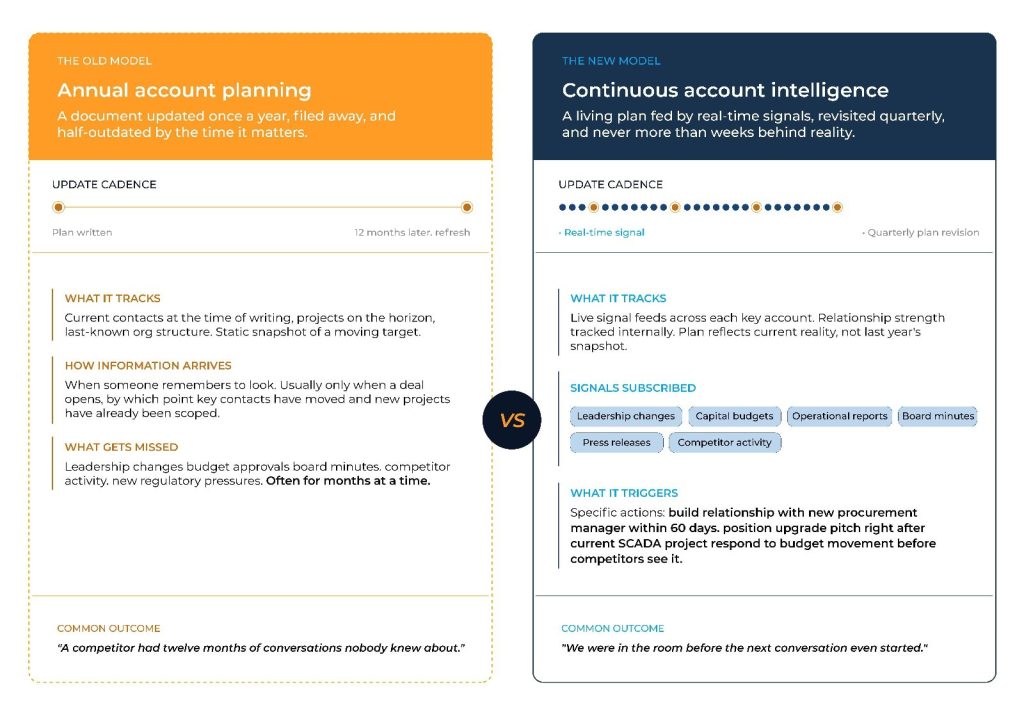
The old model of account planning was mostly annual. Someone updated a document, noted the current contacts, listed the projects on the horizon, and filed it away. By the time it was relevant again, half the information was outdated. Key contacts had moved, new projects had emerged and a competitor had already had twelve months of conversations nobody knew about.
Intelligence-driven account planning works differently as it is largely continuous. The sales team subscribes to real-time information about each key account. Leadership changes at the utility→Updated capital budgets→Operational reports→Board meeting minutes→Press releases→Alerts when a utility is mentioned in connection with a new water quality initiative or when a board approves a significant infrastructure investment.
Internally, teams track relationship strength and engagement frequency with each stakeholder. With these inputs, account plans become living documents revisited quarterly or monthly. The plan might outline a strategy to build a relationship with the new procurement manager within 60 days. Or to position a software upgrade pitch right after the utility completes a current SCADA project.
Competitive intelligence feeds in too. Which competitors are active in this account, what contracts they hold or if any service issues were experienced with the utility. It impacts how you engage with incumbents and where to apply pressure, and it requires careful consideration. Organizations that use analytics effectively in their account management practices will experience more growth and higher customer lifetime value. In water industry terminology, this translates to selling equipment and then becoming a long-term partner through maintenance, renewal, and cross-sell.
With the federal government investment into water infrastructure, such as the $55 billion allocated by the Bipartisan Infrastructure Law of 2021, there are plenty of opportunities for utilities, but not enough internal capacity.
The vendors who stay engaged through the entire project lifecycle and anticipate the next need are genuinely valuable. After selling a treatment system, a vendor tracking when components will need replacement or when new regulations will require upgrades can proactively offer solutions before the utility is even thinking about it.
What This Looks Like in Practice
The company in our case study saw a 38% increase in identified opportunities per existing account simply by not missing signals and surfacing needs proactively. Last-minute competitor wins in target accounts dropped by 57% because they now had early warning and responsive strategies. Service revenue from existing customers grew 215% as the team pursued add-on services and maintenance contracts systematically rather than waiting for the customer to ask.
One key account manager described their accounts beginning to view them as an embedded partner rather than an external vendor. That’s what all of this is really about. Not a standalone deal or proposal but about becoming the vendor that utilities call first because you know their system, you understand their constraints, and you’ve proven over time that you’re focused on their outcomes rather than your revenue.
The Whole Picture
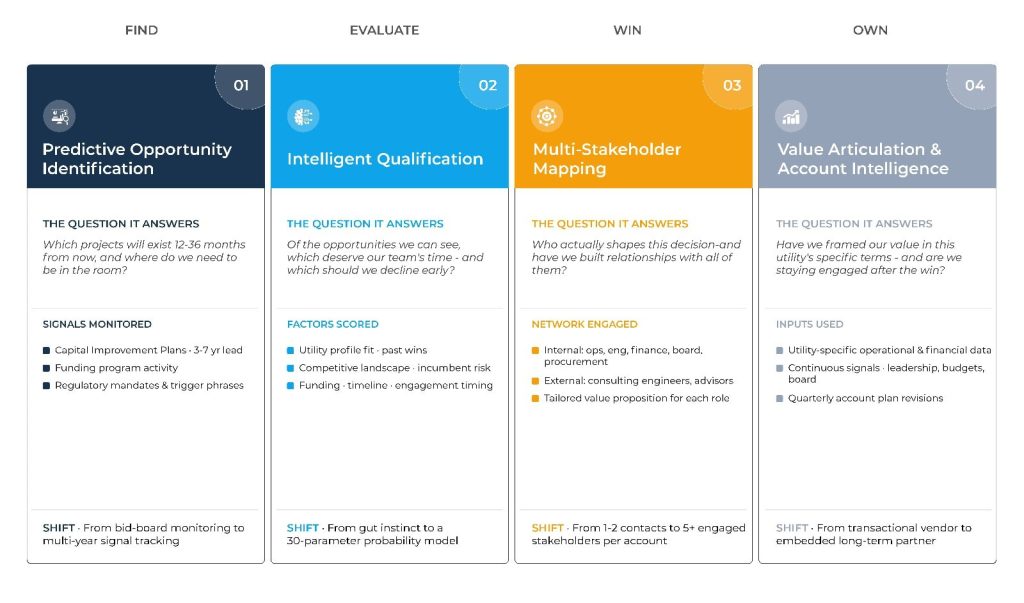
These four strategies, namely, predictive opportunity identification, intelligent qualification, multi-stakeholder mapping, and context-driven value articulation, combined with ongoing account intelligence drove a significant step-change in sales performance for the company in our case study. The win rate moved from 23% to 41%. Average stakeholder contacts per account went from 1.8 to 5.2. The services attached to deals went from 34% to 78%.
Yet, the more important shift was qualitative. The company stopped being a vendor that responded to RFPs and started being a partner that utilities wanted to work with before the RFP existed.
As Christine Ow, a Digital Water analyst at Bluefield Research, put it:
“The adoption of digital solutions is not just inevitable—it is critical for utilities to ensure the resilience and sustainability of water systems.”
The vendors who embrace data-driven sales mirror that evolution. They use intelligence to serve their utility clients better. Every project that’s been secured, feeds new insights back into the intelligence loop, sharpening the competitive edge continuously.
The vendors who figure this out, those ones who combine genuine domain expertise with systematic intelligence, will eventually be the ones utilities call trusted partners. That’s what a business outcome is. It compounds over time in ways that no amount of reactive bidding ever will.