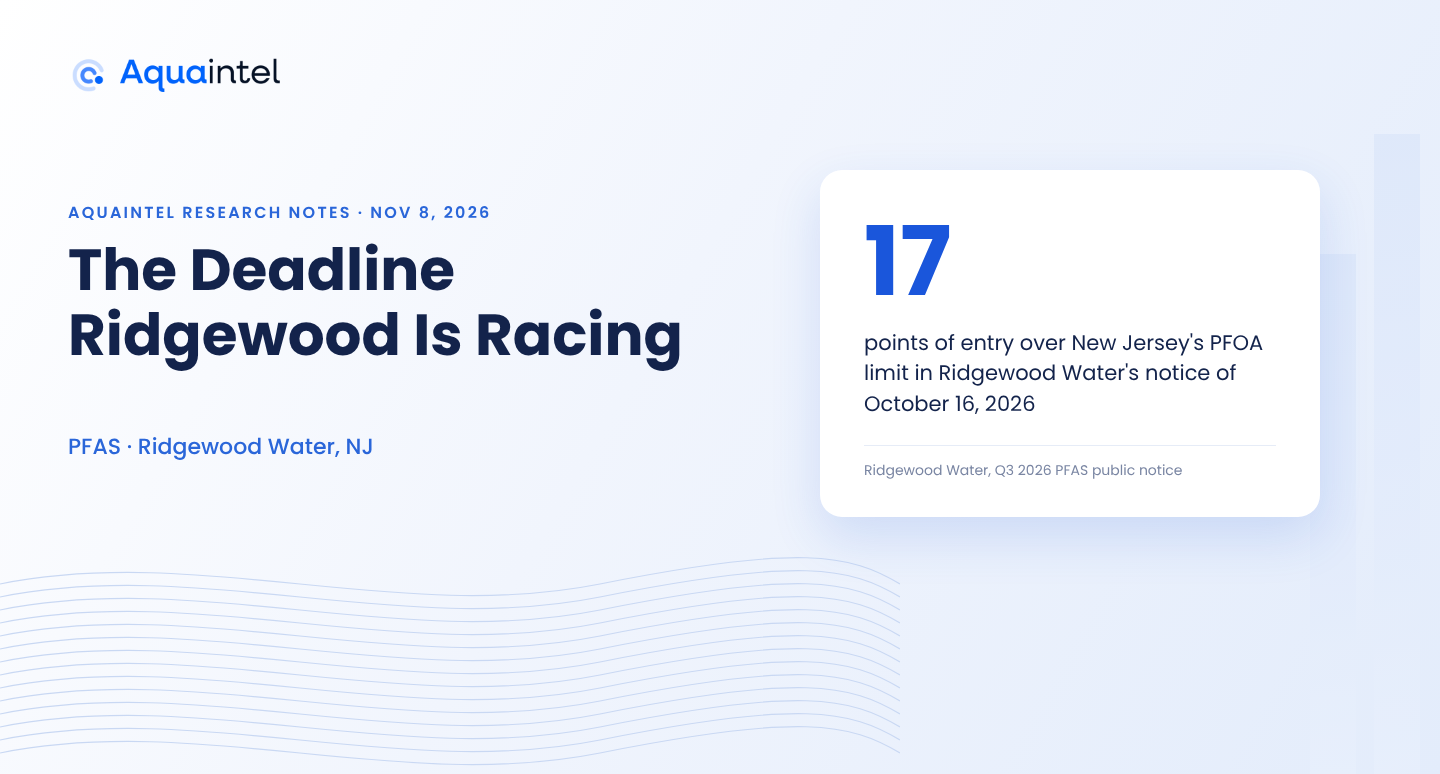

Ridgewood Water’s latest public notice, dated October 16, says PFOA is over New Jersey’s limit at 17 of its points of entry, and that eight of its twelve new treatment plants are online. The last one is due in early 2027. EPA’s proposal to give utilities until 2031 for PFOA and PFOS has not changed that schedule at all, because Ridgewood’s deadline is a state consent order.
The weekly brief that started this piece said EPA’s rollback has turned PFAS into a “fragmented, state-by-state compliance environment”. That is true, and too abstract to act on. I wanted to see what it looks like inside one utility’s records. Ridgewood Water serves about 61,000 people in Ridgewood, Glen Rock, Midland Park and Wyckoff, in Bergen County, from 52 wells. It has been building PFAS treatment since 2018, and it posts its notices, budgets and plans.
I believe the question to ask about any utility is which deadline it is working to. For Ridgewood it is a state date that arrives more than two years before the federal one. For a utility across the state line in Pennsylvania, it is the federal date alone.
What EPA proposed, and what it did not
The federal rule of April 2024 set limits of 4.0 parts per trillion (ppt) for PFOA and PFOS, 10 ppt for three other PFAS, and a hazard index for mixtures, with compliance by April 26, 2029. In May 2025 EPA said it would keep the PFOA and PFOS limits and rescind the rest.
The two proposals came out on May 20, 2026. The first would rescind the limits for PFHxS, PFNA, GenX and the mixture. EPA’s stated reason is procedure: the proposal says it is “necessary to correct the unlawful procedure under which these regulations were promulgated.” EPA’s own page adds that when it evaluates these PFAS again, “it is possible that the result could be more stringent requirements.”
The second is the one behind the 2031 headlines. It proposes a federal exemption that moves the compliance date “from April 26, 2029, to April 26, 2031, for those systems that submit a request.” EPA’s version applies “in states, territories, and Tribes that have not obtained primacy for those MCLs”. In a state with primacy, the state decides. Comments on both closed on July 20, 2026. EPA said it aimed to finalize the extension in the fall; I have not found a final rule as of November 3.
So PFOA and PFOS stay at 4.0 ppt, the 2029 date stands unless a system asks for more time and gets it, and the four other limits stay on the books until a final rule removes them.
The states did not wait
Several states set their own enforceable limits years before EPA, and some have moved since.
New Jersey set its PFOA and PFOS limits in 2020, at 14 and 13 ppt, with monitoring from the first quarter of 2021. Its PFNA limit of 13 ppt dates from 2018. Under the state rule, a system that violates a limit has one year to fix it. Vermont’s new rule took effect on January 1, 2026, with 4.0 ppt for PFOA and PFOS and limits for the very PFAS that EPA proposes to drop. California has no enforceable limit, but in October 2025 it lowered its notification levels for PFOA and PFOS to 4.0 ng/L.
A New Jersey limit of 14 ppt is looser than the federal 4.0. The state limit came first, though, and it carries its own enforcement. For a utility over 14 ppt in 2021, the federal date of 2029 was a second, later deadline.
EPA’s own monitoring data shows how many New Jersey systems sit between the two limits. Under the fifth Unregulated Contaminant Monitoring Rule (UCMR 5), 265 New Jersey systems reported PFAS results from January 2023 to September 2025. I counted their highest results in EPA’s final data release: 137 had a PFOA or PFOS result at or above 4.0 ppt and none at the state limits, and 18 had a result at or above the state limits (derived). Ridgewood Water is one of the 18, with a high of 31.4 ppt PFOA.
- Under 4 ppt: 110 systems (Large systems 57 systems; Small systems 53 systems)
- 4 ppt to under NJ limits: 137 systems (Large systems 91 systems; Small systems 46 systems)
- At or over NJ limits: 18 systems (Large systems 12 systems; Small systems 6 systems)
For the 137 in the middle, the federal date is the first deadline that can reach them, so what EPA does with the 2031 proposal sets their schedule.
Ridgewood’s deadline is the end of 2026
Ridgewood Water’s PFAS questions page says: “In May 2023, Ridgewood Water voluntarily entered into an Administrative Consent Order (ACO), recognizing the need for comprehensive treatment, setting a goal to have all treatment facilities online by the end of 2026.” The plan is to consolidate 31 treatment points into 12 new plants.
The Q3 2026 notice shows how far there is to go. As of September 30, PFOA was over the state limit at 17 points of entry, with running annual averages of 13 to 36 ppt, and PFOS at three. “Our water system was not able to remediate the PFOA and PFOS MCL violations at seventeen (17) points by the one-year deadline.”
Every one of those 17 readings is more than three times the federal 4.0 ppt (derived). Ridgewood says that when all twelve plants are running, regulated PFAS will be non-detectable in treated water.
The plants went out one contract at a time. Ridgewood’s September 2025 construction update lists them, from the Carr plant, awarded in November 2018 for $2.67 million and running by September 2019, to Cedar Hill, the largest, at 3.6 million gallons a day.
- Awards to date: 2018.85: $2.7M; 2021.85: 3.2 M; 2023.29: 7.15 M; 2023.62: $16.6M; 2024.29: 26.55 M; 2024.62: 34.32 M; 2024.79: $40.6M; 2025.71: 55.27 M; 2025.87: $69.8M
The construction awards add up to about $70 million (derived, with Cedar Hill at its award ceiling of $14,554,000). The same update puts the whole program, with engineering and inspection, at $98 million, against $89 million in the 2020 master plan. Most of it is financed through the New Jersey Water Bank, the state revolving fund. Customers pay for it through a separate PFAS surcharge, which went from $24.71 to $37.07 a quarter for a standard meter in 2025, according to the rate consultant’s review of that year’s budget.
Cedar Hill shows how a state deadline can slip for state reasons. The first low bidder withdrew in October 2025, and under state law a bidder who withdraws cannot be awarded the rebid. The Village Council awarded the contract to Pact Two, LLC on November 12, 2025, for up to $14,554,000. In the minutes of that meeting, the Village explains that the consent order “requires that the work be completed by the end of 2026”, that NJDEP required an archaeological dig at the site, and that “there is a chance that this may run into the first quarter of 2027.”
The same rule, the opposite case
The Borough of Carlisle, Pennsylvania, sits on the other side of the patchwork. Pennsylvania’s limits are 14 ppt for PFOA and 18 for PFOS. Carlisle’s highest results were 7.1 and 15.8, under the state limits and over the federal ones. Its PFAS page says: “Although the Borough’s water meets Pennsylvania’s existing drinking water requirements, the new federal standards require additional treatment”. On August 13, 2026, the Borough Council voted 7-0 to approve the treatment evaluation and a final design contract of up to $738,000.
For Carlisle, the 2031 proposal could change the schedule. Ridgewood’s schedule is set by the state, and both utilities read the same federal news.
If you sell to utilities
- Find out which deadline a utility is on before you read anything into federal news. A state limit, a consent order or a quarterly public notice will usually tell you.
- Read the quarterly PFAS notices where a state requires them. Ridgewood’s lists every point of entry, its running average and the plants still under construction.
- Look at how the work is bought. Ridgewood bid each plant separately, and in May 2025 it put the carbon treatment systems for three plants out in their own bids, apart from construction. That is a different sale from a single large design-build contract.
- Watch what comes after the plants. On November 4, 2026 the Council’s agenda listed an engineering contract for “Surface Water Interconnections PFAS Alternatives and Distribution System Optimization”.
What I don’t know yet
- The text of the 2023 consent order and whether NJDEP has formally extended it for Cedar Hill.
- Whether New Jersey will adopt the federal 4.0 ppt, and when. I have found no proposal.
- Whether EPA will finalize the 2031 exemption, and in what form.
- Whether Ridgewood has received money from the national PFAS settlements. It is a plaintiff in the federal litigation, and I found no receipt in its council records.
The next marker for Ridgewood is Cedar Hill coming online in early 2027. The next marker for everyone else is EPA’s final rule on the extension.
At AquaIntel we read state rules, consent orders, quarterly notices and council awards together and keep each with its date, so a vendor can see which deadline a utility is working to and what it has already bought.
Sources
- US EPA, PFAS National Primary Drinking Water Regulation, 89 FR 32532, 26 Apr 2024.
- US EPA, press release, 14 May 2025.
- US EPA, proposed rescission for four PFAS, 91 FR 29413, 20 May 2026; proposed compliance extension for PFOA and PFOS, 91 FR 29425, 20 May 2026; proposed rescission page; EPA overview slides, July 2026. Retrieved 3 Nov 2026.
- New Jersey DEP, adoption of PFOA and PFOS MCLs, effective 1 Jun 2020, and N.J.A.C. 7:10.
- 25 Pa. Code 109.202; 10 NYCRR Subpart 5-1, Table 1; Michigan EGLE, PFAS drinking water rules; Vermont DEC, Water Supply Rule effective 1 Jan 2026; California State Water Board, PFOA notification level, 29 Oct 2025.
- Ridgewood Water, PFAS Q&A; Q3 2026 PFAS public notice, 16 Oct 2026; PFAS Treatment Construction Update, 29 Sep 2025; Village of Ridgewood, notices to bidders 2025-004 to 2025-006 (GAC treatment systems for Eastside, Main and Mountain); 2025 Annual Water Quality Report; Raftelis, Ridgewood Water 2025 Budget Review, 19 Feb 2025; New Jersey Water Bank project notices, 2024 to 2026.
- US EPA, UCMR 5 occurrence data, final release, August 2026 (New Jersey, PFOA and PFOS).
- Village of Ridgewood, Village Council agendas and minutes, 9 Jul 2025 to 4 Nov 2026, on the Village’s agenda center.
- Borough of Carlisle, PFAS page and Borough Council minutes, 13 Aug 2026.
Part of Last Week in US Water Utilities, November 8, 2026, from AquaIntel Research Notes.
If you sell into utilities and want records like these for the accounts in your territory, talk to us→