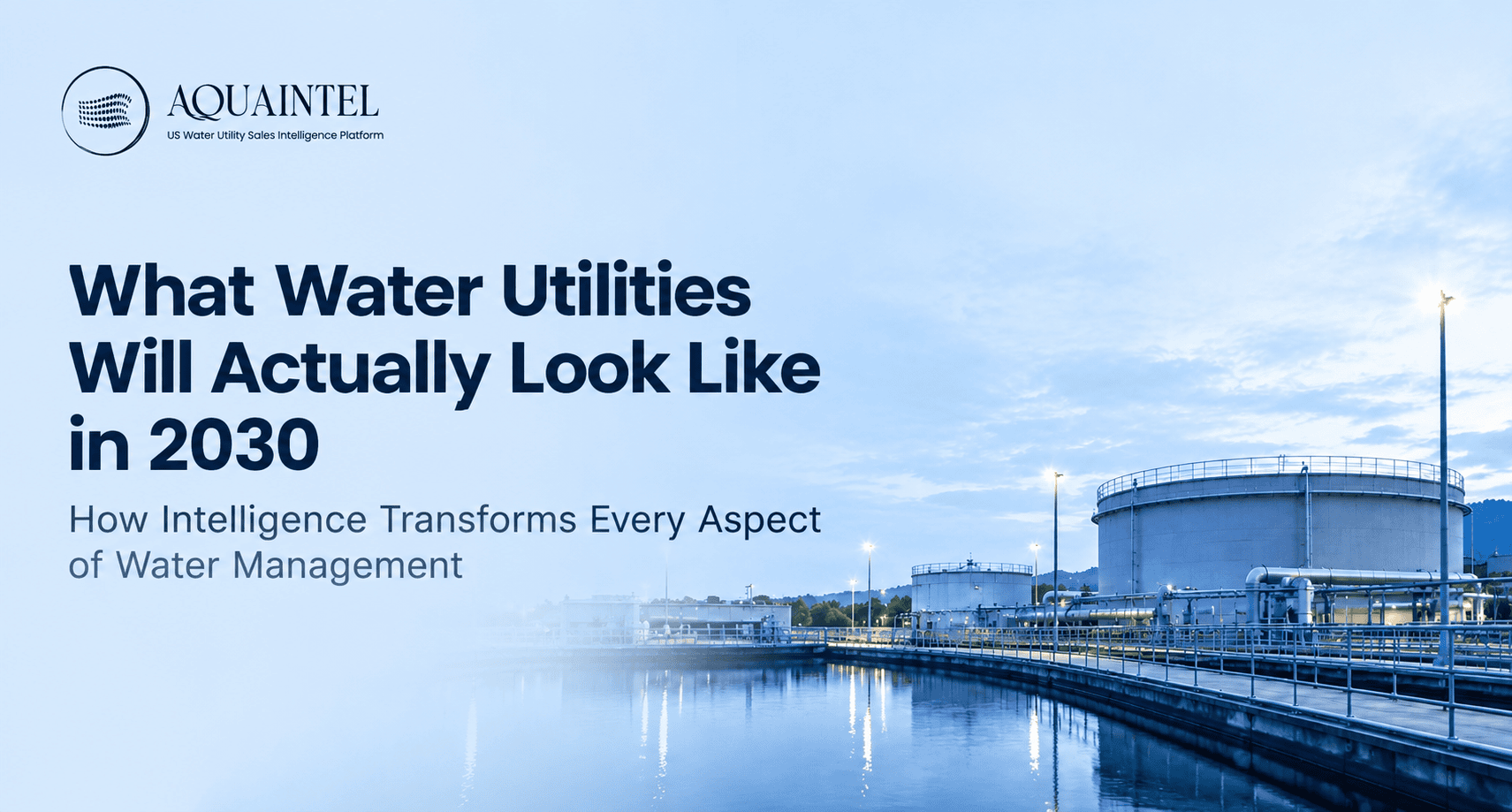

Water infrastructure may move slowly, but the information surrounding it doesn’t.
The real transformation isn’t happening inside treatment plants or distribution networks. It’s happening in how vendors identify opportunities, understand utilities, and engage with decision-makers. The companies pulling ahead aren’t necessarily offering different technologies, they’re operating with better information.
For a long time, selling into water utilities was a relationship business: You knew people→ you heard about projects through your network→ you showed up when the time was right. That model worked when the market moved slowly and information asymmetry was accepted as a fact of life that simply can’t be helped.
The Market Is Changing and So Is the Competitive Landscape
The water sector isn’t changing overnight, but the forces shaping it are.
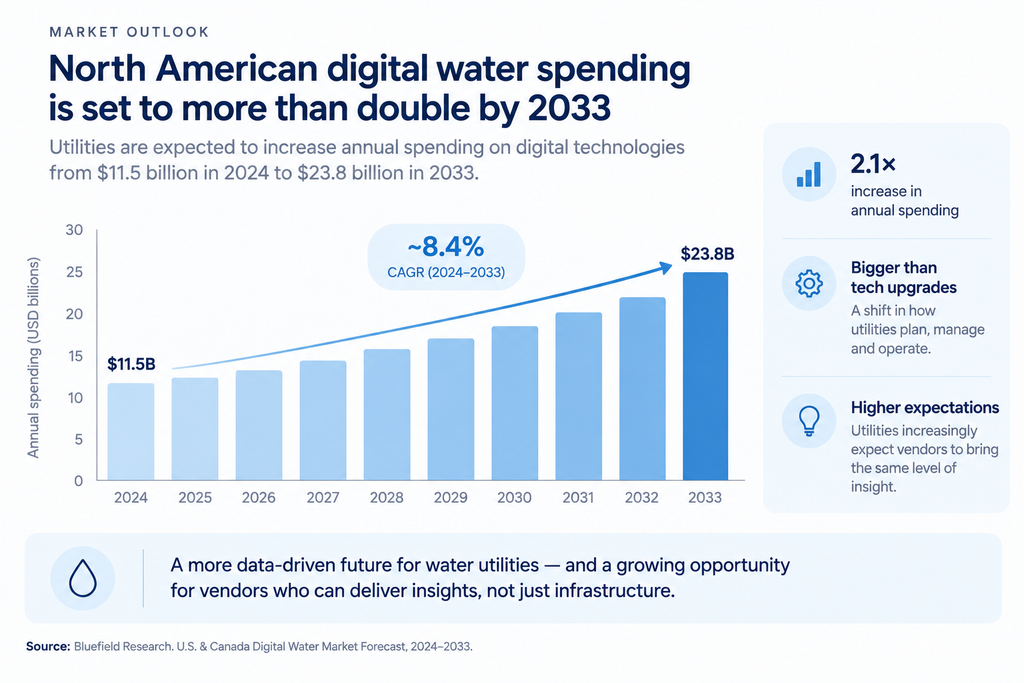
North American water utilities are expected to increase annual spending on digital technologies from approximately $11.5 billion in 2024 to $23.8 billion by 2033. This isn’t simply a technology upgrade but a broader shift in how utilities plan capital investments, manage assets, and make operational decisions. As utilities become more data-driven, they increasingly expect the vendors supporting them to bring the same level of insight.
- The digital maturity gap is creating opportunity
Ironically, while digital investment is accelerating, only 4% of utilities believe their existing digital solutions are fully delivering the outcomes they were intended to achieve. That gap between where utilities are today and where they want to be will drive billions of dollars in future investment. The vendors best positioned to benefit won’t simply be those offering new technologies, but those who understand the operational problems utilities are trying to solve before procurement even begins.
- The workforce is changing faster than institutional knowledge can be replaced
The industry’s workforce transition is adding another layer of complexity. Between 2015 and 2023, vacancy rates across water utilities doubled as experienced professionals retired, taking decades of operational knowledge with them. Utilities increasingly need vendors who bring continuity, context, and a deep understanding of their challenges, not just products. Relationships remain critical, but maintaining them has become more difficult as organisations themselves continue to evolve.
- Regulation is creating new pockets of demand
Regulatory pressure continues to reshape utility priorities. PFAS treatment requirements, Lead and Copper Rule revisions, cybersecurity mandates, and supply chain resilience initiatives are all driving new infrastructure investment. Each regulation affects utilities differently and on different timelines. Vendors that can identify which utilities face which compliance challenges and engage them with solutions tailored to those specific needs will consistently outperform those relying on broad, one-size-fits-all sales approaches.
Federal financing has also scaled dramatically. As of December 2023, the WIFIA program alone had enabled more than $43 billion in water infrastructure investments nationwide, a mechanism increasingly layered alongside SRF loans and BIL grants by utilities and their advisors who understand how to structure a funding stack.
Where Intelligence Creates Measurable Advantage
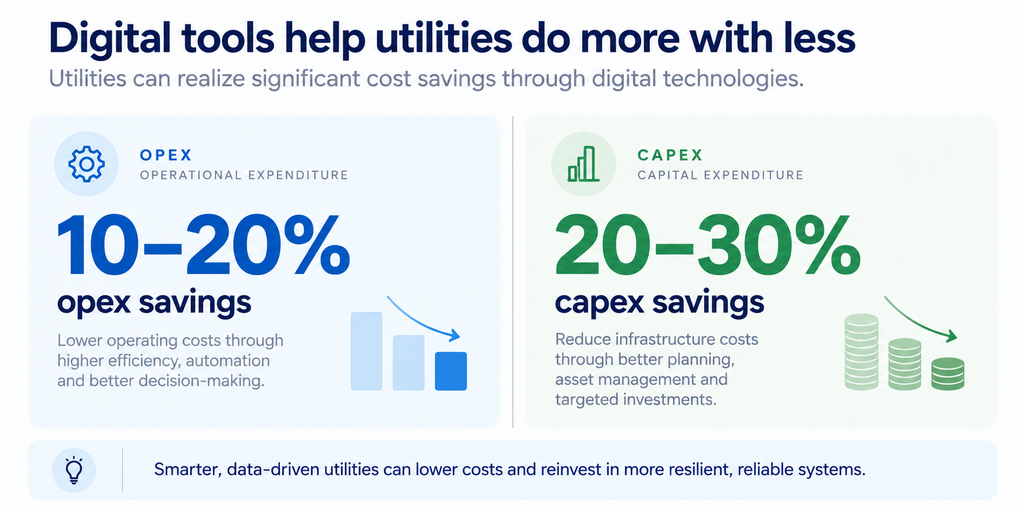
The impact of data intelligence isn’t theoretical anymore. Across sales performance, market coverage, customer engagement, and revenue generation, the gap between organizations that systematically use intelligence and those that don’t has become increasingly measurable. It’s measurable on the utility side too: McKinsey found that advanced analytics models enabling predictive maintenance allow water utilities to see typical yearly savings of 10 to 20% in maintenance operating expenditures and 20% to 30% in capital expenditures meaning vendors who can speak to those outcomes aren’t just selling a product, they’re speaking the utility’s own financial language.
- Higher Win Rates Begin Earlier
Organizations using intelligence platforms achieve overall win rates of approximately 38%, compared with roughly 22% for traditional approaches. The advantage becomes even more pronounced during early-stage engagement, where vendors involved before formal procurement can see win rates approach 64%. The implication is clear: the earlier vendors understand an opportunity, the greater their ability to shape the outcome.
Intelligence also changes the speed at which opportunities move through the pipeline. Average sales cycles fall from approximately 24 months to 16 months, allowing revenue to be realized significantly sooner. For a business generating $10 million in annual sales, reducing the average sales cycle by eight months represents roughly $3.3 million in revenue brought forward rather than remaining tied up in the pipeline.
The benefits extend beyond individual deals. Vendors relying on traditional methods typically reach around 28% of their addressable market. Organizations using intelligence platforms increase that figure to approximately 65%, giving them visibility into projects and planning activity that competitors may never see. Quite simply, vendors cannot pursue opportunities they don’t know exist.
Intelligence doesn’t just help vendors find projects earlier, it helps them become part of the planning process itself. Strategic partner relationships increase from approximately 15% to 47%, allowing vendors to move beyond transactional procurement and become trusted advisors. Those relationships compound over time, making future opportunities easier to identify and harder for competitors to displace.
The Financial Return Is Difficult to Ignore
The commercial impact becomes even clearer when organizations begin measuring return on investment.
One national equipment manufacturer implemented an intelligence platform and reduced its average sales cycle by 43%, increased win rates by 58%, and generated $5.2 million in additional revenue during its first year, all from an investment of approximately $175,000.
A regional engineering firm reported similarly strong results. After adopting an intelligence platform, it identified 127% more infrastructure funding opportunities, improved pursuit selection effectiveness by 41%, and generated an additional $3.8 million in revenue during its first year against an annual subscription cost of approximately $85,000, an estimated 29-fold return on investment.
These are documented outcomes from real deployments instead of projections illustrated for emphasis.
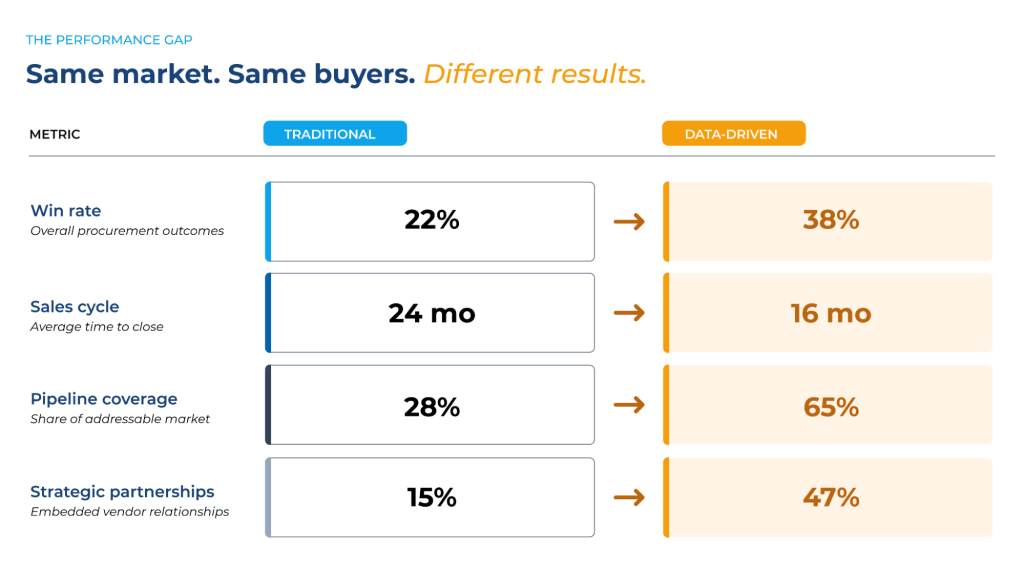
Water vendors using intelligence-driven sales strategies consistently achieve higher win rates, broader market coverage, shorter sales cycles, and stronger utility relationships.
The Competitive Reality
Digital water solutions companies that are listed on stock exchanges backed this up with real numbers: Bluefield Research found the 10 publicly traded digital water companies it tracks posted average annual revenue growth of 7.2% in 2023, with five firms posting double-digit growth led by Badger Meter’s 24.4% increase over the prior year.
The reason for this success lies in their ability to be much more effective at conveying value to utilities compared to vendors who have not adopted an approach based on intelligence and intuition yet. And this disparity between vendors will only become greater in the coming years.
The benefits that intelligent selling brings will only continue to add up: better data, improved forecasting models, enhanced account transparency, and more strategic business relationships. The longer vendors sell through an intelligence-based approach, the more effective their strategy becomes. In contrast, the vendors that decide to ignore this opportunity find themselves falling further and further behind.
The opportunity is immense but it doesn’t go equally to everyone in the market. It goes disproportionately to the vendors who can see it clearly, engage early, understand what’s driving decisions, and demonstrate specific value in terms utilities can act on.
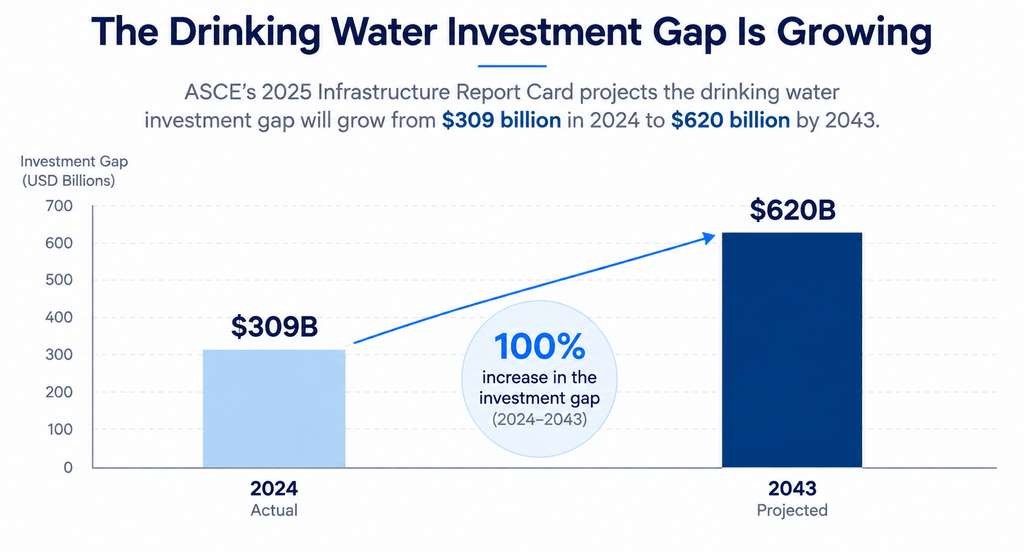
These market dynamics make the opportunity for vendors particularly noteworthy. There has never been so much federal money invested into the water sector at the same time as ASCE’s 2025 Infrastructure Report Card projects the drinking water investment gap growing from $309 billion in 2024 to $620 billion by 2043. The pressure on utilities coming from regulators has made them feel compelled to act, while workforce shifts have made them more open to partnership than ever before.
It’s a sizable opportunity, yet one that will be unequally spread throughout the market, and which will fall upon those vendors able to recognize the opportunity, understand what motivates utilities to act and how, build stakeholder engagement, and articulate their value proposition. This is where intelligence comes in, and for those vendors serious about competing in the water sector, it becomes crucial, leaving no room for postponement or waiting for things to click.