

There’s a version of water utility sales where every deal goes to bid. You sharpen your pencil→ you come in slightly lower than the competition→ you win some, lose some. Your margins stay under pressure because the utility has no particular reason to choose you over someone else at the same price. In this case, you are a commodity supplier and hence, interchangeable. Most vendors in this market are stuck in that narrative.
Then there’s a different version, where utilities call you before they’ve defined the project, where you’re involved in planning conversations, instead of procurement ones, where your win rate isn’t dependent on having the lowest number on the last page of a proposal and lastly, where nearly half your accounts view you as a strategic partner involved in long-term planning.
The difference between those two positions ultimately comes down to intelligence.
What Commodity Positioning Costs
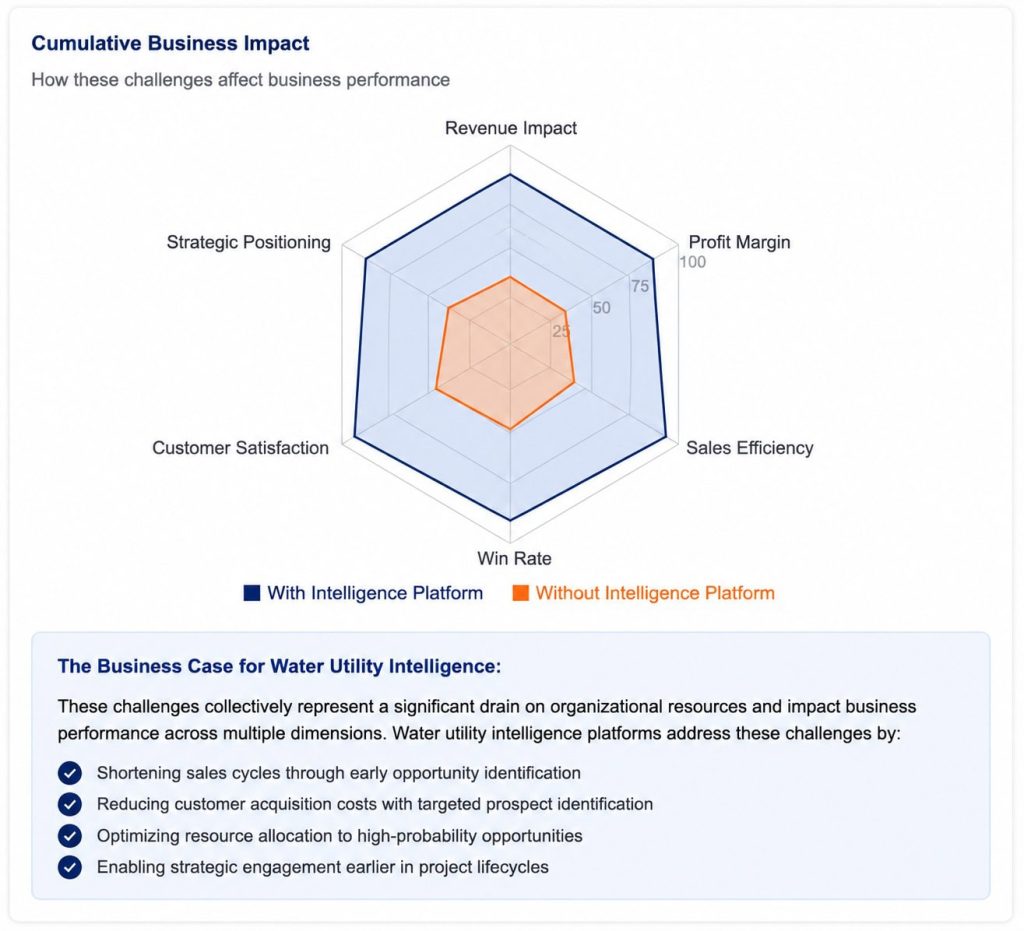
Before intelligence platforms change the picture:
- Average contract values in the water sector sit around $250,000.
- Gross margins hover near 34%.
- About 38% of existing customers expand or upsell into additional products and services. Around 15% of accounts treat the vendor as a genuine strategic partner which means that 85% of accounts see the vendor as a supplier to be managed rather than a partner to be engaged.
They compare proposals, run competitive processes and make decisions based on price and spec compliance. The vendor has limited ability to influence outcomes before specifications are set, with limited insight into what’s really driving the decision paired with a just as limited leverage when negotiations start.
This is the consequence of engaging late and generically. Showing up at the RFP stage with a standard proposal tells the utility you don’t know their system, you don’t know their constraints, and you don’t even know what they’ve already decided matters.
How Intelligence Changes the Position
With deep account intelligence, the entire engagement model shifts.
Average contract values grow to approximately $325,000—a 30% increase. Not through aggressive pricing strategy. Through expanded scope. When you understand a utility’s actual situation, you can propose solutions that address the full problem rather than the subset that made it into the RFP.
Gross margins improve to roughly 42%. When you’re competing on genuine understanding and tailored value rather than price, procurement conversations change character. There’s less pressure to discount when the proposal demonstrates specific, defensible ROI for that utility’s situation.
Upsell and cross-sell rates move from 38% to 65%. Customers who experienced a vendor that understood their system and delivered results want more of the same. They bring the vendor into the next problem instead of starting a new competitive process.
Strategic partner relationships grow from 15% to 47% of accounts. That is nearly half of the customers involving the vendor in long-term planning instead of just procurement processes.
What Strategic Partnership Actually Means
A vendor engaged as a strategic partner looks different from a commodity supplier in every interaction.
They’re in planning conversations before projects are defined, they understand what funding the utility has secured, what regulatory pressures they’re facing, and what’s in the capital improvement plan for the next five years.
When they bring a proposal, it’s a response to a specific, documented understanding of what the utility actually needs instead of randomly and vaguely addressing the RFP. The value proposition is quantified in the utility’s own terms. Not “our solution improves efficiency” but “based on your current energy consumption data and local electricity rates, this has extremely high chances to save you approximately $200,000 annually.”
That specificity is only allowed into rooms prioritizing intelligence. And that specificity is what moves the conversation from features and price to outcomes and partnership.
The Compounding Value of Strategic Relationships
Strategic partner status doesn’t just change individual deals. It changes the account economics over time.
When utilities view you as a partner, they tell you about problems before they’ve defined solutions. They involve you in planning processes. They introduce you to colleagues at other utilities. They provide references that carry weight because they’re genuine. The competitive process that commodity suppliers navigate continuously either doesn’t happen or is a formality.
Service revenue from existing customers grows 215% for organizations that shift from reactive to intelligence-driven account management. That growth isn’t from selling harder. It’s from seeing opportunities that were always there and being positioned to act on them.
The institutional knowledge that builds up through sustained strategic relationships is itself a competitive advantage. Understanding a utility’s history, infrastructure, financial situation, regulatory context, and organizational dynamics is hard to replicate. A competitor can match your technology. They can’t quickly replicate five years of deep account knowledge.
Organizations that effectively leverage analytics in account management achieve higher customer lifetime value by turning one-off equipment sales into long-term partnerships spanning maintenance, renewals, and cross-product sales over decades. That’s the difference between a business built on transactions and one built on relationships.
And relationships, in the water sector, are built on understanding. Understanding comes from intelligence.