
There are roughly 50,000 community water systems in the United States. Most vendors selling into this market are reaching about 28% of potential utility customers. That means 72% of the market is essentially dark and it cannot be credited to utilities being inaccessible, because the problem lies in the lack of infrastructure that could allow vendors to see through favorable opportunities. This coverage gap makes up one of the most expensive problems in water utility sales which is entirely invisible until you sit down and measure it.
Why the Gap Exists
The fragmentation of the water sector turns out to be the root cause in such cases. There are fifty thousand systems recorded across the country ranging from major metropolitan utilities managing billions in assets to small rural systems serving a few hundred households. They’re governed differently, funded differently and hence, procure differently. Some publish detailed capital improvement plans while others have minimal public documentation.
Building coverage across that landscape manually is much more difficult than it might seem. Sales teams tend to focus on where they have existing relationships; areas where they know projects are coming from, and where they have before. Naturally, the accounts that are already visible get the most attention. The result is a systematic bias toward known accounts and away from the broader market opportunity.
What 28% Coverage Actually Costs
The financial implication of covering 28% of your addressable market is straightforward: you’re competing for a fraction of the available opportunity.
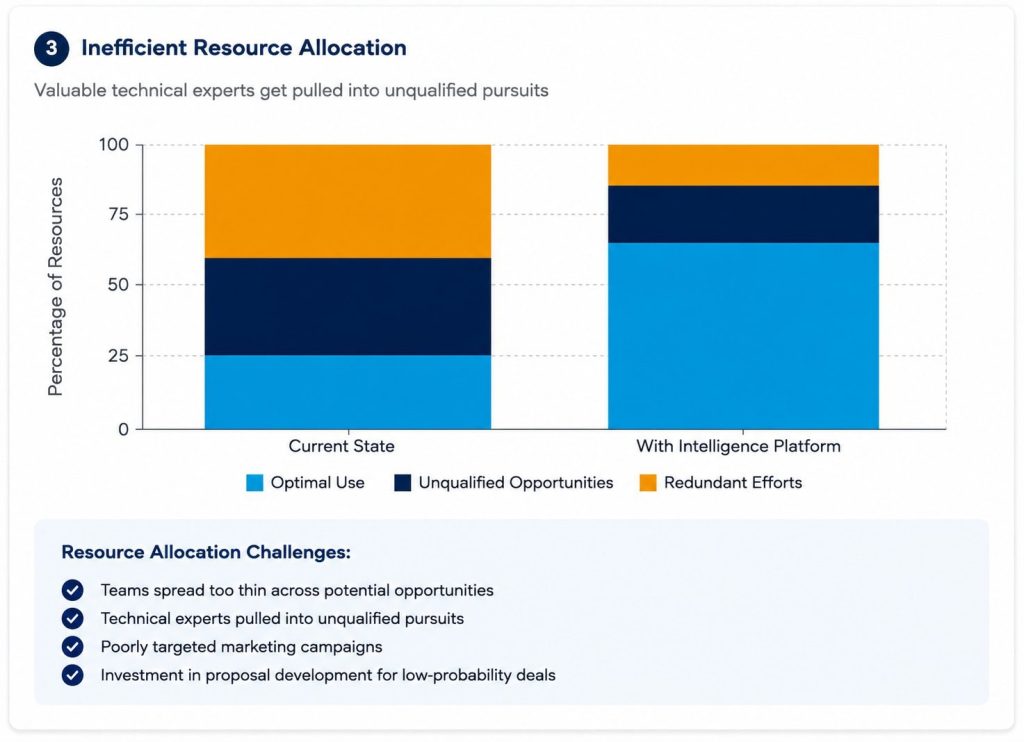
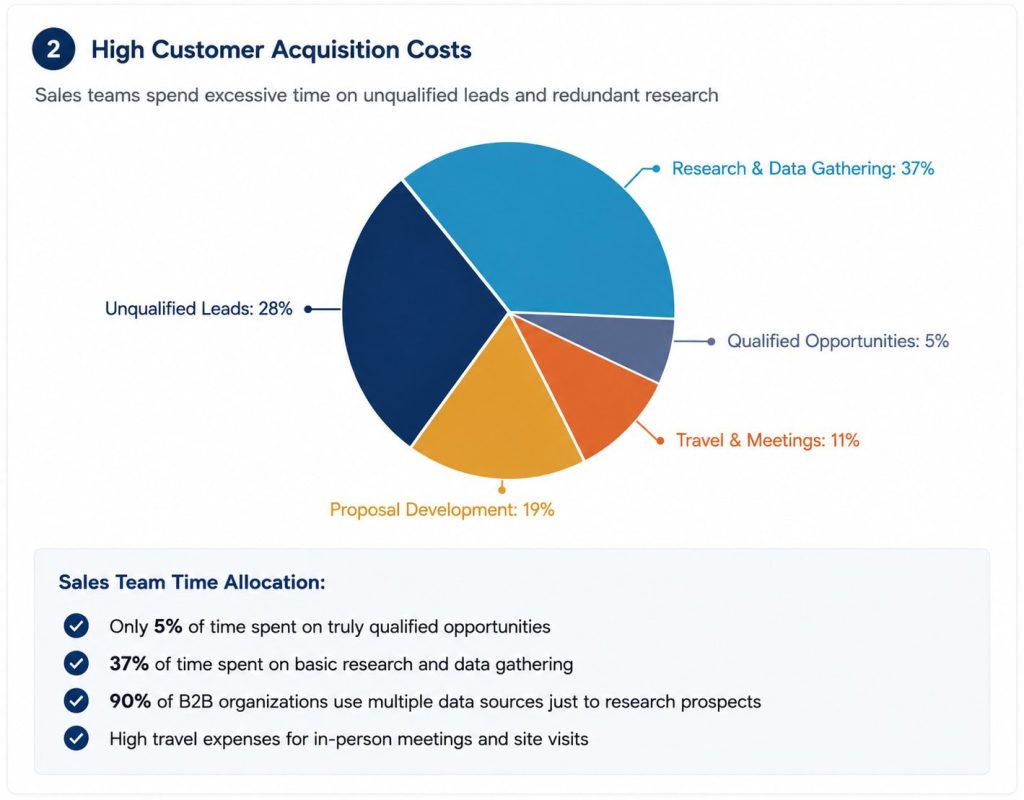
When you’re covering 28% of utilities, your pipeline is shallow in ways that affect every downstream metric heavily: Fewer qualified leads means more pressure on the ones you have→ More pressure on individual leads means less selectivity about which ones to pursue→ Less selectivity means lower win rates and more wasted effort. The coverage problem compounds through the entire sales funnel.
It also creates geographic and segment blind spots that competitors can exploit. If a competitor is monitoring capital improvement plans and funding awards across your entire territory while you’re covering 28% of it, they’re going to find projects before you do.
What Intelligence Changes
With systematic intelligence, territory coverage expands to approximately 65% of target utilities. That’s more than a doubling of market visibility.
What drives that expansion is the automation of information gathering across public sources that individually are accessible but collectively are impossible to monitor manually. Capital improvement plans. Board meeting minutes. State revolving fund applications. Federal funding awards. Regulatory compliance records. Budget documents. Permit applications.
Most of this information is public. The challenge isn’t access—it’s scale. A sales team can’t manually scan thousands of documents across hundreds of utilities on a continuous basis. Intelligence platforms do exactly that. They monitor systematically. They flag relevant signals. They bring the information to the team instead of requiring the team to go find it.
The coverage expansion has downstream effects across every sales metric. More utilities in view means more early-stage opportunities identified. More early-stage opportunities means more chances to engage before RFPs are written. More pre-RFP engagement means higher win rates and larger contracts.
Early-stage engagement rates jump from 22% to 68% with intelligence platforms. That near-tripling of pre-RFP involvement is in part a direct consequence of coverage. You can only engage early on projects you know about.
The Compounding Effect
Coverage is far more than lead generation metric as it is capable of significantly changing the character of the pipeline.
With 28% coverage, the pipeline is concentrated. A handful of known accounts represent most of the opportunity. Losing one big deal has an outsized impact. The team doesn’t have the visibility to quickly reallocate attention because they don’t know what else is out there.
With 65% coverage, the pipeline is diverse. Multiple opportunities across different accounts, geographies, and stages. Losing a deal hurts less because the team can see what’s next. In such cases, resource allocation becomes an option rather than being just an outcome.
The fact is that being robust in the pipeline is especially important in the water industry, where schedules always tend to go off track because of either delays in receiving funds, regulatory issues, or changes in political landscape. If you have transparency, you can afford to offset your delays elsewhere.
When you’re covering 28% of the market, every delay is a crisis. The coverage gap is a structural problem that produces structural consequences throughout the sales organization. Closing it requires better information infrastructure instead of onboarding one candidate after another with the hope of one of them coming up with something revolutionary.