
There’s a particular kind of frustration that comes with running a sales pipeline you can’t actually see.
You know there are opportunities out there, you know projects are moving and you’re very much aware of the fact that decisions are being made, but you don’t know which ones, or when, or where things actually stand. Pipeline management is being taken on based on what you know is in it, while being vaguely aware that most of what’s actually happening is invisible to you.
In water utility sales, before intelligence platforms enter the picture, about 35% pipeline visibility is typical. That means roughly two thirds of what’s actually happening in your target accounts is unknown to your team.
What 35% Visibility Actually Looks Like
At 35% visibility, pipeline management is primarily guesswork with a thin layer of data placed on top.
Most teams rely on opportunities that become visible through familiar channels such as a direct call, a public RFP, or information shared by an existing contact. What is often missing is a proactive and systematic view of what is developing across accounts before those opportunities formally appear. The consequences appear in a variety of ways:
Forecasting becomes unreliable because revenue projections are based only on visible pipeline activity, which does not accurately reflect the full range of potential opportunities. Teams may overestimate results when visible opportunities fail to close, while also underestimating performance when previously unseen opportunities emerge at the last minute.
Resource allocation ends up being very reactive. Without knowing where things stand in target accounts, teams can’t make intelligent decisions about where to invest time. Attention goes to the loudest signals rather than the most promising situations.
Competitive surprises happen constantly. A competitor wins a deal you didn’t know was even advancing. A project moves from planning to procurement in an account you thought was quiet. By the time you find out, you’re too late to do anything about it.
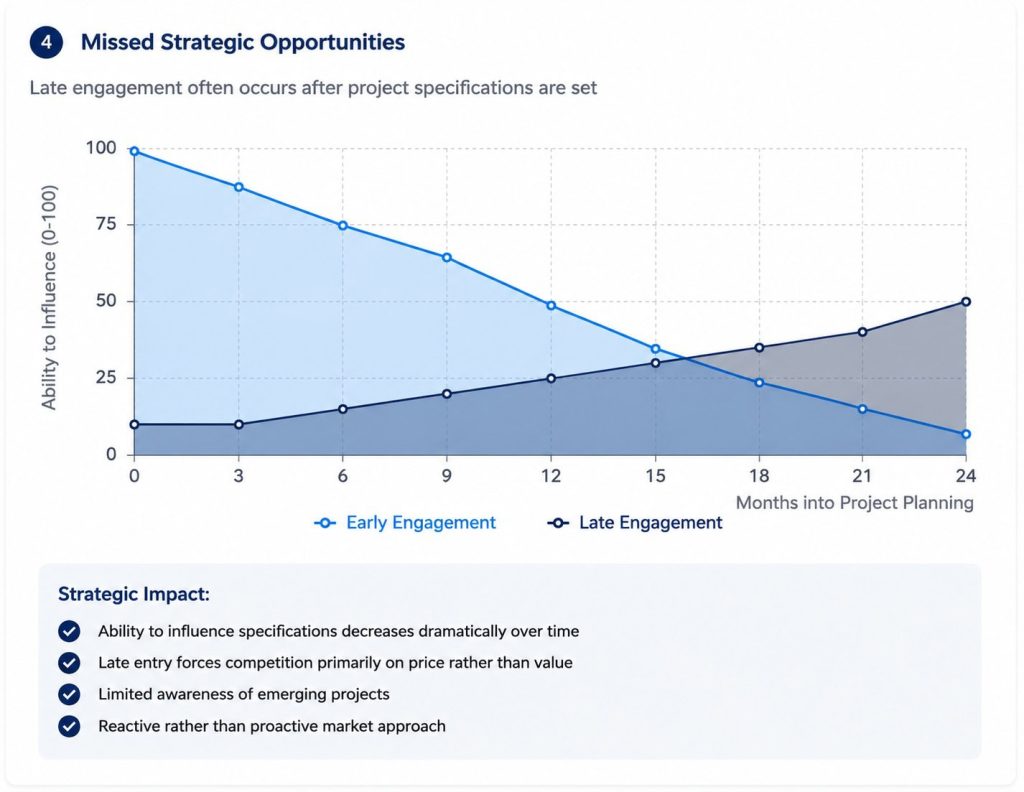
Early engagement becomes impossible in such cases. If you don’t know a project exists until the RFP drops, you can’t engage before specifications are written. You can’t influence the design, you can’t build relationships with the stakeholders who shaped the decision and you’re essentially responding to outcomes rather than actively contributing in shaping them.
What 82% Visibility Enables
With intelligence platforms, pipeline visibility reaches approximately 82%. The difference in how a sales organization operates at that level of transparency is substantial.
- Early identification becomes systematic: When you can see capital improvement plans, funding awards, board meeting discussions, and regulatory filings across your target accounts, you find projects two to seven years before formal procurement. That timeline is the relationship-building window. It’s when you can help utilities think through their problems, influence specifications and become a trusted advisor rather than staying as a simple bidder.
- Resource allocation becomes strategic: When you can see where things stand across your entire pipeline, you can make informed choices about where to invest, which accounts need more attention right now, which ones are moving faster than expected, where a competitor might be gaining ground and where to deploy your technical experts for maximum impact.
- Forecasting becomes meaningful: When 82% of pipeline activity is visible, revenue predictions are very much grounded in something tangible. You can see what’s advancing, what’s stalling and also what’s at risk. The planning conversation shifts from speculation to analysis readily.
- Competitive surprises drop dramatically: Last-minute competitor wins in target accounts fall significantly when teams have early warning systems in place and responsive strategies ready. They know what’s moving and they’re watching for activity, hence deals don’t disappear into thin air without explanation.
The Early Engagement Multiplier
The relationship between pipeline visibility and early engagement is direct. Early-stage engagement rates move from 22% to 68% with intelligence platforms. That’s in no way a strictly behavioral change but an information change that needs to be dealt with tactically. The teams that know about projects in their early planning stages engage early because they can. The ones operating at 35% visibility engage late because the first visible signal is usually the RFP.
Early-engagement win rates reach approximately 64%. The win rates at the RFP stage hover around 22%. Everything else being equal, engaging earlier is worth about three times as much on a win-rate basis. Early-stage opportunities that never go to public bid at all account for about 29% of wins for organizations using intelligence platforms. Those deals unfortunately do not exist in a world where you can only see what’s already public.
The Organizational Effect
Pipeline transparency changes how the sales organization functions day to day.
When people can see the pipeline clearly, conversations change:
- Sales reviews become analytical instead of anecdotal.
- Account planning is grounded in evidence.
- Decisions about where to invest are based on data instead of functioning on pure instinct.
The platform becomes a shared view of market reality: The focus shifts to what’s in it, what’s moving, and what needs attention. That shared view reduces the coordination overhead that comes from everyone having different, incomplete information about the identical accounts.
It also creates accountability. When pipeline activity is visible, it’s measurable. You can see whether early-stage engagement is actually happening, whether research is being conducted and whether accounts that should be getting attention are getting it. Visibility enables management that invisible pipelines lack the resources to support.
Going from 35% to 82% pipeline visibility is a fundamental change in how much of the market you can actually manage.