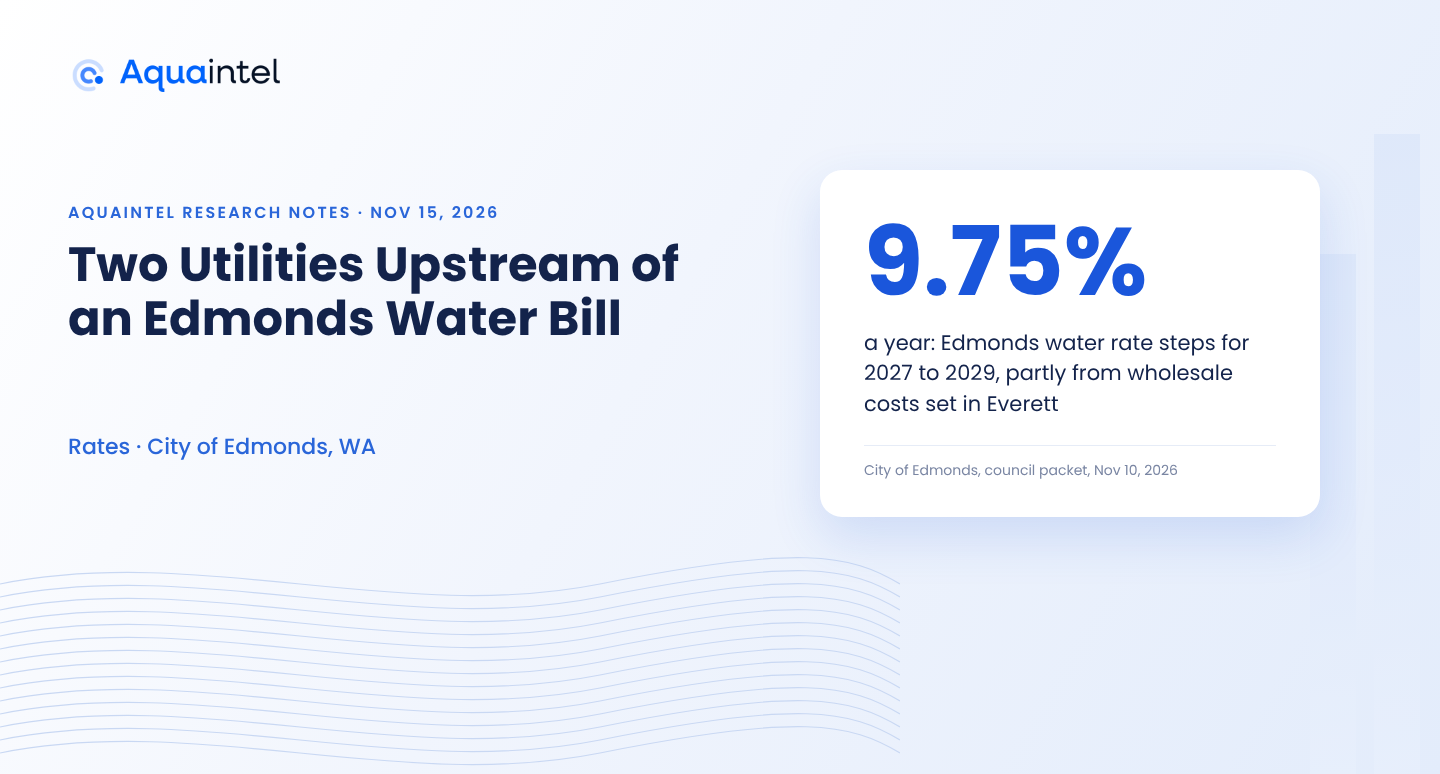

The Edmonds City Council’s consent agenda for November 10, 2026 carried the fourth reading of a utility rate ordinance. It raises water rates 9.75% on January 1 of 2027, 2028 and 2029, with sewer and stormwater rising more slowly. The council had forwarded it to consent unanimously on November 2. On November 10 a councilmember moved the item to the regular agenda to ask for a multi-year forecast of the utility funds, and the council then adopted it unanimously, My Edmonds News reported. The Daily Herald in Everett reported increases each year through 2032; the ordinance itself sets rates through 2029, and the three later years are the consultant’s projections.
Edmonds does not treat its own drinking water. The city’s water page says it buys from Alderwood Water & Wastewater District, and Alderwood buys from the City of Everett. The ordinance names the link directly, among its reasons: “wholesale cost increases for potable water from Alderwood Water and Wastewater District”.
I believe Edmonds is a clear case for reading a rate increase from upstream. A city that buys its water inherits its supplier’s rate cycle, its supplier’s disputes and its supplier’s capital plan, and they reach the customer’s bill a year or two later.
What Everett changed
Everett’s council adopted Ordinance 4183-26 on May 27, 2026. It took effect on June 10, and the new rates started on August 1. Its recitals say the 2024 cost of service study by HDR for the 2025 to 2028 rate period “has been amended to account for the addition of a proposed utility tax”, and that a general increase “is necessary to cover operations, maintenance, capital expenditures, and utility taxes.”
Wholesale customers on master meters pay a water charge and a separate filtration charge per hundred cubic feet (CCF). The filtration charge moved the most.
- Filtration charge: 2025: $1.012; 2026: 1.093 per CCF; 2026.58: $1.383; 2027: 1.439 per CCF; 2028: $1.499
- Water charge: 2025: $0.780; 2026: 0.82 per CCF; 2026.58: $0.877; 2027: 0.912 per CCF; 2028: $0.949
From 2025 to August 2026, the filtration charge rose from $1.012 to $1.383 per CCF, about 37%, and the water charge from $0.780 to $0.877, about 12% (both derived). The ordinance adds a 20% or 25% multiplier to the water charge for wholesale meters; it does not say which applies to Alderwood. Everett also replaced a 6% payment in lieu of taxes with a 12% utility tax on customers outside the city, which Edmonds and Alderwood objected to, according to the Herald.
The dispute in the middle
Alderwood has been disputing Everett’s increases and paying older rates while it does. In an email in the November 10 packet, Edmonds’ rate consultant, Chris Gonzalez of FCS, a Bowman company, explains what that has done to the city’s numbers: “Alderwood has been paying Everett’s 2023 rates while disputing Everett’s recent rate increases.” The Herald reported in July that the two are in non-binding arbitration and that Alderwood pays the 2024-25 rate. The two accounts give different years.
The effect shows in Edmonds’ own 2025 results. The water fund projected $2,797,027 for purchased water and spent $2,342,734, about 22% of water rate revenue (derived). The consultant’s model then assumes three things for the years ahead:
- Wholesale increases of 15.5% a year in 2027, 2028 and 2029.
- A one-time $3.0 million “true-up” payment in 2027, “based on an estimate from City staff”.
- A smaller main replacement program. In the consultant’s words: “for the water utility, we had to cut funding for main replacements to keep the rate increases under 10% per year, given the increases in water purchase costs and the related true-up payment.”
The city’s own letter to Everett in June estimated a wholesale impact of “more than $1.4 million” a year, as the Herald reported.
What a household pays
The consultant’s typical residential bill uses 14 CCF over two months, billed bimonthly.
- 2026: $411.53 (Water 140.52 per two months; Sewer 142.52 per two months; Stormwater 59.9 per two months; Utility tax 68.59 per two months)
- 2027: $445.45 (Water 154.21 per two months; Sewer 153.21 per two months; Stormwater 63.79 per two months; Utility tax 74.24 per two months)
- 2028: $481.38 (Water 169.28 per two months; Sewer 163.93 per two months; Stormwater 67.94 per two months; Utility tax 80.23 per two months)
- 2029: $475.78 (Water 185.78 per two months; Sewer 175.41 per two months; Stormwater 71.34 per two months; Utility tax 43.25 per two months)
- 2030: $513.17 (Water 203.92 per two months; Sewer 187.69 per two months; Stormwater 74.91 per two months; Utility tax 46.65 per two months)
- 2031: $552.74 (Water 223.75 per two months; Sewer 200.83 per two months; Stormwater 77.91 per two months; Utility tax 50.25 per two months)
- 2032: $595.71 (Water 245.63 per two months; Sewer 214.89 per two months; Stormwater 81.03 per two months; Utility tax 54.16 per two months)
The total bill rises from $411.53 in 2026 to $481.38 in 2028. It dips in 2029, because Edmonds’ temporary 20% utility tax on water, sewer and stormwater ends after 2028 and drops back to 10%. The water portion alone goes from $140.52 to $245.63 by 2032, about 75% (derived), though the last three of those years are projections.
The consultant also showed what a smaller reserve would do. The city’s policy holds 180 days of operating cash. At 60 days, water increases would be 8.5% a year, and the ordinance on the agenda kept 9.75%.
From our data
Edmonds is one of 148 community water systems in Washington whose primary source, in EPA’s drinking water records, is water bought from another system. Together they serve about 2.9 million people, 31% of the state’s community-system population (derived).
Everett sits at the top of this chain. EPA’s records count about 216,000 people as Everett’s own retail customers, and EPA’s needs survey counts 594,690 people behind its system once wholesale customers are included. By those two counts, nearly two of every three people drinking Everett’s water live in other utilities’ service areas (derived), and part of their rates follows Everett’s ordinances.
If you sell to utilities
- For a utility that buys its water, read the supplier’s rate ordinance first. Edmonds’ increase for 2027 starts in an Everett ordinance from May.
- Look for the line that gives way. At Edmonds it is water main replacement, which the consultant cut to keep increases under 10%, and the Herald reports the city is deferring main replacements in 2027.
- Wholesale disputes end in payments. Edmonds has $3.0 million set aside for 2027 on an estimate, and the size of the real payment depends on how Alderwood and Everett settle.
What I don’t know yet
- The adopted ordinance number, which is not yet posted.
- Why the model assumes wholesale increases of 15.5% a year when Everett’s adopted master-meter schedule steps about 4% a year after August 2026 (derived). Alderwood’s own pass-through or the outcome of the dispute could explain it; no document I read says.
- Which Everett rate Alderwood pays today, and where the arbitration stands.
- Which water capital plan the council will adopt with the budget on November 24. The consultant shows $30.6 million for 2026 to 2032, and the city’s draft capital plan shows $31.1 million for 2027 to 2032.
The next dates are the budget vote on November 24 and the first rate step on January 1, 2027.
At AquaIntel we read a utility’s rate documents next to its supplier’s, so a vendor can see when a capital plan is being squeezed by costs from upstream.
Sources
- City of Edmonds, City Council packets of 6 Oct 2026 (2026 Utility Rate Update, FCS, pp. 124 to 142), 27 Oct 2026 (draft capital facilities plan), 2 Nov 2026 and 10 Nov 2026 (item 8.4, consultant correspondence and draft ordinance, pp. 34 to 67). Retrieved 10 Nov 2026.
- My Edmonds News, “Edmonds Council extends boards and commissions pause, funds deputy finance job, honors veterans”, 11 Nov 2026.
- City of Edmonds, Water Utility System.
- City of Everett, Ordinance 4183-26, passed 27 May 2026.
- Alderwood Water & Wastewater District, rates.
- The Daily Herald (Everett), reports of 24 Jul 2026, 29 Jul 2026 and 5 Nov 2026.
- US EPA, Safe Drinking Water Information System, public water system data (download of 9 Jul 2026), active community water systems by primary source.
- US EPA, 7th Drinking Water Infrastructure Needs Survey and Assessment, system-level data (PWSID WA5324050).
Part of Last Week in US Water Utilities, November 15, 2026, from AquaIntel Research Notes.
If you sell into utilities and want records like these for the accounts in your territory, talk to us→