
There is no denying that selling into the water utility sector is one of the most demanding B2B sales environments. Major infrastructure projects routinely involve sales cycles lasting 18 to 36 months. Vendors spend months, sometimes years, nurturing relationships across a single account while navigating formal procurement processes, evolving priorities, and multiple decision-makers. Throughout that time, visibility into where a project truly stands is often limited.
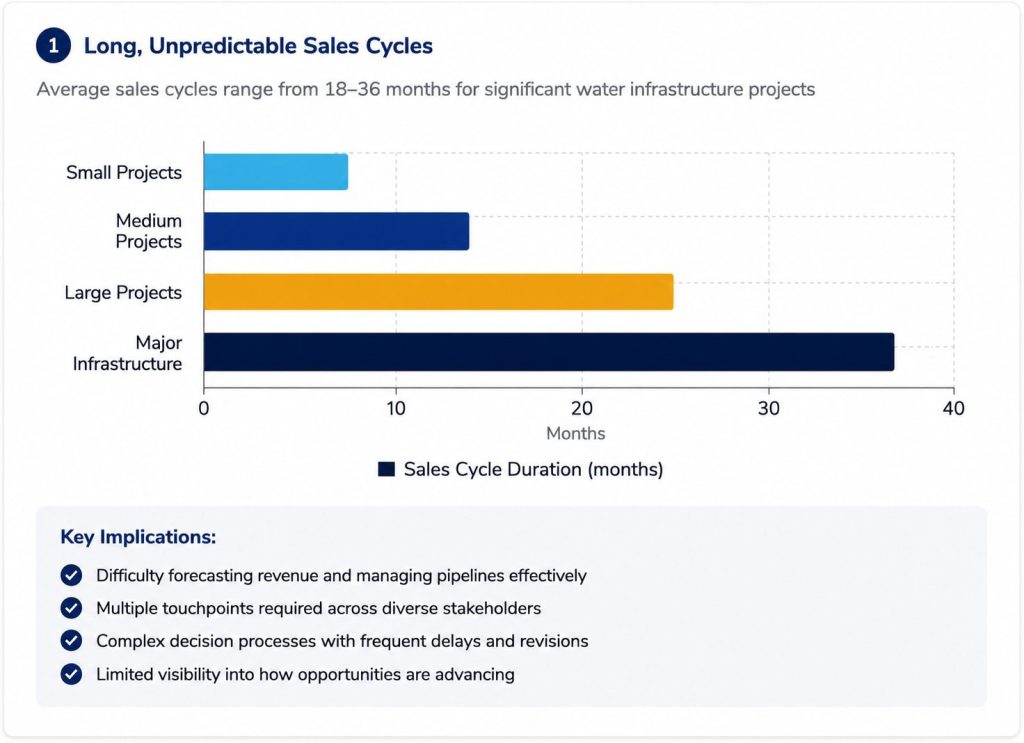
Water utility sales cycles often extend from 18 to 36 months, creating challenges for forecasting, stakeholder engagement, and pipeline management.
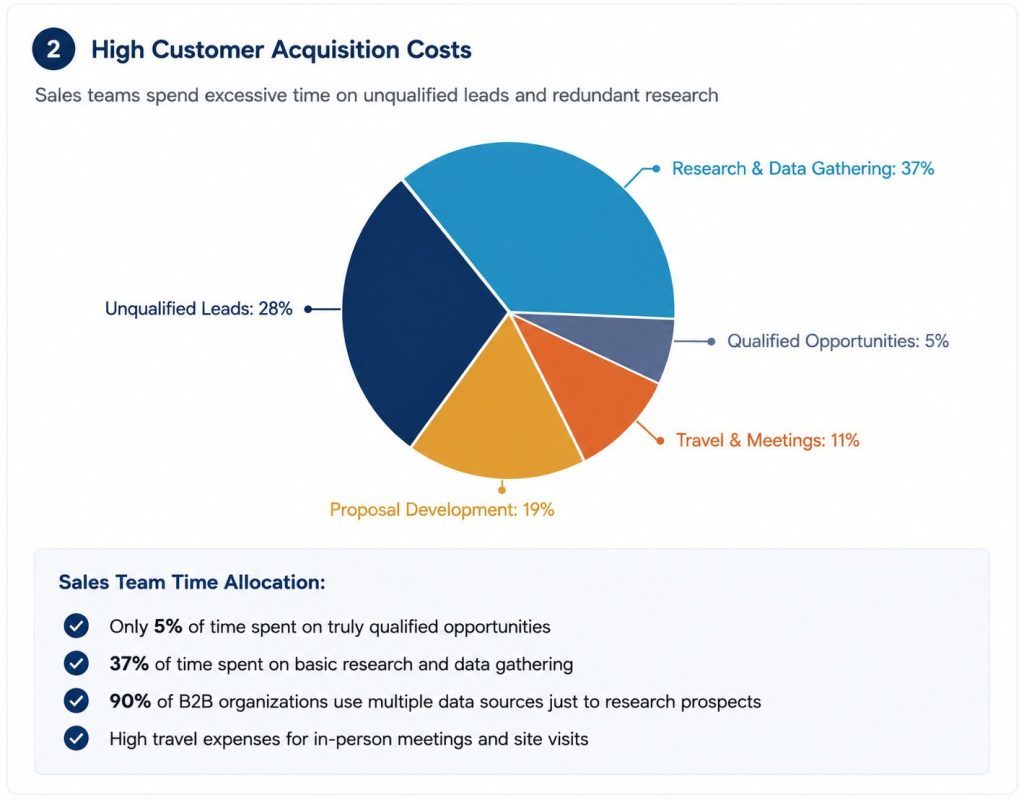
The financial implications are significant. Before intelligence platforms enter the picture, the average cost of generating a qualified lead in this market is approximately $1,850. Research alone can consume more than four hours per prospect, and despite that investment, the average vendor reaches only about 28% of the utilities within their territory. Nearly three-quarters of the potential market remains unexplored and not because it is inaccessible, but because identifying, understanding, and prioritizing opportunities manually simply does not scale.
The challenge is often viewed as a sales problem.
In reality, it is an information problem.
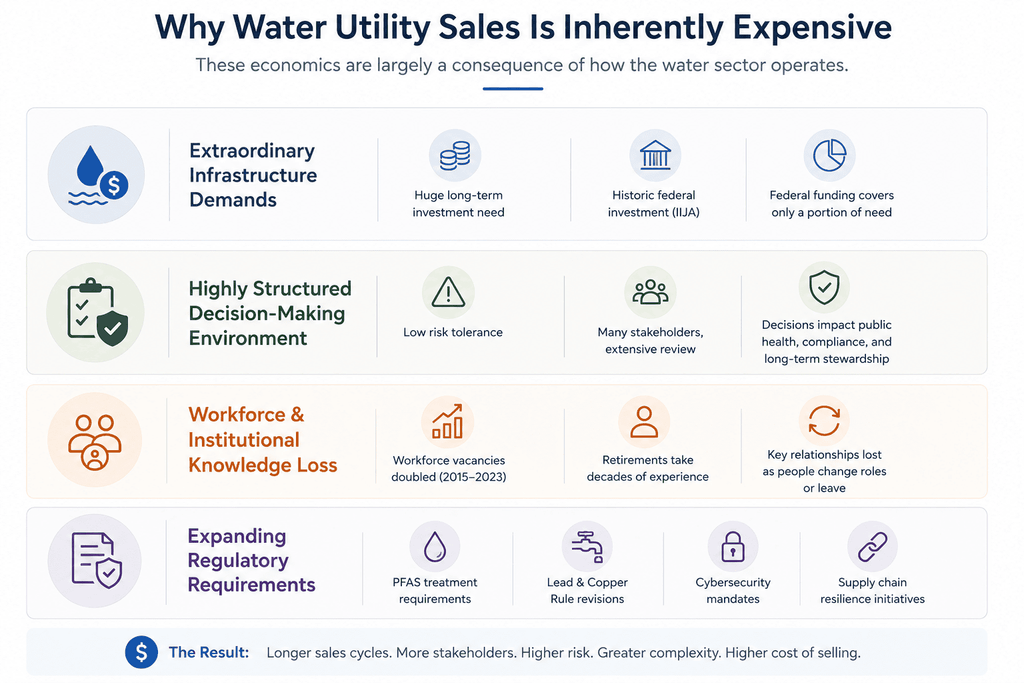
Why Water Utility Sales Is Inherently Expensive
These economics are largely a consequence of how the water sector operates rather than shortcomings in sales execution.
- Utilities face extraordinary infrastructure demands, with more than $470 billion in drinking water infrastructure investments required over the next two decades. While the Infrastructure Investment and Jobs Act (IIJA) introduced a historic $55 billion federal investment, it addresses only a portion of the overall need.
- At the same time, utilities operate within highly structured decision-making environments where risk tolerance is naturally low. Every infrastructure decision carries implications for public health, regulatory compliance, and long-term financial stewardship. Projects therefore move deliberately, involve extensive internal review, and rarely depend on a single decision-maker.
- The operating environment has also become more complex. Between 2015 and 2023, workforce vacancies across utilities doubled while experienced professionals retired in large numbers, taking decades of institutional knowledge with them. Relationships that vendors spend years building can disappear as personnel change roles or leave the organization altogether.
- Regulatory expectations continue to expand as well, from PFAS treatment requirements and Lead and Copper Rule revisions to cybersecurity mandates and supply chain resilience initiatives. Each new requirement introduces additional planning, funding, and stakeholder considerations that vendors must understand before meaningful conversations can even begin.
The compliance calendar alone illustrates why this is so demanding to track: the Lead and Copper Rule Improvements compliance window opens October 16, 2027, with a 10-year lead service line replacement mandate; the PFAS drinking water rule originally required compliance by 2029, with EPA proposing in May 2026 to extend it to 2031; and federal cybersecurity requirements under AWIA/SDWA 1433 are hitting mid-sized systems with deadlines through mid-2026. Yet only 8% of U.S. water systems had PFAS removal filters installed as of 2024, meaning most utilities facing these deadlines haven’t started the work required to meet them.
Selling into this market has never simply been about presenting a better product. It requires understanding a constantly evolving landscape of infrastructure priorities, funding availability, regulatory pressures, and organizational dynamics long before procurement begins.
Where Sales Resources Are Actually Lost
Without systematic intelligence, sales organizations spend a remarkable amount of effort pursuing opportunities that were unlikely to succeed in the first place.
A lead qualification rate of roughly 23% means most prospects entering the pipeline never become viable opportunities. Sales teams invest time researching accounts, initiating outreach, coordinating internal discussions, and maintaining relationships that ultimately produce little return.
The consequences extend far beyond the sales team.
Solutions engineers and technical specialists become involved in pursuits with little chance of success. Proposal teams dedicate substantial effort to technical reviews, pricing exercises, and document preparation for opportunities that were never realistically winnable.
The scale of that effort is real: a typical B2B technical proposal requires 40 to 60 hours of development time, and industry analysis finds that 65-70% of that effort goes into content retrieval, formatting, and administrative assembly rather than strategy or client-specific customization. When that full effort gets poured into a pursuit that was never winnable, it’s not a small loss, it’s dozens of engineering and proposal hours spent producing a document nobody was going to read closely.
Travel budgets are consumed by meetings that provide limited strategic value because vendors lack visibility into the project’s actual stage, funding status, or stakeholder landscape.
None of these activities are inherently wasteful.
They become wasteful when they are directed toward the wrong opportunities.
The result is not simply higher customer acquisition costs but a continuous misallocation of time, expertise, and financial resources across the entire commercial organization.
How Intelligence Changes the Economics
The role of an intelligence platform is not to make sales teams work harder.
It enables them to work on better opportunities.
Rather than manually assembling information for every account, intelligence platforms consolidate project planning documents, funding activity, regulatory developments, stakeholder information, and operational data into a continuously updated picture of each utility. Sales teams spend less time searching for information and more time acting on it.
The operational improvements are immediate.
- Research time per prospect falls from more than 4 hours to roughly 48 minutes.
- Lead qualification rates increase from approximately 23% to 58%,
- While territory coverage expands from about 28% to 65% of target utilities.
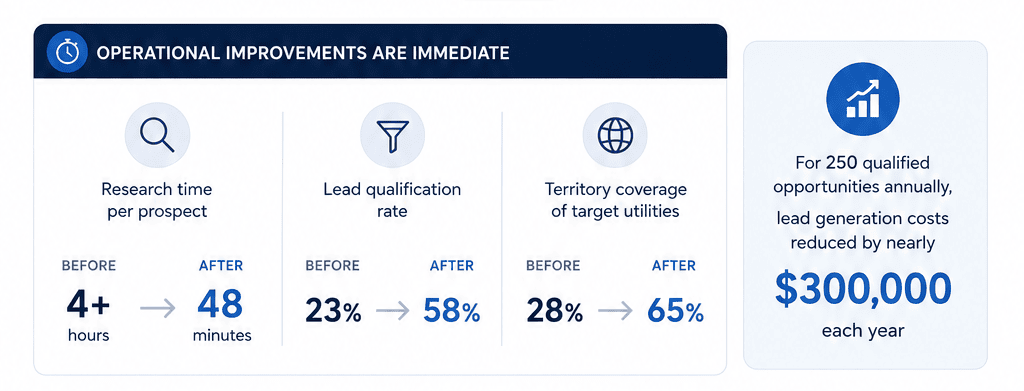
For an organization generating 250 qualified opportunities annually, these efficiency gains alone can reduce lead generation costs by nearly $300,000 each year.
Improved qualification also changes overall sales performance.
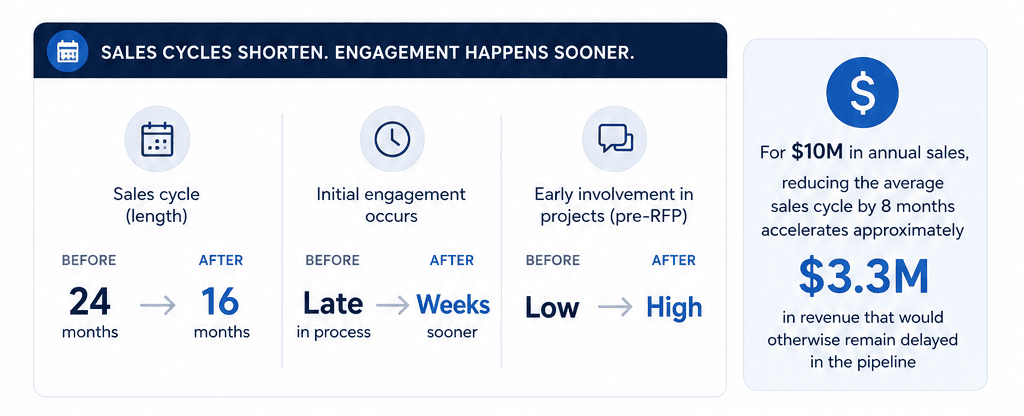
Sales cycles shorten from roughly 24 months to around 16 months because vendors identify opportunities earlier and engage before procurement formally begins. Initial engagement occurs weeks sooner, pipeline visibility improves substantially, and early involvement in projects before RFP issuance increases dramatically.
These improvements compound over time.
For a company generating $10 million in annual sales, reducing the average sales cycle by eight months can accelerate approximately $3.3 million in revenue that would otherwise remain delayed within the pipeline.
One water technology provider implementing a data intelligence platform reduced its typical sales cycle from approximately 15 months to between 6-9 months, contributing to an additional $7 million in new sales bookings.
Win rates improve as well. Increasing success rates from roughly 22% to 38% represents approximately $4 million in additional annual revenue for an organization pursuing 100 opportunities each year with an average contract value of $250,000
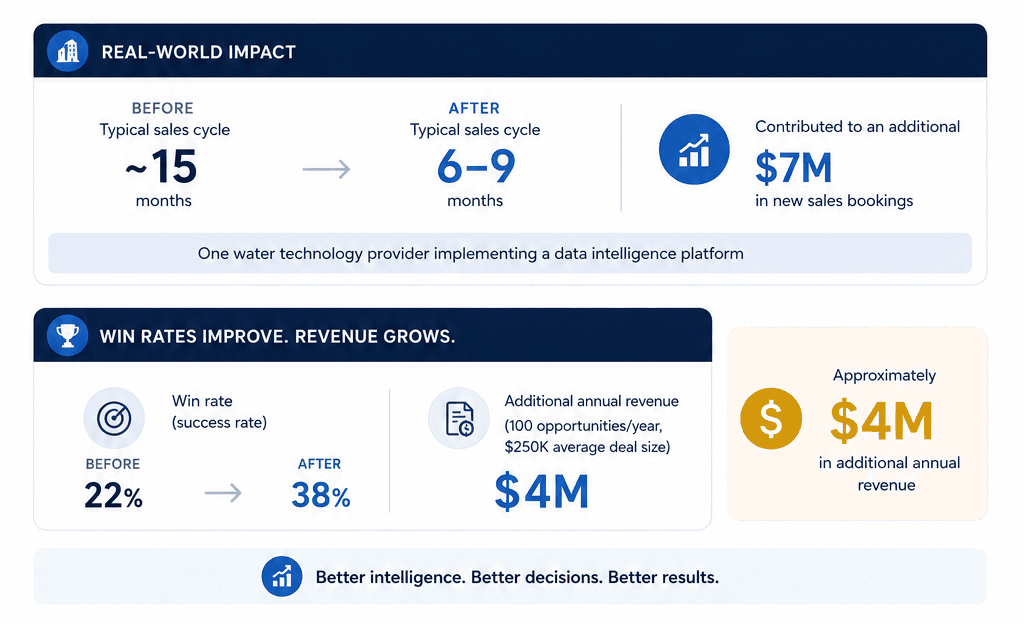
While each metric is valuable individually, together they demonstrate something more important: intelligence improves the economics of the entire sales process rather than optimizing a single activity.
The Real Cost Isn’t Selling, It’s Searching
The high cost of selling to water utilities is often attributed to long procurement cycles or complex buying processes.
Those factors certainly matter.
But the deeper issue is that every opportunity requires an enormous amount of information before effective selling can even begin.
- Which utilities are entering capital planning?
- What operational or regulatory challenge is driving the project?
- Has funding already been secured?
- Who actually influences the purchasing decision?
- How far has internal consensus progressed?
Without systematic intelligence, every salesperson answers these questions independently for every account, repeatedly rebuilding the same understanding through manual research, fragmented public records, and individual relationships. The process is slow, expensive, and ultimately limits market coverage regardless of how capable the sales team may be.
This is why customer acquisition costs remain so high.
The $1,850 cost per qualified lead is not fundamentally a sales problem. It is the cost of searching for the right information, assembling it manually, and doing so repeatedly across thousands of potential customers.
This tracks with sales performance data broadly: B2B reps spend only 28-30% of their working time on actual selling calls, demos, negotiations with research alone consuming roughly 9-14% of the week before a single conversation happens. The rest disappears into administrative work, data entry, and the manual reassembly of context that intelligence platforms exist to eliminate. Selling was never the bottleneck. Searching was.
Intelligence changes that equation.
Instead of allowing sales teams to spend months discovering which opportunities deserve attention, it enables them to identify, qualify, and prioritize those opportunities before significant resources are committed. Engineering expertise is focused where it matters most. Proposal development becomes more selective. Relationship-building begins earlier. Pipeline forecasts become more reliable.
The result is not simply lower acquisition costs or shorter sales cycles.
It is a fundamentally different commercial model. One where success depends less on searching for opportunities and more on acting on the right ones.