

If you sell technology into water or wastewater utilities, you’ve probably encountered this a lot more than you’d like to remember or admit.
It is really disappointing when you respond to an RFP, shed your blood, sweat and tears into meeting every requirement, you set your prices at a competitive range, and just when you think you’ve got all your bases covered, the rejections come flooding in.
Please know that none of this occurs because your solution was faulty but because the decision had already been made, ages before you thought of proceeding with the project!
The Uncomfortable Truth About RFPs
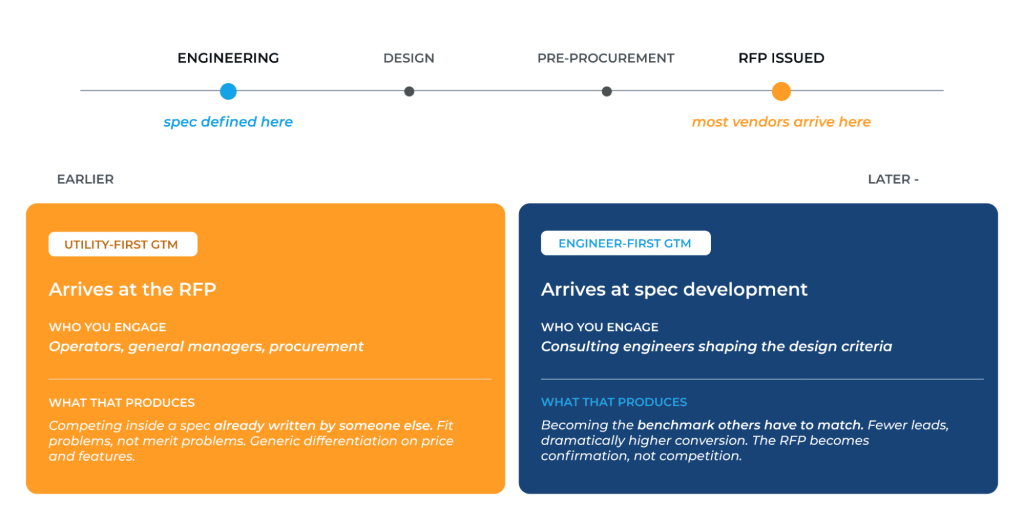
This might not be common knowledge but utilities very rarely choose technologies at the RFP stage. They confirm choices that were made much, much earlier, inside of the engineering firms.
When procurement puts out an RFP, the decision-making process is usually already set. Performance standards are defined, risk limits are cautiously fixed, and evaluation criteria are decided upon with incumbents generally receiving an advantage because of built-in familiarity and trust.
At this stage, companies basically rely on minor price discounts and changes to features in order to outdo each other. However, there are a great many sales techniques used within the water industry that revolve around faster responses, tougher pricing, better proposals, and an increased bid-winning ratio.
While these moves do matter, they generally don’t change the bigger picture: the purchasing structure was finalized well before the RFP appeared. The companies that tend to succeed are the ones who help define and refine the requirements ages before the official procurement kicks off.
Understanding Engineers’ Responsibilities and Their Importance
The responsibilities of engineering firms are not limited to simply designing projects. They define what technologies are acceptable, what performance looks like, what risks are tolerable and what alternatives feel defensible to regulators and boards.
This is far from corruption and is the rational behavior that must be shown in order to survive and flourish within such a regulated, risk-averse industry.
Engineers make sure to optimize for proven outcomes, regulatory defensibility, and repeatability across clients. When they’re specifying a treatment process or infrastructure solution, they’re never focusing on running a neutral evaluation and hoping for it to work. They’re strategically drawing on what they’ve seen work, what they know they can defend, and what they’re comfortable staking their professional reputation on.
That means the vendor who influenced how an engineering firm thinks about a solution category, long before any specific project was on the table, allowing them a structural advantage that no amount of proposal quality can overcome after the fact.
Why Utility-First Selling Continues To Fail
Most GTM strategies in this sector still focus on operators, general managers, and procurement teams. There isn’t a world where those stakeholders do not matter, but they rarely have a say in what goes on in the solution space and what ends up being the ultimate course of action.
It is quite fascinating how engineers define the space within which procurement operates, operators go on to express preferences within that space, general managers approve recommendations that come up through that space and by the time procurement is involved, the question isn’t really which solution wins but which vendor fits the solution that’s already been specified.
That’s why vendors end up chasing late-stage RFPs, over-investing in bids, and losing on fit rather than merit. The fit problem wasn’t created at the RFP stage but usually months if not years earlier, when the engineering firm made swift decisions which the vendor failed to be present for let alone be prepared.
Engineer-First GTM Changes the Game
With vendor involvement in engineering firms upstream, that is prior to project definition and spec development, the dynamic meets a very noticeable shift.
They generally dictate design criteria, set performance criteria, become the benchmark for which comparisons are made and by the time the procurement process takes place, they are no longer battling to be chosen but have successfully transformed into the benchmark by which others have to compete and aspire to match if they’re motivated enough.
Procurement has now reached the threshold of the delivery stage and is not stuck at the choosing stage. This has turned into an entirely different ballgame that has to be dealt with accordingly; applying generic solutions or relying on chances can prove to be a thing to regret in the future.
And the reward? Not extra leads, but high-quality leads. Fewer leads in total, but much more chance for conversion. This is precisely what a sales team desires: time and effort invested in opportunities with a built-in edge, not spread thinly over purchasing procedures that have been determined well in advance.
Making the Invisible Visible
The hardest part of engineer-first GTM has always been opacity.
Which engineering firms actually matter in your market? Where do they operate? Which utilities do they influence? Are they receptive to innovation? When would be the ideal time to approach them before it’s too soon to be pertinent or too late to make any impact at all?
Don’t feel demotivated just because these are unfamiliar or you feel underconfident. These questions do not have obvious answers.
Engineering firm influence is diffused and informal and is very likely to not show up in procurement records or public databases:
It lives in long-term consulting relationships, master service agreements, and the professional reputations that utility leadership trusts when they need an outside opinion. It might seem like a tedious process that does not yield results instantaneously but just know that in the long run, this is precisely what ends up mattering the most to the agencies and thus, you.
That opacity is precisely the problem SpecMap was built to solve. It reveals which engineering firms actually shape specifications nationwide, which utilities they influence, and how to engage them deliberately, allowing you a considerable amount of time to sit with the requirements and proceed strategically, all before the RFPs ever come into the equation.
The Shift Every Serious Vendor Must Make
Again, I do not intend to demotivate you or make things appear far more complex than they are but there is no denying the fact that selling after the spec has been written out is not very different from joining a race after the starting gun. You will put your all into it yet the people who started on time have an immense advantage that effort alone cannot realistically close.
Engineer-first GTM does not exist to display the presence of a relationship on the surface that’s got things going. Understanding where decisions actually get made, being present in those conversations before they become decisions and getting to shape the criteria that procurement will eventually enforce matter a lot and arriving at the spot before the others, eases other things out in the later stage, things which would otherwise have taken a considerable time to tackle.
In infrastructure markets, structure beats effort every time. The vendors who understand that are competing on different terms than everyone else and the ones who haven’t are still wondering why they keep losing deals they should have secured easily.