
Something I learned the hard way after years in this industry is: that org chart you’re studying and devoted hours towards preparing? It’s practically fiction when it comes to how water utilities actually make purchasing decisions.
I’ve watched countless vendors walk into utility meetings armed with perfect presentations, targeting what they believe is “the decision-maker.” They leave frustrated, wondering why their technically superior solution got passed over. It is actually because they were playing checkers while the utility was playing chess.
The majority of vendors identify “understanding the decision-making process” as their greatest challenge when selling to utilities. After working on over 30 high-impact projects across utilities of every size, I can assure you that it happens because decision-making in water utilities doesn’t follow the neat hierarchies we’re used to seeing in corporate settings.
The Real Story Behind Utility Decisions
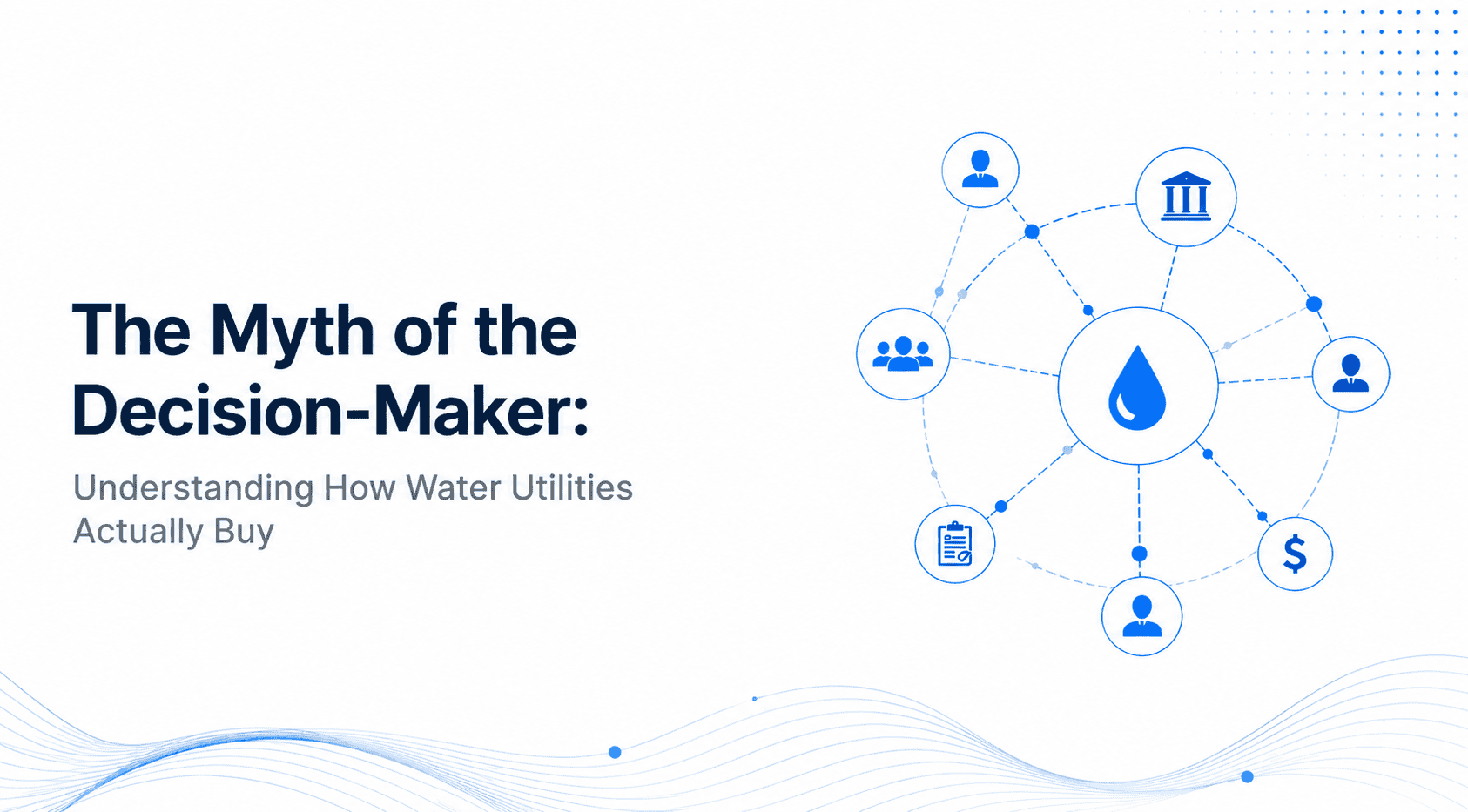
Water utility decisions emerge from dynamic interactions among various stakeholders with different priorities, technical backgrounds, and authorities.
Sue Murphy, former CEO of Water Corporation, puts this into perspective perfectly:
“The days of single-person decision making in water utilities are long gone. Today’s complex challenges require diverse perspectives and expertise that no individual can possess alone”.
This complexity explains why simplified approaches targeting a single “decision-maker” fail so consistently. Success requires understanding the full ecosystem and how influence actually flows through it.
The Core Players: Who They Are and What They Actually Care About
(1/6) Technical Staff: The Front Line
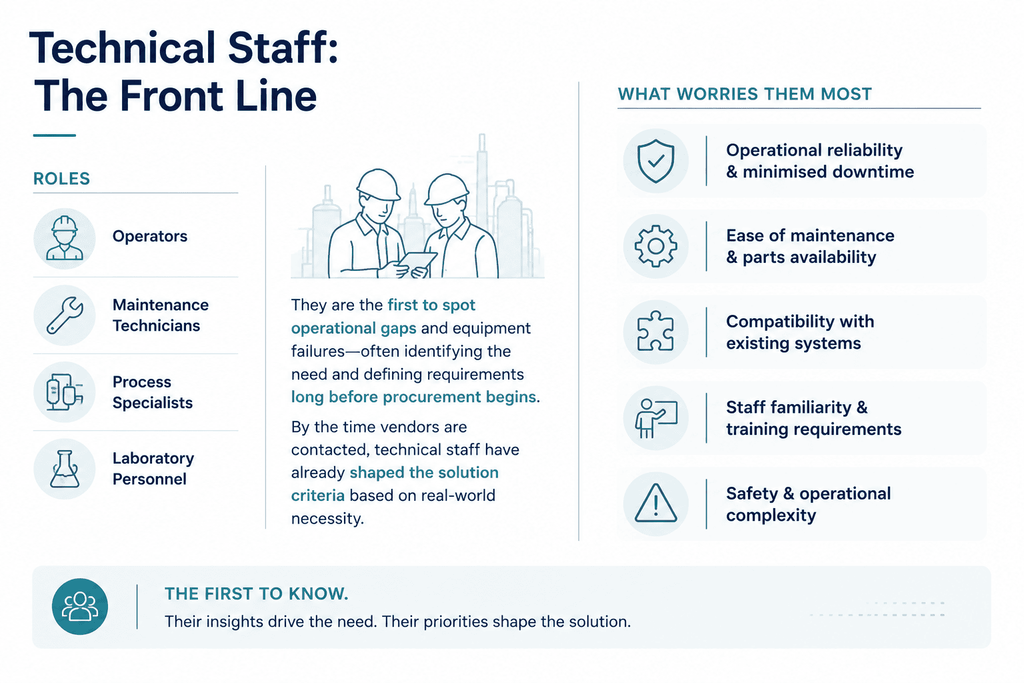
Roles: Operators, Maintenance Technicians, Process Specialists, Laboratory Personnel
Technical staff are your most powerful gatekeepers because they are the first to encounter the operational gaps and equipment failures that trigger a new purchase. Since they live within these systems daily, they typically identify the need and define the technical requirements long before a formal procurement process even begins. By the time a vendor is contacted, these hands-on experts have already shaped the solution’s criteria based on real-world necessity.
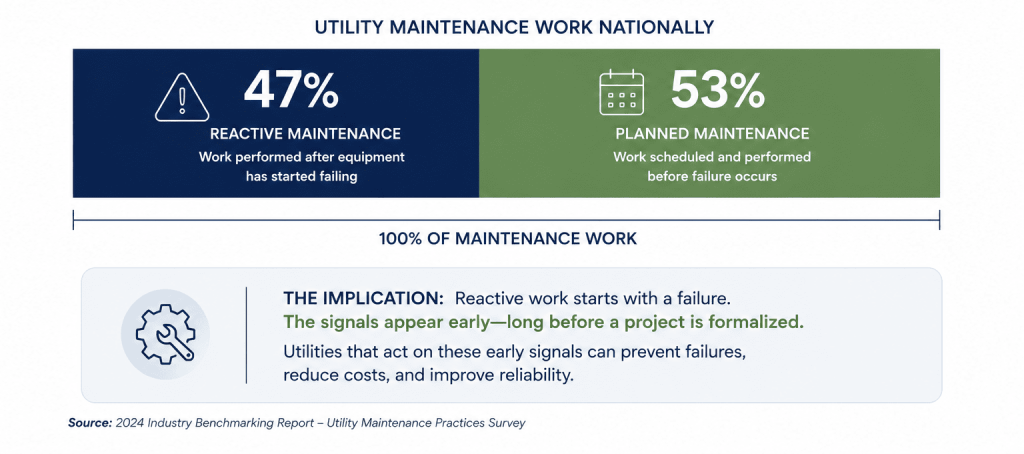
This tracks with a broader pattern across the sector: nationally, nearly half of all utility maintenance work 47% is still reactive, meaning it happens only after equipment has already started failing. Every one of those failures is a technical-staff-level signal forming well before anyone drafts a spec sheet.
What worries them the most: Operational reliability and minimised downtime. Ease of maintenance and parts availability, Compatibility with existing systems and processes, Staff familiarity and training requirements and Safety and operational complexity
How to speak to them:
Highlight actual operational advantages over technical data. They do not require any complex language; they only want reassurance that there will be no late-night calls when the system fails!
Provide hands-on demonstrations and operator testimonials,discuss the maintenance needs of the product including availability of spare parts, keep it simple, reliable and compatible, and last but not the least include complete training of the end user and continue to support the product after sale.
Technical staff rarely have formal purchasing authority but possess significant veto power through their evaluation of proposed solutions. As one plant superintendent told the Water Environment Federation: “I may not have the authority to say ‘yes,’ but I definitely have the power to say ‘no’”.
(2/6) Engineering Heads: Architecture Strategists
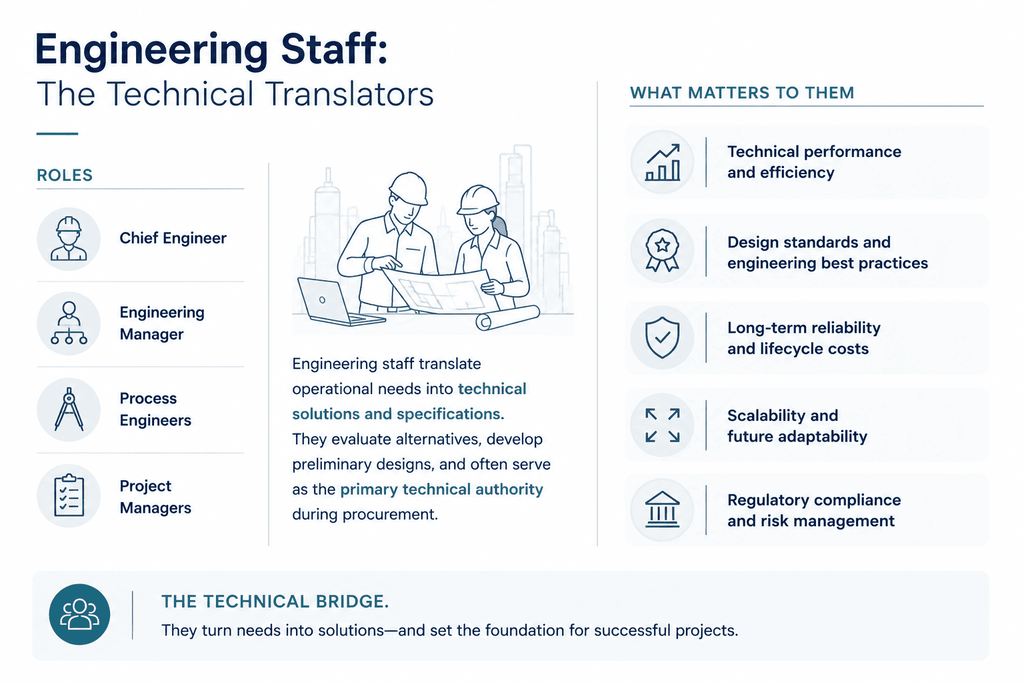
Roles: Chief Engineer, Engineering Manager, Process Engineers, Project Managers
Engineering staff translate operational needs into technical solutions and specifications. They evaluate alternatives, develop preliminary designs, and often serve as the primary technical authority during procurement.
What matters to them: Technical performance and efficiency, Design standards and engineering best practices, Long-term reliability and lifecycle costs, Scalability and future adaptability, Regulatory compliance and risk management
How to engage them:
Provide detailed technical documentation and performance data. Discuss design principles and engineering considerations. Share case studies from similar applications. Offer design support and specification assistance. Demonstrate your regulatory compliance track record.
The critical insight here: engineers often write the specifications that determine which solutions even qualify for consideration. A McKinsey study found that 80% of water infrastructure projects have key parameters defined before formal procurement begins . By the time you see the RFP, you might already be out of the running.
(3/6) Financial Leadership: The Resource Allocators
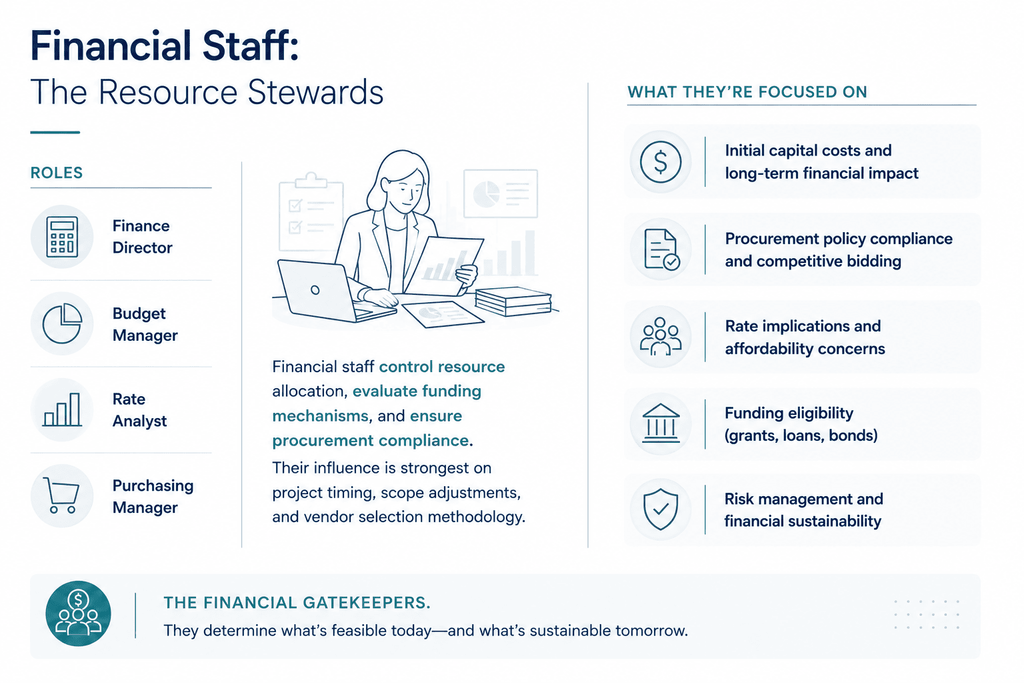
Roles: Finance Director, Budget Manager, Rate Analyst, Purchasing Manager
Financial staff control resource allocation, evaluate funding mechanisms, and ensure procurement compliance. Their influence is strongest on project timing, scope adjustments, and vendor selection methodology.
What they’re focused on: Initial capital costs and long-term financial impact, Procurement policy compliance and competitive bidding, Rate implications and affordability concerns, Funding eligibility (grants, loans, bonds), Risk management and financial sustainability
How to work with them:
Provide comprehensive lifecycle cost analyses, demonstrate understanding of public procurement requirements, discuss rate impact minimization strategies, highlight grant or loan eligibility of solutions and offer flexible pricing and implementation options.
Dennis Doll, President and CEO of Middlesex Water Company, says:
“Understanding a utility’s financial constraints is just as important as understanding their technical needs”.
Financial teams often determine whether projects advance based on funding availability, making knowledge of utility financial health and funding mechanisms essential.
(4/6) Executive Leadership: The Vision Setters
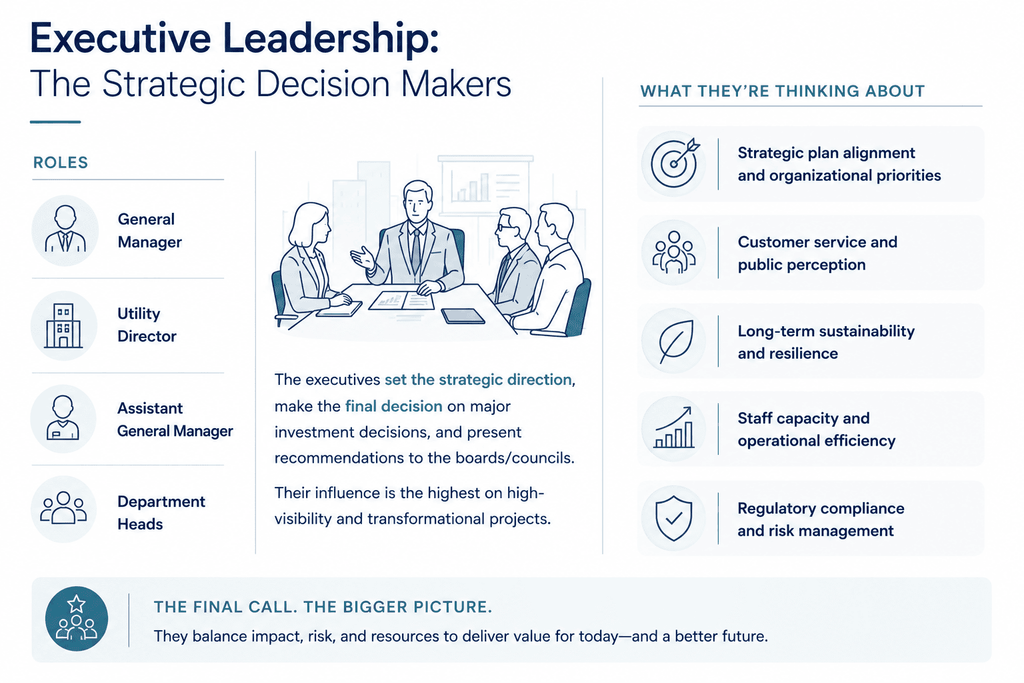
Roles: General Manager, Utility Director, Assistant General Manager, Department Heads
The executives set the strategic direction, make the final decision on major investment decisions, and present recommendations to the boards/councils. Their influence is the highest on high-visibility and transformational projects.
What they’re thinking about: Strategic plan alignment and organizational priorities, Customer service and public perception, Long-term sustainability and resilience, Staff capacity and operational efficiency, Regulatory compliance and risk management
How to approach them:
Connect solutions to strategic objectives and utility vision, highlight benefits to the community and ratepayers, show impacts on long-term sustainability, address issues of resource constraints and implementation capacity, and lastly offer executive-level case studies and references.
Executives make decisions on large investments, but they heavily rely on staff recommendations and do not override technical evaluations. Not having convinced the technical and engineering teams first, won’t save you even if you manage to get to the executive.
(5/6) External Influencers: The Outside Authorities
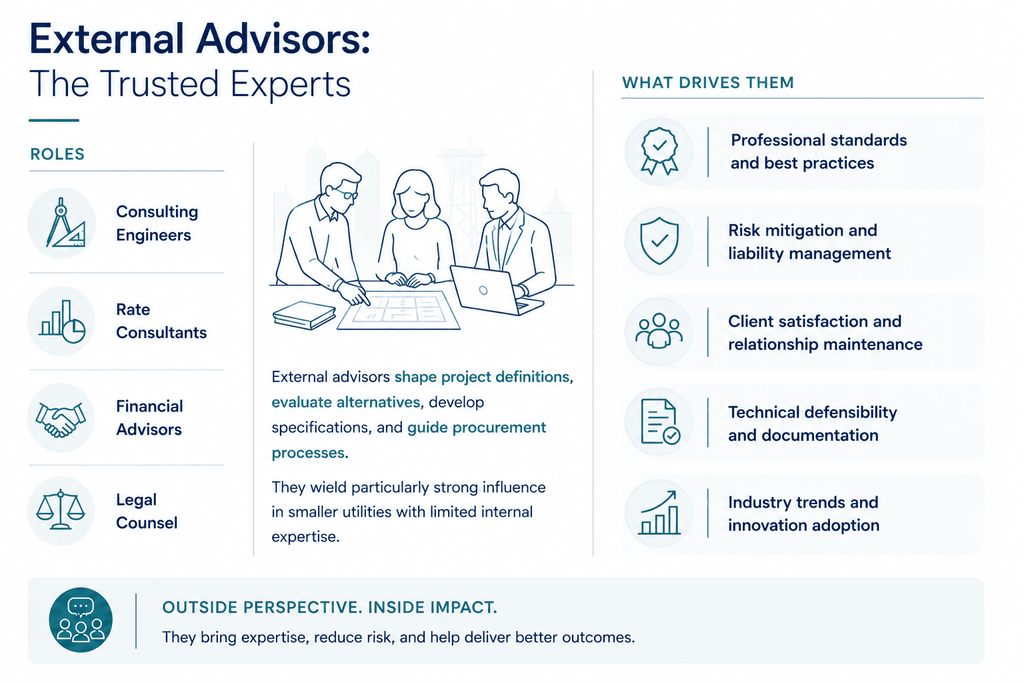
Roles: Consulting Engineers, Rate Consultants, Financial Advisors, Legal Counsel
External advisors shape project definitions, evaluate alternatives, develop specifications, and guide procurement processes. They wield particularly strong influence in smaller utilities with limited internal expertise.
What drives them: Professional standards and best practices, Risk mitigation and liability management, Client satisfaction and relationship maintenance, Technical defensibility and documentation, Industry trends and innovation adoption
How to build relationships:
Build relationships before projects are assigned. Provide engineering-focused educational content. Offer technical support during evaluation processes. Demonstrate successful implementation history. Maintain visibility at industry events and associations.
Engineering consultants often play a pivotal role in shaping water infrastructure projects by helping utilities define scope, technical specifications, and procurement requirements before construction procurement begins. Through Qualifications-Based Selection (QBS), consulting engineers are frequently engaged early in the project lifecycle and can significantly influence project design and evaluation criteria.
This isn’t a minor procedural detail — it’s federal law for many projects. Under the Brooks Act, federal agencies must select engineering firms based on qualifications before price is discussed, and 46 states have adopted their own version for state and local work. In practice, the engineering firm is often locked in — and already shaping specifications — before a vendor’s product enters the conversation.
(6/6) Governance Bodies: The Ultimate Authority
Roles: Board Members, City Council Members, County Commissioners, Mayors
Governance bodies have the ultimate authority in the approval process, especially with regards to major spending, rate increases, and policy changes. The power and influence of the governance bodies vary widely depending on the utility’s governance structure and the local politics.
What concerns them: Fiscal responsibility and ratepayer impact, Constituent satisfaction and public perception, Regulatory compliance and risk management, Community development and economic impact, Environmental stewardship and sustainability
How to communicate with them:
Provide clear, non-technical summaries of benefits, emphasize community impact and public benefits, demonstrate fiscal responsibility and value, address local economic impacts (jobs, development) and share successful examples from peer communities.
Board and council decisions often reflect broader community priorities that extend beyond technical and financial considerations, making public perception a critical factor.
Before diving into how decisions flow across different project types, it helps to visualize how these roles connect is practice:
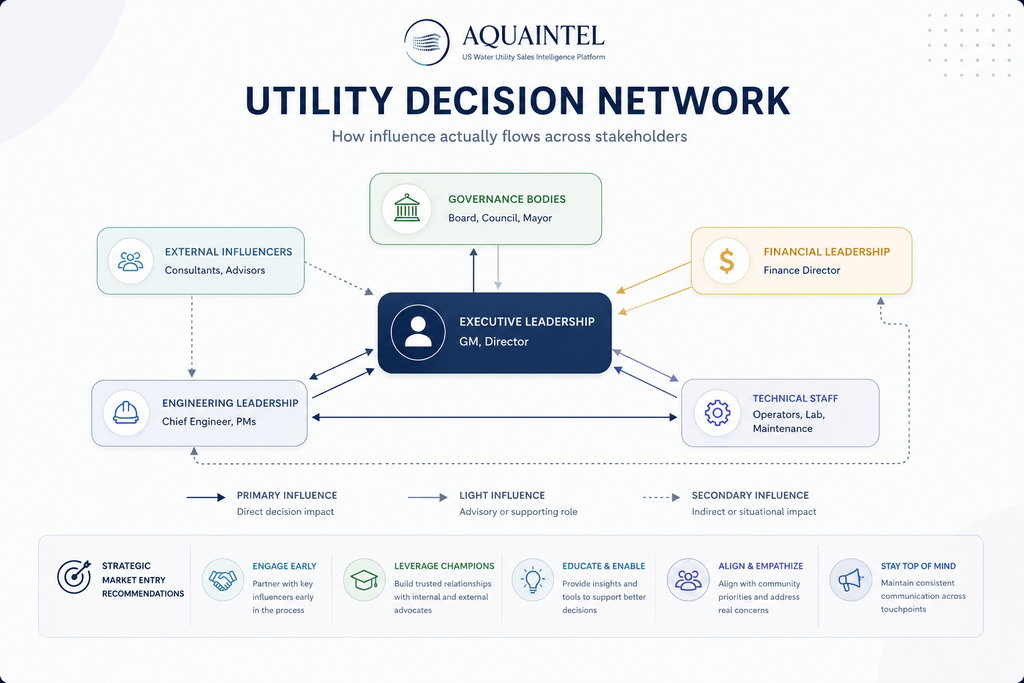
How Decisions Flow: Patterns By Project Type
The roles and relationships described above manifest differently depending on project type. Understanding these patterns helps you focus on the engagement well.
1. Capital Improvement Projects (>$1M)
Typical Decision Flow:
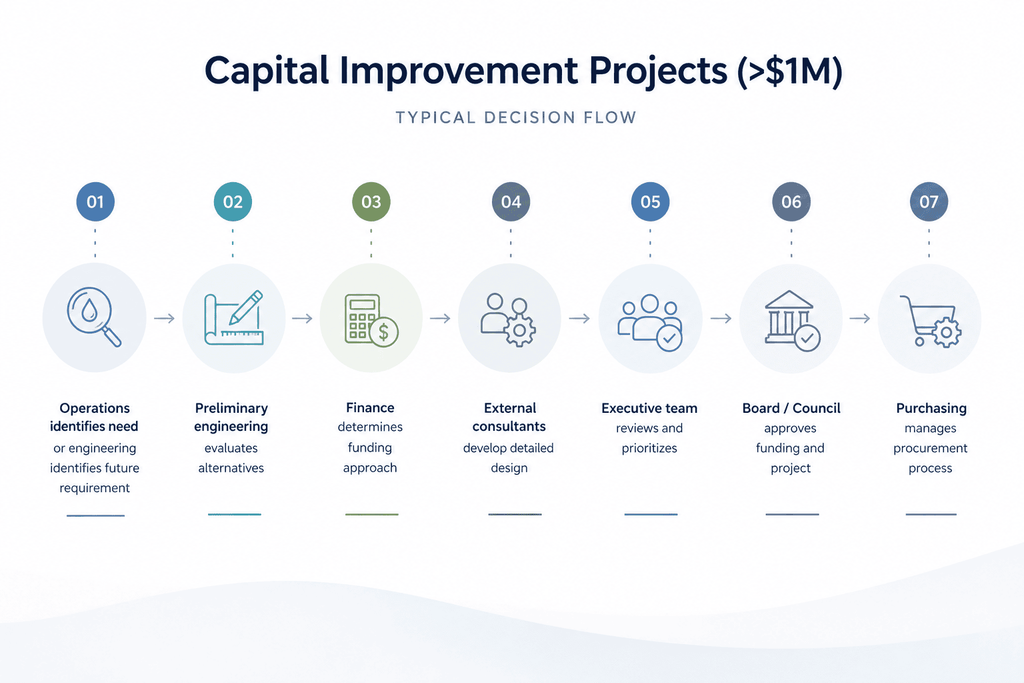
Large capital improvement projects typically involve the broadest range of stakeholders and the longest decision timelines. They often begin with a utility identifying a long-term infrastructure need, followed by funding evaluations, feasibility studies, and preliminary engineering. Once the project scope is defined, consulting engineers play a central role in evaluating alternatives, developing technical specifications, and recommending solutions before the utility’s leadership and governing board approve the investment. Procurement then formalizes the purchasing process through a public RFP.
Key Influencers: Consulting engineers often have the greatest influence in these projects because they shape the technical specifications and evaluate alternative solutions during the design phase. Their recommendations frequently determine which technologies and vendors are ultimately considered.
Critical Engagement Point: The best opportunity to engage is during the preliminary engineering and funding discussions, before specifications have been finalized. Vendors that establish relationships and provide technical expertise at this stage are better positioned to influence project requirements long before the RFP is released.
2. Equipment Replacement ($100K-$1M)
Standard Decision Flow:
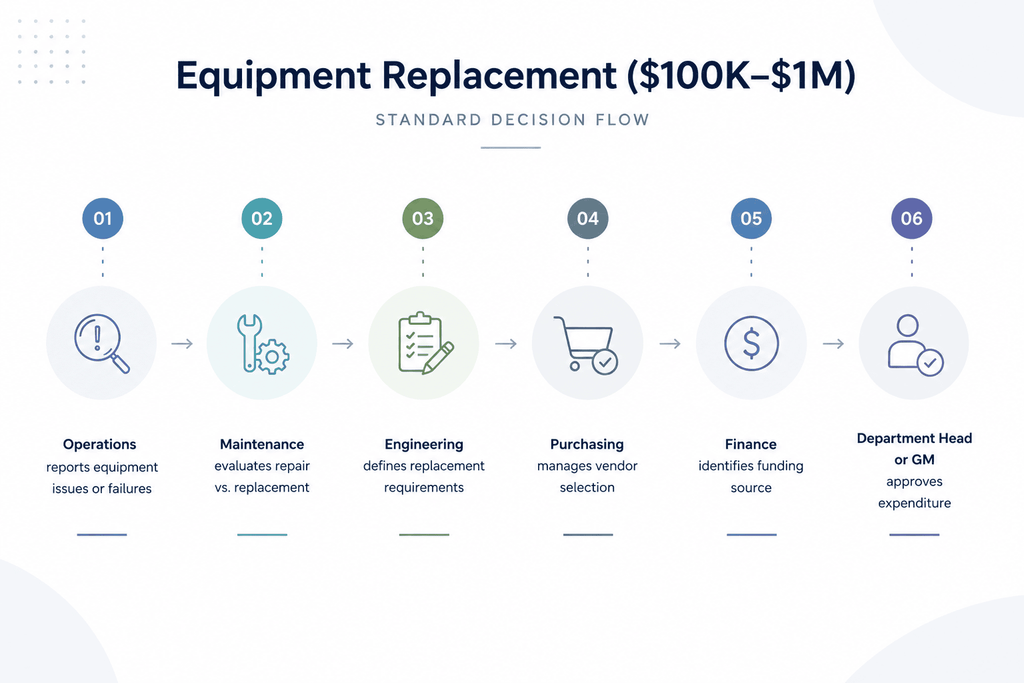
Equipment replacement projects are generally driven by day-to-day operational challenges rather than long-term capital planning. The process often begins when maintenance teams experience increasing breakdowns, declining reliability, or rising operating costs. Operations and maintenance staff document these issues, evaluate replacement options, and work with engineering and procurement teams to define the replacement requirements before seeking management approval.
Key Influencers: Operations and maintenance personnel are usually the strongest influencers because they work directly with the equipment every day. Their firsthand experience with recurring failures, maintenance costs, and operational inefficiencies heavily influences both vendor selection and technical specifications.
Critical Engagement Point: The ideal time to engage is before a formal replacement project has been approved, while maintenance teams are still discussing recurring performance issues and evaluating possible solutions. Demonstrating improved reliability, lower maintenance requirements, and operational savings at this stage can help shape the eventual procurement.
3. Treatment Process Improvements
Standard Decision Flow:
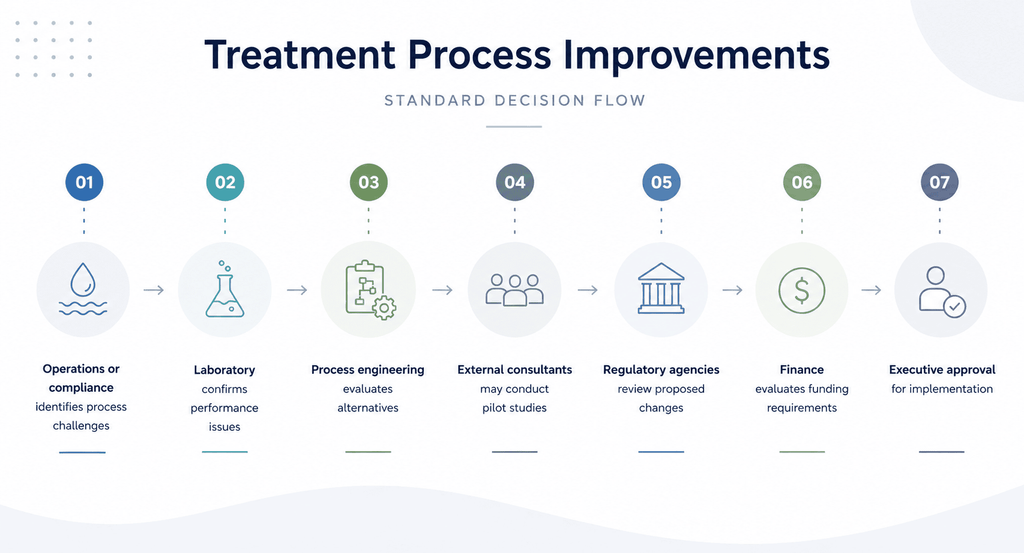
Treatment process improvement projects are typically initiated when utilities need to improve water quality, increase operational efficiency, or comply with new regulatory requirements. These projects require a careful evaluation of treatment technologies, process performance, and long-term operating costs before any procurement decisions are made. Utilities frequently conduct pilot studies, process modeling, or technology demonstrations to validate potential solutions before moving into detailed design.
Key Influencers: Process engineers and regulatory compliance teams are the primary decision-makers because they are responsible for ensuring that any proposed solution consistently meets treatment objectives while satisfying current and future regulatory requirements.
Critical Engagement Point: The most valuable time to engage is during the early process evaluation phase, before a preferred treatment approach has been selected. Vendors that can provide pilot testing, performance data, case studies, and technical demonstrations are far more likely to influence the technology evaluation and become part of the final specification.
The Real Competitive Advantage Isn’t Your Product. It’s Understanding the Decision Network
The biggest takeaway from all of this is surprisingly simple: utilities do not buy solutions; networks of people do.
Every major decision is shaped by operators concerned about reliability, engineers focused on technical performance, finance teams managing limited budgets, executives balancing strategic priorities, consultants influencing specifications, and governance bodies accountable to the public. Success rarely depends on convincing a single decision-maker. It depends on understanding how these stakeholders interact, who influences whom, and where consensus is ultimately built.
Unfortunately, most vendors only gain visibility into this network after a project has already entered procurement. By then, specifications have often been written, preferences established, and key influencers aligned around a particular approach.
The organizations that consistently win utility business take a different path. They invest in understanding decision dynamics before opportunities become formal projects. They identify influential stakeholders early, tailor their messaging to different audiences, and engage at the moments when decisions are still being shaped.
This is where data and intelligence become powerful differentiators.
At Aquaintel, we’ve built technology specifically to uncover these hidden decision networks. By analyzing board minutes, procurement records, project histories, organizational structures and stakeholder relationships, we help vendors move beyond static org charts and gain a clearer understanding of how influence actually flows within a utility.
Because in today’s water industry, the question is no longer “Who is the decision-maker?”
The better question is:
“Who influences the decision, and how do they influence it?”
The companies that can answer that question consistently are the ones that earn a seat at the table long before the purchasing decision is made.
If you found this article valuable, you might also enjoy “How $2.2 Trillion Funding Gap of U.S. Water Infrastructure Is Moving Toward Replacement. And Why Vendors Need to Move Before the RFP”, where we take a deeper look at another challenge shaping the future of water utilities and what it means for vendors