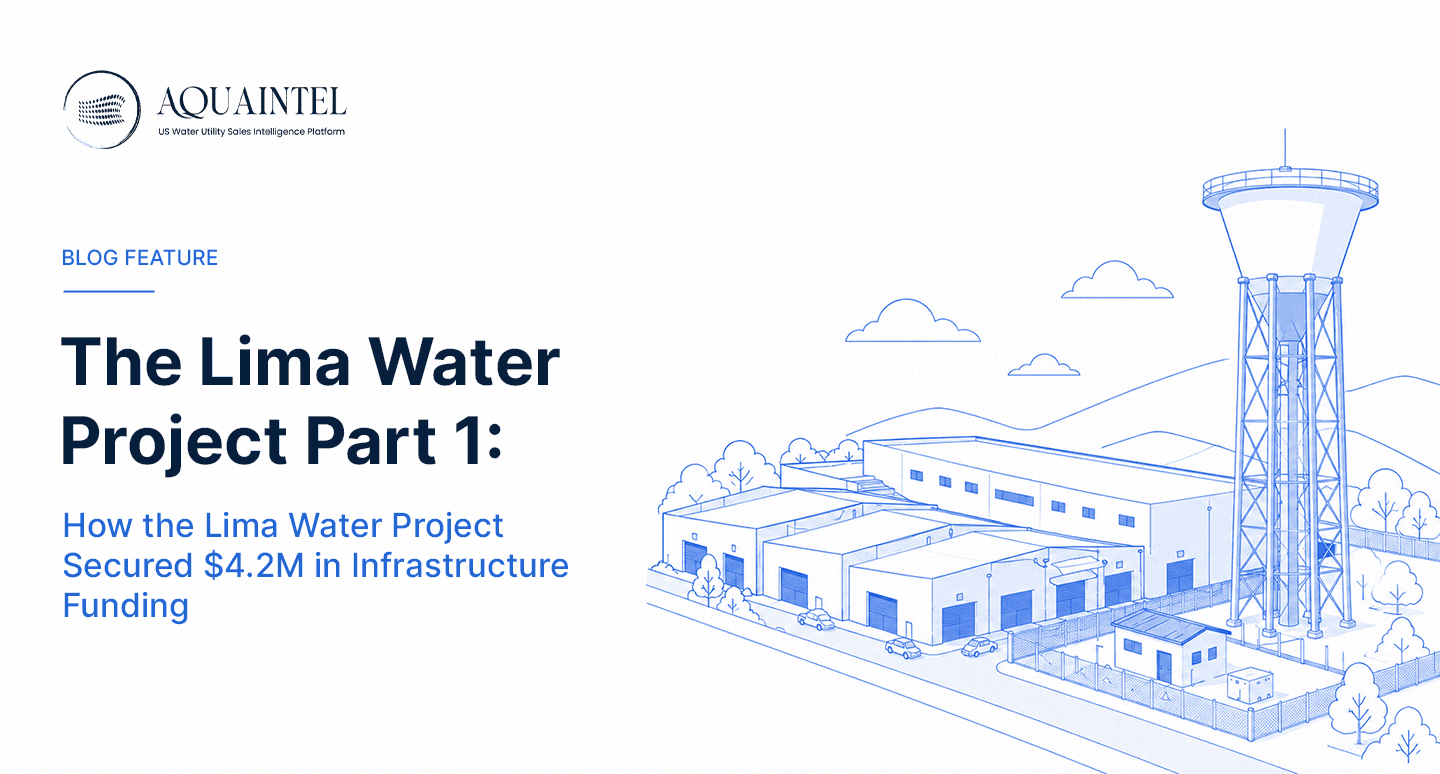

The Lima Municipal Water Authority in Pennsylvania didn’t just wake up in a state of frenzy one morning facing a crisis and deciding to take on reinventing the system and their approach overnight. The issues crept up on them over the years, the way these things usually do and they had to deal with it all very strategically.
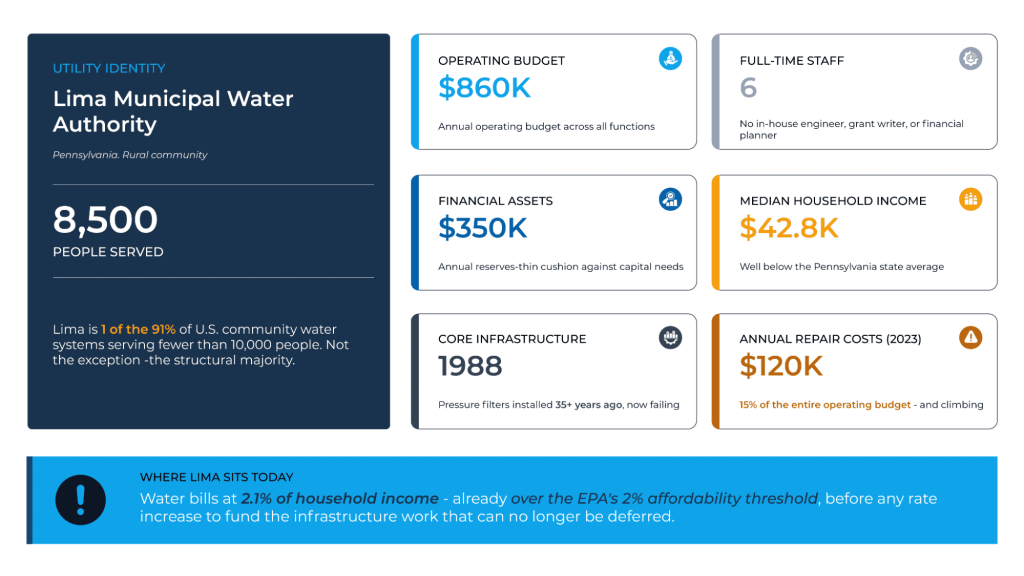
The pressure filters were installed in 1988 and by 2023, they were breaking down constantly. Annual repair costs had climbed past $120,000 which was approximately 15% of Lima’s entire operating budget. The water quality remained within legal limits, but when peak demands were reached, the margins became increasingly narrow. This may not be a catastrophe, but one did not need to be very sharp to foresee what was coming.
This is precisely the situation small utilities find themselves in all across America. The collapses are rarely dramatic. It usually takes the route of slow deterioration with costs creeping up, staff getting stretched thin to the point of abrupt breakage which later turns out to be an arduous task to repair. The final strike comes in the absence of an obvious path forward or the inability to see what the future holds.
The Numbers Behind the Bind
While Lima serves 8,500 people with an operational budget of $860,000 and financial assets of $350,000 per year, ninety-one percent of the community water systems in the United States provide services to fewer than 10,000 individuals.
Median income in this community stands at $42,800, which is well below Pennsylvania’s average. Before the rate increase, water costs represented 2.1% of the average household’s income. The EPA’s guideline is to keep water bills under 2% of median income. Nationally, 88% of Americans pay under that threshold. But up to 36% of households could struggle to afford water by 2024. Lima was gradually approaching that very dangerous edge and realised that something had to change.
This paves the way for the central problem small utilities face: they can’t raise rates because their communities can’t afford it but they also cannot fund infrastructure without money magically appearing from somewhere. The usual fallback is issuing debt and raising rates which generally works out in larger systems with stronger income bases, but in Lima, it would push bills into genuinely unaffordable territory for a significant share of residents.
Only 21% of U.S. water utilities can fully cover costs with current rates. Among small utilities, just 10% expect to sustain full cost recovery. The rest face funding gaps that translate into either deferred upgrades or steep rate increases. Lima was caught squarely in that majority.
The Staffing Reality
There’s a human side to this that cannot be disregarded.
Lima operated with six full-time employees. No in-house engineering team, nobody on staff with grant-writing experience, not even somebody with dedicated time to navigate complex funding applications. This was just as draining as it sounds and a situation difficult to bounce back from.
Previous capital projects had been funded through municipal bonds and rate increases — approaches that were now off the table. This is completely common. Small systems often lack full-time technical experts. They rely on personnel who are already stretched across multiple responsibilities. They typically don’t apply for many funding programs without outside help because they need dedicated no-cost assistance for project development and for qualifying for funding in the first place.
Lima had the will to fix the aging infrastructure. What they lacked was the resources and the know-how to finance a multi-million dollar project on their own. Acknowledging that gap and working towards fixing it systematically was what proved to be immense for Lima.
Why This Matters Beyond Lima
Lima’s situation isn’t unique to Lima. It’s the template for hundreds of small utilities across the country.
They had multiple issues to combat; from aging assets, thin financial reserves, a community that can’t absorb rate increases without real hardship, staff doing the work of departments three times their size to a funding landscape that looks, from the outside, impossibly complicated. You’d name a struggle and Lima had it.
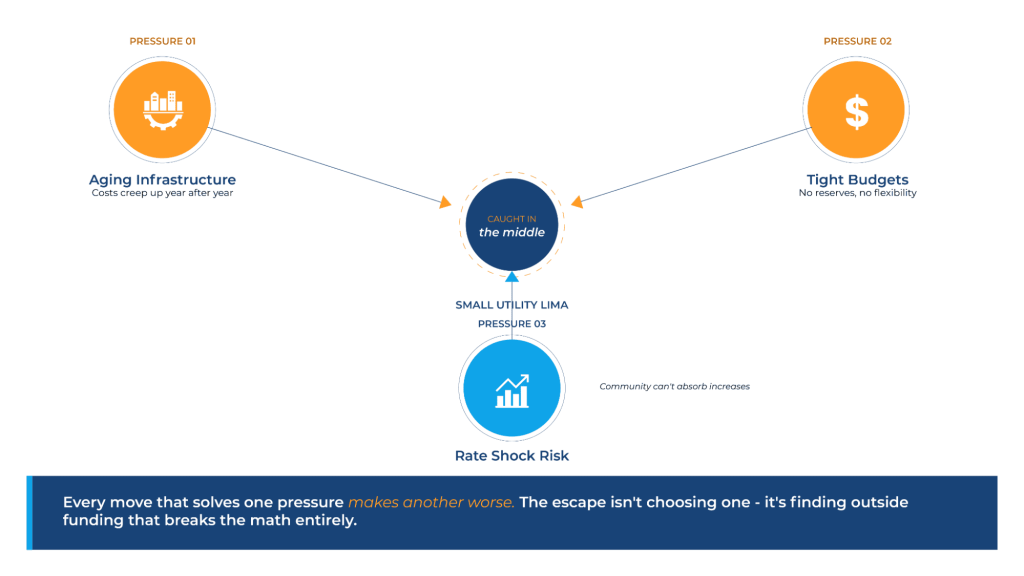
What Lima’s story shows is that complicated doesn’t mean impossible. But getting from one to the other requires a completely different approach than what small utilities have traditionally taken, and that starts with understanding exactly what you’re dealing with before you do anything else.
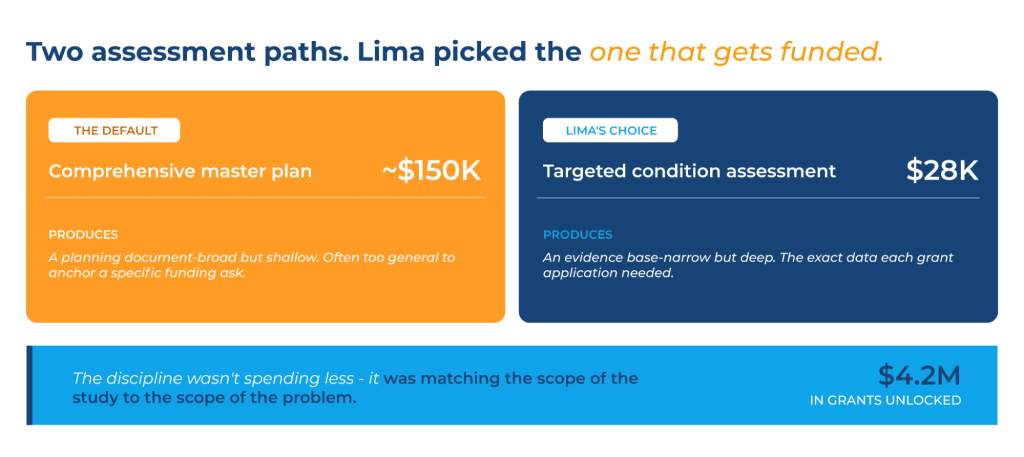
To do this, Lima’s leadership invested in understanding the problem first by spending $28,000 on a targeted condition assessment and energy audit before doing anything else. This decision ended up being what made everything else possible.
What $28,000 Actually Buys
The cost of creating a complete plan for a water plant is about $150,000. Instead of reaching this $150,000 budget allocation, Lima requested an assessment and audit aimed solely at the malfunctioning filtration system. This allowed them narrow scope, answers to specific questions and concrete data that are far more important in the long run.
What they got back changed the conversation entirely.
- The audit identified a 32% drop in filtration energy efficiency. The aging system was using roughly one-third more energy to treat water than it had when it was new.
- Energy costs run 30–40% of a water utility’s operating budget, second only to labor. A 32% efficiency loss wasn’t just a technical finding. It was a financial drain that had been bleeding Lima’s budget quietly for years.
- Maintenance records showed a sharp uptick in filter breakdowns during peak summer demand with Lima approaching an inevitable failure curve that was rushing towards them at a pace it would be very difficult to recover from.
- The data on the water quality revealed that, although the required turbidity levels for regulatory purposes had been achieved, the turbidity of the water that had gone through the filtration process began approaching the 0.3 NTU threshold, which is the safety limit set by EPA guidelines. The safety margin was narrowing. That’s not a comfortable position to be in for a utility whose entire mission is public health protection.
- Finally, the audit produced a lifecycle financial analysis. Status quo versus full replacement. Ongoing repairs and high energy use compared to the capital cost of new equipment. The analysis showed that over the equipment’s life, replacement would actually save money. This reduced energy costs and eliminated emergency repair expenses outweighing the capital investment.
Why Data Changes the Funding Conversation
Sarah Williams, Lima’s Board Chair, says: “We realized that to compete for limited funding, we needed to clearly demonstrate both the urgency of our situation and the community impact.”
That is precisely correct. Grant proposals are competitive, and there is always more demand for funds than supply. The utilities that succeed aren’t necessarily the ones in the most desperate situations but they sure are the ones that can prove their situation with real numbers and convincing results.
Without the assessment, Lima would have been making an argument. With it, they were presenting evidence and that is hard to ignore or override. There’s a significant difference in how those land with a funding agency.
The $28,000 assessment gave Lima specific, defensible metrics instead of general claims. A 32% energy efficiency loss with annual repair costs at 15% of total operating budget. turbidity margins narrowing toward regulatory limits with lifecycle analysis showing replacement saves money over time. These are data points that a funder could evaluate, verify, and use to justify their decision and must not be taken as anecdotes you hear once and forget.
This data would form the backbone of every grant application Lima filed:
- When they applied to PENNVEST, they cited the energy efficiency data.
- When they applied for the state energy grant, they quantified the projected savings.
- When they applied for ARPA funds, they documented the public health risk.
The same assessment, very different angles but each and every time, everything was backed by numbers.
The Lesson That Generalizes
Lima’s assessment approach offers something transferable to any small utility facing similar constraints.
You don’t need a comprehensive master plan to build a compelling funding case but you indeed require targeted data on the specific problem you’re trying to solve. Find out what’s failing, why it’s failing, what it’s costing you now, what it will cost if you wait and what the fix will deliver in operational and financial terms.
That’s the evidence base funders are looking for. And it doesn’t require spending $150,000 to build it. What gets measured gets money. Lima spent $28,000 to make a $4.2 million case, which is nowhere near being a bad return on a data investment.
That data gave Lima a rock-solid case, but numbers alone don’t build water plants. The next step was figuring out how to actually turn those metrics into real funding, without burying the community in debt.