
Gathering the data was a huge win, but proving you have a problem is only half the battle. To actually get the job done, Lima had to step into a complicated funding landscape and piece together $4.2 million from scratch. It took a lot of strategy, a few key partnerships, and a complete refusal to let a small budget slow them down.
Here is how it actually came together.
Casting the Net Wide
Before Lima applied to anything, they conducted a comprehensive scan of every potential funding source. You’d be mistaken to think that this was limited to the programs they already knew about. Everything mattered and they understood it and worked accordingly.
State and federal grants targeting small systems and disadvantaged communities:
- Pennsylvania’s PENNVEST program, which is the state’s SRF vehicle which offers grants and forgivable loans for communities meeting income criteria.
- EPA Drinking Water State Revolving Fund grants.
- USDA Rural Development funds for rural communities.
- American Rescue Plan Act funds allocated to counties for infrastructure.
- State energy efficiency grants for projects delivering measurable energy savings.
This exhaustive search revealed opportunities Lima hadn’t known existed. The most significant discovery was that PENNVEST had a Small System Disadvantaged Community designation that Lima qualified for based on its size and income levels. That designation unlocked principal forgiveness on a portion of any loan — meaning part of what they borrowed wouldn’t need to be repaid. In practical terms, that’s a grant inside a loan structure.
The current federal infrastructure funding environment made this timing particularly favorable. The EPA is putting $50 billion or more under the 2021 Bipartisan Infrastructure Law into water infrastructure projects, and at least 49 percent of that amount must come from grant or forgivable loan financing.
Identifying programs was only half the battle. Accessing those dollars is notoriously challenging for small utilities. Applications are complex and competitive. The funding applications for a village of 1,000 look much like those for a city of 500,000 are extensive processes that take months to complete. Small utilities often don’t apply without outside help because they lack the bandwidth.
Lima’s leadership committed upfront to pursuing every viable source rather than assuming anything was out of reach.
The Funding Stack
The final package came together as four complementary pieces.
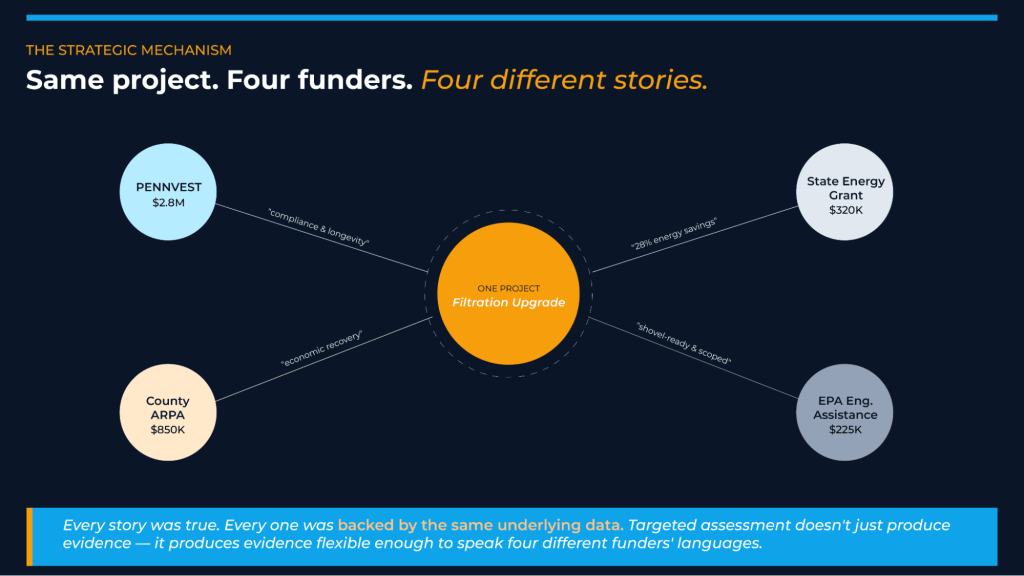
- PENNVEST provided $2.8 million which was obviously the foundation of the stack. Crucially, about 51% of that loan, that is $1.428 million, was forgiven because Lima qualified as a disadvantaged small community. That portion functions as a grant. The remaining $1.372 million is a 30-year loan typically landing on an interest rate between 0% and 2% depending on the affordability score. The Bipartisan Infrastructure Law enabled state SRFs to offer unprecedented levels of principal forgiveness, and Lima hit the income and size metrics for maximum subsidy.
- The county ARPA grant contributed $850,000. Lima’s county had set aside American Rescue Plan Act dollars for infrastructure, with water projects explicitly eligible. Lima’s thorough documentation and shovel-ready project convinced county officials to direct a portion here. Utilities that had their data organized and their project defined moved faster through these processes.
- A state energy efficiency grant added $320,000. This came from a state clean energy program targeting municipal facilities. Because the project incorporated high-efficiency pumps, motors, and process controls projected to cut filtration energy use by 28%, Lima qualified for funding that water utilities often overlook entirely. Most water professionals don’t think of themselves as running energy projects.
- Engineering assistance provided by EPA was worth $225,000. This money was used to hire an external consultant for doing environmental reports, pre-engineering, and preparing the SRF loan application. These were expenses that Lima City Council would have to pay out of its scarce reserves had it not received this money.
External funding: approx. $4.2 million. Sixty-five percent in non-repayable support. Thirty-five percent in a low-interest loan.
What the Stack Actually Delivered
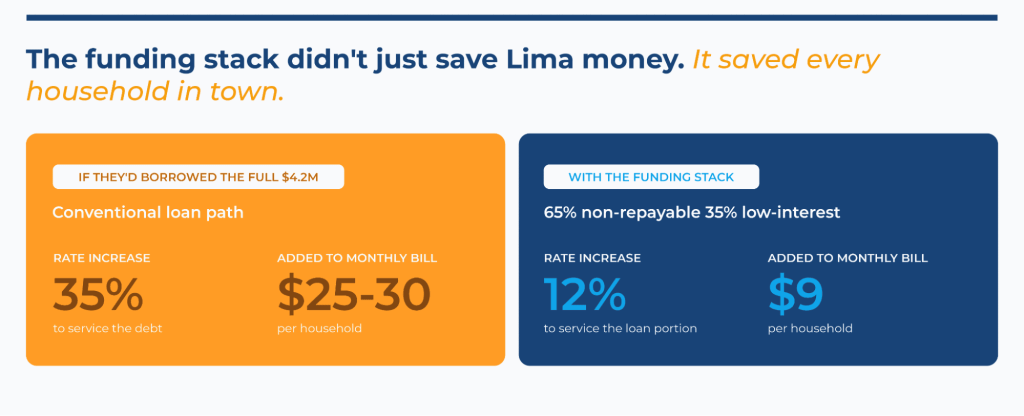
Without this funding approach, Lima calculated they would have needed to borrow the entire $4.2 million. At even favorable interest rates, servicing that debt would have required approximately a 35% rate increase.
Because of the grants and forgiveness, the actual rate increase was 12%. The average household’s water bill rose by about $9 a month instead of an estimated $25–30. For a community where median household income is $42,800, that difference is what lies between affordable and genuinely burdensome.
For comparison, another rural system in Kentucky recently imposed a 24% increase and still struggles. Community advocates there describe it as a huge burden on the poorest residents. Lima avoided that outcome by pursuing every grant and forgiveness opportunity available to them.
From a vendor perspective, the assembled funding stack meant the project could proceed at full scope. Small utilities often cut project quality to fit what they can afford. Lima implemented the optimal engineering solution because the money was available to do so. Creative financing produced better technical outcomes.
The Approach That Made It Work
The key wasn’t finding one program that covered everything. No such program exists for a $4.2 million project. The key was understanding that multiple programs could be layered together, each covering a different piece, collectively meeting the full need.
Each source had its own application narrative. When Lima applied to the state energy office, they highlighted the 28% energy reduction. For the SRF, they emphasized compliance and asset longevity. For ARPA, they stressed economic recovery and community wellbeing. Same project. Different angles. Targeted messaging backed by the data the $28,000 assessment had produced.
Multiple agencies having a hand in the project also built momentum. When PENNVEST was approved, it strengthened the ARPA application. When the energy grant came through, it reinforced the project’s viability to everyone else. Each approval made the next one more likely.
That’s what a strategic funding stack looks like. Not luck. Not a single windfall. Systematic pursuit of every available source, assembled piece by piece into something that works.
But the money only tells part of Lima’s story; the partnerships and the design choices tell the rest. Getting $4.2 million assembled from four different sources didn’t happen because Lima had connections or advantages that other small utilities lack. They built relationships with organizations that exist specifically to help small utilities, because they designed the project to be as fundable as possible, and because they stayed the course through 18 months of applications, waiting, and adjustments. Any small utility can achieve what Lima did with a sound and strategic plan.
Building the Support Network
Lima went into this knowing they couldn’t do it alone. The internal capacity simply wasn’t there but rather than treating that as a disqualification, they treated it as a problem to solve externally.
The Pennsylvania Rural Water Association was the first call. PRWA advisors reviewed Lima’s plans, provided template documents, and coached operators through necessary steps. Organizations like PRWA exist precisely for this purpose, funded by EPA to diagnose problems and help small systems secure funding at no cost to the utility. Lima had never engaged them prior to this.
Through an EPA technical assistance initiative, Lima obtained direct help with engineering and planning. An EPA technical assistance grant of $225,000 funded an outside engineering consultant to complete environmental reports, preliminary engineering, and the SRF application package. The quality of their submissions improved dramatically as a result.
A nearby university’s environmental engineering department became an unexpected resource. Graduate students under faculty supervision assisted with data analysis and benefit-cost documentation. This was mutually beneficial as students got real-world experience while Lima got extra analytical capacity at no cost. Academic letters of support also strengthened grant applications in ways Lima’s staff couldn’t have produced internally.
State programs, rural water associations, technical assistance providers, universities, all of these exist because small utilities often face these challenges and are waiting to be engaged.
Designing the Project to Secure Funding
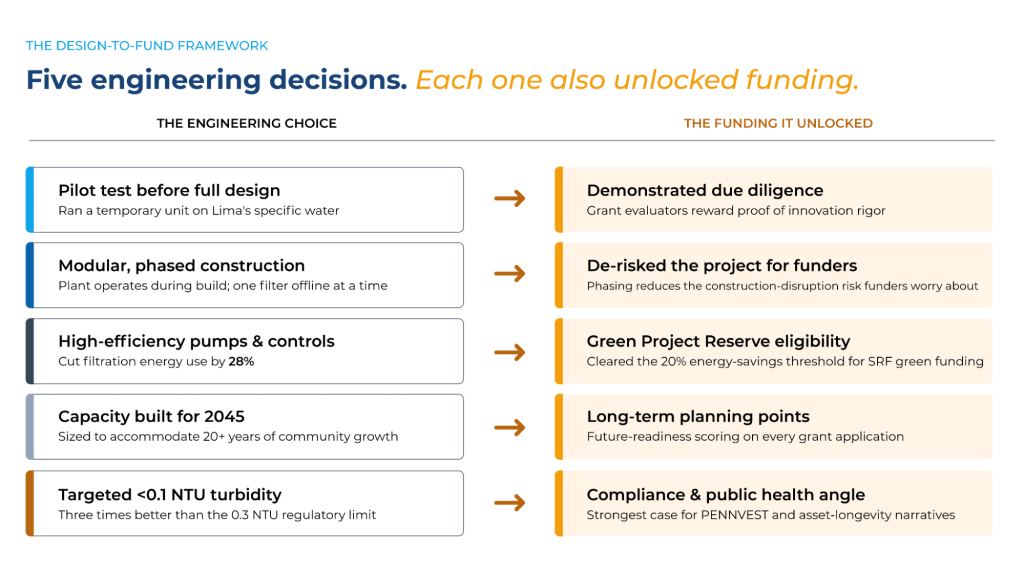
The engineering decisions Lima made were far beyond building a good filtration system, with the primary focus being around building a system that wouldn’t be difficult to fund.
Before settling on a final design, Lima piloted a newer filtration technology with vendor support. A temporary pilot unit operated for a few weeks to verify performance on Lima’s specific water. This demonstrated due diligence and commitment to innovation which are considerations that matter in grant evaluations, not just in engineering ones.
- The design was structured in modular components that could be built in phases. If full funding didn’t arrive simultaneously, construction could proceed in stages as money became available. Phasing also meant the plant could continue operating during construction by taking one filter offline at a time. Modularity reduces risk for funders who worry about construction disruptions in small communities.
- The decision to incorporate high-efficiency pumps, motors, and process controls was partly engineering judgment and partly funding strategy. The finished project was calculated to cut filtration energy use by approximately 28%. This led to two immediate results: savings of about $42,000 per year from the electrical bill and maintenance costs, and eligibility for the Drinking Water SRF Program’s Green Project Reserve. Projects that have achieved 20% or higher energy savings automatically qualify for green infrastructure grants. Lima’s 28% improvement cleared that threshold comfortably, opening a funding stream that water utilities routinely overlook.
- Future planning was not forgotten in the designing phase either, because the system was built to be able to develop up to 2045. The goal was for finished water turbidity to be below 0.1 NTU, which is better than the regulation of 0.3 NTU. By showing how the project was prepared for the future, additional points were earned by Lima.
- Each funding program got a narrative tailored to what it valued. The state energy office heard about the 28% reduction. PENNVEST heard about compliance and asset longevity. ARPA heard about economic recovery and community wellbeing. Same project throughout. Different emphasis in each application, drawing on the data the initial assessment had produced.
What Came Out the Other Side
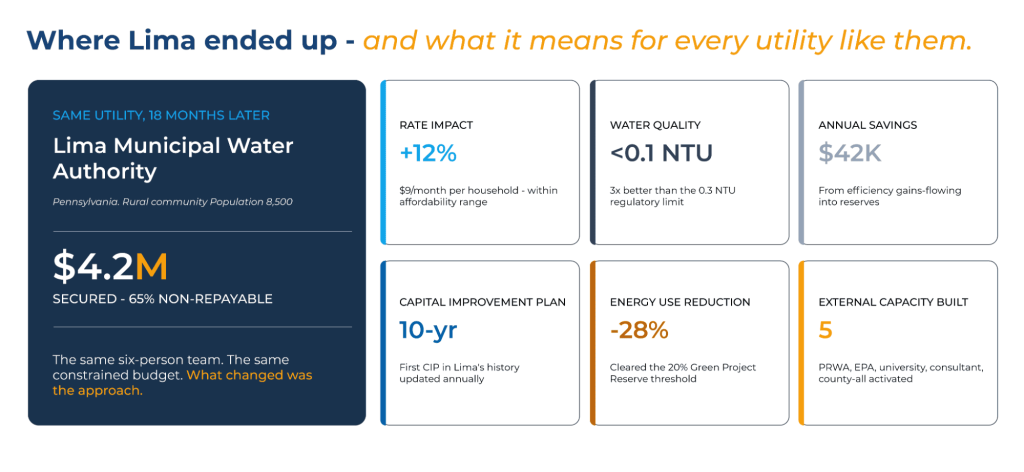
By mid-2025 construction was underway. The results were already visible:
- Finished water turbidity dropped below 0.1 NTU which is well inside the regulatory limit that had been narrowing during peak demand periods. The risk of boil alerts or filter breakthrough violations was effectively eliminated.
- The rate increase came in at 12% instead of the 35% that full debt financing would have required. The average household bill increased by about $9 a month. Annual operational savings of approximately $42,000, from lower energy consumption and eliminated emergency repair costs, began flowing back toward rebuilding reserves for future needs. Construction proceeded in phases with no service interruptions.
- Lima’s staff and board emerged from the process with experience in grant applications, loan structures, and complex project management. They were already mentoring a neighboring small water system on how to approach similar challenges. The confidence that comes from having done something difficult once is its own kind of infrastructure.
- Lima also adopted a formal Capital Improvement Plan for the first time, a 10-year prioritization of projects, to be updated regularly. Nearly one-third of U.S. water utilities now have a robust asset management plan in place, up from 20% in 2016. Lima joined that group. They’re now positioned to anticipate issues rather than react to them, and to demonstrate long-term planning capacity in every future funding application.
What Lima Actually Teaches
The $4.2 million didn’t appear because Lima got lucky or had advantages other small utilities don’t.
It appeared because they gathered data before they did anything else. Because they cast a wide net across every available funding source. Because they asked for help and built a genuine support network. Because they designed the project to serve multiple policy priorities simultaneously. Because they stayed persistent through 18 months of complexity. And because when they got to each funder, they had a specific, evidence-backed case for why this project deserved support.
None of those things require size or resources that small utilities don’t have. They require a different approach than the one most small utilities default to.
Lima’s board chair said they needed to clearly demonstrate both urgency and community impact. A demonstration that help is justified, backed by evidence, and that the investment will deliver results. Being a small utility doesn’t equate to small ambitions and that is exactly what Lima has proved!
A Note On Lima For The Reader
Lima Municipal Water Authority is a composite case study, not a real utility. It was constructed to illustrate funding strategies, project structures, and financial dynamics that are entirely real, drawn from actual programs, published federal data, and documented outcomes from small water systems across the United States.
Every statistic cited in this series, from EPA affordability thresholds, SRF principal forgiveness structures under the Bipartisan Infrastructure Law, Green Project Reserve eligibility criteria, national data on utility cost recovery and asset management adoption, turbidity standards, to energy cost benchmarks, comes from primary sources cited below. The funding programs described (PENNVEST, ARPA infrastructure allocations, state energy grants, EPA technical assistance) are real and actively available to qualifying small systems.
Lima’s numbers were built to reflect the financial profile of a real disadvantaged small community in Pennsylvania, not to exaggerate the challenge, and not to make the solution look easier than it is. The point of the composite is to make the strategic logic concrete and traceable. Real utilities facing similar circumstances have navigated these same programs to similar outcomes.