
The numbers around America’s water infrastructure are staggering enough that they stop registering as real. Billions here. Trillions there yet after a while it becomes abstract. No clarity on the figures which makes a sector which is already very secretive when it comes to transparency appear even more mysterious.
Let’s put this into perspective and clear it all out:
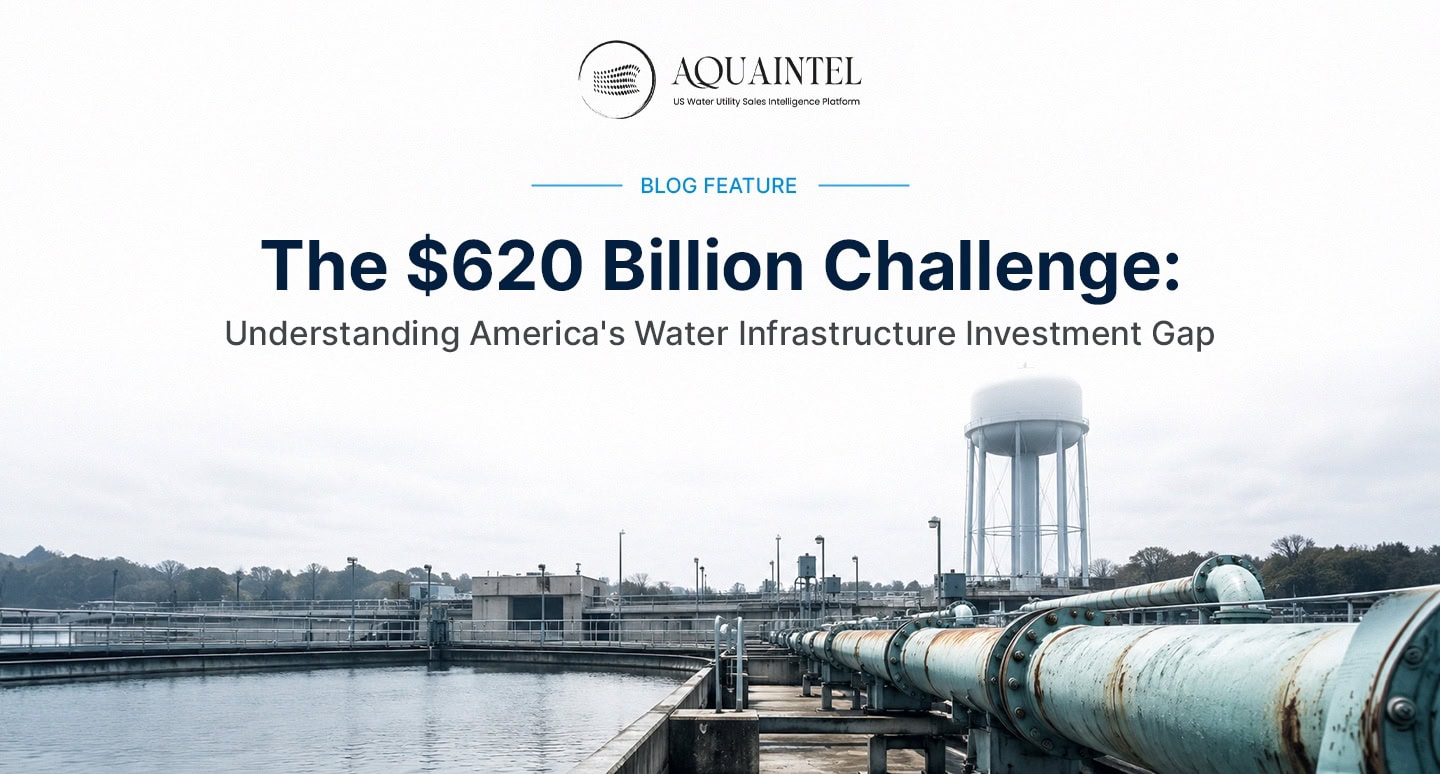
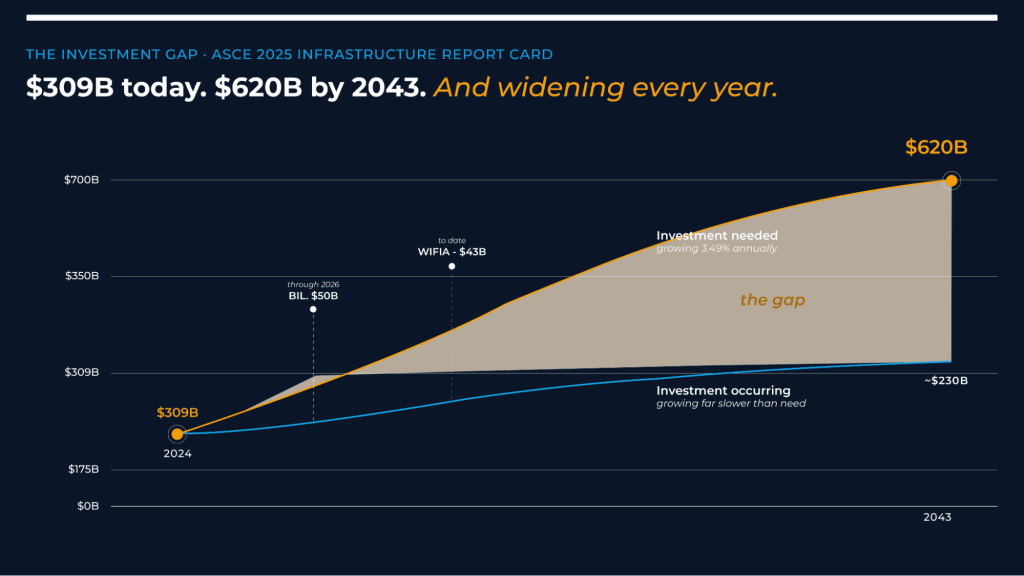
According to the ASCE’s 2025 Infrastructure Report Card, the projected gap between drinking water infrastructure needs and investments stood at $309 billion in 2024. By 2043, that gap grows to $620 billion. Add wastewater infrastructure needs and the total i not too shy of approaching the multi-trillion dollar range.
That’s nowhere near a funding shortfall but a structural crisis that’s certainly been building for decades and is just now arriving and you must immediately get to addressing it before it turns into a bigger problem.
What Aging Infrastructure Actually Means
Most of America’s water and wastewater systems were built in the early to mid 20th century. It is astonishing that such systems have managed to remain operational despite changing demographics, economics, and technology over decades, but this was never their intended purpose. Created as limited-life assets, many of these facilities have already reached their lifespan or are close to doing so in systems that serve tens of millions of Americans.
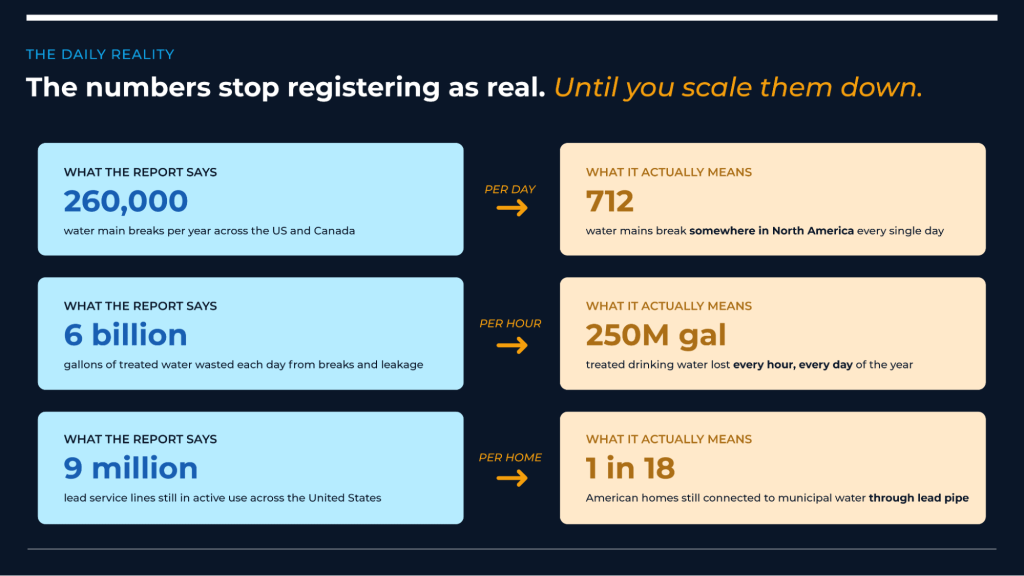
It’s quite fascinating how more than nine million lead service lines are being used in the country at the moment with attempts to create more and more such lines on the daily.
According to a new research study carried out by Utah State University, 260,000 water main breaks take place every year in the United States and Canada. This results not only in water wastage but also involves heavy repair costs for the utilities, which are struggling to maintain their system because of these water main breaks. About six billion gallons of water is being wasted each day due to water main breaks and leakage.
Small and mid-sized utilities are carrying a disproportionate share of this burden. As the USU study noted, small water utilities may find it challenging to renew their water infrastructure in the coming years because they have lower populations with fewer customers per mile of pipe, which increases the financial burden of maintaining these systems tenfold.
The math is brutal with the infrastructure cost being largely fixed, leaving little to no room for the customer base to spread it across with regard to how small it is.
The Funding Landscape
Several mechanisms exist to address this but none of them, individually or collectively, have been able to deal with the system effectively enough to close the gap.
- State Revolving Funds have been the foundation of water infrastructure investment for more than 30 years, providing low-interest loans for local projects across America. They’re essential while also being consistently oversubscribed. Demand outpaces available funds in virtually every state.
- The Bipartisan Infrastructure Law allocated over $50 billion to water infrastructure through 2026. This is a historic investment, that too a massively meaningful one and yet it failed to be enough. Experts have been pretty straightforward about this: it is the single largest investment in water the federal government has ever made, but it was never going to be enough to close the water infrastructure investment gap. Nothing not meant to serve the needs of the water sector is going to make the cut regardless of its volume.
- The Water Infrastructure Finance and Innovation Act (WIFIA Act) is a source of long-term and low-cost supplemental financing for important national water projects. As of December 2023, the program has enabled more than $43 billion worth of investments in infrastructure projects across the country,an impressive accomplishment, to say the least. However, despite its success, even that amount seems small and unimpressive against the scope of America’s infrastructure challenges.
The problem, however, is more than just the amount of money allocated to projects; the mismatch between what is available and what the project may require poses challenges beyond the mere lack of funding. In some cases, the former scenario is better than the latter one since it forces a utility to enter a particular situation with a lack of funding rather than without any funding. With such an approach, one might get overwhelmed by the necessity to manage resources efficiently because it leaves no room for innovations, strategic planning, and other critical aspects.
- USDA Rural Development Programs target smaller rural communities with loans and grants, though specific eligibility requirements limit accessibility for many of the systems that need help most. Municipal bonds and public-private partnerships fill additional gaps, but both depend heavily on a utility’s financial health and bond rating; the most potent of tools go to the systems already in the strongest position.
Carol Haddock, vice chair of the ASCE report card committee, puts this into perspective:
‘Our nation’s water infrastructure is aging and underfunded. Only about 30% of utilities have fully implemented asset management plans. The capacity to manage the problem systematically doesn’t exist across most of the sector.’
Where Data Intelligence Changes the Equation
The thing is that the funding gap is not closing anytime soon. What can change is how efficiently utilities use the money they do have. This is where data intelligence and advanced analytics are genuinely transforming what’s possible.
Predictive asset management uses machine learning to anticipate failures before they occur, allowing utilities to prioritize replacements and maximize limited capital. McKinsey found that using advanced analytics models to enable predictive maintenance allows water utilities to see typical yearly savings of 10 to 20% in maintenance operating expenditures and 20 to 30% in capital expenditures. On a system managing hundreds of millions in assets, those percentages represent real money redirected from emergency repairs toward planned investment, making it a significant improvement.
An AI-driven asset management system analyzed variables including pipe material, age, and environmental conditions, to help the utility prioritize investments where they’re most needed and extend the lifespan of critical infrastructure. The shift from reacting to failures to anticipating them, changes the entire cost structure of infrastructure management.
Funding optimization is another area where data intelligence delivers measurable value. Analytics platforms help utilities identify optimal funding mixes by revealing the most cost-effective approaches to combining SRF loans, federal grants, WIFIA financing, and other sources. The difference between a well-structured funding stack and a poorly structured one can be the presence of tens of millions of dollars in grant versus loan ratios for the same project.
For solution providers, data analytics reveal emerging infrastructure needs years before formal projects begin. Utilities’ capital improvement plans, regulatory filings, maintenance records, and board meeting discussions all contain signals about what’s coming. Organizations that read those signals early can engage strategically rather than responding to RFPs after decisions have already been made.
As Arcadis noted: aging infrastructure is an issue that will only get worse unless we get smarter about how we manage it. Predictive AI enables utilities to quickly identify potential weak points in their networks, prioritize maintenance efforts, and prevent failures before they occur.
The Path Forward
Realistically speaking, there’s no single solution to bridging a $620 billion gap, but there’s a direction which vendors need to proceed towards strategically.
Moving from reactive to proactive infrastructure planning is the foundational shift that can change everything. Technologies focused on water utility asset failure prediction with AI models that analyze sensor data to forecast pipe failures before they happen are currently operational and the utilities that readily adopt them, change the nature of their maintenance spending from emergency-driven to planned, avoiding a considerable amount of hassle in the long run.
Comprehensive funding strategies that leverage every available financing option matter enormously: SRF programs function like infrastructure banks, providing low-interest loans for clean water infrastructure projects. Utilities that understand how to layer these programs together, like pairing SRF loans alongside WIFIA financing alongside federal grants, access capital on fundamentally different terms than those pursuing one source at a time. This is not only time-consuming but makes effort and capital to be localised towards chasing one specific utility and rely on a standalone source which can prove to be quite risky.
Technology adoption that extends asset life and improves operational efficiency is very much capable of reducing the capital requirement over time. Every year of additional useful life extracted from aging infrastructure through better management is a year that replacement capital doesn’t need to be found.
Collaborative approaches between utilities, vendors, government agencies, and research institutions can accelerate all of this. The EPA is now offering Water Technical Assistance to help disadvantaged communities identify water challenges, develop infrastructure upgrade plans, and apply for funding. These programs exist. Utilities that engage them actively are better positioned than those navigating the funding landscape alone.
The $620 billion gap is far from being fictional. Apart from this, the infrastructure is aging and the timeline is arriving now, in the form of 260,000 water main breaks a year and 9 million lead service lines laid deep in the ground.
The tools to manage this more intelligently exist and are improving rapidly. The question for every utility and every vendor working in this space remains: Are you using them?